
AI for HR already automates routine administration and surfaces people insight that used to take weeks to compile. The fastest way in is not a platform overhaul. It is a single, measurable pilot, either cutting time-to-hire or speeding up how survey feedback turns into action, run with human oversight and clear success criteria from day one.
TL;DR:
- Focusing on a single, measurable pilot that addresses either time-to-hire or survey-to-action improves AI adoption success in HR.
- Successful AI in HR depends on data quality, integration across systems, and clear governance to mitigate bias and protect privacy.
- The first AI projects should prioritize impact, data readiness, effort, and stakeholder risk, with phased implementation and specific KPIs.
- Building internal skills in prompt literacy, data literacy, and ethical oversight fosters sustainable AI use within HR teams.
- Connecting HR data with business operations enhances insights and allows early detection of resourcing or morale issues before they escalate.
Table of Contents
- What AI for HR actually does across the employee lifecycle
- Choosing and prioritising your first AI pilot
- Building fairness and oversight into every AI decision
- Giving HR teams the skills to lead AI, not just adopt it
- Legal and compliance issues around AI use in HR
- Managing the change so AI adoption sticks
- Proving the ROI: what to measure and how
- Why HR's real advantage is connecting people data to the business
- How Oak & Nine connects HR insight to the rest of the business
- Sources
What AI for HR actually does across the employee lifecycle
Most HR leaders have heard the promise. Fewer have seen where artificial intelligence in human resources genuinely earns its place versus where it is bolted on for the sake of a vendor deck. The distinction matters, because MIT Sloan Management Review's analysis of HR technology adoption found that AI automates content creation and analysis in HR, freeing time for the judgement calls that still need a human. The functions below are where that split shows up most clearly.
Recruitment and screening is the most mature use case. Machine learning HR applications here range from parsing CVs against role criteria to summarising interview transcripts and automating calendar coordination between candidates and hiring panels. Done well, this shortens time-to-hire without removing the recruiter from the decision. Done badly, it quietly encodes the biases of whoever wrote the original job description and historical hiring data.
Employee listening and surveys is where natural language processing does something genuinely new. Rather than a manager reading five hundred free-text comments and guessing at themes, NLP tools extract sentiment and recurring topics, then rank them by frequency and severity. The output is a prioritised action list rather than a slide of word clouds. Any team refining this discipline benefits from pairing it with a structured employee engagement measurement approach so the AI-generated themes map onto metrics leadership already tracks.
Performance and 360 feedback benefits from the same synthesis logic. AI can collapse dozens of open-text peer comments into consistent themes and even draft coaching prompts a manager can use in a one-to-one, though the final conversation still needs a human who knows the context behind the words.
Learning and development is shifting from generic course catalogues to AI tools for talent management that recommend learning pathways based on a person's actual skills gaps, project history and stated career interests. This is one of the areas with the clearest, least controversial return: nobody argues that personalised learning suggestions carry much ethical risk.
Workforce planning is the newest and riskiest of the five. Attrition-risk indicators and scenario modelling can flag which teams are likely to lose people in the next two quarters, which is useful for succession planning but dangerous if treated as a verdict on individuals rather than a pattern to investigate.
A systematic review of AI applications in human resource management confirms this spread, AI supporting recruitment, training, performance and workforce planning, while flagging privacy and bias as the recurring governance gaps across all five.
Integration is where good intentions stall. AI tools need clean, connected data from the HRIS, the applicant tracking system and the learning management system, and most organisations discover their data lives in three incompatible formats across three vendors. Common pitfalls include:
- Survey data sitting in a separate tool from performance data, so sentiment analysis never connects to actual outcomes
- ATS candidate data that is inconsistently tagged, degrading matching accuracy over time
- No single owner for data quality, so errors compound quietly for months before anyone notices
- Treating AI output as a final answer rather than an input to a human decision
Practitioner experience from AI-native applicant tracking platforms suggests that centralising sourcing, screening and analytics in one connected workflow reduces the friction that comes from stitching together disconnected point solutions, a lesson that applies well beyond recruitment alone.
Choosing and prioritising your first AI pilot
The temptation is to buy a platform and hope the use case reveals itself. Reverse that. Pick the problem first, using four criteria to rank candidate projects:
- Impact: does solving this save meaningful hours or improve a metric leadership already cares about?
- Data readiness: is the underlying data clean, connected and recent enough to trust?
- Effort: can this be scoped and delivered by a small team within weeks, not quarters?
- Risk and stakeholder appetite: how exposed is this to legal, reputational or DEI risk, and does leadership have the patience for a learning curve?
Score two or three candidate projects against these four criteria before committing to one. Time-to-hire reduction and survey-to-action velocity tend to be common starting points due to their practical impact and feasibility.
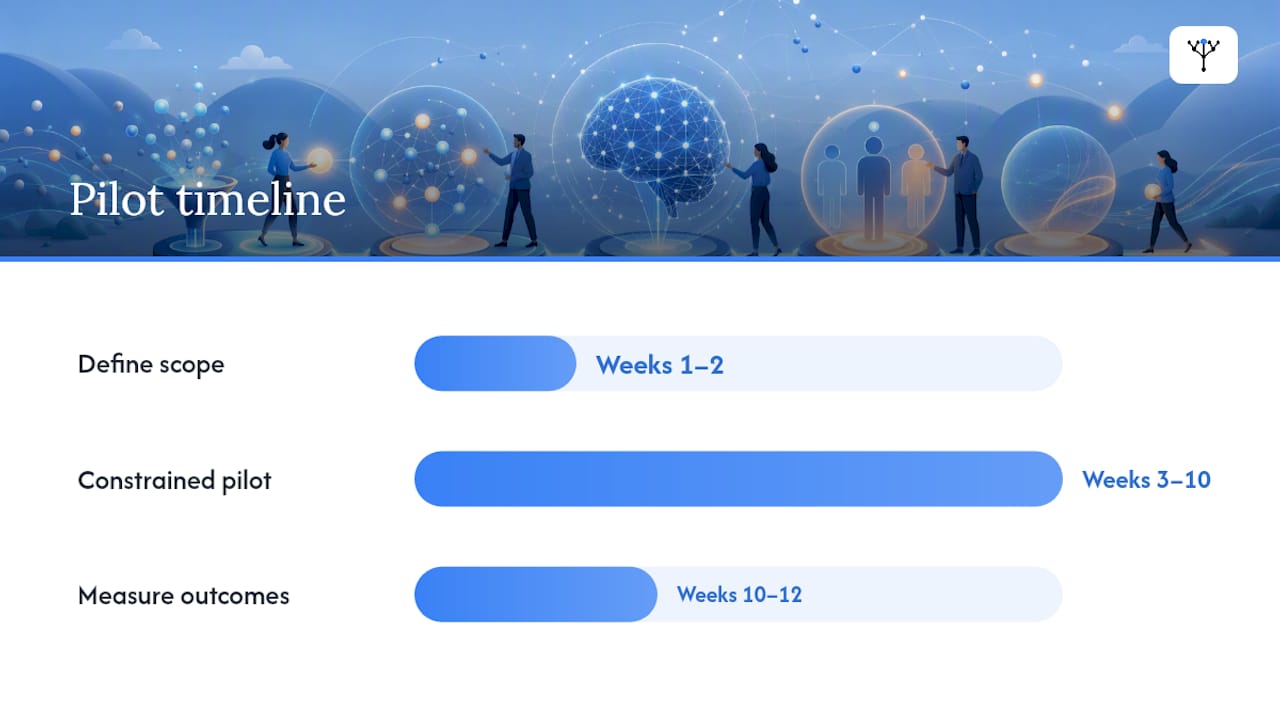
The roadmap itself runs in four stages, and phased integration with human-in-the-loop oversight is consistently the model that academic and practitioner sources recommend over broad, all-at-once rollouts:
- Define scope (week 1 to 2): pick one process, one team, one measurable outcome. Resist the urge to pilot three things at once.
- Run a constrained pilot (weeks 3 to 10): a pilot period of several weeks is long enough to observe meaningful patterns and short enough to limit risks and costs.
- Measure outcomes (weeks 10 to 12): compare against your baseline using pre-agreed KPIs, not vibes.
- Decide to scale, adjust or stop: a pilot that fails cleanly with clear learning is more valuable than one nobody wants to admit underperformed.
Suggested KPIs vary by use case but typically include measures of time saved, survey action rates, learning completion, and predictive accuracy of attrition indicators.
You will need at least one person who understands the data behind the process, one who owns the relationship with the vendor or platform, and one senior stakeholder who can make the scale-or-stop call without political drag. Before signing anything, check the vendor's data retention terms, audit rights, and whether the contract lets you exit if the pilot fails.
Pro Tip: Write your stop criteria before the pilot starts, not after. Agreeing in week one what "this isn't working" looks like removes the awkward politics of admitting failure in week eleven.
Building fairness and oversight into every AI decision
No HR AI deployment survives scrutiny without governance built in from the start, not retrofitted after a complaint. The dual nature of the risk is well documented: AI in human resources can reduce subjective bias through standardisation, but it can just as easily entrench historical inequities if the underlying data or model design goes unchecked.

Bias mitigation needs both a technical layer and a design layer. Balanced training data and regular audits catch statistical skew. Participatory design, involving the people affected by a tool in its design, catches the problems a spreadsheet audit misses.
A working governance checklist should include:
- A human decision gate before any AI output triggers a hiring, promotion, or termination action
- Scheduled algorithmic audits, quarterly at minimum for high-stakes tools like screening
- Documentation of what data trained the model and what it excludes
- A plain-language explanation ready for any candidate or employee who asks how a decision was reached
- A written privacy policy specific to AI use, separate from general HR data handling
Statistic worth sitting with: the same review found AI's impact on diversity, equity and inclusion runs in both directions at once, meaning a tool that reduces bias in one part of a process can simultaneously introduce it elsewhere if nobody is watching the whole pipeline, not just the part that looks efficient.
Giving HR teams the skills to lead AI, not just adopt it
The teams that get the most from AI for HR are the ones who built internal capability before the tools arrived, not after something went wrong. Four capabilities matter most: prompt literacy (writing instructions that get useful output), data literacy (knowing what "clean data" actually means), ethics oversight (recognising bias before it reaches a candidate), and change facilitation (helping colleagues trust a new tool rather than resent it).
Formal training helps here. CIPD's introductory course on AI for HR and equivalent online specialisations give practitioners a structured route into the topic rather than a scattered pile of blog posts. Internal workshops, run by whoever on the team has picked this up fastest, often do more for adoption than an external course alone.
Practical role design also helps:
- An AI champion who tracks what is working and flags what is not
- A data steward who owns data quality for whichever HRIS or ATS feeds the AI tool
- An HR subject-matter expert who keeps the human judgement calls anchored to real workplace context
- A vendor integrator who manages the technical relationship so it does not fall entirely on IT
Small experiments, a templated prompt library, a one-page playbook for reviewing AI-flagged CVs, build confidence faster than a single big-bang rollout ever will.
Legal and compliance issues around AI use in HR
Employee consent and regulatory exposure are where many otherwise well-run pilots come unstuck. Using AI to screen candidates or monitor performance typically counts as automated decision-making under data protection law, which usually requires you to tell people it is happening, explain the logic in plain terms, and give them a route to challenge or request human review of a decision. That obligation does not disappear because the tool is "just for triage."
Employee consent is not always a simple checkbox. In many jurisdictions, using AI for performance monitoring or workforce analytics needs a clear lawful basis, and consent obtained under obvious pressure, such as at the start of employment, may not hold up if challenged later. Being upfront about what is collected, why, and for how long, tends to reduce both legal exposure and internal distrust.
Regulatory requirements are shifting quickly, and rules differ by jurisdiction and by how "high-risk" a given AI use case is classified. Recruitment and performance-related AI tend to sit in the higher-risk categories almost everywhere, which usually means more documentation, more audit obligations and more scrutiny of training data.
The practical takeaway is not to wait for a perfect legal map before starting. It is to build documentation, consent language and audit trails into the pilot from week one, treating compliance as part of the design rather than a review step bolted on at the end.
Managing the change so AI adoption sticks
Resistance to AI in HR rarely comes from the tool itself. It comes from people who were not consulted before it arrived. Framing AI as something that removes drudgery rather than something that watches or replaces staff changes how quickly a team accepts it, and that framing has to be genuine, not a talking point in a launch email.
Start with the people whose daily work changes first, recruiters, HRBPs, whoever handles the survey data, and let them shape how the pilot runs rather than announcing it to them finished. Their early scepticism, addressed directly, becomes the strongest internal advocacy once the tool proves useful.
Communicate what is changing, why, and what stays exactly the same. Most anxiety around AI adoption is really anxiety about job security, and vague reassurance makes it worse, not better. Specific commitments, "this tool screens, a human still decides", land better than general enthusiasm about efficiency.
Build in a feedback loop during the pilot itself, not just at the end. Weekly fifteen-minute check-ins with the people using the tool surface friction while it is still cheap to fix. Insider accounts of successful rollouts consistently point to the same pattern: framing AI as augmentation rather than replacement reduces internal resistance and speeds adoption more reliably than any technical feature does.
Proving the ROI: what to measure and how
A pilot without a baseline cannot prove anything, however good the tool feels. Before the pilot starts, record your current time-to-hire, your survey-to-action turnaround, or whatever metric the pilot targets, exactly as it stands today.
The most useful ROI measures combine hard numbers with a quality check. Hours saved per week is real, but pair it with an accuracy or satisfaction measure, otherwise you risk optimising for speed while quietly degrading candidate experience or feedback quality. A recruiter who screens twice as fast but misses better candidates has not actually improved anything.
Track leading and lagging indicators separately. Leading indicators, adoption rate among the team, number of AI-flagged actions actually taken, tell you whether the tool is being used as intended. Lagging indicators, actual time-to-hire, actual attrition, actual survey-response rates, tell you whether it worked. A pilot can look successful on leading indicators for months before the lagging ones confirm or deny it.
Review outcomes at the twelve-week mark against the KPIs set at the start, not against a revised, more flattering target set halfway through. If the numbers do not move, that is a legitimate and useful finding, not a failure to hide. Short, focused pilots with clear KPIs consistently produce faster, lower-risk learning than sprawling rollouts precisely because the measurement stays honest.
Why HR's real advantage is connecting people data to the business
The HR teams getting genuine value from AI are not the ones with the flashiest recruitment bot. They are the ones who stopped treating HR data as a silo and started asking what it means alongside operations, finance and delivery data. A survey theme about "unclear priorities" reads very differently once you can see it against a project team's missed deadlines, an insight operations leaders reach the same conclusion from the opposite direction.
That connective view, people signals read alongside process and asset signals, is precisely where an integrated operating model earns its keep, catching a resourcing problem before it becomes a resignation.
— Ronan
How Oak & Nine connects HR insight to the rest of the business
Everything covered above works best when HR is not the only department watching its own dashboard. Oak & Nine is a live organisational model, not another point solution, which means the survey theme flagging low morale on one team and the operations data showing that same team missing deadlines get read together, not filed in two separate systems nobody cross-references.
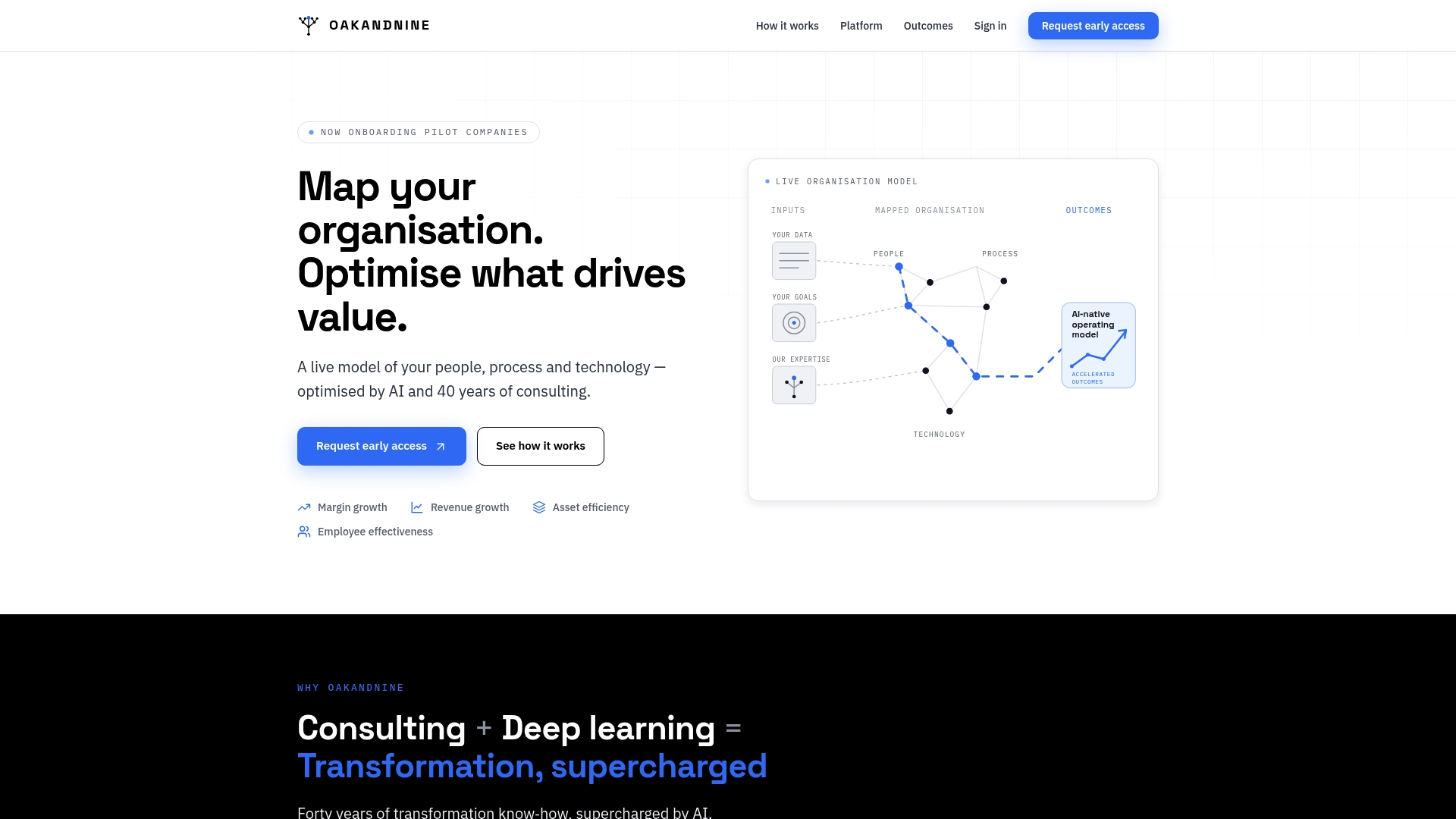
Practically, that means Oak & Nine automates the routine administrative work that eats HR's week, while connecting the functions that usually operate in isolation, HR, operations, finance, so a resourcing risk shows up before it becomes an exit interview. Pilot deployments often start with one team and one clear metric, following the scope discipline recommended for AI projects. For managing directors weighing whether an integrated model beats another disconnected HR tool, the for managing directors page sets out how the platform maps and optimises the organisation as a whole. Booking a discovery conversation is the practical next step if this connective view sounds like the gap in your current setup.
Sources
- An AI reckoning for HR: transform or fade away (MIT Sloan Management Review)
- Artificial intelligence applications in human resource management (PMC)
- The role of artificial intelligence in transforming human resource management and sustainable workplace practices