
Yes, AI can transform shared services, but only if leaders treat shared services as the scaling engine rather than a testing ground. The immediate priorities are sequencing decisions process by process, fixing data hygiene and governance before agents go live, and piloting agentic use cases with clear KPIs. Bain's research argues that shared services should become an enterprise intelligence hub, not a transactional back office, and that shift starts now.
TL;DR:
- Centralising shared services enables scalable AI deployment by consolidating data, funding, and governance, which reduces complexity and accelerates model development.
- Prioritise bounded, measurable pilots like invoice processing and HR case automation that deliver early results while minimizing operational risk.
- Assess processes against variability, data readiness, volume, regulatory needs, and resources to determine whether to automate or involve human experts first.
- Fix foundational infrastructure such as master data quality, integration APIs, and governance controls before scaling agentic AI across functions.
- Traditional billing models need to shift from effort-based to outcome-based or capacity-based, with experiments like subscription pricing and Virtual FTEs to capture true AI value.
Table of Contents
- Why shared services are the control centre for AI
- Practical AI use cases to pilot in finance, HR, IT and service desks
- Sequencing framework: deciding 'AI-first' versus 'shift-first' at process level
- Operational foundations you must fix before scaling agentic AI
- Commercial implications: how AI changes pricing and value capture
- A 6 to 12 month roadmap: pilot, govern, measure, scale
- Oak & Nine: how a blueprinting platform accelerates pilots and reduces key-man risk
- Author perspective: common pitfalls and cultural shifts leaders must make
- Oak & Nine: a practical option to map, pilot and scale AI in shared services
- Sources
Why shared services are the control centre for AI
Shared services concentrate the volume, structure, and repeatability that machine learning models need to perform reliably. Fragmented, function-by-function AI experiments rarely reach this scale, which is why centralised operations remain the logical home for industrialising artificial intelligence in business services.
Centralisation also solves the funding and governance problem that kills most AI pilots before they scale. A shared services function can fund a platform once, govern it once, and deploy it across finance, HR, IT, and customer service rather than rebuilding the same capability five times.
- Scale reduces model complexity by concentrating clean, comparable training data in one place.
- Centralised governance structures give AI projects a funding and accountability home that siloed teams cannot provide.
- EY's analysis of GBS operations finds most organisations investing in AI for support functions report productivity gains, with CFOs increasingly expecting both cost savings and quality improvements from the same investment.
- Bain's modelling suggests AI agents and tokens could account for 20–30% of operating expenses for AI pioneers by 2028–2029, up from just 1–2% in 2026, a shift only centralised cost structures can absorb cleanly.
Practical AI use cases to pilot in finance, HR, IT and service desks
Pick pilots that are bounded, measurable, and reversible. Here are five that consistently deliver early wins without exposing the business to unacceptable risk.
- Agentic accounts payable and invoice processing. Track cycle time and straight-through rate (STR%) as the two numbers that prove value fastest.
- Cash application and intelligent matching. Measure match rate and days sales outstanding (DSO) improvement, since both respond quickly to better matching logic.
- HR case automation. EY notes that specialised HR AI platforms can now resolve the majority of routine cases end-to-end. Track case resolution rate alongside employee satisfaction scores.
- Service desk co-pilot. Watch first-contact resolution uplift and average time-to-resolve as your headline metrics.
- Master data and expense policy enforcement. Use AI to flag policy exceptions automatically rather than routing every expense report through a human reviewer.
Generative AI can also speed up knowledge search and document-heavy tasks like invoice processing, but ScottMadden's research is clear that outputs still need guardrails and periodic human review to protect accuracy and intellectual property.
Pro Tip: Run each pilot for one full billing or reporting cycle before judging it. A four-week trial on a monthly close process will always look worse than it actually is.
Sequencing framework: deciding 'AI-first' versus 'shift-first' at process level
The hardest question in shared services digital transformation isn't which tool to buy. It's which process to touch first. Score every candidate process against five lenses before committing budget.
- Variability and complexity. Highly variable, judgement-heavy work (bespoke advisory, exception handling) resists automation longer than repeatable transactional work.
- Data readiness. Clean, structured, accessible data is a prerequisite, not a nice-to-have.
- Volume. High-volume processes justify the setup cost of an AI-first approach; low-volume processes often don't.
- Regulatory and explainability needs. Processes requiring audit trails or regulatory sign-off need more human oversight built in from day one.
- Funding and talent. Do you have the budget and the skills on hand to run this pilot properly, or are you borrowing both?
A demand forecasting process, high volume, low variability, clean historical data, minimal regulatory friction, scores as AI-first almost immediately. Bespoke financial advisory work, low volume, high variability, heavy explainability requirements, scores as shift-first: redesign the process and involve a human expert before layering automation on top. Bain frames sequencing as an ongoing exercise rather than a single strategic decision, and that framing holds up in practice.
Operational foundations you must fix before scaling agentic AI
Agentic AI amplifies whatever foundation it's built on. A brittle data environment doesn't get better with AI on top; it gets faster at producing bad outcomes.
- Master data and canonical sources. Run a quick audit to identify which systems hold the "true" version of customer, vendor, and employee records, then remediate the worst gaps first.
- Integration architecture. Invest in proper APIs rather than stitching together point-to-point connections that break the moment one system upgrades.
- Model governance and identity controls. SSO Network's research identifies governance, data quality, and change management as the most cited barriers to scaling agentic AI, and agent identity governance, knowing exactly which agent did what and why, is now as important as human access controls.
- Workforce baseline. Document who currently handles exceptions and how, before an agent takes over the routine cases. Skipping this step creates what one industry analysis calls the "automation blind spot": agents running unsupervised with no one tracking what falls through the cracks.
Pro Tip: Before approving any agentic pilot, ask who owns the exception queue once the agent goes live. If nobody can answer immediately, you're not ready to scale yet.
Commercial implications: how AI changes pricing and value capture
Traditional time-based billing was built for a world where effort and output moved in lockstep. AI breaks that link, and pricing models built on hours no longer capture the value being created.
Simon-Kucher's analysis shows front-runner services firms experimenting with subscription and Virtual FTE models instead, treating an AI agent as a fractional resource priced by outcome or capacity rather than hours logged. Forbes' commentary on services economics makes a sharper point: the bottleneck usually isn't the technology, it's the organisation's ability to monetise the value that technology creates.
Three experiments worth running now:
- Price one pilot process as a fixed monthly subscription instead of cost-plus hours.
- Offer a Virtual FTE rate card for one repeatable service line and compare margin against the old billing model.
- Track internal chargeback separately for AI-assisted versus human-only output, so you can see where the value actually lands.
Trends in SaaS pricing show this shift isn't unique to shared services; it's reshaping how technology-enabled service businesses price talent generally.
A 6 to 12 month roadmap: pilot, govern, measure, scale
Momentum matters more than perfection here. A structured, time-bound plan beats an open-ended "AI strategy" every time.
- Months 1 to 2: Score candidate processes against the five sequencing lenses and pick two or three pilots. Set KPIs before you start, not after.
- Months 2 to 3: Stand up a central AI operating team and a governance forum with clear escalation rules.
- Months 3 to 5: Prioritise the data fixes that unblock your chosen pilots. Schedule incremental releases rather than one large go-live.
- Months 5 to 8: Build upskilling plans for affected teams and write exception-handling playbooks before agents take on live volume.
- Months 8 to 12: Decide how you'll measure and reallocate value internally, whether that's an internal charge model or a revised pricing structure, then widen the rollout to the next tranche of processes.
This sequencing logic mirrors the approach in Oakandnine's guide to designing an AI operating model, which treats scaling as a series of deliberate stages rather than a single leap.
Oak & Nine: how a blueprinting platform accelerates pilots and reduces key-man risk
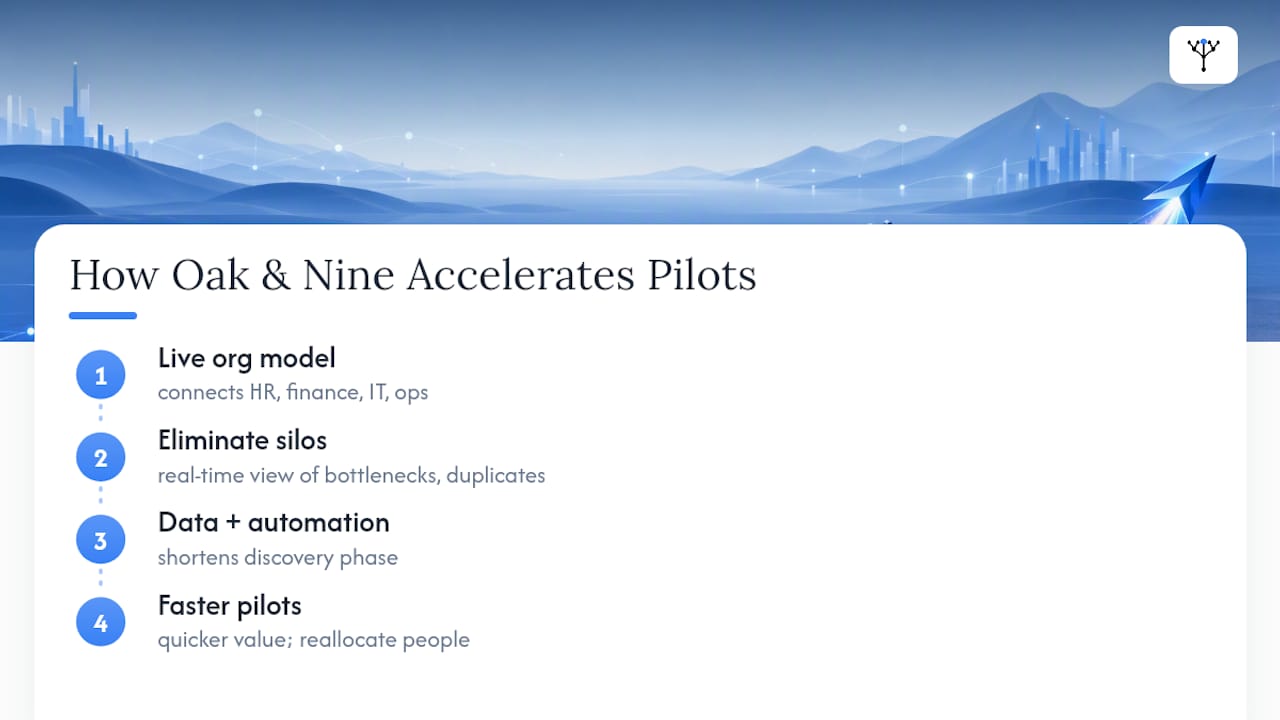
Oakandnine connects HR, finance, IT, and operations into one live organisational model, eliminating the silos that usually slow AI pilots down. Instead of mapping processes on a whiteboard that goes stale within weeks, the platform gives leaders a real-time view of where bottlenecks, duplicated effort, and margin leaks actually sit.
Integrating blueprinting with data unification and automation cuts the discovery phase that normally eats months off a pilot timeline. For mid-market operations leaders, that typically means faster pilot value and a clearer picture of where to reallocate people once agents take on the routine work, exactly the service blueprinting approach built for this transition.
Author perspective: common pitfalls and cultural shifts leaders must make
The real shift isn't AI replacing people. It's AI plus human judgement (HI) working together, and most failures trace back to skipping the workforce baseline, the automation blind spot in practice.
— Ronan
Oak & Nine: a practical option to map, pilot and scale AI in shared services
Oakandnine gives you what a spreadsheet-based process map never can: a live, connected view of where your finance, HR, IT, and operations workflows actually bottleneck, updated in real time rather than reviewed once a quarter.
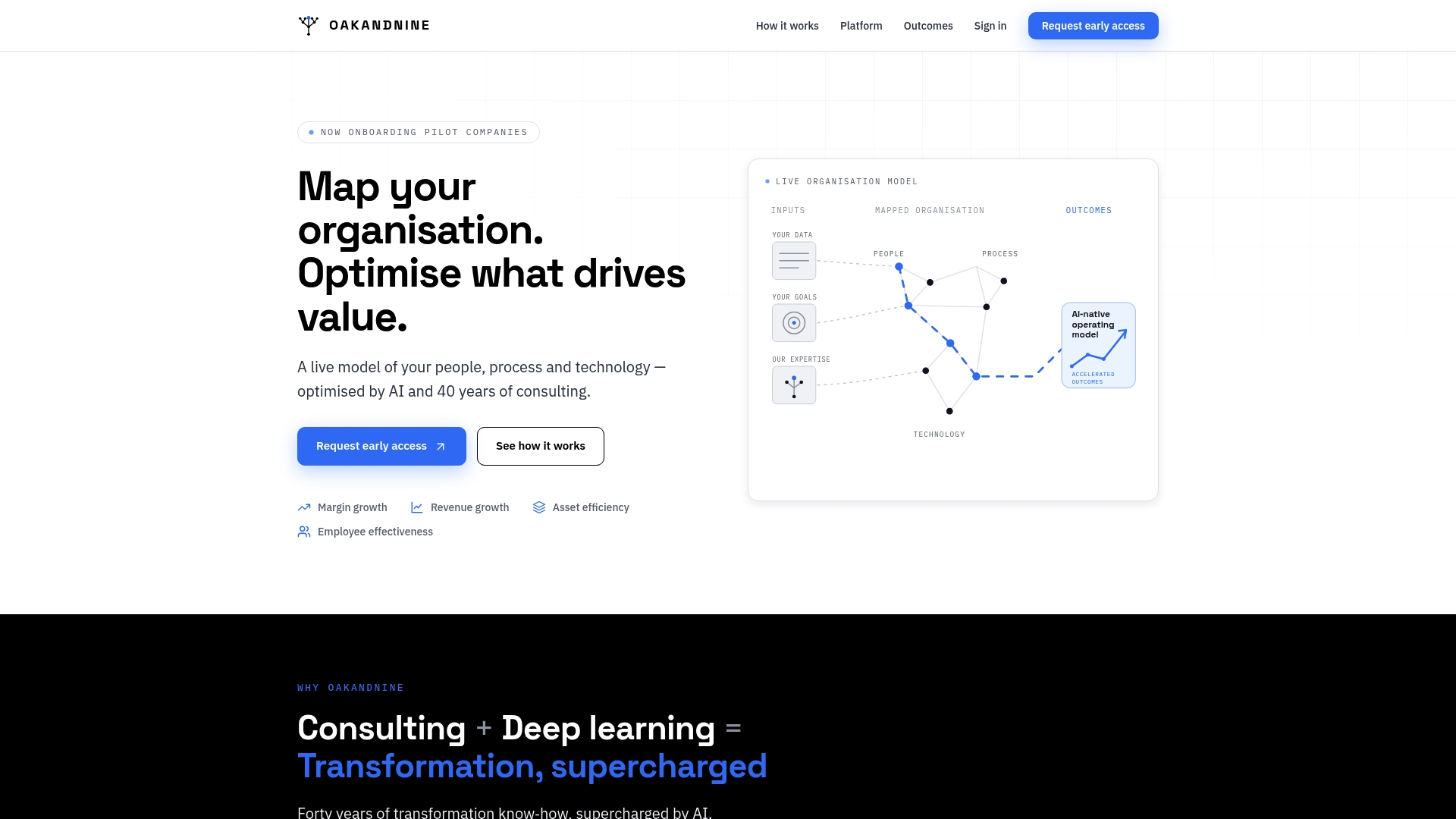
Rather than guessing which process to pilot first, you get preemptive alerts when a workflow starts leaking margin, and a single framework to sequence AI pilots against real bottleneck data instead of instinct. That's the core advantage for operations leaders trying to move past the pilot-purgatory stage most shared services teams get stuck in. If you're ready to see where your own processes are losing time and money before you commit budget to an AI pilot, book a walkthrough of the platform and map your operating model properly first.
Sources
- EY — AI in GBS operations to enterprise intelligence
- Simon‑Kucher — Services as Software: why AI is rewriting commercial logic
- SSO Network — Is shared services ready for agentic AI?