
A canonical data model is a single agreed-upon schema that every source system maps into and every consumer maps out of, replacing point-to-point translation with one shared contract as part of a long-term integration strategy. Adopt one once you have several producers and consumers that need to share entities like Customer or Order reliably. Skip it below that threshold, and never build one without a named owner.
TL;DR:
- A canonical data model significantly reduces mapping complexity and maintenance by consolidating multiple source-to-consumer translations into a single shared schema.
- Implement it gradually, starting with a specific domain and minimal entities, and ensure a dedicated owner manages schema updates and governance.
- Use a schema registry to enforce compatibility rules, and establish clear versioning, deprecation, and change approval processes to prevent schema drift.
- Focus on enterprise-scale deployment where multiple systems and consumers share entities, rather than small or short-term projects.
- Maintaining schema ownership and governance through dedicated tools or platforms prevents drift and ensures the model remains a reliable integration foundation.
Table of Contents
- What is a canonical data model and how does it work?
- Why CDMs matter: the mapping-math that justifies them
- When should you use a canonical data model?
- How do you actually implement a canonical data model?
- How do you keep a canonical model healthy over time?
- What do canonical data model patterns look like in practice?
- What integration pitfalls should you plan for?
- Oak & Nine perspective: what actually makes canonical models stick
- How Oak & Nine supports canonical modelling and governance
- Sources
What is a canonical data model and how does it work?
A canonical data model defines shared entities, Customer, Order, Employee, in one standardised, enterprise-wide schema that acts as the common language between systems that would otherwise need to understand each other's native formats directly, as Wikipedia's entry on canonical models sets out. Producers map their own schema into the canonical form once. Consumers map out of it once. Nobody maps to anybody else.
Middleware carries the weight: an enterprise service bus, an iPaaS layer, or a set of message translators sit between systems, converting inbound data to canonical shape and outbound data back to whatever format the receiving application expects.
A few things this is not:
- A data warehouse schema, which is built for analytical querying, not real-time transactional exchange.
- A data contract, which governs a single point-to-point agreement rather than a shared, many-to-many standard.
- A master data management record, which resolves identity and golden records rather than message structure.
Why CDMs matter: the mapping-math that justifies them
The case for a canonical data model rests on arithmetic, not opinion. Connect multiple systems point-to-point and you need substantially more distinct mappings, because each system must understand every other system's format. Route them through a canonical schema and that reduces mappings substantially, to the sum of sources plus consumers.
The maths in full: Enterprise Integration Patterns frames this as N×M point-to-point translators collapsing to N+M once every application maps to and from a single canonical form, a reduction that Datadriven confirms scales sharply as N grows.
That reduction pays off in three concrete ways:
- Maintenance drops because a schema change touches one mapping, not N others.
- Consistency improves because every consumer reads the same field names and types.
- New system onboarding gets faster, since a new source only needs one mapping into the canonical schema, not one per existing consumer.
The trade-off is real: you have traded distributed complexity for a centralised dependency, and everything now leans on one schema staying correct.
When should you use a canonical data model?
Fit depends on scale, domain maturity, and whether anyone is willing to own the thing. Three situations tip the decision:
- You have several source systems, or multiple consumers pulling the same entity. Below that, point-to-point mapping is usually cheaper to build and reason about.
- You have governance capacity. A named owner, a change-review process, and engineers who can maintain mapping code are prerequisites, not nice-to-haves.
- The domain is stable enough to model. Entities like Order or Employee that don't reshape every quarter are good candidates; a domain still being redefined monthly is not.
Avoid a CDM for a two-system integration, a short-lived migration project, or any domain where nobody has volunteered to own the schema long-term. A canonical model without an owner rots faster than the point-to-point mess it replaced.
How do you actually implement a canonical data model?
Treat this as a sequence, not a big-bang rollout. Each step earns the next.
- Scope one domain first. Pick Finance or HR, not "the whole company." Datadriven.io recommends domain-scoped canonical models specifically to avoid building one bloated universal schema nobody can maintain.
- Choose minimal canonical entities. Model the fields that genuinely need sharing across systems, not every field any source happens to have. Splunk's guidance on CDM implementation stresses this restraint as the difference between a durable model and a swamp.
- Build testable mapping patterns. Each translator, source in, consumer out, needs its own test suite, not a shared "integration works" smoke test.
- Stand up a schema registry. Avro, Protobuf, or JSON Schema each enforce compatibility rules at publish time, catching a breaking field change before it reaches a consumer instead of after.
- Pilot narrowly. Run two or three producers and one or two consumers through the model, validate the mapping logic under real traffic, then widen.
- Set a versioning and deprecation policy before go-live. Decide now how long an old schema version stays supported once a new one ships, not after the first complaint.
Pro Tip: Run your pilot on a domain that already has a willing owner. A technically perfect canonical schema with no one accountable for it will drift within two quarters, no matter how clean the mapping code is.
Roll out wider only once the pilot's compatibility rules have survived a real schema change.
How do you keep a canonical model healthy over time?
Governance is what separates a canonical data model that accelerates integration from one that becomes the bottleneck everyone routes around. Assign an owner from day one, someone accountable for approving changes, not just documenting them.
Build these into the operating rhythm:
- A change-review process that any schema modification must pass through before merging.
- Compatibility rules (backward and forward) encoded directly in the registry, not left to memory.
- Defined deprecation windows so consumers know exactly when an old field disappears.
- Permissions that limit who can propose canonical changes, since an open-edit model invites drift.
- Schema-evolution monitoring with SLAs, so a breaking change is caught in CI, not in production.
Pro Tip: Treat every canonical schema change like a public API change, because to your consumers, that's exactly what it is.
A model left ungoverned doesn't stay neutral, datadriven.io warns it becomes a source of confusion and technical debt rather than the accelerator it was built to be.
What do canonical data model patterns look like in practice?
Three patterns cover most real deployments:
- Event-driven: Kafka topics carry canonical-shaped events, with a schema registry enforcing compatibility on every publish, so a producer can't push a breaking change without the registry rejecting it first.
- ESB or iPaaS translator pattern: middleware sits between systems, translating each message into canonical shape on the way in and back out on the way to the consumer.
- Warehouse feed: canonical entities flow into the warehouse as clean, consistent input, but the warehouse schema itself stays a separate, analytics-optimised concern.
A short example makes this concrete. A canonical Employee entity might carry employee_id, full_name, department_code, start_date, and employment_status, nothing more. Payroll, HR systems, and access-provisioning tools each map their own richer records down to that shared shape, and each maps back out only the fields they need.
What integration pitfalls should you plan for?
Budget for translation maintenance from the start, every schema change generates mapping updates across every connected system, and that cost never disappears once the model ships.
Watch for these traps:
- The amalgamation trap: trying to model every field every source has, rather than the minimal shared set.
- Skipping publish-time validation, which lets a bad payload reach every downstream consumer at once.
- No rollback plan when a canonical change breaks a consumer in production.
- Reaching for a full CDM before you've hit the scale that justifies it, lighter point-to-point mapping or a simple shared library is often enough for two or three systems.
The trade you're making: the mapping-count reduction from N×M to N+M only pays off if the canonical schema itself is actively curated, otherwise the single model becomes the bottleneck the pattern was meant to eliminate, per Wikipedia's canonical model entry.
Oak & Nine perspective: what actually makes canonical models stick
Most CDM failures I've traced back to one cause: nobody treated the schema as a living asset. Oakandnine's platform approach, mapping and maintaining shared definitions across HR, Finance, and Operations, works precisely because it keeps ownership visible rather than buried in a wiki nobody reads, an approach Oak & Nine's own architecture is built around.
The outcome worth chasing isn't the elegant schema. It's fewer integration failures, faster onboarding for new systems, and a genuinely shared view across departments that used to guard their own data quietly.
— Ronan
How Oak & Nine supports canonical modelling and governance
Oakandnine is the practical route to canonical governance for organisations that don't want to build a schema registry team from scratch. Where a hand-rolled CDM demands dedicated engineers for mapping, versioning, and change review, Oakandnine gives operations leaders a live model of shared entities across HR, Finance, and Operations without that build overhead.
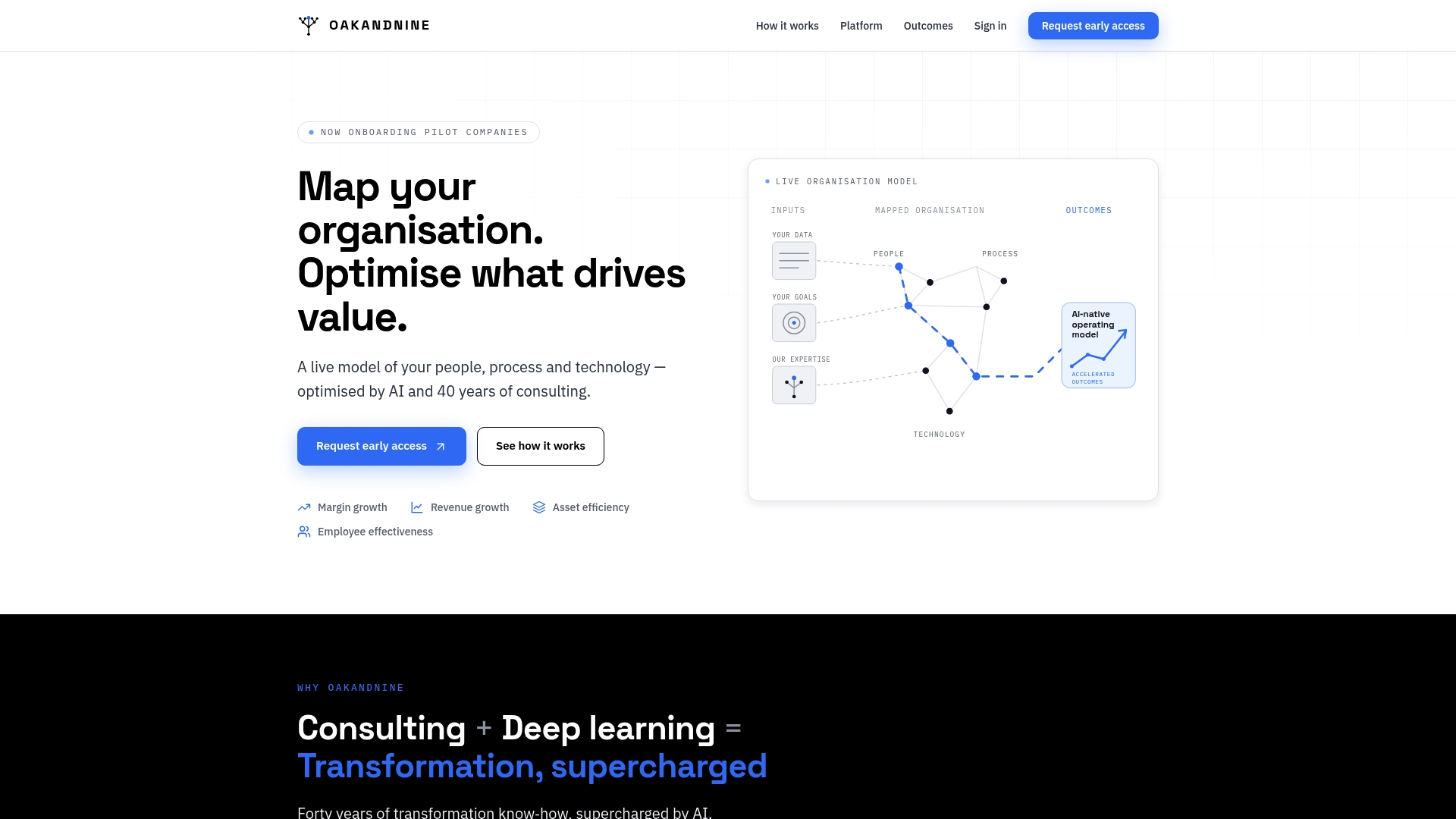
That matters most once you've hit the scale threshold this article covers, multiple sources, multiple consumers, and a real need for one owner accountable for definitions rather than five teams guessing at each other's field names. Oakandnine's connected functions approach keeps HR, Finance, and Operations reading from the same definitions in real time, which is the governance outcome most CDM projects spend months trying to reach manually.
If you're an operations leader weighing whether to build this internally or adopt a platform that already does it, visit the page built for operations leaders and see how the mapping and governance work in practice.