
Change management software is defined as any platform designed to help organizations plan, execute, and sustain transformations, but the term covers four distinct tool categories that serve fundamentally different purposes. Buying the wrong category is the most common and most expensive mistake mid-market managers make. The four categories are IT change control, organizational change management platforms, digital adoption platforms, and behavior layers. Each maps to a different stage of the ADKAR model, the industry-standard framework developed by Prosci. Knowing which stage your organization is failing at tells you which category to buy.
What are the four categories of change management software?
The four software categories are not interchangeable. They address different problems, serve different users, and produce different outcomes. Treating them as equivalent is why so many implementations stall after go-live.
IT change control
IT change control software governs how technical changes move through an organization. It handles approvals, audit trails, risk classification, and deployment scheduling. ITIL-framework tools sit in this category. They protect system stability but do not address whether employees actually adopt the new system. A clean audit trail and a workforce that has reverted to old habits can coexist without contradiction.

Organizational change management platforms
These platforms focus on human readiness and stakeholder engagement. They support communication planning, impact assessments, training schedules, and readiness scoring. Organizational change management tools prevent adoption drift by keeping people informed and prepared before a system goes live. They are the closest match to what most managers picture when they search for "change management software."
Digital adoption platforms
Digital adoption platforms, often called DAPs, sit inside your applications and guide users through new workflows in real time. They deliver tooltips, walkthroughs, and task lists directly within the software interface. DAPs build knowledge and ability by reducing the gap between training and actual use. They are most effective during and immediately after go-live, when users face new screens for the first time.
Behavior layers
Behavior layers are the least understood and most under-purchased category. They deliver in-workflow guidance and measure behavioral adherence to confirm that new habits are actually sticking weeks and months after deployment. Where DAPs teach, behavior layers reinforce. This distinction matters because most change failures happen not at launch but in the months that follow.
Pro Tip: Before you evaluate any vendor, write down the specific moment your last implementation broke down. Was it a failed approval? A training gap? People reverting to old processes three months later? That answer tells you which category to prioritize.
| Category | Primary focus | ADKAR stage served |
|---|---|---|
| IT change control | Approvals, audit trails, risk | Pre-change governance |
| Org change management | Readiness, communication, stakeholders | Awareness, Desire |
| Digital adoption platforms | In-app guidance, task walkthroughs | Knowledge, Ability |
| Behavior layers | In-workflow reinforcement, adherence tracking | Ability, Reinforcement |
How do these categories align with the ADKAR model?
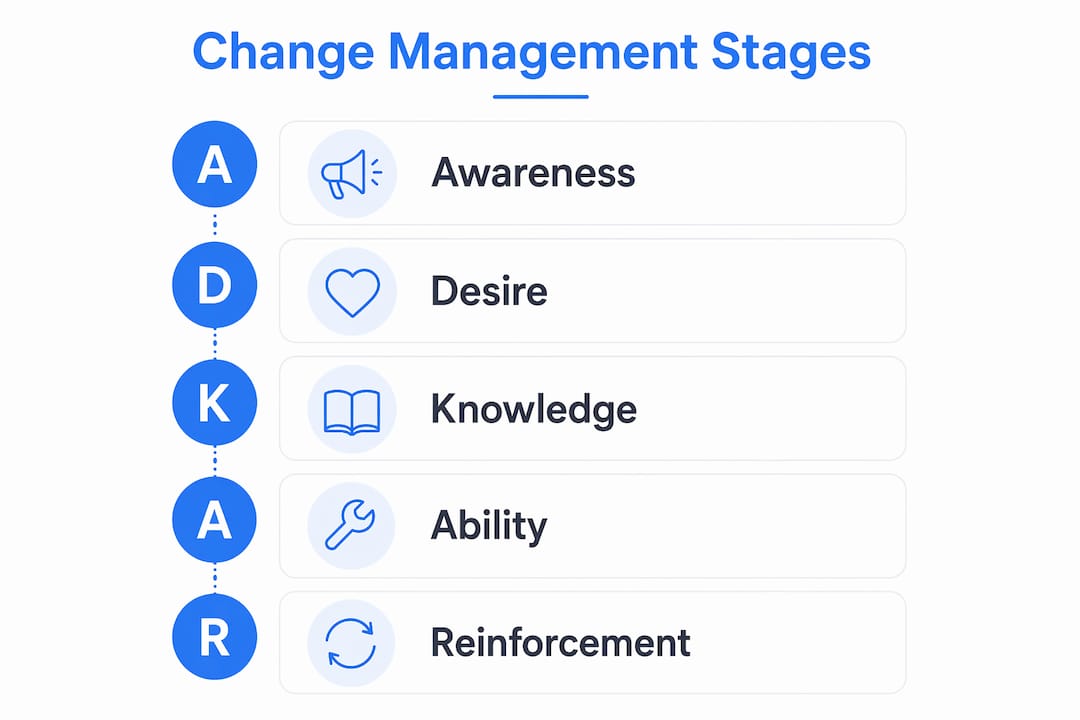
The ADKAR model defines five sequential stages every person must pass through during a change: Awareness, Desire, Knowledge, Ability, and Reinforcement. Prosci developed this framework to explain why change fails at the individual level, not just the organizational level. Each software category covers a different slice of this sequence.
Organizational change management platforms address Awareness and Desire. They communicate why the change is happening and build the motivation to participate. IT change control tools operate before the ADKAR sequence even begins, governing the technical deployment that triggers the change. DAPs cover Knowledge and early Ability by guiding users through new processes in real time.
The critical gap sits at Ability and Reinforcement. Most change management software clusters in the Awareness-to-Knowledge range, leaving the later stages underserved. This is where adoption fade happens. An employee completes training, passes a knowledge check, and then quietly returns to the old way of working because no system is watching or guiding them.
Behavior layers exist specifically to close this gap. They track whether people are actually performing new behaviors in their daily work, not just whether they attended a training session. Without this coverage, organizations invest heavily in go-live readiness and then lose the gains within a quarter.
Pro Tip: Map your last three change initiatives against the ADKAR stages. If your post-mortems consistently cite "people reverting to old habits," you are under-investing in Reinforcement-stage tools, not in training.
- Awareness: covered by communication plans and org change platforms
- Desire: supported by stakeholder engagement features and leadership alignment tools
- Knowledge: addressed by DAPs and e-learning integrations
- Ability: partially covered by DAPs, but requires hands-on reinforcement
- Reinforcement: served almost exclusively by behavior layers, the most neglected category
What criteria should mid-market companies use to select the right tool?
Selecting the right tool starts with an honest diagnosis, not a vendor demo. Buying software based on demos without first identifying which change stage is failing leads to costly purchases that solve the wrong problem. Mid-market organizations face a specific challenge: they lack the dedicated change management offices that large enterprises use to absorb poor software choices.
Use these four diagnostic questions before you open a single RFP:
-
Where did your last implementation break down? If the answer is "approvals took too long" or "we had a compliance audit failure," you need IT change control. If the answer is "people didn't know the change was coming," you need an organizational change management platform.
-
What does your go-live data actually show? If training completion rates are high but system usage is low, the gap is at Ability or Reinforcement. A DAP or behavior layer will address this. More training will not.
-
Do you have readiness data before go-live? Tracking employee readiness before deployment reduces costly post-launch fixes. If you cannot answer "who is ready and who is not" two weeks before go-live, you need a platform with readiness scoring built in.
-
Can you produce audit-defensible adoption data? Mid-market companies increasingly need to justify technology investments to boards and investors. Audit-defensible readiness data showing who is affected by which changes and when provides the compliance and budget justification that spreadsheets cannot.
Integration matters as much as features. A behavior layer that does not connect to your HRIS or your core business application will produce data nobody trusts. Prioritize tools that integrate with the systems your employees already use daily. A mid-market ERP rollout, for example, needs a DAP that sits inside the ERP interface, not a standalone training portal that employees visit once and forget.
Pro Tip: Ask every vendor for a case study from a company with fewer than 2,000 employees. Enterprise implementations have resources and dedicated change teams that mid-market organizations do not. The vendor's answer tells you whether their tool actually fits your context.
How does the right software improve organizational efficiency?
The right category of tool, applied at the right stage, produces measurable efficiency gains. Appropriate change management tools reduce incidents, compliance failures, and operational disruptions during complex technology transitions. Each of those outcomes has a direct cost attached to it.
Consider a mid-market manufacturer rolling out a new ERP system. Without IT change control, a misconfigured deployment window causes a production outage. Without an organizational change management platform, the finance team learns about the go-live date two weeks late and cannot prepare. Without a DAP, users spend their first month calling the help desk for basic navigation questions. Without a behavior layer, the purchasing team reverts to spreadsheets by month three because nobody is tracking whether the new process is being followed.
The efficiency gains from getting this right compound over time:
- Reduced help desk volume in the first 90 days post-go-live
- Faster time-to-competency for employees using new systems
- Lower compliance risk through documented approvals and audit trails
- Sustained behavior change that protects the ROI of the technology investment
- Clearer stakeholder communication that reduces project delays and rework
Mid-market organizations benefit most from software that integrates readiness tracking, stakeholder management, and adoption data in one coherent view. Fragmented tools produce fragmented data. Fragmented data produces decisions made on instinct rather than evidence. The organizations that sustain change are the ones that can see, in real time, who is adapting and who is not.
Continuous change cycles amplify this benefit. A single ERP rollout is not the end of the story. Cloud platforms update quarterly. Regulatory requirements shift. Workforce composition changes. Organizations that build the capability to manage change repeatedly, using the right tools at each stage, accumulate an efficiency advantage that one-off project teams cannot replicate.
Key Takeaways
The most effective approach to selecting change management software is diagnosing your specific failure stage first, then matching the tool category to that stage rather than buying based on features or demos.
| Point | Details |
|---|---|
| Four distinct categories exist | IT change control, org change platforms, DAPs, and behavior layers are not interchangeable. |
| ADKAR alignment is the selection framework | Match your software category to the ADKAR stage where your last change initiative failed. |
| Reinforcement is the most neglected stage | Most tools cluster at Awareness-to-Knowledge; behavior layers are the missing piece for sustained adoption. |
| Diagnose before you demo | Identify your failure stage before evaluating vendors to avoid buying the wrong solution. |
| Readiness data prevents post-launch costs | Tracking who is ready before go-live reduces expensive fixes and supports audit and compliance needs. |
The uncomfortable truth about how mid-market companies buy change tools
I have spent years working with mid-market leadership teams on technology transitions, and the pattern is almost always the same. The project sponsor attends a vendor demo, the software looks impressive, and the purchase decision follows within weeks. Six months later, the system is live, the training is done, and adoption is at 40% of target. Nobody can explain why.
The explanation is almost always the same: the organization bought a tool that solved the wrong stage of the problem. They purchased an organizational change management platform when what they actually needed was a behavior layer. Or they bought a DAP when the real failure was in stakeholder communication three months before go-live.
The behavior layer category is where I see the most consistent under-investment. Managers understand training. They understand communication plans. Reinforcement feels abstract until you watch a workforce revert to spreadsheets three months after a £500,000 ERP implementation. At that point, it stops feeling abstract very quickly.
My advice is blunt: do not buy change management software until you can name the specific stage where your last initiative failed. If you cannot name it, you are not ready to buy. You are ready to diagnose. The diagnosis is the work. The software is what you buy after the diagnosis is done.
— Ronan
How Oakandnine helps mid-market organizations get change right
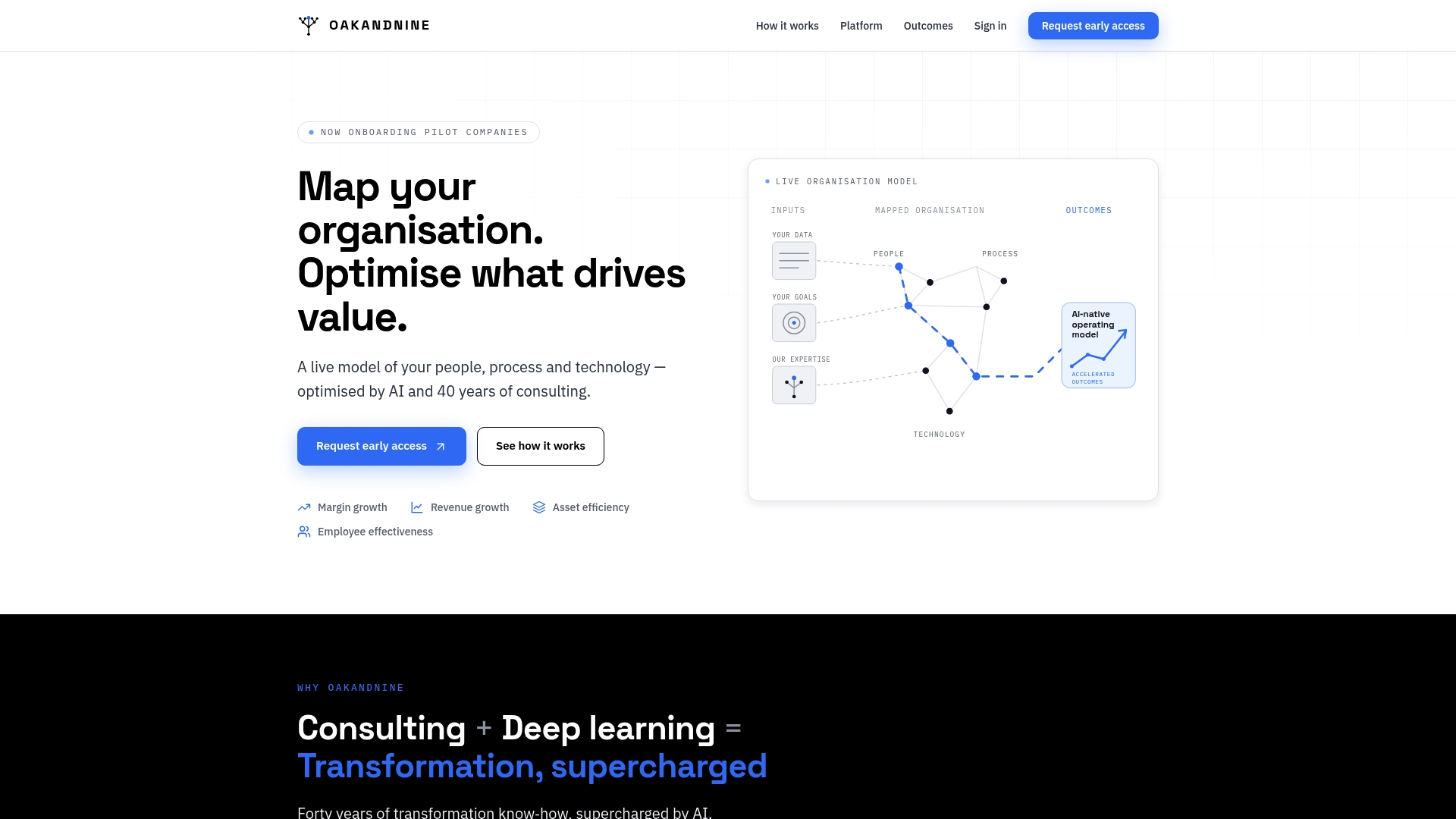
Oakandnine works with mid-market organizations that are serious about getting technology transitions right the first time. The platform integrates people, processes, and technology into a live operating model, giving managers the visibility to see where readiness gaps exist before they become post-launch problems. With four decades of consulting experience behind it, Oakandnine brings the diagnostic rigor that most software vendors skip entirely. If you are preparing for a major technology rollout and want to know exactly where your organization stands before go-live, map your organization with Oakandnine and build the evidence base your implementation needs.
FAQ
What is change management software?
Change management software is any platform that helps organizations plan, execute, or sustain a transformation. The term covers four distinct categories: IT change control, organizational change management platforms, digital adoption platforms, and behavior layers.
What is the ADKAR model and why does it matter for software selection?
The ADKAR model, developed by Prosci, defines five stages of individual change: Awareness, Desire, Knowledge, Ability, and Reinforcement. Each software category maps to different stages, so identifying where your change initiative fails tells you which tool category to buy.
What is the most neglected stage in change management software coverage?
Reinforcement is the most under-served stage. Most available tools focus on Awareness through Knowledge, leaving behavior layers, the only category that tracks sustained habit adoption, significantly under-purchased.
How should mid-market companies evaluate change management software tools?
Diagnose your failure stage before evaluating any vendor. Ask where your last implementation broke down, whether you have pre-go-live readiness data, and whether you can produce audit-defensible adoption metrics. Match the tool to the answer.
Does change management software work for ongoing change, not just one-off projects?
Yes. Organizations facing continuous change cycles, such as quarterly cloud updates or regulatory shifts, benefit from tools that track readiness and adoption repeatedly across multiple initiatives, not just single deployments.