
Data unification is the process of consolidating and reconciling data from multiple systems into a governed, unified view that everyone in the business can trust. The direct payoff is a single dataset accurate enough to drive reporting, automation, and AI without a team spending Monday mornings arguing over which spreadsheet is right. Operations, finance, HR, and analytics leaders are the ones who feel the difference first.
TL;DR:
- Data unification resolves conflicts and inconsistencies across multiple systems, creating a trusted, governed view that supports accurate reporting and AI.
- The unification pipeline includes source mapping, profiling, schema transformation, entity matching, and ongoing monitoring, often requiring real-time approaches for certain use cases.
- Achieving trust in a unified model depends on governance practices like data lineage, standardized dimensions, clear ownership, and continuous quality metrics.
- Siloed ownership and complex identity resolution are common obstacles that demand executive sponsorship and hybrid matching approaches to maintain progress.
- Many projects succeed through phased implementation starting with high-value domains, establishing canonical structures, and expanding iteratively to improve data trustworthiness.
Table of Contents
- Why data unification matters for business and analytics
- How does the data unification process actually work?
- Is data unification the same as data integration or MDM?
- What challenges typically derail data unification projects?
- What governance practices keep a unified data model trustworthy?
- What does a realistic implementation roadmap look like?
- How data unification can be approached in practice
- See how Oak & Nine handles unification for your organisation
- Authoritative sources and further reading
- Sources
- FAQ
Why data unification matters for business and analytics
Most mid-market companies do not have a data problem. They have a reconciliation problem. Customer records live in the CRM, invoices sit in the finance system, headcount data hides in HR software, and nobody agrees on which one is correct when a number gets challenged in a leadership meeting. Data unification removes that argument by producing one governed view that all departments draw from.
The commercial case is straightforward: decisions get faster and more accurate once teams stop reconciling numbers manually and start trusting a shared dataset. That trust compounds. Analysts spend less time on data janitorial work and more time on the analysis leadership actually asked for.
A handful of use cases show up again and again once companies get this right:
- Customer 360: merging CRM, support, billing and marketing data into one profile per customer, rather than four half-complete ones.
- Financial reconciliation: matching transactions across ledgers, banks and ERP systems to catch discrepancies before audit season.
- Fraud detection: spotting patterns that only emerge when transaction, identity and behavioural data sit in the same view.
- Personalisation: tailoring offers or service based on a complete customer history instead of a fragment of it.
- AI readiness: feeding models consistent, deduplicated inputs, because AI-assisted matching and curation only performs as well as the data underneath it.
That last point deserves emphasis. Every AI initiative a business launches inherits the mess sitting in its source systems. Unification is the unglamorous work that makes the glamorous work possible.
How does the data unification process actually work?
Unification is not one action, it is a pipeline. Microsoft's framework for the process breaks it into four core steps: source mapping, deduplication, matching, and generating the unified view. In practice, most implementations expand that into six workable stages.
- Map sources and discover schemas. Catalogue every system, its fields, its owners and how frequently it changes. You cannot unify what you have not inventoried.
- Profile data quality. Check completeness, freshness and consistency before you touch a transformation rule. Profiling tells you where the real remediation work sits, rather than guessing.
- Build schema mapping and transformation rules. Translate each source's fields into a common structure, so "cust_id" and "customer_number" become one field with one meaning.
- Run entity resolution and deduplication. Match records that represent the same person, account or asset across systems, then apply survivorship rules to decide which version of a conflicting field wins.
- Publish the unified view. Deliver it through a semantic layer, database views, APIs, or streaming feeds, depending on how consumers need to use it.
- Monitor and validate continuously. Unification is not a one-off project; new sources and schema drift mean the pipeline needs ongoing checks.
Latency choices matter more than most teams expect at the outset. A daily batch refresh is fine for financial reconciliation; fraud detection or real-time personalisation needs a streaming approach, which raises the operational bar considerably.
Pro Tip: Start entity resolution with your highest-volume, highest-value entity (usually "customer" or "account"). Getting that one right builds the survivorship logic and confidence you will reuse everywhere else.
Vendor case studies illustrate the scale involved: Tamr's customer projects describe deduplication efforts spanning millions of records, with measurable gains in completeness once AI-assisted matching replaced manual rules. That is the difference between a spreadsheet exercise and an actual data platform.
Is data unification the same as data integration or MDM?
No, and conflating the three is one of the most common planning mistakes we see. Each solves a different problem, and picking the wrong one for your goal wastes months.
- Data integration is about connectivity. It moves data from one system to another, or makes systems talk to each other, without necessarily resolving whether the data means the same thing once it arrives. Profisee draws this distinction clearly: integration transports, unification reconciles.
- Data unification goes further. It resolves duplicates, standardises meaning across domains, and produces a dataset that is semantically consistent, not just technically connected.
- Master data management (MDM) focuses specifically on managing the "golden record" for core entities such as customer, product or supplier. It is narrower than unification, which spans multiple domains and data types at once.
- Single source of truth (SSOT) is often misunderstood as one physical database. In reality, an SSOT is usually a conceptual, reconciled layer that aggregates and harmonises data across domains rather than centralising every dataset physically, a distinction IBM's framing of systems of record versus sources of truth makes explicit. A single source of truth is often architected as a governed view, not a single warehouse holding every row of raw data.
Knowing which of these you actually need determines your whole architecture, your budget, and how long the project realistically takes.
What challenges typically derail data unification projects?
The technical work is rarely what kills these projects. Politics, edge cases and scale usually do the damage.
Siloed ownership is the first wall most teams hit. If finance, sales and operations each guard their own data without a shared operating model, no pipeline fixes that on its own. You need an executive sponsor and named data owners before you write a single transformation rule.
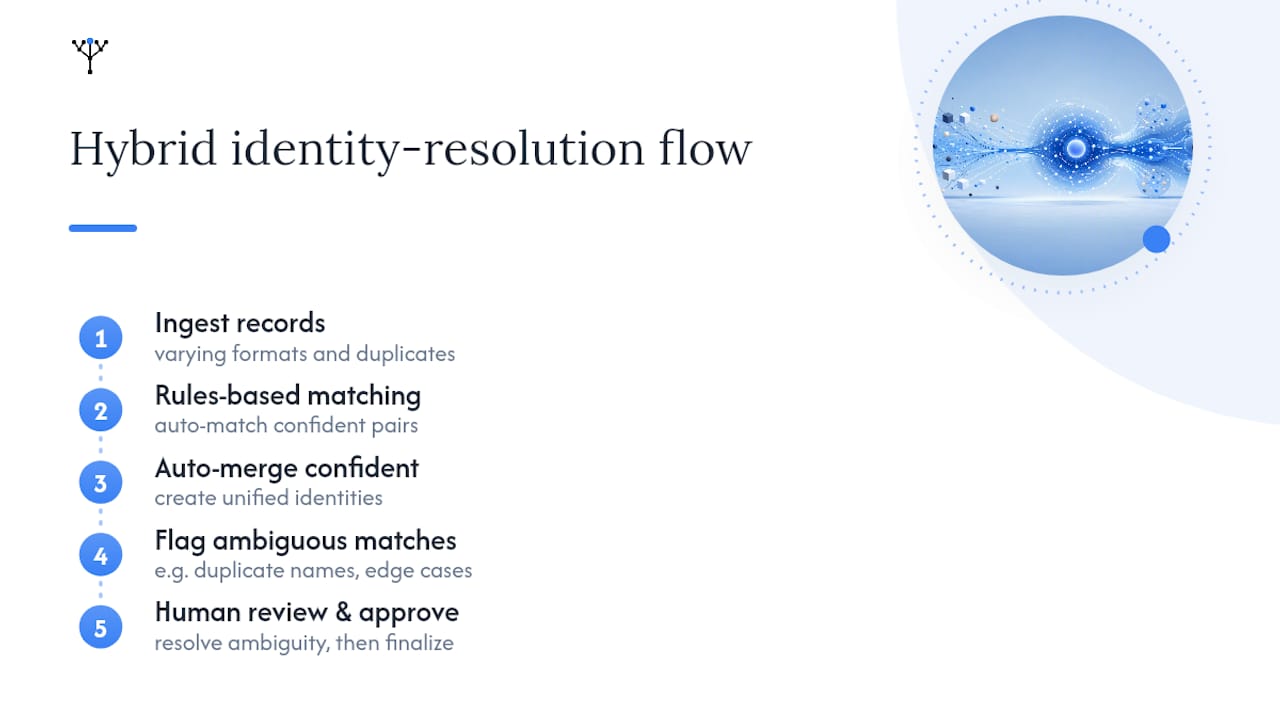
Identity resolution edge cases trip up even well-funded projects. Two "John Smith" records might be the same person or two different ones, and rules-based matching alone gets this wrong often enough to erode trust in the whole system. RudderStack's breakdown of unification challenges points to inconsistent formats and identity resolution as recurring blockers, which is why a hybrid approach, rules plus human review on ambiguous matches, tends to outperform either extreme.
Format and semantic mismatches between systems (different date formats, different currency conventions, different definitions of "active customer") need canonical shapes and reusable mapping libraries rather than one-off fixes per source. Oakandnine's guidance on building a domain-scoped canonical data model is worth reading before you write your first mapping rule, since retrofitting a canonical structure later is far more expensive than designing for it early.
Scale and performance decisions, batch versus streaming, come down to what the business actually needs, not what sounds more modern. Fraud detection genuinely needs near real-time data; monthly board reporting does not.
Privacy and compliance controls need to be built into the pipeline itself, not bolted on afterwards. Access controls, masking rules and audit trails belong in the design phase, particularly where personal or financial data is involved, a point enterprise AI governance guidance reinforces for any system feeding AI models.
Pro Tip: Duplicate detection is where finance teams often see the fastest win. Techniques used to catch duplicate invoices before payment translate directly to broader entity resolution work across your unified dataset.
What governance practices keep a unified data model trustworthy?
A unified data model (UDM) is the standardised structure that gives your reconciled data consistent shape across teams. Microsoft's own UDM practices document uses entities, profiles, profile extensions, attributes and standardised dimensions to prevent the classic failure mode: two departments running the "same" report and getting different numbers because their underlying metrics were never aligned.
Standardising dimensions matters more than it sounds. Without it, teams build fragile joins between tables that break the moment someone renames a field, and inconsistent metrics multiply silently until nobody trusts the dashboard anymore. A practical modelling pattern worth borrowing: keep base profiles lean, and push frequently changing attributes into profile extensions rather than the core schema, which keeps queries fast and the model maintainable as it grows.
Governance is not a separate workstream bolted onto the technical build, it is the thing that makes the technical build worth trusting. That means:
- A data glossary defining what each term means, agreed across departments, not written by one team in isolation.
- Data lineage tracking where every field originated and what transformations touched it along the way.
- Named ownership for every domain, so a data quality issue has one accountable person, not a committee.
- Schema enforcement at the point of ingestion, catching malformed records before they pollute the unified view.
- Ongoing quality metrics, tracked continuously rather than checked once at launch.
Microsoft's own experience building a semantic layer found that treating governance, lineage and discoverability as first-class concerns, rather than afterthoughts, reduced rework substantially and gave downstream AI systems consistent inputs to work from. That last part matters more each year: an AI model trained on inconsistent, undocumented data will confidently produce wrong answers, and it will do so at scale.
The quality metrics worth tracking on an ongoing basis are completeness, accuracy, timeliness and uniqueness. These four, monitored continuously rather than audited annually, catch drift before it reaches a board report.
For companies weighing architectural approaches at this stage, a semantic layer sitting over a data mesh or data fabric is worth understanding before committing, and Oakandnine's comparison of the two approaches lays out the governance trade-offs each one carries.
What does a realistic implementation roadmap look like?
Skip the temptation to unify everything at once. Every mid-market company that has tried a big-bang unification project has a story about the eighteen months it took and the executive who eventually pulled funding. A phased approach works better and proves value faster.
- Pick a high-value pilot. Choose one use case where bad data visibly costs money, customer 360 and financial reconciliation are common starting points, and measure the baseline before you change anything.
- Build canonical shapes for the pilot only. Define minimal schema enforcement and mapping rules for that one domain rather than designing an enterprise-wide model on day one.
- Run it, measure it, fix it. Collect feedback from the people actually using the unified view, not just the team that built it, and expect your first mapping rules to need revision.
- Expand to adjacent domains. Once the pilot proves the model, extend the same canonical patterns to the next highest-value domain, automating validation checks as you go.
- Assign permanent roles. Data owners for each domain, stewards to handle day-to-day quality issues, platform operations to keep the pipeline running, and an executive sponsor to hold the whole effort accountable.
- Track adoption alongside data metrics. Completeness, accuracy, timeliness and uniqueness tell you if the data is good. Whether teams actually use the unified view instead of their old spreadsheet tells you if the project succeeded.
Guidance on designing an AI operating model that scales is a useful companion read here, since the schema enforcement and validation controls that make unification reliable are the same controls that make AI outputs trustworthy downstream.
How data unification can be approached in practice
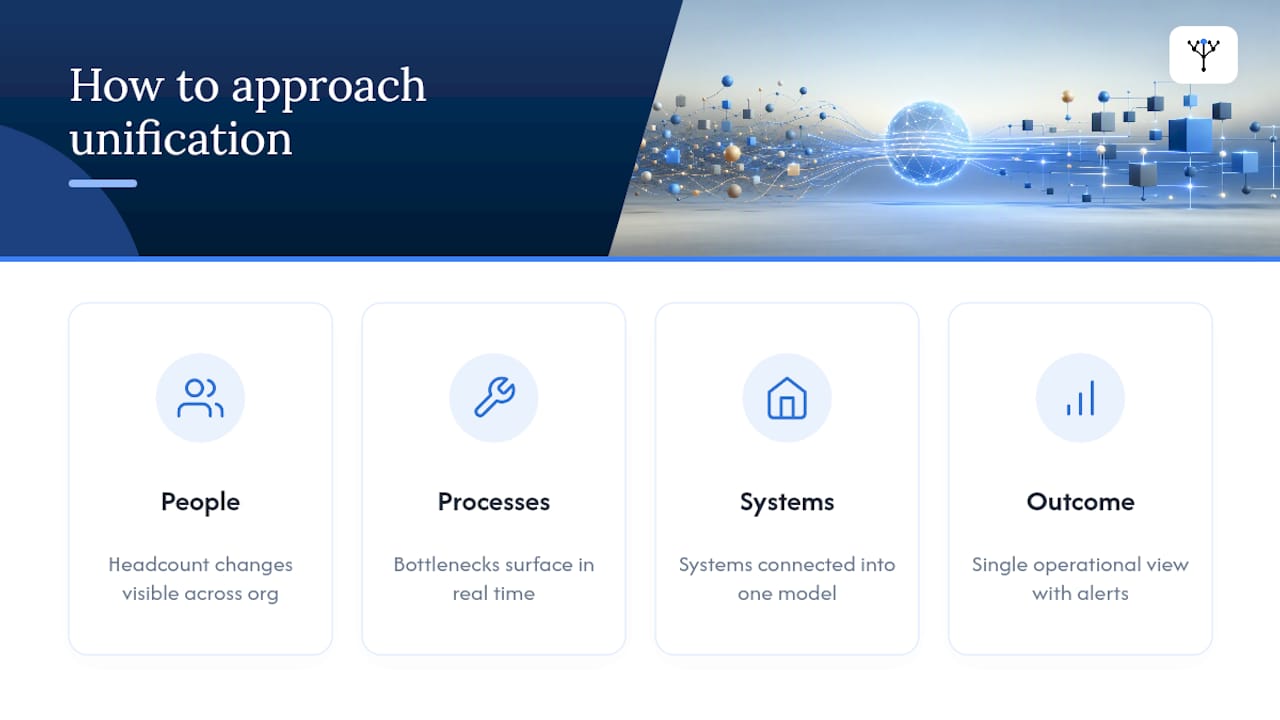
Data unification is not just a standalone technical exercise. It can be framed as connecting people, processes and systems into a live organisational model, one where a change in HR headcount, a bottleneck in operations and a margin shift in finance are all visible in the same place, at the same time.
That framing changes what "success" looks like. It is not just a clean dataset sitting in a warehouse. It is real-time insight into where the business is leaking time or money, and a preemptive alert before a small inconsistency becomes a costly one. Managing directors get a single operational view instead of four departmental reports that disagree with each other. That, more than any schema diagram, is what unification is actually for.
— Ronan
See how Oak & Nine handles unification for your organisation
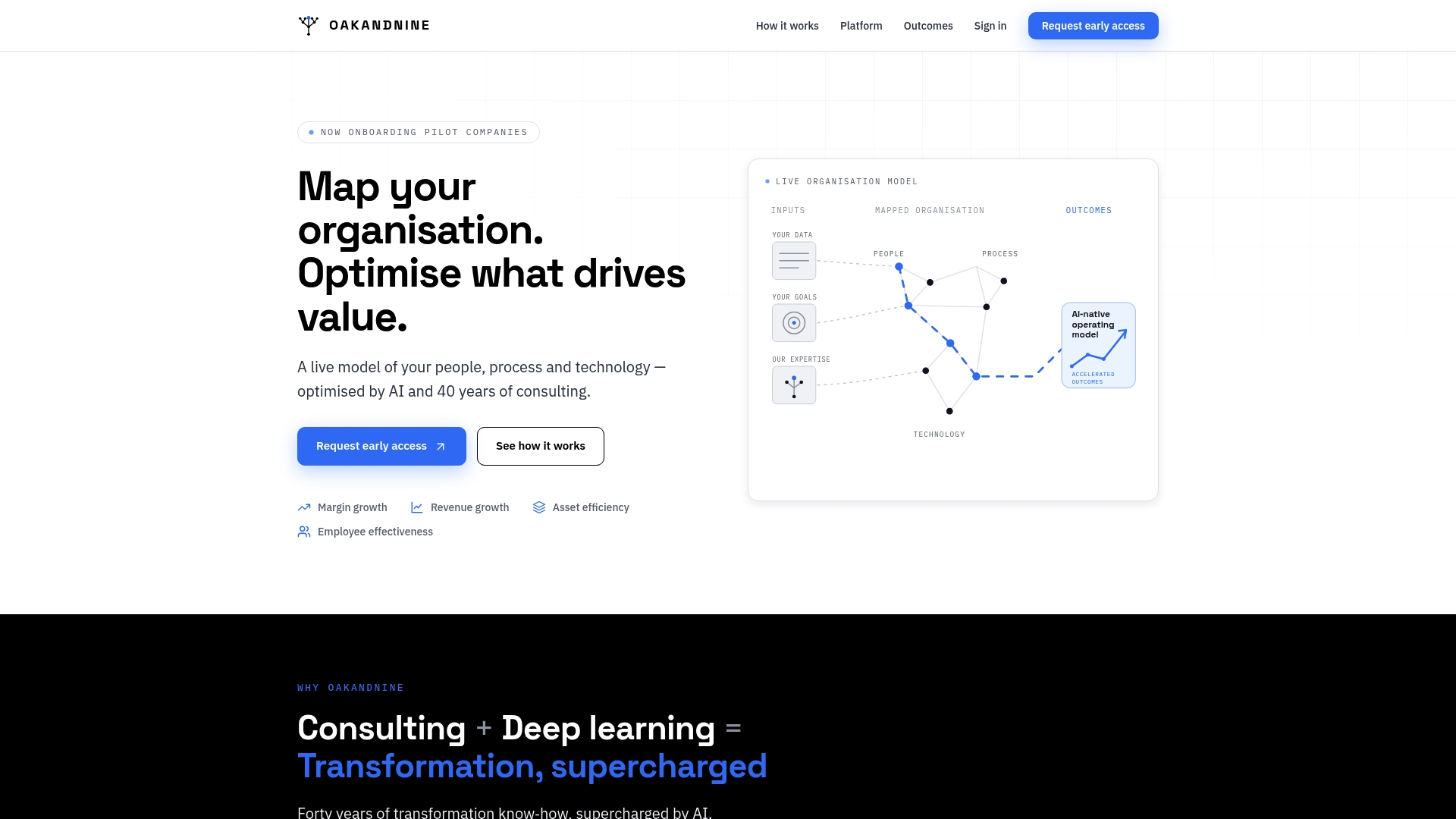
There are alternatives for mid-market leaders who want a governed, unified view of their business without running a multi-quarter data engineering project first. Some providers pair AI-driven systems with consulting support that map existing people, processes and systems into one live model, so you see where data is disconnected and where it is already costing you money.
Fit tends to be clearest for companies past the startup stage but not yet running dedicated data engineering teams, where the gap between "we have data everywhere" and "we trust our data" is widest. A pilot typically starts with one high-value domain, customer records, operational bottlenecks, or financial reconciliation, and expands once the model proves its value.
If you are weighing whether to build this in-house or bring in a platform that does the mapping for you, start by reviewing what Oak & Nine offers operations leaders or explore how the platform connects the functions across HR, finance and operations. From there, requesting a pilot scoped to your business is the fastest way to see the model applied to your own data.
Authoritative sources and further reading
- Microsoft's data unification framework for the core four-step process.
- RudderStack's guide to challenges and best practices.
- Microsoft's Unified Data Model documentation for modelling patterns.
- IBM on systems of record versus sources of truth
Sources
The general term is data integration, but when the goal is resolving duplicates and reconciling meaning rather than just moving data, that specific process is called data unification.
- Data unification | Microsoft Learn
- What is data unification? Challenges and best practices | RudderStack
- Devblogs
- What is Data Unification? | Tamr
FAQ
What is an example of unification in a business setting?
A retailer merging customer records from its e-commerce platform, loyalty programme and support system into one profile per customer is a classic example, often called a customer 360 view.
What does unified data actually mean?
Unified data means records from different systems have been matched, deduplicated and reconciled into one consistent, governed view, so a customer, product or transaction has a single agreed version of the truth rather than several conflicting ones.
What does data merging mean, and is it the same as unification?
Data merging usually refers to the technical act of combining records, while unification is the broader process that includes merging plus profiling, entity resolution, governance and ongoing validation.
Do I need a single physical database to achieve a single source of truth?
No. An SSOT is typically a conceptual, governed layer that reconciles data across domains, delivered through views, APIs or a semantic layer, rather than one database holding every raw record.