
Enterprise AI adoption succeeds when leaders treat it as organisational transformation first and technology second. Across 51 enterprise cases studied by the Stanford Digital Economy Lab, the gap between success and failure was change management, data quality and process redesign, not model choice. Two-thirds of organisations already report productivity gains from AI, according to Deloitte, yet most still struggle to convert that into revenue. Sponsorship and governance decide the outcome.
TL;DR:
- Most successful enterprise AI projects treat it as organizational change, focusing on process redesign and change management rather than solely on technology.
- Scaling AI depends on clear ownership, frequent measurement, deliberate planning, and early involvement of legal and risk functions.
- Revenue gains from AI are rare and require purpose-built use cases, not just efficiency improvements or automated workflows.
- Data quality, consistent identifiers, and a shared architecture are essential to build repeatable, trustworthy AI pilots.
- Leaders should prioritize launching a single measurable pilot aligned with existing OKRs and with active sponsorship to avoid common failure points.
Table of Contents
- Where enterprise AI adoption stands right now
- What benefits should leaders actually expect?
- Why do so many AI pilots stall before scale?
- What does a pilot-to-scale roadmap look like?
- How should leaders govern and sponsor AI projects?
- What makes a pilot technically repeatable?
- Which metrics prove enterprise AI adoption is working?
- How does a connected platform support this roadmap?
- What should leaders prioritise this quarter?
- Ready to move your organisation from pilot to scale?
- Sources
Where enterprise AI adoption stands right now
Adoption has moved past the experimentation phase. Deloitte's research finds that most organisations now use AI in at least one business function, and 66% report measurable productivity or efficiency gains from it. That is no longer a frontier statistic. It is the baseline.
What separates leaders from laggards is depth of use, not presence of use. A widening group of firms have moved from single-task copilots into agentic AI: systems that plan, execute and hand off multistep work with only occasional human checkpoints. That shift changes what "adoption" even means, and it changes the readiness bar too.
A few patterns explain why some organisations scale faster than others:
- They treat AI projects as operating model change, not IT procurement.
- They give pilots a defined owner with authority to redesign a process, not just automate it.
- They measure early and often, rather than waiting for a year-end review to judge success.
The firms stuck at pilot purgatory usually skipped one of these three, not because the technology failed them.
What benefits should leaders actually expect?
Efficiency gains arrive first and fastest. Cycle-time reduction, fewer manual handoffs, faster document turnaround: these are the wins organisations report most consistently, and they are also the easiest to measure against a clean before-and-after baseline.
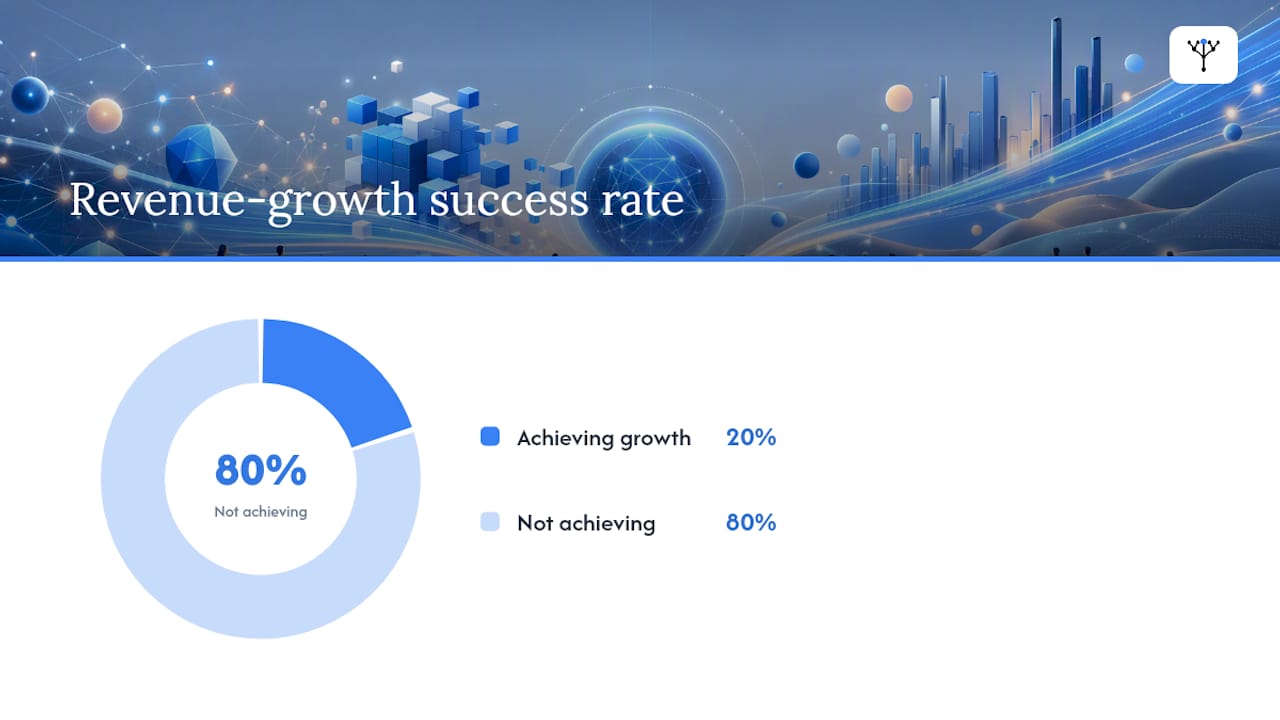
Revenue gains are a different story. The Stanford playbook found that 74% of organisations hope to grow revenue through AI, but only around 20% are currently doing so. The organisations achieving it tend to target it deliberately, through personalisation engines that lift conversion, or sales tooling that shortens time to close. Revenue impact does not happen as a side effect of efficiency work. It requires a use case built for that purpose from the start.
Pro tip: If your board is expecting revenue results from an efficiency pilot, reset expectations now. Efficiency and revenue are different projects with different success metrics, and conflating them is one of the fastest ways to make a working pilot look like a failure.
Why do so many AI pilots stall before scale?
The technology rarely kills a pilot. What kills it is the cost nobody budgeted for.
- Process redesign debt. Bolting AI onto a broken workflow just makes the workflow break faster.
- Change management. Staff who were not consulted early tend to route around new tools rather than adopt them.
- Data hygiene. Inconsistent identifiers and fragmented records quietly cap what any model can do, no matter how capable it is.
- Talent gaps. Few teams have anyone whose job is to own the AI workflow end to end.
Legal, HR, Risk and Compliance functions are the most common sources of friction, and reasonably so. They are the ones who inherit liability if an automated decision goes wrong, so they slow things down when they feel bypassed.
Pro tip: Bring Legal, Risk and Compliance into the room during pilot design, not after a working prototype exists. Early involvement turns them into co-authors of the guardrails rather than a late-stage veto.
What does a pilot-to-scale roadmap look like?
A workable roadmap runs through four distinct stages, each with its own exit criteria.
- Readiness. Confirm you have usable data, a documented workflow to improve, a named owner, and outcome metrics agreed before build starts. Skipping this step is the single most common cause of a stalled pilot.
- Pilot design. Set one clear objective, a tightly bounded scope, and a fixed window of several weeks to a few months. Staff it with a cross-functional team: the process owner, an IT or data lead, and someone from the function most affected by the change, whether that is HR, Finance or Operations.
- Iterate. Use an escalation model where AI handles the routine cases and humans handle exceptions, rather than requiring approval on every output. Codify the components that worked, whether that is a prompt structure, a data pipeline, or an integration pattern, so the next pilot does not start from zero.
- Scale. Set a deliberate medium-term horizon for moving from pilot to platform investment, rather than rushing on the strength of one good result. That timeline discipline correlates with stronger long-term outcomes than firms that "move fast" without a structured gate.
The decision gate for platform-level investment should rest on evidence, not enthusiasm: a repeatable productivity lift, a stable data foundation, and a team that has already ironed out the escalation model on a smaller scope. Shared services functions, in particular, benefit from sequencing pilots deliberately rather than running several at once with no shared infrastructure between them.
How should leaders govern and sponsor AI projects?
Passive sponsorship, a name on a slide, rarely moves anything. The Stanford research found that successful projects shared a pattern of active steering: weekly check-ins between the executive sponsor and the delivery team, sponsors who removed blockers within days rather than weeks, and named liaisons connecting the AI team to the functions it touched.
The most transformational cases went further and tied AI outcomes directly to corporate OKRs, rather than treating the pilot as a side initiative sitting outside the normal planning cycle. That single change, folding AI metrics into the targets leadership is already accountable for, appears repeatedly among the organisations that scaled fastest.
Governance should be distributed rather than centralised, as a single AI ethics committee distant from daily work can become a bottleneck. What works better:
- Escalation protocols that route edge cases to the right function quickly, rather than to a generic queue.
- Responsible AI checks built into the workflow itself, not bolted on as a separate audit step.
- Incentives for managers that reward successful adoption, not just technical delivery.
Designing this properly from day one is easier than retrofitting it, and operating model guidance built specifically around AI governance is worth reviewing before your first pilot launches, not after.
What makes a pilot technically repeatable?
Most technical failures trace back to a missing foundation, not a weak model. EY's seven-layer blueprint argues that an AI-native foundation, cloud infrastructure, real-time data access, and consistent identifiers across systems, needs to exist before intelligence and trust layers can function reliably. Skip that layer and every pilot after it inherits the same data quality problems.
A "truth layer", a single reliable source for the data an agent acts on, is what allows agentic workflows to run with less human checkpointing. Without it, escalation models collapse back into approval models by necessity, because nobody trusts the underlying data enough to let AI act on it alone.
Practical priorities for repeatable pilots:
- Standardise identifiers across HR, Finance and Operations systems before automating a cross-functional process.
- Favour escalation over blanket approval wherever risk allows it. Escalation-based models produced markedly higher productivity gains than approval models in the Stanford dataset.
- Redesign the process itself before automating it. Automating a bad process just produces a faster bad process.
- Upskill the team that will own the workflow long term, since education and role redesign are the most cited responses to closing talent gaps.
Reviewing existing workflow automation patterns before building from scratch often saves months of avoidable rework.
Which metrics prove enterprise AI adoption is working?
Board credibility rests on metrics chosen before launch, not justified afterwards. Track productivity (cycle time, throughput), quality (error rates, rework), adoption (active usage, not licences purchased), cost-to-serve, and, where the use case targets it directly, revenue impact.
Establish a baseline before the pilot starts, then use A/B or holdout comparisons rather than a single before-and-after snapshot, which is too easily skewed by seasonal noise. For revenue use cases specifically, attribute the lift narrowly: a personalisation engine's conversion uplift, or the reduction in days-to-close for a sales workflow.
Only around 20% of organisations are currently achieving the revenue growth most hope for, which makes honest attribution more valuable than an optimistic top-line claim finance will later challenge.
- Productivity and quality metrics for most pilots.
- Revenue attribution only for use cases explicitly designed to drive it.
- Adoption metrics to catch shelfware early, before it shows up in a budget review.
How does a connected platform support this roadmap?
Most of the invisible costs described above, fragmented data, unclear ownership, siloed escalation, come from running HR, Finance and Operations as separate systems that were never designed to talk to each other. Oak & Nine addresses that gap directly: a live map of the organisation's people, processes and technology gives leaders the same real-time view the Stanford research suggests successful sponsors already rely on informally.
Illustrative applications for a managing director or operations leader might include:
- Mapping an existing workflow before automating it, so redesign happens ahead of the pilot rather than as damage control after it.
- Surfacing preemptive alerts when a process bottleneck is forming, rather than discovering it in a monthly report.
- Automating the routine handoffs between departments that currently rely on email and spreadsheets to function.
[Case studies demonstrating platform outcomes will be added here.] The mechanics matter more than any single number: a unified data model reduces the identifier inconsistencies that undermine agentic workflows, and a connected view across functions shortens the readiness stage that most pilots underestimate.
What should leaders prioritise this quarter?
The evidence keeps pointing the same direction: the technology is rarely the constraint. What derails enterprise AI adoption is unclear ownership, sponsors who show up at the kickoff and disappear until the review, and data that nobody has bothered to clean.
If I had to pick one action for a leader reading this, it would be to set a single measurable pilot this quarter, tied to an existing corporate OKR rather than a new initiative, with a named sponsor who checks in weekly. Not because that guarantees success. It does not. But it removes the two most common reasons pilots fail before they get a fair test.
I would also say this plainly: nobody has this fully solved yet, including the organisations quoted throughout this piece. The firms scaling fastest are not the ones with the best model. They are the ones treating each pilot as a chance to learn something they will use in the next one.
— Ronan
Ready to move your organisation from pilot to scale?
The pattern running through this entire roadmap, unify the data, map the process, give someone real ownership, reflects the approach needed for mid-market organisations that are past the experimentation stage and ready to make AI adoption stick. Instead of running pilots on disconnected spreadsheets and half-integrated tools, a connected live model of people, processes and systems can help surface bottlenecks before they cost you a quarter.
Managing directors weighing where to start can see how the platform maps and optimises an organisation end to end, while operations leaders focused on the integration challenge covered above may prefer to look at how Oak & Nine connects the functions that currently sit in silos. If governance and risk oversight are your bigger concern right now, reviewing external AI governance frameworks alongside Oak & Nine's approach is a sensible next step before you commit budget. Book a working session to see your own organisation mapped, and decide from there whether a pilot makes sense this quarter.
Sources
- The Enterprise AI Playbook: Lessons from 51 successful developments (Stanford Digital Economy Lab)
- State of AI in the enterprise (Deloitte)
- AI transformation: seven-layer blueprint for ROI (EY)