
Employee productivity is defined as the meaningful output a worker generates relative to the time, resources, and organizational goals invested in their role. Knowing how to increase employee productivity is not about squeezing more hours from your team. It requires aligning goals, fixing broken workflows, and creating conditions where people can do their best work. Productivity challenges most often stem from system failures, not from individual effort. That distinction changes everything about how you manage.
How can managers set clear goals to increase employee productivity?
Clear goals are the single most direct lever managers control. Setting SMART goals aligned with company objectives reduces rework and confusion, giving employees a precise picture of what success looks like. Without that clarity, teams waste energy on low-impact tasks that feel busy but deliver little.
The SMART framework (Specific, Measurable, Achievable, Relevant, Time-bound) works because it forces you to define outcomes, not just activities. A goal like "improve client response time to under four hours by the end of Q3" is actionable. "Be more responsive" is not. The difference in focus and motivation between those two instructions is significant.

Shifting priorities destroy productivity faster than almost anything else. When you change direction mid-sprint, employees lose the context they built and must restart mentally. Protect your team from that cost by committing to goal cycles of at least four weeks before reviewing priorities.
Regular communication about progress matters as much as the initial goal-setting. Weekly check-ins that take fifteen minutes keep people on track without creating overhead. They also give you early warning when a goal is unrealistic or when a team member needs support.
- Define one primary outcome per person per quarter, then align daily tasks to that outcome.
- Use a shared tracker so everyone sees how individual work connects to team targets.
- Limit priority changes to monthly reviews unless a genuine business emergency demands it.
- Communicate the "why" behind each goal, not just the "what."
Pro Tip: Run a five-minute goal alignment check at the start of each week. Ask each team member to name their top priority for the day. Misalignment surfaces immediately, and you can correct it before it costs hours.
What role does workflow optimization play in boosting employee productivity?
Time is the one resource you cannot recover. A one-week time audit that categorizes all work into billable, non-billable, and administrative tasks reveals systemic bottlenecks more reliably than individual performance reviews. Most managers are surprised by how much time disappears into meetings, status updates, and low-value admin.
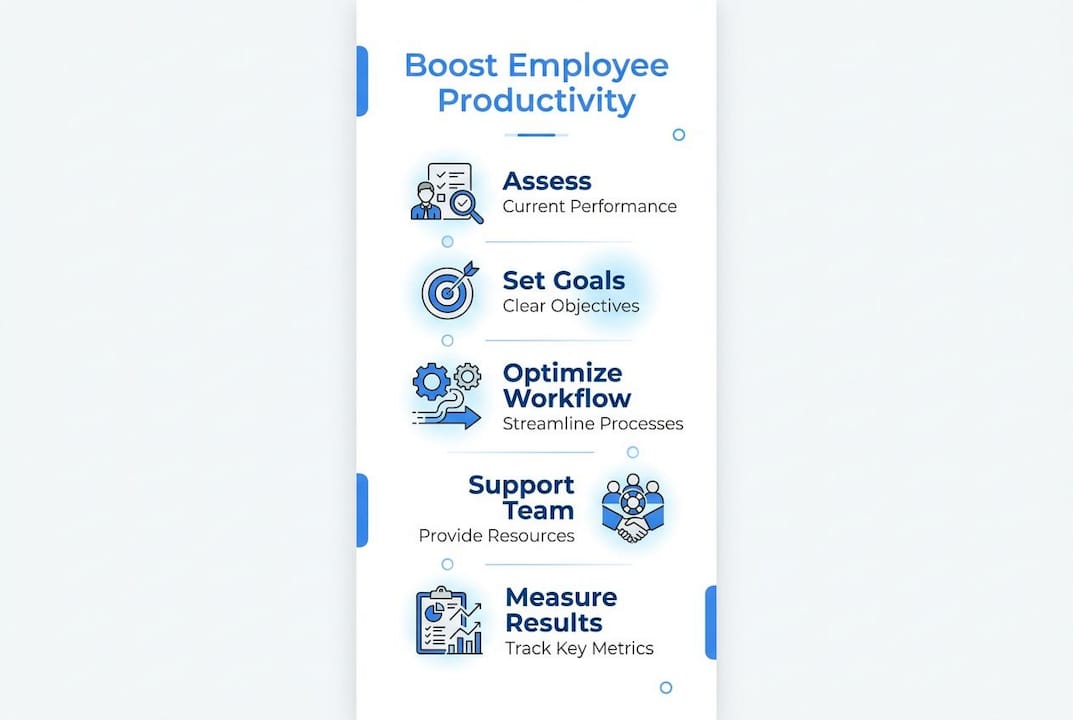
The planned-to-done ratio is a practical leading indicator. Track what your team plans to complete each week against what they actually finish. A consistent gap signals a capacity problem or a prioritization problem. Both are fixable at the system level.
Meetings are the most common productivity drain in UK organizations. The fix is not to eliminate them but to design them better. Every meeting needs a written agenda sent 24 hours in advance, a defined decision or output, and a participant list limited to people who are genuinely needed. Observers belong on a summary email, not in the room.
- Conduct a one-week time audit across your team. Categorize every task as deep work, collaborative work, or administrative overhead.
- Identify the top three sources of non-billable overhead and assign an owner to reduce each one.
- Audit your recurring meetings. Cancel any that lack a clear decision output.
- Protect at least two uninterrupted focus blocks per day for each team member.
- Batch similar tasks together and schedule them during each person's peak energy window.
| Workflow problem | Practical fix |
|---|---|
| Too many context switches | Batch similar tasks into dedicated time blocks |
| Meetings without outcomes | Require a written agenda and defined decision before scheduling |
| Admin overhead eating deep work | Automate or delegate recurring low-value tasks |
| Unclear capacity | Use planned-to-done ratio weekly to spot overload early |
Pro Tip: Ask your team to block "no-meeting mornings" two days per week. The protected focus time compounds over months into measurable output gains.
How does a supportive work environment enhance productivity?
A supportive environment is not a soft benefit. Managing workplace stress and improving working conditions directly increases output. Burnout from unrealistic workloads reduces both quality and speed, and the recovery time after a burnout episode costs far more than the short-term gains from overloading a team.
Recognition is one of the highest-return investments a manager can make. Making half of employees feel recognized can boost productivity by 9%. That is not a trivial number. Recognition works because it reinforces the behaviors you want repeated, making performance expectations concrete without a single formal review.
Continuous professional development keeps skills current and signals that you invest in your people's futures. This matters especially in hybrid and remote settings, where employees can feel disconnected from organizational growth. A quarterly learning budget, even a modest one, sends a clear message about long-term commitment.
- Set workloads based on realistic capacity, not aspirational targets. Burnout from unrealistic deadlines causes disengagement and errors that take weeks to correct.
- Encourage regular breaks. Short recovery periods during the day protect sustained concentration.
- Give employees autonomy over how they complete their work, not just what they complete. Autonomy builds ownership and reduces the need for micromanagement.
- Create clear channels for raising workload concerns without fear of judgment. Open communication reduces duplication and delays, producing faster and higher-quality output.
- Support mental health through access to employee assistance programs and by modeling healthy working hours yourself.
Working from home can increase employee productivity when managers provide the right structure. Clear goals, protected focus time, and regular check-ins replicate the best parts of office culture without the commute overhead.
What measurement frameworks help sustain employee productivity?
Most productivity measurement fails because it tracks the wrong things. Traditional metrics focused on quantity of activity miss true impact. Counting emails sent or hours logged tells you nothing about whether the work moved the business forward.
A balanced framework pairs lagging indicators with leading indicators. Lagging indicators measure results after the fact: revenue per employee, tasks completed, client satisfaction scores. Leading indicators measure the conditions that predict future results: team autonomy, goal clarity, engagement scores, and quality of working conditions. Leading indicators like autonomy and purpose clarity are more reliable predictors of sustained productivity than output volume alone.
Employee engagement scores deserve a place in every manager's dashboard. Engagement predicts discretionary effort, which is the difference between a team that meets targets and one that exceeds them. Run short pulse surveys monthly rather than annual engagement surveys. The data is more current and the response rate is higher.
| Indicator type | Examples | When to use |
|---|---|---|
| Lagging (output) | Revenue per employee, tasks completed, error rate | Monthly or quarterly reviews |
| Leading (behavioral) | Engagement score, goal clarity rating, autonomy index | Weekly or fortnightly check-ins |
| Qualitative | Team feedback, 1:1 notes, retrospective themes | Ongoing, structured monthly |
Review cycles matter as much as the metrics themselves. A monthly data review that leads to a system adjustment is worth more than an annual report that sits in a folder. Workforce management technology automates much of this data collection, giving you real-time insights without manual overhead. Use the time you save to act on what the data tells you.
Key Takeaways
Increasing employee productivity requires fixing systems first, then measuring the right mix of output and behavioral indicators to sustain gains over time.
| Point | Details |
|---|---|
| Fix systems, not people | Most productivity losses come from broken processes, not individual effort. |
| Set SMART goals | Align individual tasks with company objectives to reduce rework and confusion. |
| Audit time weekly | A one-week time audit reveals where overhead is killing deep work capacity. |
| Recognize consistently | Making half your team feel recognized can lift productivity by 9%. |
| Measure leading indicators | Track autonomy, clarity, and engagement scores alongside output metrics. |
The productivity trap most managers fall into
After working with dozens of mid-market organizations, I keep seeing the same pattern. A manager notices output is down, so they schedule more check-ins, add reporting requirements, and tighten deadlines. Output drops further. The team disengages. The manager concludes the people are the problem.
The people are rarely the problem. The system is. When I map an organization's workflows, I almost always find the same culprits: unclear priorities, meeting culture that fragments the day, and recognition that is too infrequent to shape behavior. These are design failures, not performance failures.
The managers who get lasting results are the ones who treat productivity as an operating model question. They ask: "What in our structure is making it hard for people to do good work?" That question leads to fixes that compound. Clearing one bottleneck frees capacity that makes the next fix easier.
Measurement is where I see the second major mistake. Managers track activity volume because it is easy to count. But aligning individual tasks with organizational priorities and measuring whether that alignment holds is what actually predicts performance. Build your dashboard around leading indicators and you will stop being surprised by lagging results.
The most productive teams I have worked with share one trait: their managers protect the conditions for good work rather than managing the work itself. That shift in focus is harder than it sounds, but it is the one that lasts.
— Ronan
How Oakandnine supports organizational productivity
Productivity gains that stick require visibility into how your people, processes, and technology actually interact. Most managers lack that view.
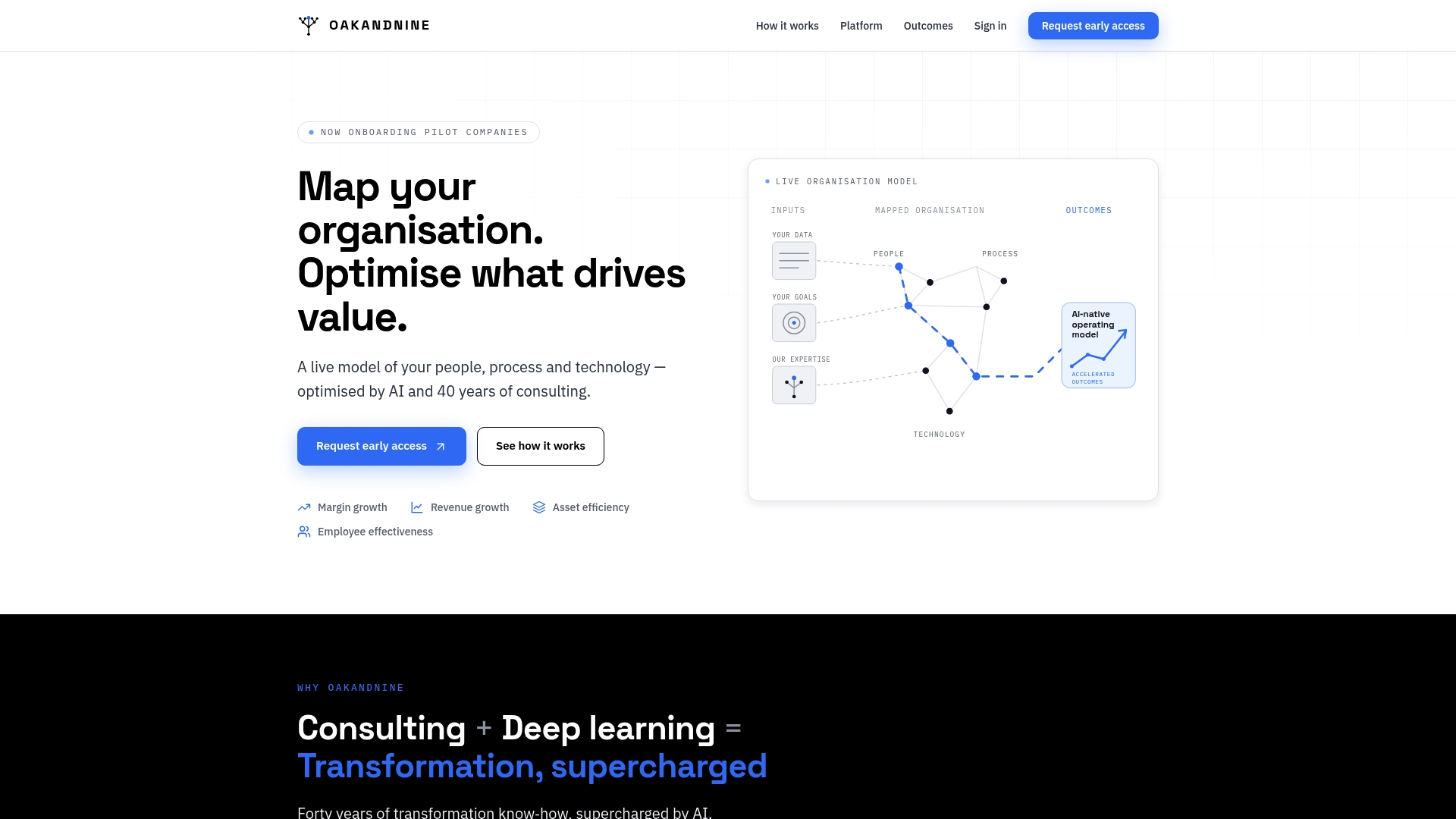
Oakandnine builds a live operating model of your organization, integrating engagement data, workflow patterns, and performance signals into a single coherent picture. Instead of guessing where friction lives, you see it. The platform's AI-driven approach turns scattered operational data into clear priorities, so your team focuses on the work that moves the business forward. For managers who want to move from reactive performance management to proactive system design, Oakandnine provides the structural foundation to make that shift.
FAQ
What is the fastest way to increase staff productivity?
The fastest gains come from removing friction, not adding pressure. Conduct a one-week time audit, cancel meetings without clear outputs, and set one primary goal per person per quarter.
Does working from home increase employee productivity?
Working from home can increase employee productivity when managers provide clear goals, protected focus time, and regular check-ins. Without that structure, remote work amplifies existing system problems.
Do employee wellness programs increase productivity?
Yes. Managing stress and improving working conditions directly increases output. Recognition programs that make employees feel valued can lift productivity by 9%, according to published research.
How do you measure employee productivity accurately?
Pair lagging indicators (output, error rate, revenue per employee) with leading indicators (engagement scores, goal clarity, autonomy). Relying on activity volume alone misses the conditions that drive real performance.
How does employee engagement increase productivity?
Engaged employees apply discretionary effort, meaning they go beyond the minimum required. High engagement scores predict lower error rates, faster output, and stronger retention, all of which compound into measurable productivity gains.