
OKRs and KPIs answer different questions: an OKR asks "what change do we need to make?" while a KPI asks "is the business healthy right now?" They aren't competing frameworks, they're complementary ones. If you're auditing your goal-setting stack this quarter, pick one metric that's underperforming and ask whether it needs a KPI fix or an OKR sprint.
TL;DR:
- KPIs track ongoing business health and are reviewed continuously, while OKRs set ambitious, time-bound goals for specific changes or outcomes.
- Most organizations should keep critical KPIs to around five to ten, focusing on stable, measurable metrics like retention, uptime, or revenue.
- Convert KPIs into OKRs only when they are underperforming, clearly owned, and have a specific deadline, ensuring they drive meaningful improvement.
- Combining KPIs and OKRs in a single connected view enables real-time alerts and clearer dependency tracking, reducing redundant meetings.
- Proper audit of existing metrics before goal-setting improves focus and reduces wasted effort on tracking non-essential data.
Table of Contents
- OKR vs KPI: the core distinction managers need to understand
- When should you use OKRs versus KPIs?
- How do OKRs and KPIs work together in practice?
- How to turn a KPI into a key result (and back again)
- Common pitfalls (and how to avoid them)
- How an integrated view makes OKR and KPI alignment faster
- The gap between the theory and the planning room
- Bring your KPIs and OKRs into one connected view
- Sources
- FAQ
OKR vs KPI: the core distinction managers need to understand
An OKR (Objective and Key Result) pairs an ambition with a small set of measurable outcomes, usually set on a quarterly or annual cadence. A KPI (Key Performance Indicator) is a standing metric that tracks the ongoing health of a process, department, or system, checked continuously rather than reset each cycle. The difference between KPI and OKR comes down to direction versus diagnosis: KPIs tell you where the business currently stands, OKRs tell you where you're trying to push it next.
Andrew Grove introduced the thinking behind this framework at Intel in the 1970s, long before "OKR" became a Silicon Valley export via John Doerr. That history matters less than the practical point it left behind: OKRs work best applied at team level, not as a rebadged individual appraisal form. Treat them that way and the KPI vs OKR confusion mostly disappears, because you stop asking KPIs to do a job they were never built for.
Here's how the two frameworks stack up across the dimensions that actually affect planning decisions.
| Dimension | OKRs | KPIs |
|---|---|---|
| Purpose | Drive a specific change or outcome | Monitor ongoing operational health |
| Time horizon | Quarterly or annual, then retired or reset | Continuous, no natural end date |
| Ambition | Deliberately a stretch (70% achievement is often fine) | Steady, realistic targets |
| Measurement | Key results scored and normalised, not pass or fail | Numeric target against actual, tracked over time |
| Ownership | Team-owned, reviewed against supporting initiatives | Function-owned, reviewed against a threshold |
| Review rhythm | Weekly check-ins, formal quarterly scoring | Weekly or monthly dashboard review |
Worked example, OKR: Objective: "Launch our self-serve tier successfully in Q2." Key Result 1: sign up 500 self-serve customers by the end of the quarter. Key Result 2: reach a 40% activation rate within the first seven days.
Worked example, KPI: Monthly customer churn rate, tracked against a 2% ceiling, reviewed by the customer success lead every week regardless of what else is happening that quarter.
Score key results consistently rather than judging them as binary hits or misses. Perdoo's own framing captures it well: KPIs keep the engine running while OKRs change the route, and a good scoring system reflects that a KR landing at 70% of target can still represent a genuine win on a deliberately ambitious goal.
When should you use OKRs versus KPIs?
The decision usually comes down to whether you're trying to change something or maintain something. OKRs suit situations with a clear before-and-after, such as a product launch or a new market entry over a set period. KPIs are used to monitor areas that need to stay stable and predictable like retention or system uptime.
Function by function, the pattern holds up:
- Sales — KPI: pipeline conversion rate, tracked monthly. OKR: "Break into the mid-market segment," with key results around named-account wins and average deal size.
- Product — KPI: feature adoption rate, monitored weekly. OKR: "Ship a mobile-first experience," with key results tied to release milestones and early usage thresholds.
- HR — KPI: employee turnover rate, reviewed monthly. OKR: "Rebuild onboarding to cut early attrition," with key results around 90-day retention and manager satisfaction scores. Our guide to employee engagement measurement covers the KPI side of this in more depth.
- Operations — KPI: on-time delivery rate, tracked continuously. OKR: "Halve process bottlenecks in fulfilment," backed by a focused improvement sprint. Our operations KPI playbook walks through 15 metrics worth tracking as steady-state baselines.
Pro Tip: If you can't name a specific finish line, you're probably describing a KPI, not an OKR. "Improve customer satisfaction" has no end date. "Lift NPS from 32 to 45 by the end of Q3" does.
Before locking in your approach, run through this checklist: Is the metric currently stable and acceptable? Keep it a KPI. Is it underperforming and does it need concentrated attention this quarter? Convert it into a key result. Does it apply company-wide with no single owner? It stays a KPI guardrail, not an OKR.
How do OKRs and KPIs work together in practice?
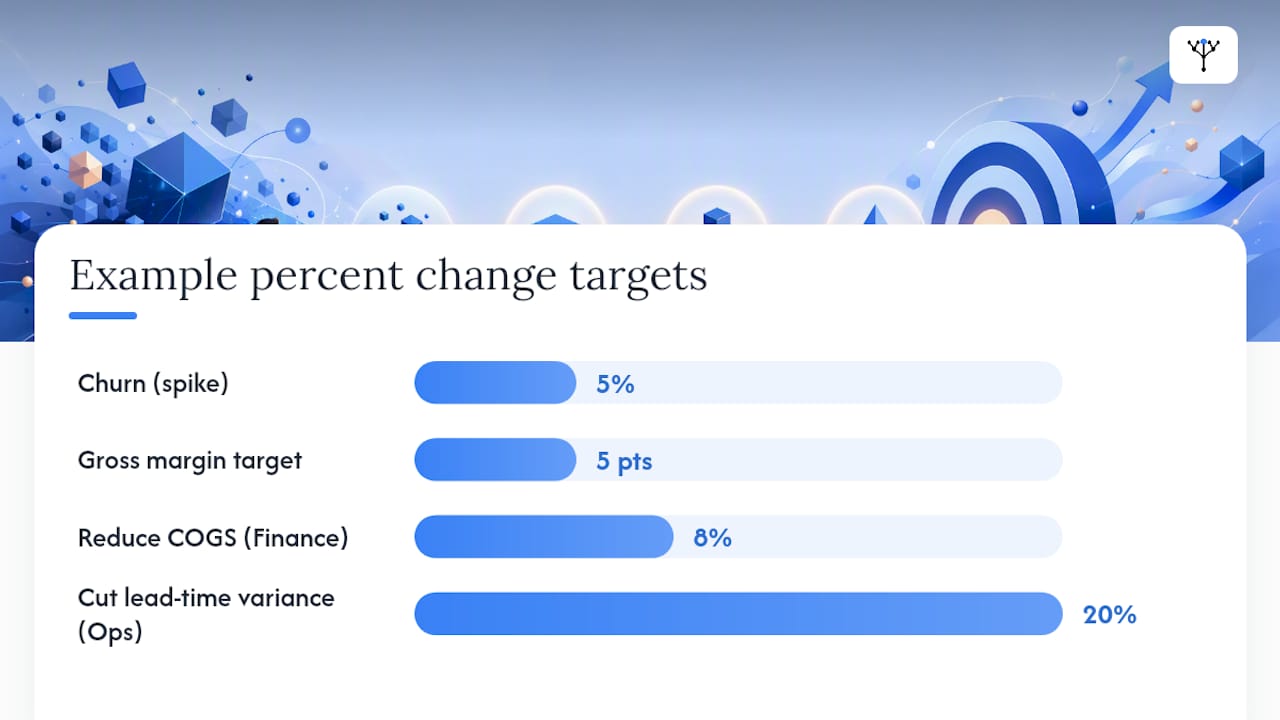
Three mapping patterns cover most real-world situations. First, a KPI becomes a KR when a steady metric slips below an acceptable threshold and needs deliberate, time-boxed improvement, such as churn spiking from 2% to 5%. Second, a KR feeds a KPI once an OKR sprint succeeds and the improved number simply becomes the new baseline you monitor going forward. Third, a KPI acts as a guardrail, sitting in the background of an OKR sprint to make sure you're not sacrificing one metric (support response time) to hit another (feature velocity).
Asana's guidance on this is blunt and correct: don't overuse OKRs to measure business as usual, because that adds overhead without adding value. Reserve OKRs for KPIs that are genuinely unhealthy or genuinely need to move.
Reporting cadence should reflect the different rhythms of the two frameworks:
- KPI dashboards get checked weekly, often automatically, with exceptions flagged rather than every metric narrated, following best practices for Power BI scorecards that enhance actionable KPI tracking.
- OKR progress gets a formal review quarterly, with lighter weekly check-ins on key result movement.
- Leadership sees a small number of headline OKRs and the KPIs currently acting as guardrails, not the full metric set.
- Team-level dashboards can go deeper, showing the underlying KPIs that feed each key result.
Worked alignment example: Company objective: "Improve gross margin by 5 points this year." Finance's KR: reduce cost of goods sold by 8% by Q3, feeding off the existing gross margin KPI. Operations' KR: cut supplier lead time variance by 20%, guardrailed against the on-time delivery KPI so speed gains don't come at the cost of reliability. Our margin strategy guide shows how this cascades further down into department-level metrics, a pattern worth understanding if you're building out a KPI cascade rather than a single flat metric list.
How to turn a KPI into a key result (and back again)
Converting a metric between frameworks is a five-minute exercise if you follow the same sequence every time.
- Baseline the metric. Confirm the current number, who owns it, and where the data comes from. Skipping this step is the single biggest reason KRs quietly revert to "business as usual" a few weeks into the quarter.
- Set the timeframe and target. Attach a stretch percentage and a hard deadline, typically the end of the current quarter. A KPI with no deadline stays a KPI; adding one is what turns it into a KR.
- Assign ownership and supporting initiatives. Name the person accountable and list the two or three actions that will actually move the number, not just the number itself.
- Score it, then decide its fate. At quarter close, score the KR (normalised, not pass or fail). If the underlying metric has genuinely stabilised at the new level, promote it back into your KPI set as the new baseline; if it hasn't, decide whether it earns another OKR sprint or reverts to monitored KPI status.
Pro Tip: Specify the baseline, stretch percentage, timeframe, owner, and data source in the same planning meeting. If any of those five details is missing when the session ends, the KR won't survive contact with the following week's priorities.
Use this quick checklist before promoting any KPI to KR status: is it currently below an acceptable threshold, does a single team clearly own it, and can you name the initiative that would move it within one quarter? Three yeses means it's ready.
Common pitfalls (and how to avoid them)
The most common failure mode isn't choosing the wrong framework, it's tracking too many things in both. Practitioner guidance consistently points to a tight ceiling: 3 to 5 objectives per team, 3 to 4 key results each, and 5 to 10 critical KPIs for the metrics that actually need weekly attention. Beyond that, dashboards become noise and nobody reviews anything properly.
Four traps show up repeatedly in planning cycles:
- Too many metrics. Twenty KPIs on one dashboard means none of them get acted on.
- Using OKRs for steady-state work. If nothing needs to change, it belongs on a KPI dashboard, not an objective.
- Unclear ownership. A KR with no single accountable owner drifts by week three.
- Inconsistent cadence. Reviewing OKRs monthly and KPIs quarterly (or vice versa) breaks the whole rhythm.
For governance, keep it simple: KPIs get a weekly owner-level glance and a monthly leadership summary; OKRs get a weekly team check-in and a formal quarterly score. Our digital transformation guide covers cadence design in more depth if you're rebuilding this rhythm from scratch. Before your next quarterly planning session, run through one checklist: fewer than five objectives per team, KPIs reviewed on schedule, every KR assigned a named owner, and no metric appearing on both an OKR and a KPI list without a clear reason why.
How an integrated view makes OKR and KPI alignment faster
Most of the friction in running OKRs and KPIs side by side isn't conceptual, it's operational. Teams lose time reconciling spreadsheets, chasing data owners, and holding status meetings that exist purely to answer "is this KPI still on track?" A live organisational model removes most of that overhead by keeping the data connected in one place rather than scattered across departmental tools.
When KPI data and OKR progress sit in the same connected view, a few things change for the better:
- Real-time alerts flag a slipping KPI before it needs a full OKR sprint to fix, catching problems while they're still cheap to solve.
- Managing directors and operations leaders get a single view of which metrics are guardrails and which are active sprints, cutting the number of status meetings needed to answer that question.
- Cross-functional dependencies, like an operations KR that depends on a finance KPI, become visible automatically instead of surfacing three weeks late in a review.
[brand_signal] [internal_data]
The practical upshot for anyone juggling both frameworks: less time spent reconciling numbers, more time spent deciding what to do about them.
The gap between the theory and the planning room
Most OKR content treats the framework as self-evidently superior to KPIs, which misses the point entirely. The research is consistent: OKRs and KPIs solve different problems, and organisations that pit them against each other usually end up with either a KPI dashboard nobody acts on or a pile of OKRs measuring things that never needed to change in the first place.
The conventional advice, "set ambitious OKRs and track them religiously," undersells the harder skill: knowing which of your existing KPIs actually deserve that ambition this quarter, and which are fine left alone. That judgement call, not the scoring mechanics, is where most planning cycles go wrong.
If you take one thing from this, prioritise the audit over the framework. Before writing a single objective, walk through your current KPI set and ask honestly which ones are underperforming enough to justify a focused sprint. Leave everything else as a steady KPI. The teams that get this right spend less time in review meetings and more time acting on the two or three metrics that genuinely need it.
— Ronan
Bring your KPIs and OKRs into one connected view
A live map of how your metrics connect across HR, finance, and operations allows a slipping KPI to show up as a flagged risk before it becomes a fire drill. Instead of reconciling three separate tools to work out whether a metric needs an OKR sprint or just a nudge, you see the dependency in one place.
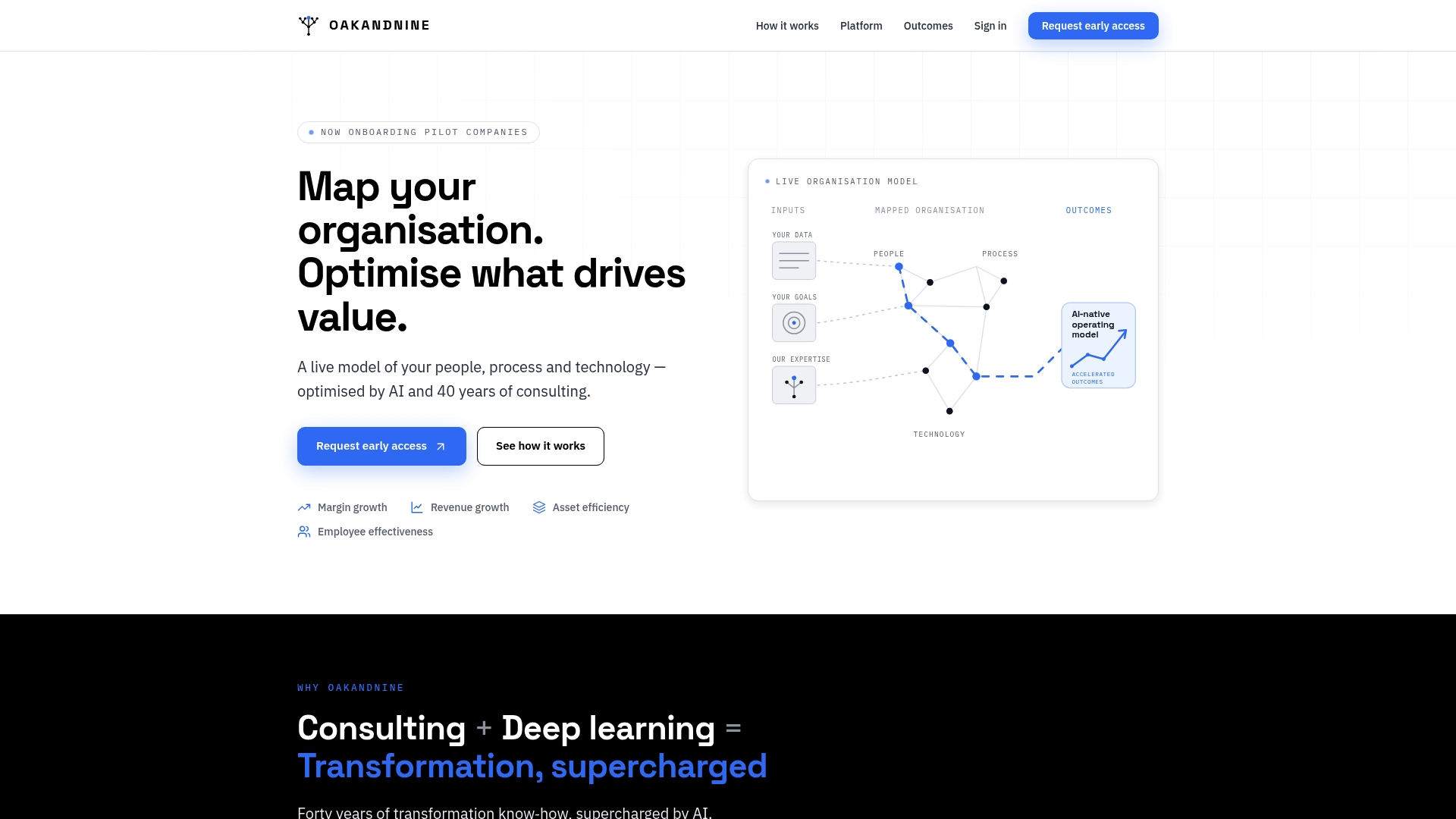
That matters most for the exact problem this article has been walking through: knowing when a KPI needs escalating into a key result, and when it's healthy enough to leave alone. Oakandnine's platform for managing directors is built around exactly that judgement call, surfacing real-time alerts so the decision gets made with current data rather than a stale monthly export. If you're planning your next quarter's objectives, it's worth seeing your existing KPIs mapped against the initiatives that touch them before you write a single objective to gain a clearer view of what actually needs to change.
Sources
For deeper detail on scoring, cadence, and conversion mechanics beyond this playbook, these practitioner resources are worth a closer read:
- OKR vs KPI: Are they different? | G2
- OKR vs KPI: Differences, Examples, and Use Cases Guide | Asana
- Use OKRs to set goals for teams, not individuals | HBR
FAQ
What are the five elements of an OKR?
The core elements are the objective itself, two to four key results, an owner, a defined timeframe (usually a quarter), and a scoring method to assess progress at the end of that period.
What are the top three KPIs most teams should track?
This varies by function, but the most common starting set covers a growth metric (such as revenue or conversion rate), a health metric (such as churn or retention), and an operational metric (such as on-time delivery or uptime). Leapsome's guidance suggests keeping the full KPI set to around 5 to 10 critical metrics rather than spreading attention across dozens.
Are OKRs still relevant?
Yes. OKRs remain widely used specifically because they solve a problem KPIs don't: driving deliberate, time-bound change, and Harvard Business Review's own guidance confirms they work best when applied at team level rather than as individual scorecards.
Do OKRs replace KPIs?
No. OKRs and KPIs serve different purposes and work best used together, with KPIs monitoring steady-state health while OKRs drive specific change within a defined period.