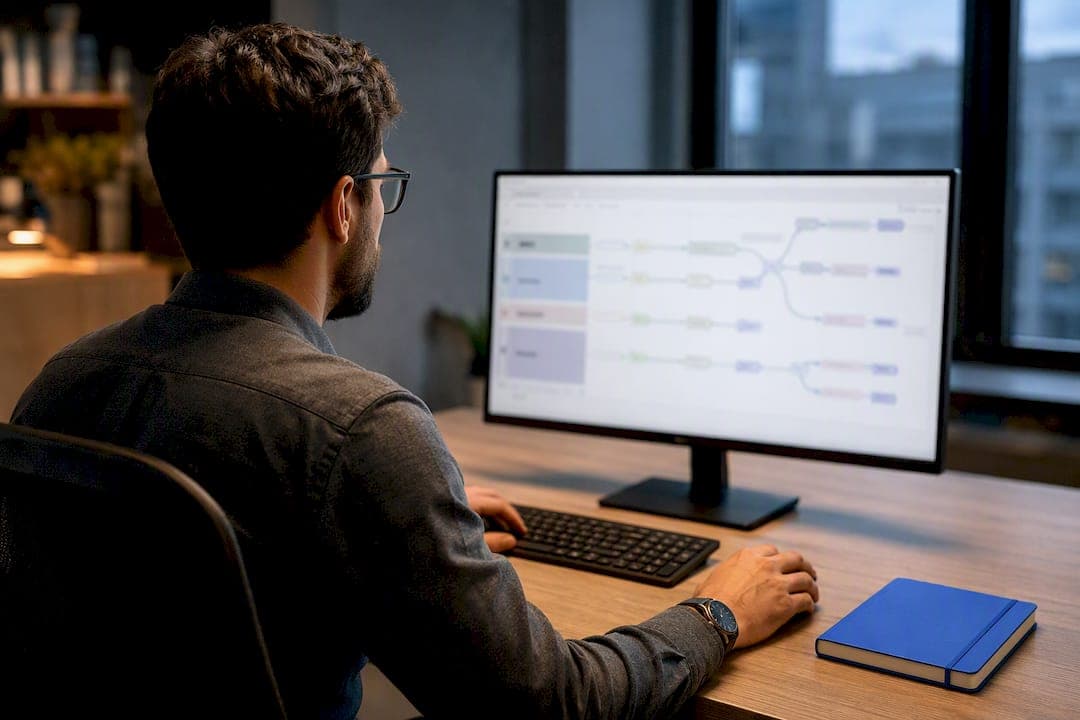
Process intelligence turns raw operational data, from event logs to user clicks, into a living model of how work actually flows through an organisation. It exposes bottlenecks that static dashboards never show, and it ranks which of those bottlenecks are worth automating first. Techniques like process mining and task mining feed it; platforms with integrated insight and action capabilities act on it.
TL;DR:
- Process intelligence integrates process mining, task mining, and AI modeling to provide a real-time, continuously updated view of work flows and bottlenecks.
- It requires accurate data with case IDs, activity names, and timestamps from source systems for effective process reconstruction and variant analysis.
- Continuous monitoring enables detection of process drift and bottlenecks, helping organizations reduce cycle times, rework, and manual workarounds.
- A pilot should focus on a simple, measurable process with clean logs, clear ownership, and defined KPIs to demonstrate value within one quarter.
- Automating responses to bottlenecks and integrating insights across functions turns process data into actionable improvements rather than static reports.
Table of Contents
- What is process intelligence, and what does it actually comprise?
- How process intelligence works in practice
- Benefits and use cases across the business
- Process intelligence vs process mining vs task mining: which do you need?
- A practical roadmap for adopting process intelligence
- Oak & Nine's approach: turning process insight into automated action
- What leaders should prioritise before they commit budget
- How Oak & Nine helps you act on what you find
- Sources
- FAQ
What is process intelligence, and what does it actually comprise?
Process intelligence is not a single technology. It is a layered approach that stitches together three distinct disciplines, each answering a different question about how work gets done.
Process mining reconstructs process flows from event logs, the digital breadcrumbs left in ERP, CRM and ticketing systems. It answers "what actually happened, and in what sequence?" Task mining captures desktop and user-interaction data: the clicks, copy-pastes and workarounds that never make it into a system log. It answers "what did the person actually do to get this task finished?" Sitting above both, AI process modelling synthesises the two into a coherent picture and layers on prediction and simulation.
None of this works without three fields in the data: a case identifier (which invoice, which claim, which order), an activity name (what step happened), and a timestamp (when it happened). Miss any one of the three and the reconstruction falls apart. Process intelligence systematically collects operational data to analyse individual process steps, which is why data quality at the source matters more than the sophistication of the analytics layered on top.
This is where the "digital twin" idea earns its place. Rather than a one-off diagnostic report, modern process intelligence platforms combine process mining, task mining and AI modelling into a living model that updates as operations change. That matters because:
- Static process maps go stale within months as headcount, systems and policy shift.
- A living model flags drift the moment a new bottleneck forms, not at the next audit cycle.
- Continuous improvement needs a continuous baseline, not a snapshot from last year's transformation project.
How process intelligence works in practice
The mechanics start with extraction. Data engineers pull event logs from source systems, typically the ERP, the CRM, the ticketing platform, and structure them so every record carries a case ID, an activity, and a timestamp. From that raw feed, the platform reconstructs individual process "variants", the different paths a case can take from start to finish. A procurement process with many variants is not unusual; most organisations are shocked to see how few of those variants match the process map hanging on the wall.
Task mining fills the gaps event logs cannot see. Combining log-based discovery with task-level observation captures the hidden manual workarounds that pure event logs miss, things like a finance clerk re-keying data between two systems because an integration never quite worked. That combination gives you both the macro view and the micro view of the same process.
Once the data is reconstructed, four analytical layers typically run:
- Conformance checking compares the real process against the intended one and flags deviations.
- Root-cause analysis links slow or error-prone cases back to specific handoffs, teams or system delays.
- Predictive alerting flags cases likely to breach a service level before they actually do.
- Simulation and what-if testing models the effect of a proposed change before anyone touches live operations.
The outputs are concrete, not abstract. Expect flow maps, variant trees, and distributions for cycle time and wait time, alongside automation-readiness scores that rank which steps are the best automation candidates. Practical outputs include variant counts, cycle and wait-time distributions, and simulation results used to decide what gets fixed first.
Pro Tip: Ask any vendor demo to show you a variant tree for your own process, not a sample dataset. If the tool cannot reconstruct your actual variants from a week of real logs, it is not going to help you prioritise anything.
Benefits and use cases across the business
The headline benefit is straightforward: less time and money wasted on work that should not have taken as long as it did. Organisations running process intelligence programmes typically see fewer handoffs, lower rework rates, and shorter cycle times, because the model shows exactly where cases stall rather than leaving teams to guess.
By function, the use cases differ but the pattern repeats:
- Finance uses it to compress payment cycles and expose where invoices sit unapproved for days without cause.
- Customer service applies it to case-handling time, catching the specific queue or escalation step that drags average resolution out.
- HR tracks onboarding throughput, revealing where a new starter's paperwork stalls between departments.
- Manufacturing monitors throughput and yield against the planned line sequence, catching drift before it becomes a missed shipment.
Process intelligence is particularly valuable for nonlinear processes with many dependencies, where a simple flowchart cannot capture the real branching paths a case takes.
Beyond speed, there is a compliance dividend. Every case reconstructed from real system data creates an audit trail that shows what actually happened, not what the policy manual says should have happened. That gives auditors and regulators something they rarely get: a verifiable record rather than a self-reported one. It also surfaces which manual steps are ripe for automation, because the model already knows which activities are repetitive, rule-based and high-volume, exactly the profile suited to AI search and automation. Our guide on finding the bottleneck in a process walks through how to read those signals before committing budget.
Process intelligence vs process mining vs task mining: which do you need?
The confusion here is understandable, largely because the market itself has been in flux. In May 2026, Gartner renamed the process mining market to "Process Intelligence Platforms", broadening the category to include modelling, monitoring and action features, while process mining remained the underlying technique inside it. The rename changed the conversation buyers have, not the underlying engineering.
In practice, the decision comes down to what you need the output to do:
- Choose process mining alone when you need audit-grade conformance checking against a defined standard, a compliance review, for instance, where the priority is proving what happened.
- Choose task mining alone when the mystery is at the desk level: why a task takes three times longer for one team than another using the same system.
- Choose process intelligence as the umbrella when you need continuous monitoring, simulation, or a model that keeps working after the initial discovery project ends.
A useful rule: if the project ends when the report is delivered, you probably only needed process mining. If the project needs to keep watching after that, you need process intelligence. Our comparison of process mining versus task mining goes deeper into the trade-offs for operations leaders weighing this decision.
A practical roadmap for adopting process intelligence
Running a pilot well matters more than picking the "best" platform. A five-step approach, scoping, data collection, pilot, governance and scale, gives you a low-risk way to prove value before committing enterprise budget.
- Pick a pilot process with clean, available logs and a measurable KPI, order-to-cash or a single approval workflow works better than something spanning six departments.
- Run the data checklist first: confirm you have case ID, activity and timestamp fields, decide what needs masking for privacy, and map which systems must be integrated.
- Assign an owner and a governance model before the pilot starts, not after; someone needs authority to act on what the model finds.
- Set the success metric up front, a percentage cut in cycle time or a reduction in variant count, and measure against it, not against a vague sense of improvement.
- Scale based on value, not enthusiasm: expand to the next process only once the pilot's KPI has moved and the governance model has held up under real use.
Pro Tip: Before any vendor conversation, list exactly which source systems the platform must ingest natively and how it handles sensitive fields. That single requirement filters out half the market faster than any feature comparison.
Governance deserves its own attention beyond the pilot. Our process governance roadmap covers ownership models and controls in more depth, and pairs well with the broader tactics in improving operational efficiency once your first pilot has proven itself.
Oak & Nine's approach: turning process insight into automated action
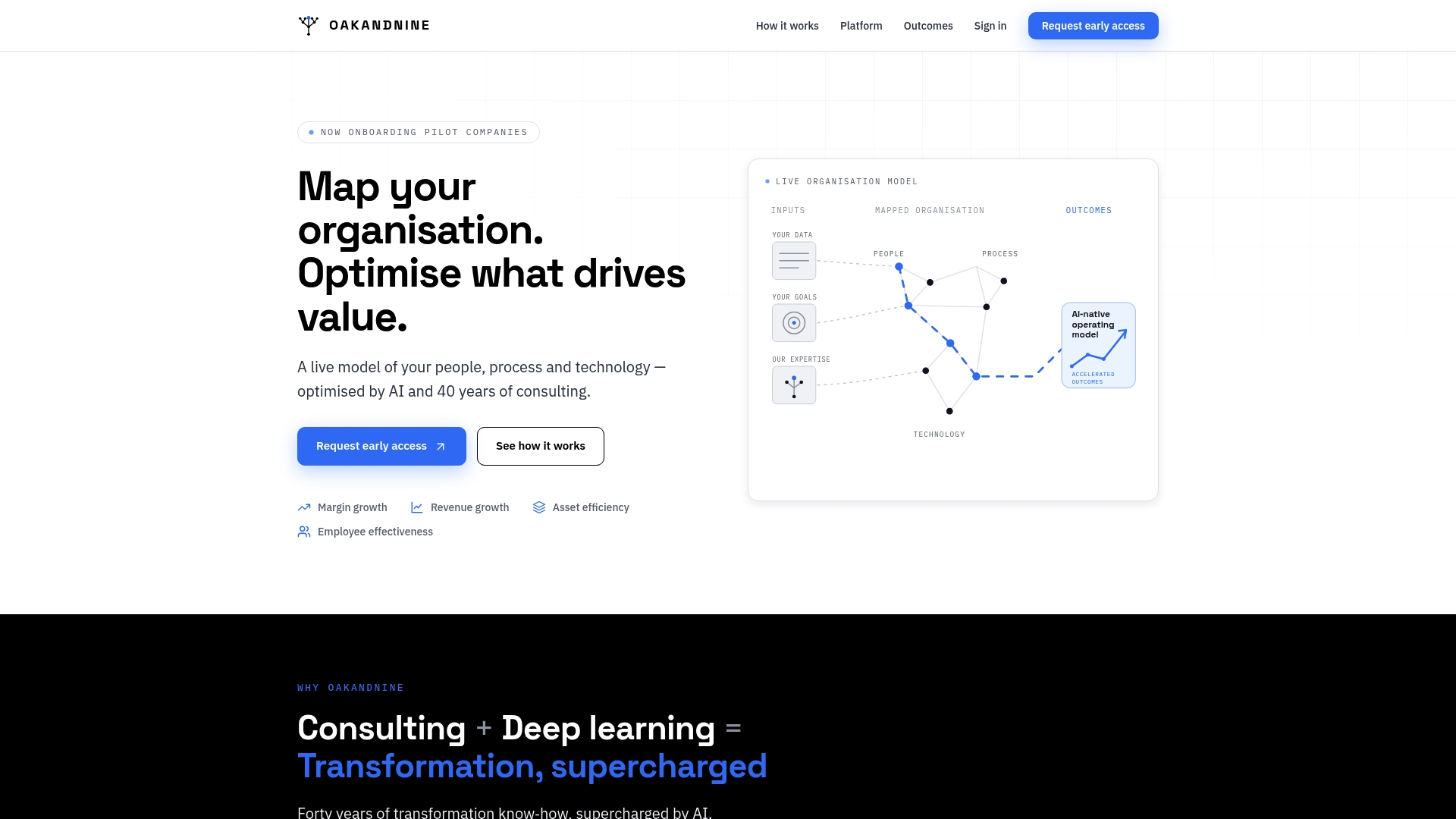
We built Oak & Nine on a premise the market rename only confirmed: insight without action is a report nobody reads twice. Our platform maintains a living organisational model across HR, Finance and Operations rather than a siloed process map, so a bottleneck found in one function is visible to the leaders who own the adjacent one.
That model does three things most standalone process mining tools do not:
- It unifies structured and unstructured data across departments into one connected view.
- It converts detected bottlenecks directly into automated workflows rather than leaving them as a static finding.
- It issues preemptive alerts, so a managing director sees strain building before it becomes a missed deadline or a customer complaint.
The outcomes we target for mid-market clients are specific: better resource allocation, fewer operational leaks, and decisions made from what is actually happening rather than what the last quarterly review assumed.
What leaders should prioritise before they commit budget
Process intelligence pays off fastest where it touches revenue or margin directly, payment cycles, customer handling time, production yield, not where it merely looks impressive on a dashboard. Weak governance and dirty source data kill more pilots than any platform limitation does, and over-automating a process before understanding why it varies just locks in yesterday's inefficiency. Before a board signs off, ask three things: what is the pilot's single measurable KPI, who owns action on the findings, and what happens to the model after month three.
— Ronan
How Oak & Nine helps you act on what you find
Some platforms are built to address the space between spotting a bottleneck and actually fixing it. Unlike standalone mining tools that hand over a report, these connect HR, Finance and Operations into one live model, so the fix is automated and the next leak gets flagged before it costs significant margin.
If you are a managing director trying to justify the investment, our page for managing directors sets out how the platform supports resource allocation decisions specifically. Operations leaders weighing a pilot should look at connecting the functions to see how the integration actually works across departments. The clearest next step is simple: book a data readiness conversation and see what your own event logs already reveal about where you are leaking time and margin.
Sources
- What is process intelligence (business process intelligence)? | Definition from TechTarget
- What Is Process Intelligence? | Salesforce
- Bardeen
- 5 steps to process intelligence for operational excellence | Process Excellence Network
FAQ
What is process intelligence?
Process intelligence is the practice of turning operational data, event logs, task-level activity and system records, into a continuously updated model of how work actually flows, so bottlenecks, delays and automation opportunities become visible in real time.
Is process intelligence the same as process mining?
No. Process mining is a log-based technique for reconstructing process flows; process intelligence is the broader platform category that combines process mining, task mining and AI modelling into one monitored, predictive model.
What data does process intelligence need to work?
At minimum it needs a case identifier, an activity name and a timestamp for every process step, plus supporting data from source systems like ERP or CRM platforms.
How long does a process intelligence pilot take to show value?
A well-scoped pilot on a single process with clean logs can show measurable KPI movement, such as reduced cycle time or fewer process variants, within one quarter.
Can process intelligence replace manual process audits?
It significantly reduces the manual effort involved, since it reconstructs what actually happened from system data rather than relying on interviews, though audit-grade conformance checks still benefit from human review of edge cases.