
System integration testing in software testing is the disciplined verification of data exchange and interface behavior between integrated systems to confirm end-to-end functionality. Defined as the fourth of five ISTQB v4.0 test levels, SIT sits after system testing and focuses on real-world operational environments where cross-system defects actually surface. Unit tests confirm individual components work. SIT confirms those components work together. For QA professionals managing complex architectures, this distinction is the difference between a confident release and a costly production rollback.
What is system integration testing and how does it differ from other test types?
System integration testing verifies that separate systems exchange data correctly at their boundaries. It does not test whether a single module functions in isolation. It tests whether two or more systems behave correctly when connected.
The confusion between SIT and related test types is common and expensive. Here is how each level differs:
| Test Level | Scope | Focus | Timing |
|---|---|---|---|
| Unit testing | Single function or class | Logic correctness | During development |
| Component integration testing | Interfaces within one system | Intra-system communication | After unit testing |
| System testing | Entire system end-to-end | Full system behavior | Before SIT |
| System integration testing | Cross-system interfaces | Inter-system data exchange | After system testing |
| User Acceptance Testing (UAT) | Business workflows | Business requirement validation | After SIT |
SIT focuses on inter-system interface validation in operational-like settings. UAT, by contrast, asks whether the system meets business needs. SIT asks whether the systems talk to each other correctly. Both questions matter, but they require different skills, environments, and evidence.
Component integration testing catches defects within a single application's internal modules. SIT catches defects at the seams between applications, such as a payment gateway receiving malformed data from an order management system. That seam is where the most damaging production defects hide.
How to execute system integration testing effectively
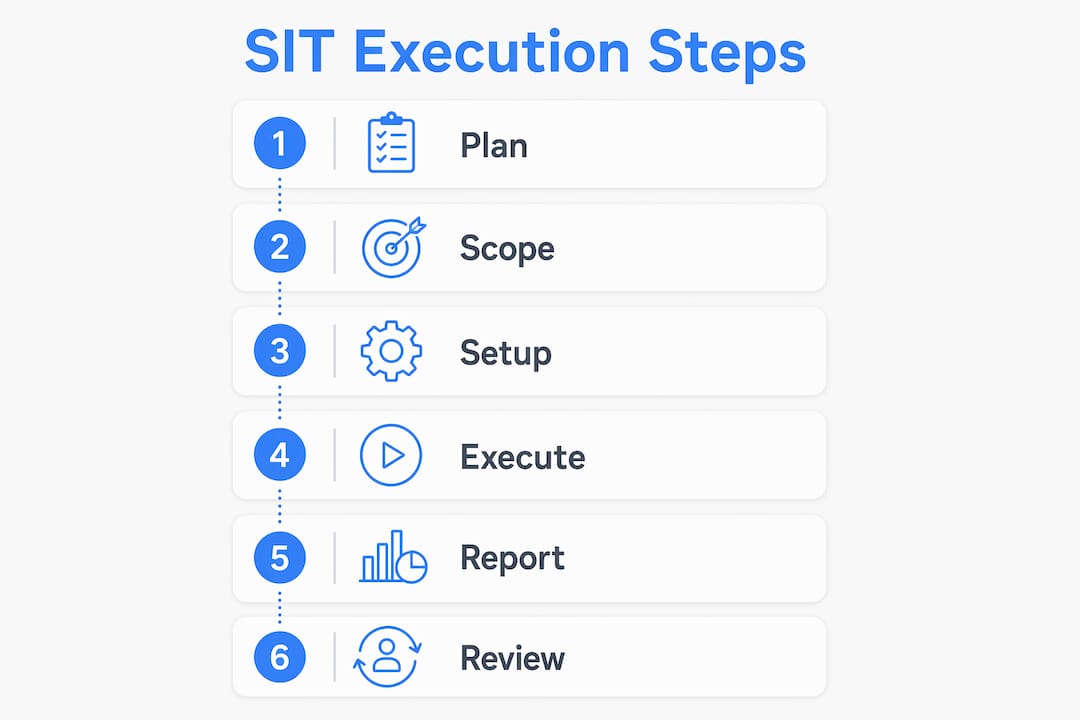
Effective SIT follows a seven-step process: test planning, environment setup, interface identification, test case design on real workflows, execution, defect logging, and revalidation. Each step builds on the last. Skipping environment setup to save time is the single most common reason SIT results cannot be trusted.
- Test planning. Define scope, risk ratings, entry and exit criteria, and ownership. Identify which seams carry the highest business risk.
- Environment setup. Build a production-like environment. Real databases, real message queues, real network latency where possible.
- Interface identification. Map every seam between systems. Document inputs, outputs, validation rules, and failure modes as explicit contracts.
- Test case design. Base tests on end-to-end business workflows, not just technical API calls. A payment flow is more valuable than a GET request test.
- Test execution. Run tests in priority order. Start with the highest-risk seams.
- Defect logging. Log every failure with full context: request payload, response, environment state, and timestamp.
- Revalidation. After fixes, retest the affected seam and any downstream interfaces it touches.
Pro Tip: Balance mocks and real infrastructure deliberately. Use service virtualization for volatile third-party dependencies you cannot control. Use real containers for critical internal systems. Over-mocking critical internal paths creates false confidence that survives all the way to production.
Risk-based scoping separates good SIT from great SIT. Not every interface carries equal risk. Prioritize seams where failure causes data loss, financial errors, or regulatory exposure. Assign each seam an impact rating and test the highest-rated ones first. This approach keeps your test suite focused and your release decisions defensible.
Automate repeatable tests and run them inside your CI/CD pipeline. Automation does not replace exploratory or scenario-based SIT. It handles regression coverage so your team can focus on new integration points and edge cases.

What are the main integration testing strategies for complex systems?
The strategy you choose for integrating components determines how quickly you find defects and how confidently you can isolate them. Incremental integration strategies reduce risk compared to Big Bang integration, which tests everything at once and makes defect isolation nearly impossible.
The three primary incremental approaches each suit different architectures:
- Top-Down integration starts with the highest-level modules and stubs lower-level dependencies. This proves the control flow early but requires stubs for unbuilt components.
- Bottom-Up integration starts with foundational services and builds upward. Core data services are proven stable before higher-level workflows depend on them.
- Sandwich (hybrid) integration combines both directions simultaneously. It suits large teams working on independent layers in parallel.
Big Bang integration is appropriate only for small, low-complexity systems where the cost of incremental setup outweighs the risk. For enterprise systems with microservices, event-driven messaging, or distributed databases, Big Bang integration is a liability.
Contract testing adds a critical layer for API-driven architectures. A contract defines the exact inputs, outputs, and error responses that two systems agree to exchange. Managing seams as explicit contracts with defined validation rules prevents late-cycle defects that appear only when two teams' assumptions finally collide.
| Strategy | Best for | Key risk |
|---|---|---|
| Top-Down | Validating control flow early | Requires stubs for lower layers |
| Bottom-Up | Proving core services first | Late validation of full workflows |
| Sandwich | Large parallel teams | Coordination overhead |
| Big Bang | Small, simple systems only | Defect isolation is very difficult |
| Contract testing | Microservices and API integrations | Contracts must stay current |
Pro Tip: For microservices and event-driven systems, treat every message schema as a contract. Version your contracts and run contract tests on every build. Schema drift between producer and consumer is one of the most common sources of silent integration failures.
Concurrency, idempotency, and retry logic deserve explicit test cases. A payment service that processes the same transaction twice due to a retry is a real-world failure that only SIT in a realistic environment will catch.
How to manage test data and environment realism
Test data is part of the system under test. Treating it as an afterthought produces flaky, unreliable SIT results. Test pollution from shared states degrades SIT effectiveness and causes tests to pass or fail based on execution order rather than system behavior.
The most reliable patterns for test data management are:
- Transaction rollbacks after each test to restore the database to a known state.
- Containerized isolated environments using tools like Testcontainers to spin up fresh dependencies per test run.
- Governed test data sets with versioned, documented records that match production data shapes without containing real personal data.
- Time and concurrency controls to make tests deterministic. Tests that depend on the current timestamp or thread scheduling are inherently fragile.
Failing to isolate test data is the biggest mistake in modern integration testing. Shared test data across parallel test runs is the most common cause of flaky SIT suites that teams eventually stop trusting.
Service virtualization has a place in SIT, but it must be used carefully. Use virtual services for third-party APIs with rate limits, unstable sandbox environments, or dependencies outside your team's control. Use real infrastructure for the systems your organization owns and operates. The goal is an environment that behaves like production, not one that merely resembles it.
Pro Tip: Link every SIT test case to a specific interface contract and a business workflow. This traceability turns your test results into decision-grade evidence that supports go/no-go release gates rather than just a pass/fail count.
What challenges do QA teams face in system integration testing?
Integration failures remain a leading cause of production issues, and most of them are predictable. The challenges that cause the most damage are not technical mysteries. They are process failures that experienced teams can prevent.
The most common SIT challenges are:
- Unrealistic test environments that do not mirror production network topology, data volumes, or service configurations.
- Flaky tests caused by shared state, timing dependencies, or inconsistent test data.
- Excessive mocking of internal systems that creates a false picture of integration health.
- Unclear ownership of seams and contracts, so defects survive handoffs between teams.
- Late contract discovery, where interface assumptions are only formalized after failures appear in testing.
Clear ownership and escalation paths for seams are necessary to prevent integration defects from surviving into production. Every seam needs a named owner, a documented contract, and a clear escalation path when that contract is violated.
"The most expensive integration defects are not the ones that are hard to fix. They are the ones that nobody owns. When a seam has no owner, every team assumes another team is responsible, and the defect ships."
Release gates tied to SIT results give your team the authority to stop a release when integration evidence is insufficient. Define explicit go/no-go criteria based on risk severity and traceable test evidence, not just test pass rates.
Key Takeaways
System integration testing is the critical verification layer that confirms cross-system data exchange works correctly before a release reaches production, and it requires realistic environments, explicit contracts, and clear ownership to produce trustworthy results.
| Point | Details |
|---|---|
| SIT is the fourth ISTQB test level | It verifies inter-system interfaces after system testing and before UAT. |
| Use incremental integration strategies | Top-Down, Bottom-Up, or Sandwich reduces defect isolation risk versus Big Bang. |
| Treat seams as explicit contracts | Document inputs, outputs, and failure modes to prevent late-cycle defects. |
| Isolate test data rigorously | Use transaction rollbacks or containerized environments to prevent test pollution. |
| Tie SIT results to release gates | Define go/no-go criteria based on risk severity and traceable evidence. |
Why SIT is the test level that actually earns its cost
I have worked with teams that invest heavily in unit tests and UAT but treat SIT as a formality. That pattern produces a predictable outcome: a system that passes every test in isolation and fails the moment two services exchange a real message in production.
The complexity of modern architectures makes this worse. API-driven microservices, event-driven messaging, and distributed data stores multiply the number of seams in a system. Each seam is a potential failure point. SIT is the only test level that addresses those seams directly, in conditions that resemble the environment where they will actually run.
The mistake I see most often is over-mocking. Teams mock internal services to speed up their test suite and end up with a suite that proves nothing about real system behavior. The speed gain is real. The confidence is false. Real containers for critical internal systems are non-negotiable if you want SIT results you can act on.
Contract ownership is the governance piece that most teams skip. Assign a named owner to every seam. Make that owner responsible for the contract, the tests, and the escalation path when something breaks. This single practice eliminates the most common cause of integration defects surviving into production.
The future of SIT is tighter integration with CI/CD pipelines, automated contract validation on every build, and risk-based scoping that focuses human effort on the seams that matter most. Teams that build this now will release faster and with more confidence than teams still running SIT as a manual phase at the end of a sprint.
— Ronan
How Oakandnine supports integration governance at scale
System integration testing does not fail because testers lack skill. It fails because the underlying operating model lacks visibility into who owns what, where the seams are, and which interfaces carry the most risk. That is an organizational problem as much as a technical one.
Oakandnine maps the people, processes, and technology that make up your operating model, giving QA leaders and engineering teams a clear view of system dependencies, ownership, and friction points. When you can see every integration point and its business impact in one place, risk-based SIT scoping becomes a structured decision rather than a judgment call. If you are building a testing practice that needs to scale, explore Oakandnine to see how organizational visibility supports better integration governance and release confidence.
FAQ
What is system integration testing in software testing?
System integration testing is the fourth ISTQB v4.0 test level. It verifies that separate systems exchange data correctly at their interfaces in a production-like environment.
How does SIT differ from system testing?
System testing validates the behavior of a complete system in isolation. SIT validates whether that system communicates correctly with external systems or subsystems.
What are the main integration testing strategies?
The main strategies are Top-Down, Bottom-Up, Sandwich (hybrid), and contract testing. Big Bang integration is generally too risky for complex systems because defect isolation becomes very difficult.
Why do SIT environments need to mirror production?
Unrealistic environments produce unreliable results. Tests that pass in a simplified environment can fail in production due to differences in network configuration, data volumes, or service behavior.
How should teams handle test data in SIT?
Teams should use transaction rollbacks or containerized isolated environments to prevent test pollution. Shared test data across parallel runs is the most common cause of flaky, untrustworthy SIT results.