
Breaking down silos starts with one decision: clarify a small set of enterprise-level outcomes and make collaboration structural, not aspirational. Most leaders try to fix silos with more meetings and a new Slack channel. That treats a systems problem as a communication problem, and it rarely survives the next reorganisation.
Two things make the structural approach work. Shared metrics create a common decision lens, so finance, operations and HR are no longer arguing from three different scoreboards. Governance converts goodwill into measurable behaviour, because a cadence with named owners outlasts any single manager's enthusiasm for cooperating.
The rest of this guide walks through a repeatable framework: Assess, Align, Act, Anchor. If you read nothing else, start with the Assess step this week: map where handoffs between two departments are actually failing, and pick one outcome you can measure within a quarter.
Key Takeaways
Breaking down silos succeeds when leaders clarify a small set of enterprise-level outcomes, embed them into shared metrics and governance, and sequence quick wins alongside structural incentive change.
| Point | Details |
|---|---|
| Diagnose before fixing | Identify whether you face an organisational, information or cultural silo before choosing an intervention. |
| Align on outcomes first | Agree enterprise-level goals and shared metrics before reorganising teams or launching a taskforce. |
| Design teams with real authority | Give cross-functional teams genuine decision rights and protected capacity, not borrowed time. |
| Redesign incentives, not just goals | Attach a meaningful share of leadership reward to the shared outcome and retire competing local metrics. |
| Use a connected platform to accelerate mapping | Oak & Nine's live organisational model shortens the Assess and Anchor steps by making dependencies and dashboards visible in real time. |
Table of Contents
- What breaking down silos actually means (and the three types you will meet)
- Why silos persist: the root causes leaders must address
- A practical Assess, Align, Act, Anchor framework leaders can apply
- How to build cross-functional teams that don't quietly dissolve
- Leadership development and incentive redesign: making collaboration rational
- Practical tools and rituals for reducing daily friction
- Measuring progress: the metrics that show silos are actually falling
- How Oak & Nine supports the framework in practice
- Which silos to tackle first: impact and feasibility
- Common resistance you will meet and how to answer it
- The role of technology in breaking down silos
- Culture change: what actually supports lasting integration
- What most silo advice gets backwards
- Where Oak & Nine fits once you've picked your first priority silo
- Sources
What breaking down silos actually means (and the three types you will meet)
Breaking down silos means removing the structural, informational and cultural barriers that stop departments acting on a shared set of priorities. It is not the same as flattening the org chart or forcing every team into open-plan seating. Silos are a function of incentives and information flow, not desk layout.
Three distinct types show up in most mid-market organisations, and each needs a different fix.
- Organisational silos: separate reporting lines, budgets and KPIs that reward local performance over shared outcomes. A sales team hitting quota while fulfilment misses delivery windows is a classic symptom.
- Information silos: data trapped in departmental systems that nobody outside that function can see, let alone query. Finance's view of margin and operations' view of cost-to-serve often disagree because they are built on different datasets.
- Cultural silos: an "us versus them" mentality between functions, often inherited from years of competing for headcount or budget, that survives even after the org chart is fixed.
Harvard Business Review's analysis of silo types that stifle collaboration confirms these three categories persist across sectors, and cites survey evidence that a majority of professionals name silos as a major obstacle to getting work done. That prevalence is exactly why a diagnostic pass matters before you launch any fix. Naming the type of silo you are dealing with tells you whether you need a new metric, a new dataset, or a new set of shared experiences.
Why silos persist: the root causes leaders must address
Silos survive because they are rational responses to how most organisations measure and reward people, not because staff are uncooperative. Three root causes explain most of what you will see.
- Incentive misalignment. When a department head's bonus depends solely on their own function's numbers, cross-functional cooperation becomes a cost with no visible return. Rational people optimise for what gets measured.
- The dual-identification problem. Leaders must hold loyalty to their own team and to the wider system at the same time. The Center for Creative Leadership's research on multiteam systems describes this as a genuine capability gap, not a motivation problem. Most managers were never trained to balance both.
- Structural fragmentation. Separate budgets, disconnected reporting lines, inconsistent handoff processes and incompatible technology stacks all reinforce division long after any team-building exercise has worn off.
Fixing the symptom (poor communication) without touching the cause (how people are measured and rewarded) is why so many collaboration initiatives fade within two quarters.
A practical Assess, Align, Act, Anchor framework leaders can apply
Forrester's guidance on cross-functional alignment makes a point worth repeating: treat alignment as a structural capability you build deliberately, not a byproduct of reorganising the chart. The four-step sequence below turns that principle into something you can run this quarter.
1. Assess. Map where dependencies between departments actually break down. Sit with the teams handing work to each other and trace one recent failure, order to cash, hire to productivity, incident to resolution, end to end. You are looking for the specific handoff point where delay or rework happens, not a general sense that "communication could be better". Pick one measurable shared outcome to fix first. Resist the urge to fix everything at once; a diagnostic that produces five priorities produces zero completed projects.
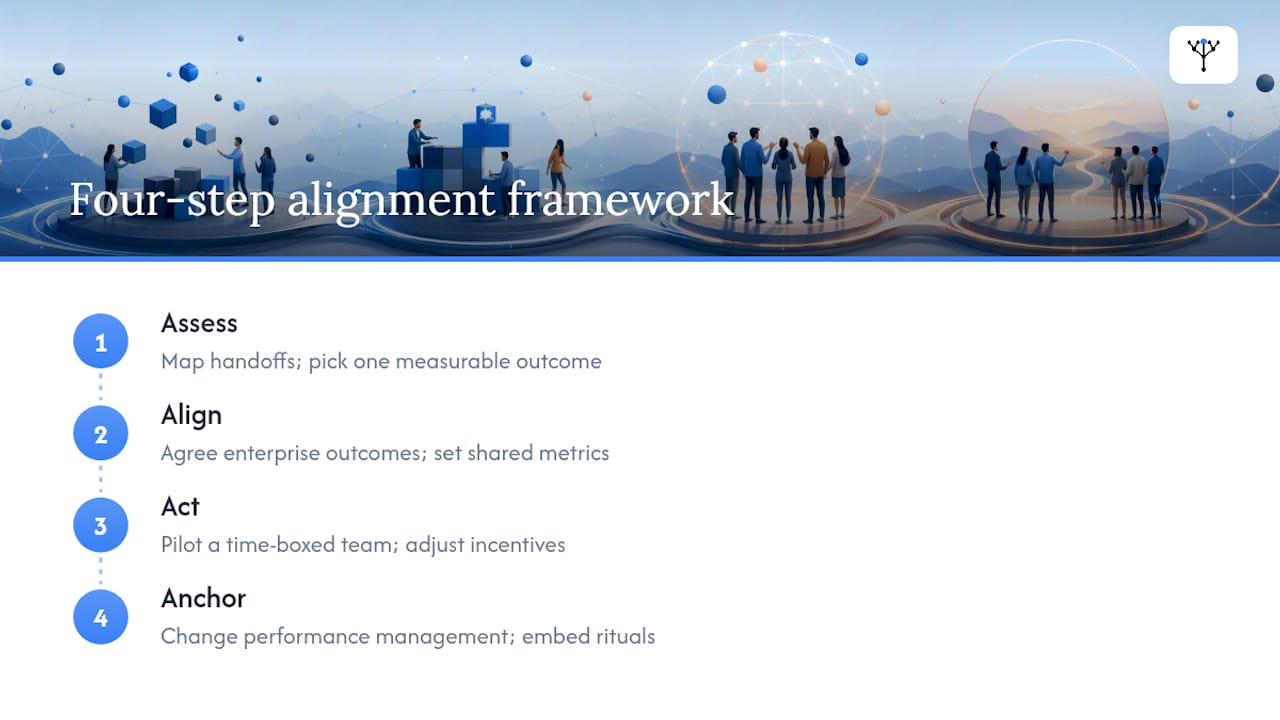
2. Align. Agree the enterprise-level outcomes that matter more than any single department's targets, and set shared metrics against them. This is the step most organisations skip, jumping straight to "let's set up a taskforce" without agreeing what success looks like. Define governance now: who reviews progress, how often, and who has authority to resolve disagreements between functions. The CDC-originated framework for fostering workplace collaboration identifies shared goals and bi-directional communication as the two practices that separate durable change from a one-off workshop.
3. Act. Pilot a cross-functional team against the outcome you chose in step one, and adjust incentives so success on the shared metric actually matters to each participant's own performance review. Keep the pilot small and time-boxed, six to twelve weeks is usually enough to prove or disprove the approach. A pilot that runs indefinitely without a review point becomes just another permanent meeting.
4. Anchor. Once the pilot shows results, change performance management to reflect the new shared metric permanently, embed the rituals that supported it (the weekly review, the shared dashboard, the decision log), and scale the model to the next priority silo identified in your original assessment.
Pro Tip: Run Assess and Align as separate working sessions, at least a week apart. Leaders who compress diagnosis and goal-setting into a single afternoon workshop tend to agree on vague ambitions rather than a genuinely measurable outcome.
Sequencing matters more than most leaders expect. Quick wins (a shared dashboard, a joint stand-up) build trust and buy you political capital, but they do not fix incentive misalignment on their own. Structural change (rewriting how leaders are measured) is slower and harder to sell, but it is the only thing that survives a leadership transition. Run both in parallel: quick wins in weeks one to six, structural changes agreed by week eight and rolled out over the following two quarters.
How to build cross-functional teams that don't quietly dissolve
Most cross-functional teams fail for a boring reason: nobody on the team actually has the authority to make a decision. FranklinCovey's research on cross-functional team design found that teams built with real decision rights and protected capacity cut the time spent waiting for approvals dramatically, compared with teams that exist mainly on an org chart slide.
Three design choices determine whether a cross-functional team delivers or drifts.
- Membership and capacity. Include people who can commit real time, not whoever their manager could spare. A team member attending "when they can" is not a team member.
- Decision rights. Give the team genuine authority over its shared outcome, with a clear escalation path for anything above that scope. If every decision needs sign-off from five department heads, the team is theatre.
- Role clarity. Assign an accountable lead, name which functions are consulted versus merely informed, and write it down. Atlassian's guidance on forming cross-functional teams treats this clarity as the difference between a team that ships and one that meets.
Cadence is what keeps the team alive after the initial enthusiasm fades. A weekly progress check against the shared metric, a visible scoreboard everyone can see without asking, a running decision log so nobody re-litigates last month's choices, and protected focus time so members aren't constantly pulled back into their home department's fires. Skip any one of these and the team reverts to its old reporting lines within a few months, usually quietly, without anyone announcing the retreat.
Leadership development and incentive redesign: making collaboration rational
Collaboration becomes durable when it is rational for the people doing it, not just encouraged. That means developing leaders who can hold two loyalties at once, and redesigning incentives so cooperation pays off in someone's actual performance review.
- Build boundary-spanning skills through shared experience. Scenario planning exercises that force two department heads to solve a joint problem, structured shadowing across functions, and cross-functional development assignments all build what CCL calls balanced identification, the ability to represent your own team's interests without losing sight of the wider system. Reading about collaboration does little; sitting in someone else's operational reality for a week does more.
- Pilot incentive redesign before rolling it out enterprise-wide. Attach a meaningful portion, not a token 5%, of leadership reward to one shared outcome you selected in the Align step. Measure whether behaviour actually shifts over one full performance cycle before extending the model further.
- Plan for scale from the outset. Set a governance cadence (monthly steering review is typical), define an escalation path for disputes between functions, and identify which early adopters will demonstrate the new behaviours to the rest of the organisation. Diffusion rarely happens by memo; it happens because people see a respected peer succeeding under the new model.
Pro Tip: When you redesign incentives, tell leaders exactly which of their existing metrics will be deprioritised. Adding a shared goal on top of an unchanged set of departmental targets just doubles what people are optimising for, and the old habits usually win.
Practical tools and rituals for reducing daily friction
Structural change matters, but most silo friction shows up in ordinary weekly habits: how meetings are run, where decisions get recorded, and who owns which document. Fixing these costs little and pays off fast.
- Redesign meeting agendas around outcomes, not status updates. A cross-functional stand-up should answer "what decision are we making today" rather than "what did everyone do this week".
- Keep the invite list tight. Invite the people with decision rights and the people directly affected; everyone else gets the notes.
- Build one shared dashboard that finance, operations and HR all read from, using a common taxonomy so "revenue" and "cost" mean the same thing in every department's report.
- Maintain a visible decision log. A simple shared document recording what was decided, by whom, and why prevents the same argument resurfacing three months later.
- Assign document ownership explicitly. Ambiguous ownership is how playbooks quietly go stale, because everyone assumes someone else is updating them.
- Use a lightweight decision register (a RACI variant) rather than a heavyweight governance tool. The goal is clarity on who decides, not a new bureaucracy nobody reads.
None of this requires new software licences. It requires someone senior enough to insist the habits stick past the first difficult week.
Measuring progress: the metrics that show silos are actually falling
Pick a handful of metrics you can review every two to four weeks, not a dashboard with forty tiles nobody opens. Four categories cover most of what matters: outcome KPIs tied to the shared goal you set in the Align step, handoff latency between the two functions you mapped in Assess, rework rate (how often work bounces back for correction), and a customer-facing indicator, because internal efficiency that customers never feel is not the point.
Set targets that are specific enough to fail against, review them on a short cadence, and put them on a scoreboard the whole cross-functional team can see without requesting access.
The harder discipline is deciding what to stop measuring. Surveys cited by HBR's research on cross-functional collaboration show that most professionals still regard departmental silos as a major obstacle, often because purely functional metrics were never retired once shared ones were introduced. If a department head is still rewarded entirely on a local number, the shared metric becomes background noise. Deprioritise, not delete, at least one function-level measure for every shared metric you introduce.
How Oak & Nine supports the framework in practice
An integrated platform does not replace the leadership work above, but it removes a lot of the manual friction that slows every step down. Oak & Nine builds a live map of how your functions actually connect, which shortens the Assess step from weeks of interviews to a working view of dependencies you can interrogate directly, as described on the connect the functions page.
That same live model supports the rest of the sequence:
- Assess: real-time organisational mapping surfaces bottlenecks and handoff points without a manual audit.
- Align: a shared view of processes gives leaders a common reference point when agreeing enterprise outcomes.
- Act: automation reduces manual handoffs between systems, so cross-functional pilots aren't slowed by re-keying data between departmental tools.
- Anchor: dashboards and preemptive alerts keep the shared metrics visible long after the pilot's initial energy fades, which is usually when old habits creep back in.
A sensible pilot scope is one department pairing, one shared outcome, and one quarter. Judge success by whether handoff latency and rework rate move, not by how many people attended the kickoff.
Which silos to tackle first: impact and feasibility
Not every silo deserves the same urgency. Score each candidate against two questions: how much value is trapped by this friction, and how feasible is it to fix within a quarter with the authority you currently have.
The highest-value target is usually the handoff causing the most customer-visible pain, a sales-to-fulfilment gap that delays delivery, or a finance-to-operations disconnect that distorts pricing decisions. If that same friction point also involves departments already reporting to one shared executive, feasibility is high, because you don't need cross-functional buy-in above your own authority to fix it.
Avoid the trap of picking the most visible silo purely because it is politically satisfying to be seen addressing it. A silo between two departments with wildly different budget cycles or reporting lines several layers up will take longer to fix, regardless of how loudly people complain about it. Start with the intersection of high impact and genuine feasibility, prove the model works, then use that credibility to tackle harder structural fights later.
A simple two-by-two, impact against feasibility, plotted with your leadership team in the Assess step usually produces an obvious first candidate. If it doesn't, that's a sign you haven't gathered enough detail on where the friction actually bites.
Common resistance you will meet and how to answer it
Expect pushback, and expect it to be reasonable from the perspective of the person raising it. Department heads who built their careers hitting local targets are being asked to share credit for outcomes they don't fully control. That is a legitimate concern, not simple obstinacy.
The most common objections follow a predictable pattern. "This isn't my job" usually means role clarity was never established, fix it with an explicit RACI, not a lecture about teamwork. "We don't have capacity" often means the pilot wasn't resourced properly at launch, which is a planning failure worth owning rather than arguing away. "The old metrics still count more" is the incentive-design gap described earlier, and no amount of enthusiasm fixes it until leadership actually changes what gets rewarded.
Middle management resistance deserves particular attention, because middle managers are the ones absorbing the operational risk of a pilot that might not work, while senior leaders take the credit if it does. Involve them in designing the shared metric, not just executing against it, and give them visible credit when the pilot succeeds.
The CDC-originated collaboration framework's emphasis on inclusion and relationship-building matters here precisely because structural fixes without genuine buy-in tend to be quietly undermined rather than openly opposed. Nobody votes against your cross-functional pilot in the steering meeting; they just stop prioritising it once the spotlight moves on.
The role of technology in breaking down silos
Technology cannot fix an incentive problem, but it removes a genuine excuse: the claim that nobody could see the data needed to collaborate. Information silos, one of the three types covered earlier, are often a straightforward integration problem before they are a cultural one.
Shared dashboards, common data taxonomies and connected systems give cross-functional teams the same facts to argue from, which shortens the pointless early meetings spent reconciling whose spreadsheet is correct. Automation of routine handoffs, order confirmations, approval routing, status updates, removes the manual re-entry that both slows work down and creates the errors that fuel "us versus them" resentment between departments.
The mistake most organisations make is buying a collaboration tool before doing the Assess and Align work described earlier. A shared platform without agreed shared metrics just gives every department a faster way to report their own local numbers in isolation. Sequence it correctly: agree what you are aligning around first, then choose the technology that makes that alignment visible and easy to maintain day to day, whether that's a connected operating platform or a simpler shared reporting tool suited to your current scale.
Culture change: what actually supports lasting integration
Structural fixes, shared metrics, governance, incentive redesign, create the conditions for collaboration. Culture determines whether people use them willingly or work around them. The two reinforce each other, but they operate on different timescales: you can change a metric in a quarter; you cannot change a decade of "finance versus the field" sentiment nearly as fast.
Cultural silos, the third type covered earlier, are usually inherited rather than designed, built up through years of competing for budget, headcount or executive attention. Fixing them requires the relationship-building the CDC framework treats as a core principle, not a soft add-on to the structural work. Shared experiences (the shadowing and scenario planning covered in the leadership development section) do more to shift culture than a values poster ever will, because they force people to see the operational reality behind a colleague's decisions.
Leaders cultivate an integrated culture less through announcements and more through what they visibly reward. If a manager who quietly hoards resources for their own team still gets promoted, everyone notices, regardless of what the culture deck says. Consistency between stated values and actual promotion decisions is the single strongest signal that integration is genuinely valued, not just performed for a slide in the all-hands meeting.

What most silo advice gets backwards
Most advice on this topic leads with culture, workshops, values statements, trust exercises, and treats structure as an afterthought. The research points the other way. Forrester's framing of alignment as a structural capability and the CDC framework's emphasis on shared goals both suggest that structure needs to move first, because culture change without a mechanism to sustain it fades within a couple of quarters.
The other thing conventional advice underrates: leadership capability itself. Dual identification, holding your team's interests and the system's interests at once, is treated as a personality trait rather than a skill you can actually develop through shared experience. That is a mistake. Leaders who never sit inside another function's operational reality will keep defaulting to protecting their own patch, no matter how many collaboration values get printed on the office wall.
If you take one thing from this framework, make it the Align step. Everything else, team design, incentives, tools, only works once leaders agree what "enterprise outcome" actually means in numbers everyone can see.
— Ronan
Where Oak & Nine fits once you've picked your first priority silo
Once you have named the outcome, mapped the dependency, and agreed the shared metric, the bottleneck usually becomes visibility: nobody can see the handoff in real time, so the weekly review runs on anecdotes instead of data. Oak & Nine is built for exactly that gap. It gives operations leaders, HR leaders and managing directors a live map of how work actually moves between departments, rather than the org chart's polite fiction of how it's supposed to move.
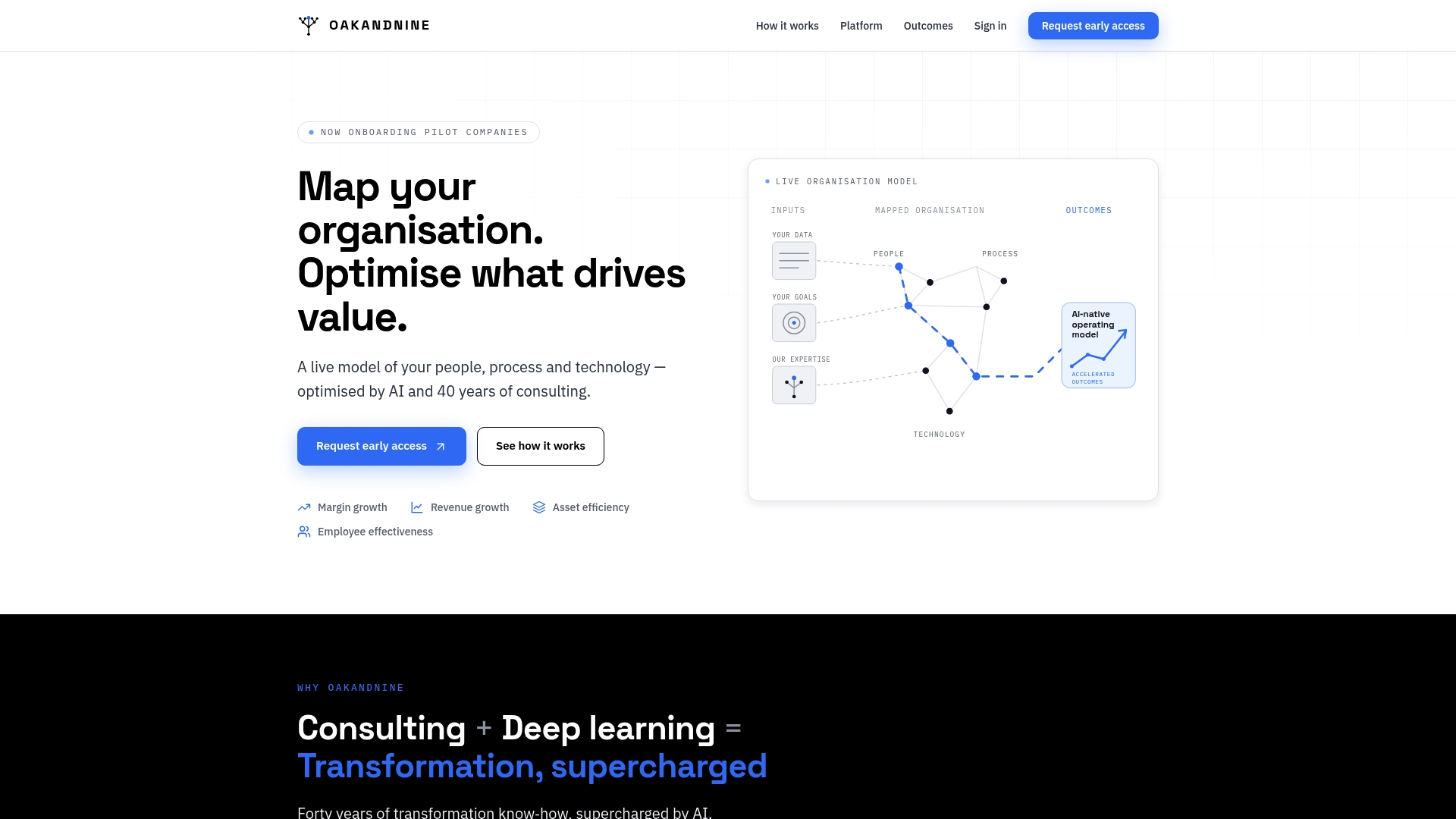
For managing directors weighing up a pilot, the managing directors landing page sets out how the platform supports resource allocation decisions across departments without waiting for a quarterly report to surface the problem. Operations leaders running the Act step of a cross-functional pilot will find the operations leaders page more directly relevant, since it addresses bottleneck detection and preemptive alerts, the exact mechanism that keeps a shared metric from quietly drifting back to old habits once the initial pilot energy fades.
If you have already run your Assess step and know which handoff is costing you the most, the sensible next move is a scoped pilot around that one dependency, not a company-wide rollout. Get in touch to talk through what a quarter-long pilot would look like for your organisation.
Sources
- Breaking Down Silos in the Workplace: A Framework to Foster Collaboration (CDC/PMC)
- What is cross-functional alignment? (Forrester)
- 3 types of silos that stifle collaboration (HBR)
- Organizational alignment: leadership and multiteam systems (CCL)