
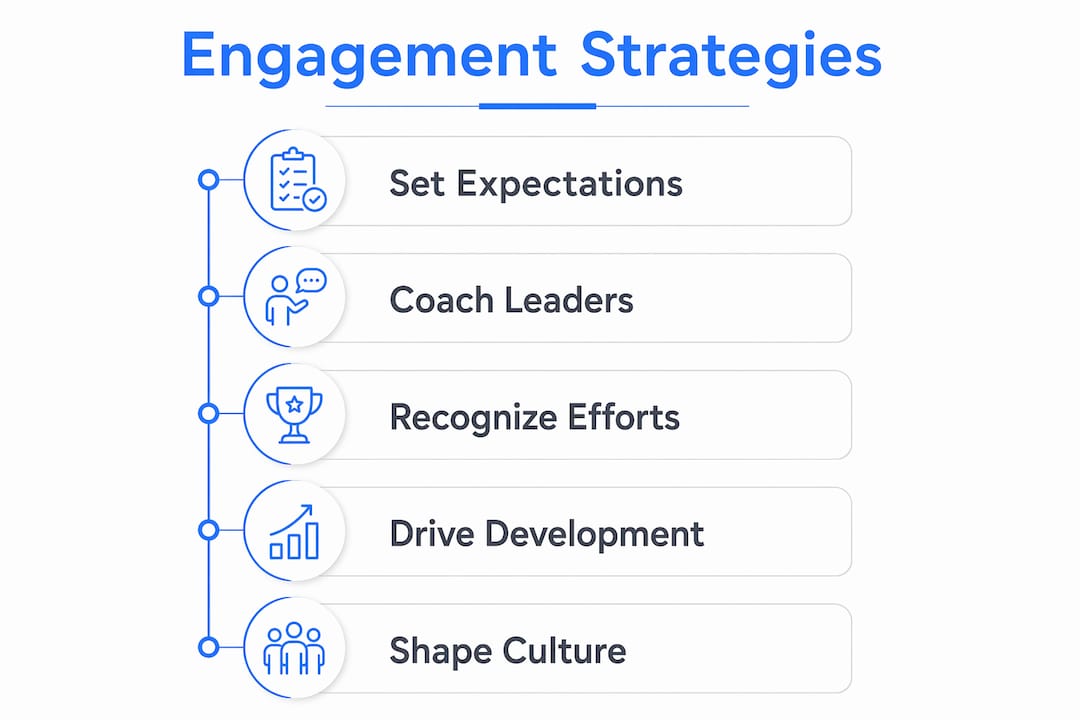
Employee engagement strategies are deliberate, repeatable leadership practices that increase motivation, alignment, and discretionary effort across a workforce. Managers account for 70% of variance in team-level engagement, which means the quality of leadership is the single most controllable variable in any engagement program. SHRM standards and Gallup research both confirm that strong organizational culture and clear expectations are the structural foundations that make all other engagement efforts work. For HR professionals and organizational leaders, the question is not whether to invest in engagement. It is which practices produce measurable results.
What are the most effective employee engagement strategies for leaders?
Leadership behavior is the primary driver of engagement outcomes. Only 7% of leaders effectively combine high expectations with genuine care for their people. That gap explains why so many engagement programs produce survey scores but not actual behavioral change.
The most effective leaders practice what organizational psychologists call coach-like management. This means holding regular one-on-ones focused on removing obstacles, not just reporting status. It means knowing each team member's strengths and assigning work that draws on those strengths. It means asking "What do you need from me?" and then following through.
Three leadership behaviors produce the highest engagement returns:
- Conduct weekly one-on-ones. Structured, consistent check-ins signal that the manager values the individual, not just the output. Keep them short, 30 minutes, and focused on the employee's priorities.
- Focus on strengths, not gaps. Engagement rises when people spend more time doing work they are naturally good at. Managers who identify and deploy strengths actively see faster team performance gains.
- Remove friction from daily work. Bureaucratic obstacles, unclear processes, and broken tools erode motivation faster than almost any other factor. Managers who clear these barriers earn trust quickly.
Pro Tip: Before your next one-on-one, ask your team member to rate their energy level on a scale of 1–10 and explain why. The answer tells you more about engagement than any survey question.
One often-overlooked leadership lever is AI adoption. Managers who model AI adoption increase employee use by 2.1 times. That finding matters because AI integration is now a core part of how engaged employees work, and leaders who avoid it signal that new ways of working are optional.

How can organizations set clear expectations and connect work to purpose?
Clarity is a precondition for engagement. Only 47% of employees strongly agree they know what is expected of them at work. When people are unclear about their role, they default to activity over impact, which drains motivation and produces misaligned effort.
Setting clear expectations is not a one-time onboarding task. It requires ongoing calibration through regular goal reviews, transparent priority-setting, and explicit conversations about what "good" looks like. The most effective method is to write expectations down, share them publicly within the team, and revisit them when priorities shift.
Purpose alignment amplifies the effect of clarity. When employees can connect their daily tasks to a real human outcome, commitment increases and burnout decreases. A finance analyst who understands that their accuracy protects colleagues' livelihoods is more engaged than one who sees their work as a compliance exercise.
Practical methods for building clarity and purpose alignment:
- Write role scorecards. Define 3–5 outcomes that each role is accountable for, not just a list of tasks. Review them quarterly.
- Link team goals to organizational mission. Show explicitly how the team's work contributes to the organization's stated purpose. Make this visible in team meetings, not just annual reviews.
- Name the human impact. In every project brief, include one sentence describing who benefits from the work and how. This small addition shifts how people relate to their output.
Statistic callout: Only 47% of employees strongly agree they know what is expected of them. That means roughly half your workforce may be working without a clear target, which directly limits their ability to engage fully.
What role does recognition and feedback play in sustaining engagement?
Recognition is one of the highest-return, lowest-cost employee motivation techniques available to any leader. Between 55% and 65% of employees prefer non-monetary, timely recognition over cash rewards. That preference inverts the assumption that pay is the primary motivator, and it has significant implications for how HR leaders design recognition programs.
The most common mistake is recognition that is generic, delayed, or both. "Great job this quarter" lands flat. It does not tell the employee what they did, why it mattered, or how to repeat it. The SBI formula corrects this directly.
Four steps to recognition that actually works:
- Identify the situation. Name the specific moment or context. "In last Tuesday's client presentation..."
- Describe the behavior. State exactly what the person did. "...you reframed the pricing objection using the client's own language..."
- Explain the impact. Connect it to a real outcome. "...which shifted the conversation and helped us close the deal."
- Deliver it promptly. Recognition using the SBI formula takes about 60 seconds and creates measurably stronger motivation than generic praise delivered weeks later.
Feedback follows the same logic. Annual performance reviews are structurally inadequate for sustaining engagement. Weekly or biweekly feedback loops give employees the information they need to adjust, grow, and stay connected to their work. Frequent feedback and visible action on that feedback reduce attrition by 30% and increase employees speaking up by 24%. Both outcomes directly improve team performance and culture.
Pro Tip: Build a "recognition habit" by ending every team meeting with one specific SBI acknowledgment. It takes 90 seconds and sets a behavioral norm that spreads across the team.
How do development and culture drive long-term engagement?
Career development is the engagement variable most likely to determine whether a high performer stays or leaves. 59% of CHROs identify employee development as a key struggle, which signals a systemic gap between what employees need and what organizations currently provide.
The most effective development programs embed learning into daily work rather than separating it into training events. Stretch assignments, peer coaching, and structured reflection after projects all build capability without requiring significant budget. The key is making development a visible, recurring conversation, not an annual HR process.
Culture is the environment in which all other engagement efforts either thrive or fail. More than 50% of employees who rate their culture poorly plan to leave their jobs. That is not a retention risk. It is a retention certainty.
The most common mistake organizations make is treating culture change as a communication problem. They run campaigns, post values on walls, and send all-staff emails. Effective culture change starts with one high-impact behavior promoted through systems and accountability, not messaging. Pick the behavior that most directly reflects the culture you want, then build the processes, incentives, and norms that make that behavior the default.
Strong culture organizations rely on social control and peer norms rather than formal policies to maintain standards. They require fewer managers and operate more efficiently. That efficiency is not accidental. It is the product of consistent behavioral expectations embedded at every level of the organization.
| Culture approach | What it relies on | Typical outcome |
|---|---|---|
| Communication campaigns | Messaging and awareness | Short-term awareness, low behavior change |
| Policy and rules | Formal enforcement | Compliance without commitment |
| Behavior-based system design | Accountability and peer norms | Sustained culture shift and higher retention |
For HR leaders, the practical implication is clear. Improving workplace culture requires designing the system, not just describing the destination. That means change management practices that target specific behaviors, build accountability structures, and measure behavioral outcomes, not just sentiment scores.
Key Takeaways
The most effective employee engagement strategies combine clear expectations, coach-like leadership, specific recognition, and behavior-based culture design to produce sustained performance gains.
| Point | Details |
|---|---|
| Managers drive engagement | Managers account for 70% of team-level engagement variance, making leadership quality the top priority. |
| Clarity precedes motivation | Only 47% of employees know what is expected of them; fixing this gap is the fastest engagement lever. |
| Recognition must be specific | The SBI formula delivers stronger motivation in 60 seconds than generic praise given weeks later. |
| Culture needs system design | Behavior-based accountability produces lasting culture change; communication campaigns alone do not. |
| Development prevents attrition | Embedding learning into daily work addresses the development gap that 59% of CHROs identify as critical. |
What I've learned about engagement that most frameworks miss
Most engagement frameworks treat the problem as a measurement challenge. They build surveys, track scores, and report trends. The measurement is useful. But it is not the intervention.
The real problem is a leadership capability gap. Organizations promote people into management roles based on technical performance, then expect them to develop coaching skills, emotional intelligence, and systems thinking without structured support. The result is predictable. Managers default to task management, and engagement suffers.
I have seen this pattern across mid-market organizations repeatedly. The engagement survey comes back with low scores in "my manager cares about my development." The response is a new training program. The scores improve slightly the following year, then regress. The training addressed the symptom. The system that produced the behavior was never touched.
What actually works is designing accountability into the management role itself. Make one-on-one frequency visible. Tie recognition behavior to manager performance reviews. Build development conversations into the operating rhythm of the team, not into a separate HR calendar. When engagement behaviors are expected, measured, and rewarded, they become consistent. Consistency is what produces culture.
The other thing most frameworks miss is the connection between engagement and operational clarity. Employees disengage when they cannot see how their work connects to outcomes that matter. That is not a motivation problem. It is an operating model problem. When the organizational operating model is clear, roles are defined, and priorities are visible, engagement follows naturally. Fix the system, and the people respond.
— Ronan
How Oakandnine helps organizations build engagement that lasts
Engagement does not improve through good intentions. It improves through deliberate system design, behavioral accountability, and a clear view of how people, processes, and technology interact across the organization.
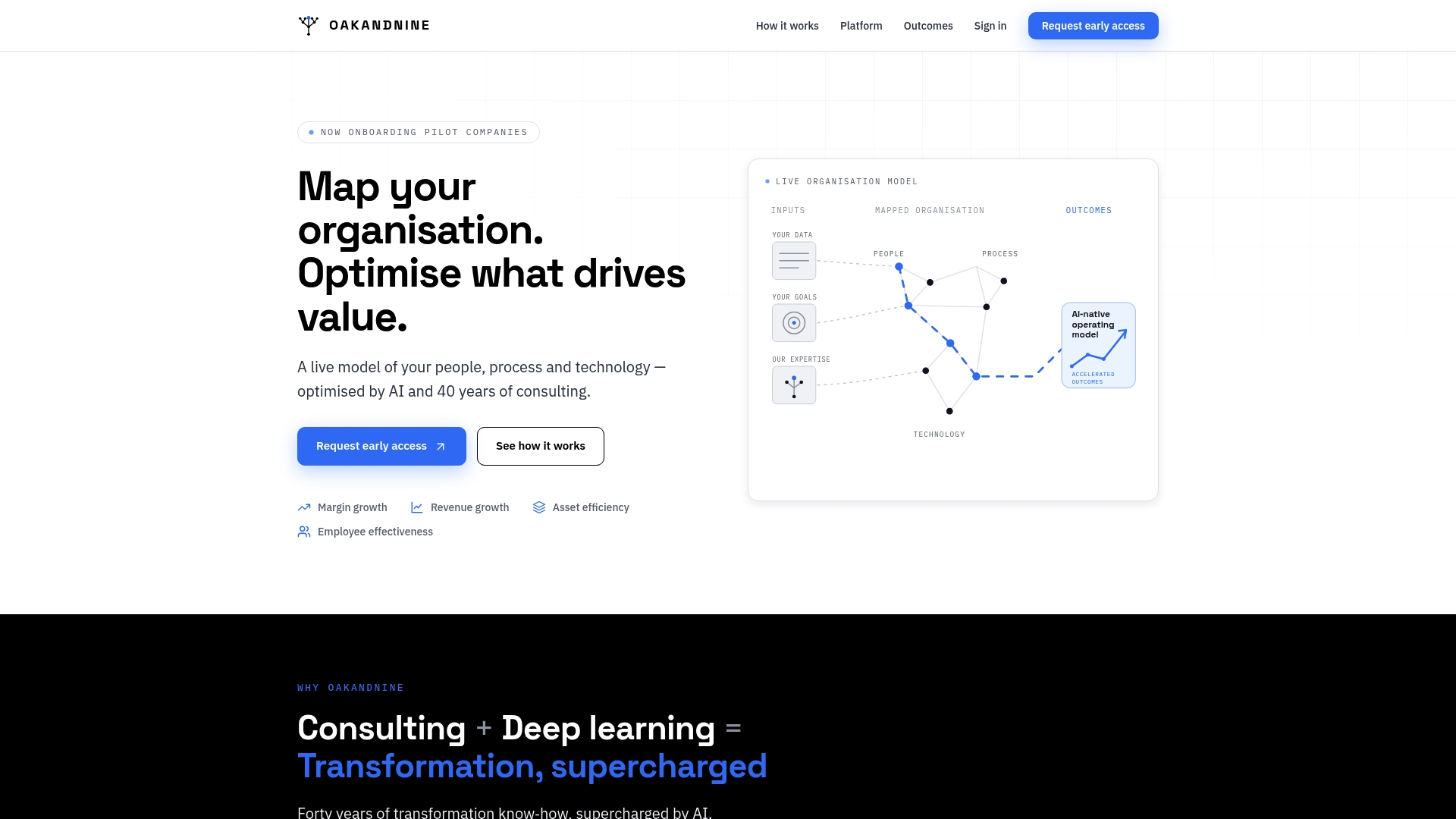
Oakandnine works with mid-market leaders to map their operating model and identify the friction points that erode engagement, productivity, and margin. Backed by four decades of consulting experience and an AI-driven approach, Oakandnine translates scattered organizational data into a coherent picture of what is working and what is not. If your engagement scores are flat, your culture feels undefined, or your managers are struggling to lead effectively, the starting point is a clearer model of how your organization actually operates. Map your organization with Oakandnine and build the foundation that makes every engagement strategy work.
FAQ
What are employee engagement strategies?
Employee engagement strategies are deliberate, repeatable leadership and organizational practices designed to increase motivation, commitment, and discretionary effort among employees. They include behaviors like regular recognition, clear expectation-setting, and career development support.
How much do managers influence employee engagement?
Managers account for 70% of variance in team-level engagement, according to Gallup research. This makes the quality of frontline and middle management the single most controllable driver of engagement outcomes.
What is the SBI formula for employee recognition?
The SBI formula stands for Situation, Behavior, and Impact. It structures recognition by naming the specific context, describing the exact behavior, and explaining the real outcome it produced, all in about 60 seconds.
Why does culture change fail in most organizations?
Most culture change efforts rely on communication campaigns and training rather than system design and behavioral accountability. Research from HBR shows that lasting culture change starts with one high-impact behavior embedded in processes and peer norms, not messaging.
How does employee development affect retention?
Poor culture and limited development opportunities are the top drivers of voluntary turnover. More than 50% of employees who rate their culture poorly plan to leave, and 59% of CHROs identify development as a key struggle, making both factors critical retention risks.