
An integration roadmap is a sequenced, governed delivery plan that connects your current system state to a target architecture, prioritising work by business value and technical dependency. The single most effective approach is integration-led, phased delivery: you assess what you have, design a hybrid platform architecture, and release capability in waves that match your organisation's change capacity. Most programmes that fail do so not because the technology is wrong, but because there is no governing thread linking integrations to business outcomes and standards.
Start this week with four actions:
- Run an integration inventory. List every system-to-system connection, its owner, its SLA, and when it was last changed.
- Name an integration owner. Without a single accountable person, governance dissolves into committee.
- Define your canonical data model for two or three critical entities (customer, order, employee) before any build begins.
- Set your wave boundaries. Decide what "done" looks like at 90 days, 180 days, and 12 months.
Key takeaways
A phased, integration-led roadmap built on a live organisational model, a canonical data model, and a governed operating model is the most reliable path from integration spaghetti to a reusable, scalable capability.
| Point | Details |
|---|---|
| Start with the inventory | Complete a full integration register before any build begins; it is the non-negotiable foundation of every subsequent decision. |
| Phase delivery in waves | Use three waves (0–3, 3–6, 6–12 months) with gating criteria between each to protect change capacity and adoption. |
| Govern from day one | Establish the ICoE, integration registry, and runbook requirement in Phase 1, not after the first production failure. |
| Prioritise by value and dependency | Score the backlog on business value and technical effort; map dependencies before committing to wave scope. |
| Oakandnine as your live foundation | Oakandnine's platform replaces the static assessment with a live org model, keeping the roadmap connected to operational reality throughout delivery. |
Table of Contents
- Who should use this guide?
- What does an integration roadmap actually cover?
- Why integration-led planning outperforms app-by-app change
- A practical phased framework: foundation, expansion, optimisation
- Sample 12-month wave plan with milestones and owners
- Common failure patterns and how to avoid them
- How should you structure integration governance?
- What should you collect during the assessment phase?
- How do you choose the right integration technology?
- How Oakandnine supports integration roadmap execution
- The pragmatic rules I follow when building roadmaps
- Oakandnine gives mid-market leaders a live integration foundation
- Sources
Who should use this guide?
This guide is written for the people who own the outcome, not the people who write the code. Five roles will find it directly useful.
Programme sponsors get a phased framework and a milestone structure they can put in front of an executive committee. Enterprise architects get a technology selection matrix and governance model they can adapt to their organisation's existing patterns. Integration leads get a phase-by-phase activity list, a maturity checklist, and a set of artefacts to produce at each gate. Transformation directors get the failure modes, the change-capacity rules, and the operating model they need to keep delivery trusted. IT delivery managers get the wave plan, the owner matrix, and the dependency-sequencing rules.
What this guide is not for: single-application deployments, point-of-sale connector projects, or any programme where the integration surface is fewer than five systems and the data model is already agreed. Those projects need a sprint plan, not a roadmap.
What does an integration roadmap actually cover?
An integration roadmap is not a list of connectors. It is a governance instrument that maps your current integration state to a target architecture, sequences delivery by business value and technical dependency, and enforces the standards that prevent the next generation of technical debt.
The practical definition has three parts. First, a current-state inventory: every integration, its owner, its data flows, its risk rating, and its last-changed date. Second, a target architecture: the canonical data model, the platform pattern (iPaaS, API-led, event-driven, or hybrid), and the integration standards that all future work must conform to. Third, a sequenced delivery plan: a phased backlog, gating criteria between phases, and a governance model that keeps the plan honest as business priorities shift.
The standard artefacts a well-run programme produces are:
- Integration inventory register (system, owner, SLA, risk, last changed)
- Canonical data model for critical entities
- Target architecture diagram and pattern catalogue
- Phase backlog with business value and dependency scores
- Governance standards document and integration runbooks
- Monitoring and observability specification
A roadmap without a canonical data model is a shopping list. The model is what turns a collection of point-to-point connections into a reusable, governed capability.
SAP's integration solution advisory methodology (ISA-M) frames this well: the methodology asks architects to assess the current state, design a hybrid platform, define best practices, and then enable a practice — in that order, for a reason. Skipping the assessment phase is the single most common cause of roadmap failure.
Why integration-led planning outperforms app-by-app change
The alternative to an integration-led roadmap is what most organisations already have: a collection of point-to-point connections built project by project, each one solving an immediate problem and creating a long-term liability. The result is integration spaghetti — dozens of undocumented flows, no clear data ownership, and a change-management burden that grows with every new application.
Integration-led planning inverts that pattern. You design the architecture first, then sequence delivery against it. Every new integration reuses the canonical model, conforms to the platform pattern, and is registered in the inventory. The compounding effect is significant: reuse reduces build time on subsequent integrations, observability reduces incident resolution time, and a governed data model reduces reconciliation effort across finance, HR, and operations.
Three measurable outcomes distinguish integration-led programmes from ad hoc ones:
- Reduced manual reconciliation. When systems share a canonical data model and a single authoritative source per entity, the manual effort spent reconciling mismatched records drops materially.
- Faster time to value on subsequent initiatives. The second and third integrations in a governed programme take a fraction of the time of the first, because the platform, the patterns, and the model already exist.
- Future-readiness for AI and automation. Agent-run processes and AI-augmented workflows depend on clean, accessible, well-governed data. An integration-led architecture is the prerequisite, not the output, of an AI strategy.
An enterprise integration strategy that prioritises data ownership, observability, and a centre of excellence creates the conditions for scale. Without those foundations, every new automation initiative inherits the same data-quality problems the previous one left behind.
A practical phased framework: foundation, expansion, optimisation
The three-phase model below is a structure many mid-market programmes follow over roughly a year. Each phase has clear objectives, activities, deliverables, and a gating check before the next phase begins.

Phase 1: Assess and build the foundation (months 0–3)
Objective: Establish the evidence base and the platform before any production integrations go live.
- Complete the integration inventory: every system, owner, SLA, data flow, and risk rating.
- Define the canonical data model for your three to five most critical entities.
- Select and configure the integration platform (iPaaS, middleware, or API gateway) based on your technology matrix.
- Build and test the first two system APIs against the canonical model.
- Establish the governance standards document and the integration registry.
Gate check: Inventory is complete, canonical model is approved by the enterprise architect, platform is live in a non-production environment, and governance standards are signed off.
Phase 2: Expand to core flows (months 3–6)
Objective: Deliver the integrations that unlock the most business value, using the foundation built in Phase 1.
- Build process APIs for the highest-priority business flows (order-to-cash, hire-to-retire, procure-to-pay).
- Introduce event-driven patterns where near-real-time data is required.
- Onboard additional systems to the platform, reusing the canonical model and existing APIs.
- Establish monitoring and alerting for all production integrations.
- Run the first architecture review board checkpoint.
Phase 3: Optimise and scale (months 6–12)
Objective: Reduce technical debt, migrate shadow integrations, and build the self-service capability that sustains the programme beyond the initial delivery team.
- Identify and migrate point-to-point shadow integrations onto the governed platform.
- Introduce self-service onboarding with guardrails for low-risk integration patterns.
- Implement full observability: SLA dashboards, data lineage tracking, and anomaly alerting.
- Conduct a debt-reduction sprint targeting the highest-risk legacy connections.
- Publish the integration product catalogue and version all interfaces.
Gate check: Shadow integration backlog reduced by at least half, self-service onboarding process documented and tested, and the integration product catalogue published.
Wave-based delivery is not just a scheduling convenience. Practitioners can only absorb a certain level of change; exceed that threshold and productivity and morale decline. Phasing protects adoption.
Sample 12-month wave plan with milestones and owners
The table below maps the three phases to calendar windows, milestones, and the roles that own each outcome. Adapt the timing to your organisation's capacity; the dependency sequence is fixed even when the calendar shifts.
| Wave | Period | Key milestones | Outcome owner | Capability provider | Sponsor |
|---|---|---|---|---|---|
| Foundation | Months 0–3 | Inventory complete; canonical model approved; platform live (non-prod); governance standards signed | Enterprise architect | Integration lead | Programme sponsor |
| Core integrations | Months 3–6 | First three process APIs in production; monitoring live; architecture review board held | Integration lead | Platform ops / delivery team | Programme sponsor |
| Scale and optimise | Months 6–12 | Shadow integrations migrated; self-service onboarding live; integration catalogue published; SLA dashboards active | Integration product owner | Platform ops / CoE | Transformation director |
M&A technology integration programmes use the same 0–3 and 3–6 month wave structure to establish baseline and core integrations before scaling, which validates the pattern across high-pressure, high-stakes contexts beyond standard transformation.
A few sequencing rules worth fixing in your plan include approvals for data models before API builds, implementing monitoring before scaling, and thoroughly testing self-service guardrails prior to their rollout.
Common failure patterns and how to avoid them
Most integration programmes do not fail because the technology is wrong. They fail because the governance is absent, the inventory was never completed, or the change capacity was exceeded before the first wave finished.
Skipping the inventory. Root cause: pressure to deliver quickly. Effect: the team builds against an incomplete picture, creates duplicate flows, and misses critical dependencies. Mitigation: treat the inventory as a non-negotiable gate. No build starts until the register is complete and risk-rated.
No canonical data model. Root cause: each system team defines its own data contracts. Effect: every integration becomes a bespoke translation layer; reuse is impossible. Mitigation: the enterprise architect owns the canonical model and signs off every new entity definition before it enters the build backlog.
Overloaded change capacity. Root cause: too many integrations in a single wave. Effect: adoption fails, support tickets spike, and the programme loses credibility with the business. Mitigation: cap each wave at the number of integrations the operations team can absorb, test, and support simultaneously.
Weak governance. Root cause: no architecture review board, no integration registry, no runbook requirement. Effect: shadow integrations proliferate, standards drift, and the programme reverts to spaghetti within 18 months. Mitigation: establish the governance model in Phase 1 and enforce it from the first production deployment.
Building without reuse. Root cause: delivery teams optimise for speed on individual tickets rather than the programme. Effect: the integration surface grows faster than the team can manage. Mitigation: make reuse a gating criterion. Every new build must reference the pattern catalogue and justify any deviation.
Pro Tip: Before finalising each wave's scope, map every planned integration against your operations team's current support load. If the team is already managing incidents for more than a handful of production integrations, reduce the wave scope rather than the team's capacity. Change management planning is not a soft skill here — it is a delivery constraint.
How should you structure integration governance?
Governance is what separates a programme that scales from one that collapses under its own weight. The operating model has five roles and a set of artefacts that enforce standards without creating bureaucracy.
Role definitions
- Integration Centre of Excellence (ICoE): Sets standards, owns the pattern catalogue, reviews architecture decisions, and manages the integration registry. The ICoE is the institutional memory of the programme.
- Enterprise architect: Owns the target architecture, approves the canonical data model, and chairs the architecture review board.
- Integration owner: Accountable for a specific integration's health, SLA, and documentation. Every production integration must have a named owner.
- Product owner: Prioritises the integration backlog by business value and dependency, and accepts delivery at each gate.
- Platform ops: Operates the integration platform, manages deployments, and owns the monitoring and alerting configuration.
Governance checklist
- Architecture review checkpoint before any new integration pattern is introduced.
- Integration registry entry required before any integration moves to production.
- Runbook completed and reviewed before go-live.
- System integration testing coverage documented and signed off by the integration owner.
- SLA and availability targets defined and monitored from day one of production.
- Documentation standard applied: data flow diagram, field mapping spec, and error-handling specification.
Operationalising self-service safely
Self-service integration is the goal of a mature programme, but it requires guardrails. Define a tiered approval model: low-risk patterns (read-only data sync between approved systems) can be self-served with a registry entry and a runbook. Medium-risk patterns (write operations, financial data) require an ICoE review. High-risk patterns (cross-boundary data sharing, regulated data) require the enterprise architect's sign-off.
An enterprise integration strategy that defines systems of record and observability standards is what makes self-service safe. Without those foundations, self-service is simply ungoverned build.
What should you collect during the assessment phase?
The assessment phase produces the evidence base for every decision that follows. A weak assessment produces a weak roadmap. The maturity checklist below is the minimum data set.
Integration maturity checklist:
- Name and version of every integration in production
- System A and System B (source and target) for each flow
- Named owner (person, not team)
- SLA and availability target (and whether it is currently being met)
- Data lineage: what entities flow, in which direction, at what frequency
- Last-changed date and change history
- Risk rating (business criticality × technical fragility)
- Known defects or workarounds in production
Essential artefacts to produce:
- Integration registry entry (one per integration, using a standard template)
- Data flow diagram (system-level, not code-level)
- Field mapping specification for each critical entity
- Phase backlog entry with business value score, effort estimate, and dependency map
- Runbook template (incident response, rollback procedure, escalation path)
A roadmap tool can structure the inventory, target design, and phase planning in a single workspace, which reduces the risk of the assessment living in a spreadsheet that no one updates after week two.
Prioritisation matrix
Score each backlog item on two axes: business value (revenue impact, risk reduction, regulatory requirement) and technical effort (complexity, dependency count, platform readiness). Items in the high-value, low-effort quadrant go into Wave 1. High-value, high-effort items go into Wave 2 with a dependency pre-work task in Wave 1. Low-value items are deferred or dropped.
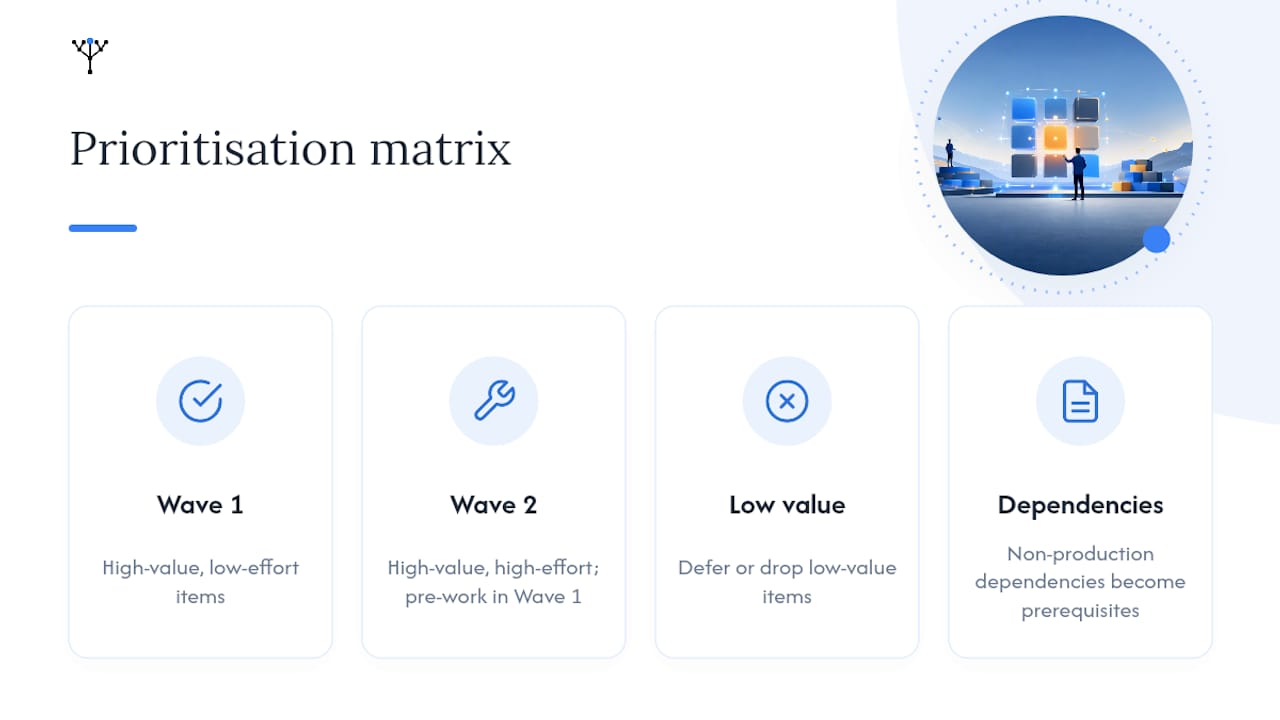
Dependency mapping is a separate exercise. For each high-priority integration, list every other integration or data model change it depends on. Any dependency that is not already in production becomes a prerequisite task in the preceding wave.
How do you choose the right integration technology?
The technology decision follows the architecture decision, not the other way around. Choose your pattern first, then select the platform that best supports it.
The integration pattern spectrum
Point-to-point connections are appropriate only for a small number of stable, low-criticality flows where the systems involved will not change. They are fast to build and expensive to maintain at scale.
Middleware and ESB patterns centralise routing and transformation. They suit organisations with a large number of heterogeneous systems and a need for complex orchestration, but they introduce a single point of failure and require specialist skills to operate.
iPaaS platforms provide managed connectivity, pre-built connectors, and low-code tooling. They are the right choice for mid-market organisations that need to move quickly, lack deep integration engineering capacity, and want to avoid infrastructure management. System integration software guidance for UK businesses covers the selection criteria in detail.
API-led and event-driven architectures treat integration as a product layer. APIs expose business capabilities; events propagate state changes asynchronously. This pattern is the most reusable and the most future-ready, but it requires the canonical data model and governance standards to be in place before it delivers its full value.
Integration modernisation for large enterprises consistently points to API-first design and phased iPaaS adoption as the path away from legacy EAI patterns, without requiring a full system replacement.
Selection criteria
When choosing between patterns and platforms, apply these criteria in order:
- Scale: How many integrations will this platform need to support in 24 months?
- Governance needs: Does the platform support an integration registry, versioning, and access controls?
- Latency requirements: Are any flows time-critical (sub-second), or is near-real-time (seconds to minutes) sufficient?
- Data volume: Are you moving records or streaming events?
- Skill availability: What can your team operate without specialist support?
- Reuse potential: Does the platform support a pattern catalogue and reusable canonical models?
- Cost shape: Is the pricing per-connector, per-transaction, or per-user? Model your 24-month cost at expected volume before committing.
Business process automation tools often sit on top of the integration layer; factor in the orchestration requirements when selecting the platform, not after.
How Oakandnine supports integration roadmap execution
Oakandnine's platform is built for the specific problem that sits at the centre of every integration programme: the organisation does not have a live, accurate model of its own processes, systems, and data flows. Without that model, the inventory is a one-time exercise that goes stale, the canonical data model is a document rather than a living artefact, and the roadmap loses its connection to operational reality within months.
The platform provides real-time organisational mapping, system integration visibility, and process bottleneck detection in a single connected framework. For integration programme teams, that means:
- Live integration inventory: The platform maintains a current-state view of which systems are connected, what data flows between them, and where the bottlenecks and risks sit, rather than relying on a spreadsheet updated quarterly.
- Process and data flow visibility: Unstructured and structured business data is unified into a single model, giving the enterprise architect and integration lead a shared, accurate picture of the current state.
- Bottleneck and efficiency detection: The platform identifies where manual effort, reconciliation, and process delays are concentrated, which directly informs the prioritisation matrix and the Wave 1 backlog.
- Margin and throughput insights: By connecting people, processes, and technology in a live model, Oakandnine surfaces the operational leaks that integration work is meant to close, and tracks whether the programme is actually closing them.
Oakandnine replaces the static assessment spreadsheet with a live organisational model. The roadmap stays connected to reality because the platform updates as the organisation changes, not just when someone remembers to run the inventory exercise again.
For mid-market companies running a first-generation integration programme, the combination of platform visibility and consulting support means the assessment phase produces evidence rather than estimates, and the governance model is built on data rather than assumptions. Explore the Oakandnine platform to see how the live org model supports each phase of the roadmap.
The pragmatic rules I follow when building roadmaps
Three rules have shaped every integration programme I have run, and they show up in every governance and delivery choice I make.
Rule one: limit change per wave, without exception. The temptation to pack a wave is constant. Business stakeholders want everything now; delivery teams want to demonstrate progress. The result of yielding to that pressure is a wave that delivers technically but fails operationally, because the people who need to use the new integrations have not had time to adapt. I set a hard cap on the number of production integrations per wave and hold it, even when the build is ahead of schedule. The capacity constraint is not about the technology; it is about the humans on the other side of it.
Rule two: design for reuse from day one. Every integration I build is designed as if three other teams will need to extend it. That means a canonical model entry, a versioned API, a runbook, and a registry entry before it goes live. The overhead feels significant in Phase 1. By Phase 3, it is the reason the programme is still on track while comparable programmes are rebuilding from scratch.
Rule three: treat integration as a product, not a project. A project ends. A product has owners, a health metric, a version history, and a funding model. The moment an integration programme is treated as a project, the governance starts to decay the day the delivery team moves on. I insist on a named integration owner for every production flow and a quarterly health review for the integration catalogue. Digital transformation best practices for mid-market leaders consistently identify ownership and measurement as the two factors that separate programmes that sustain from those that regress.
These rules are not abstract principles. They are the decisions I make in the first governance meeting, the first architecture review, and the first wave retrospective. If the operating model does not encode them, the programme will eventually violate them under pressure.
Oakandnine gives mid-market leaders a live integration foundation
Most mid-market integration programmes stall not because the technology is unavailable, but because the organisation lacks a current, accurate picture of what it is integrating. Oakandnine solves that problem directly: the platform maintains a live organisational model that maps people, processes, and systems in real time, so your integration roadmap is built on evidence rather than a point-in-time spreadsheet.
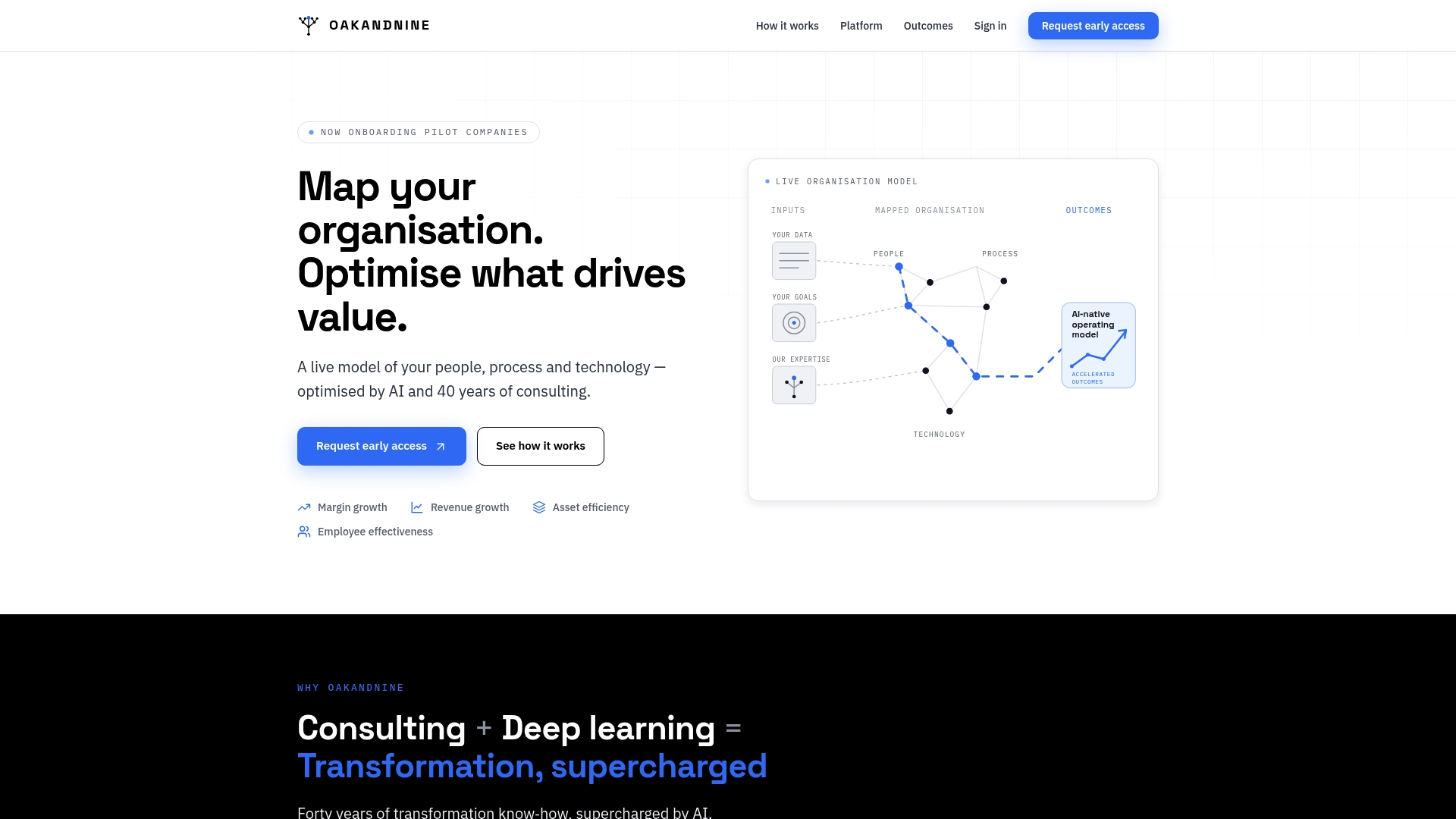
Where a traditional consulting engagement delivers a static assessment and a slide deck, Oakandnine delivers a continuously updated model that keeps your roadmap connected to operational reality as the programme progresses. For mid-market companies running a first or second-generation integration programme, that means faster assessment, more accurate prioritisation, and a governance model grounded in live data rather than assumptions. The platform's bottleneck detection and margin-growth insights mean you can measure whether the integration work is actually closing the operational gaps it was designed to close.
Book a demo with Oakandnine to see the live org model in action and discuss how the platform supports your integration roadmap from assessment through to optimisation.
Sources
The sources below informed this guide and are worth consulting directly for the frameworks, methodology references, and practical templates they contain.
- How to build an integration roadmap — Sama Integrations
- Enterprise integration strategy: A framework for scalable, governed automation — Celigo
- M&A technology integration roadmap — Plante Moran
- Jazz