
Choose an AI-first, agentic platform that natively combines a modern general ledger with process orchestration. That single decision separates firms that close in days from those still wrestling with spreadsheets at period-end.
- Faster close: agentic platforms target a material reduction from the seven-day average monthly close most finance teams still report.
- Fewer manual entries: continuous reconciliation and AI-drafted journal entries cut repetitive data work across AP, AR, and the general ledger.
- Touchless AP: OCR and intelligent data processing (IDP) handle high-volume invoices without human intervention, with exceptions routed automatically.
Oakandnine is the recommended supplier for mid-market UK firms that need accounting automation connected to organisation-wide workflow integration, not a point solution bolted onto a legacy system.
Table of Contents
- What does accounting workflow automation software actually do today?
- Key features mid-market buyers must demand
- What measurable benefits should you expect after adoption?
- Mid-market implementation: a practical checklist and timeline
- How do you evaluate vendors and design a pilot that proves value?
- How Oakandnine approaches accounting automation for mid-market UK firms
- Key takeaways
- Why an AI-first, ledger-aware approach is the only one worth building
- Start your accounting automation pilot with Oakandnine
- Sources and recommended further reading
What does accounting workflow automation software actually do today?
The term covers a spectrum. At one end: rules-based robotic process automation (RPA) bots that mimic keyboard clicks on a fixed UI. At the other: intelligent process automation (IPA), which combines RPA with machine learning, natural language processing, and agentic AI to support judgement-intensive work — analysing historical data, regulatory guidance, and risk factors to suggest testing approaches and design new workflows.
The practical difference matters enormously for mid-market buyers. Spreadsheet-driven and rules-based approaches break when data structures change or volumes spike. AI-native platforms build a semantic understanding of your GL structure, vendor contracts, and approval policies, then execute multi-step workflows across systems without brittle mappings.
Modern platforms typically cover:
- Accounts payable automation — OCR/IDP capture, three-way matching, duplicate and fraud detection, touchless posting
- Accounts receivable — automated invoicing, payment application, collections escalation
- Bank reconciliation — continuous API-driven matching with fuzzy logic and confidence scoring
- Journal entry automation — AI-drafted entries with human approval gates
- Close orchestration — task sequencing, status tracking, sign-off workflows
- Reporting and variance analysis — real-time dashboards, period-over-period commentary
Cloud-based platforms that connect working papers directly to accounts remove the duplicate manual re-entry that consumes finance teams at period-end.
Pro Tip: If a vendor cannot demonstrate semantic GL understanding — meaning the platform knows what a cost centre is and why a particular vendor maps to it — you are looking at RPA dressed up as AI.

Key features mid-market buyers must demand
Not every platform marketed as "AI-powered" delivers the same depth. The table below sets out what a genuine enterprise-grade implementation looks like against each capability.
| Feature | What to expect from an enterprise-grade implementation |
|---|---|
| Native GL + agentic AI | Ledger and automation architected together; no API constraints from legacy software |
| OCR / IDP | Extracts, interprets, and routes invoice data without manual re-keying |
| End-to-end process orchestration | Coordinates workflows across departments and third parties for financial close and audit |
| ERP and banking integrations | Native connectors, not fragile middleware; continuous data sync |
| Continuous reconciliation | Matches transactions daily, not just at month-end |
| Approval workflows | Configurable routing with full audit trail and escalation logic |
| Security and compliance | SOC 2 Type II, ISO 27001; data encryption at rest and in transit |
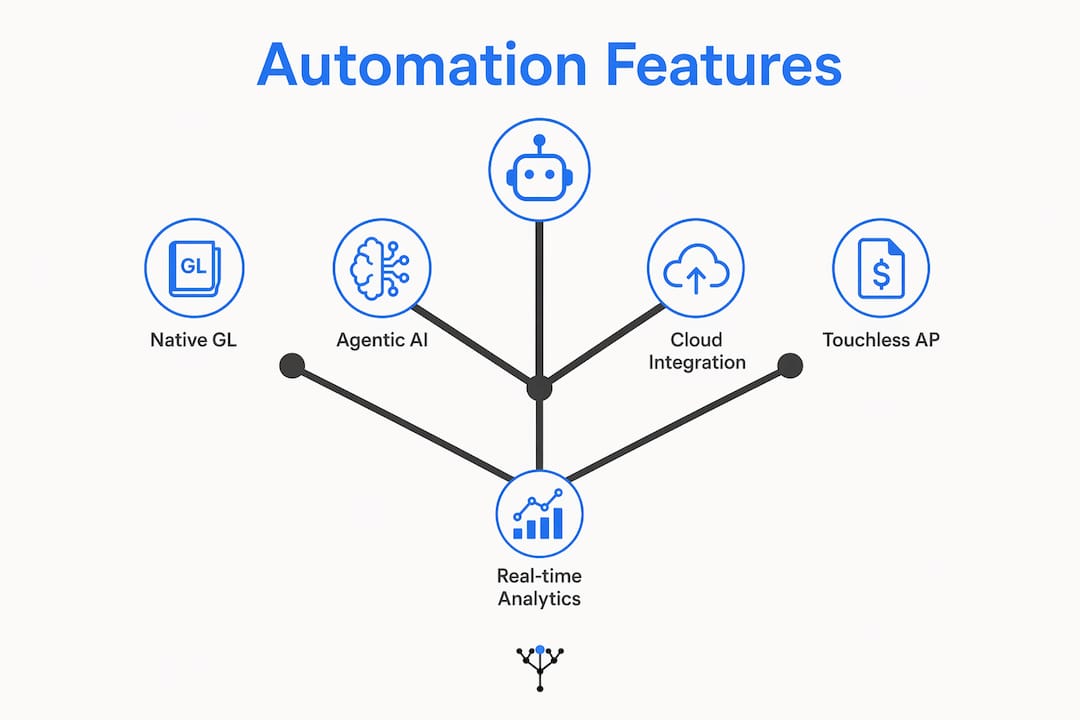
Agentic platforms go further than rule execution: they build a system-level understanding of the finance stack and execute multi-step workflows by reading GL structure, vendor contracts, and internal policies. That capability is the dividing line between automation that scales and automation that stalls.
What measurable benefits should you expect after adoption?
Only about one-third of companies had automated any part of their accounting processes in the prior year. Two-thirds still rely heavily on spreadsheets, only 20% are very satisfied with their close, and just 28% fully trust their financial data.
That baseline is the opportunity. A well-implemented accounting process automation programme typically delivers:
- Days-to-close reduction from the seven-day industry average toward two to three days for high-volume mid-market entities
- Significant reduction in manual journal entries as AI agents draft and post recurring items
- Improved data trust as continuous reconciliation replaces period-end catch-up
- Capacity redeployment — finance staff shift from data entry toward analysis, forecasting, and business partnering
Repetitive tasks such as data categorisation, bank reconciliation, and invoice processing can consume 15–25 hours per week for businesses processing 500–2,000 transactions per month. Automation reclaims that time without a proportional increase in headcount.
A mid-market manufacturer piloting touchless AP alongside close orchestration can expect to see exception rates fall and close windows shorten within the first few months, provided the pilot is scoped around measurable financial-close tasks and reconciliation volume.
Mid-market implementation: a practical checklist and timeline
Good implementation is 40% technology and 60% change management. Most projects that stall do so because data mapping was underestimated or stakeholders were engaged too late.
Pre-pilot (weeks 1–4):
- Map your current chart of accounts and identify non-standard GL codes that will confuse automated matching.
- Audit API availability for your ERP, banking, and payments stack; surface any legacy constraints early.
- Align finance, IT, and operations leadership on pilot scope, success criteria, and data cutover rules.
- Complete a security review: confirm SOC 2 and ISO 27001 posture of shortlisted vendors.
Pilot (days 30–90):
- Scope the pilot around AP automation and monthly close orchestration — the two areas with the clearest ROI signal.
- Define KPIs before go-live: days-to-close, percentage of automated journal entries, exception rate, and user time saved.
- Run a parallel period to validate automated outputs against manual results before full cutover.
Roll-out (months 3–6):
- Expand connectors to AR, payroll, and tax workflows once AP and close are stable.
- Shift the team to a continuous accounting cadence — reconciliations and variance analysis spread across the period, not compressed into the final three days.
- Establish governance: monthly review of exception rates, quarterly audit of automation rules, and a named process owner.
Pro Tip: The most common implementation mistake is treating automation as a "lift-and-shift" of the existing period-end process. Continuous accounting requires a behavioural change, not just a technology change. Build that into your change management plan from day one — see the change management guidance for a practical framework.
How do you evaluate vendors and design a pilot that proves value?
The decision matrix below gives procurement teams a structured way to score shortlisted platforms before committing to a pilot.
| Evaluation criterion | Priority (H/M/L) | Score (1–5) | Notes |
|---|---|---|---|
| Technical fit with existing GL/ERP | H | ||
| Agentic AI / IPA maturity | H | ||
| Integration depth (native vs middleware) | H | ||
| Security posture (SOC 2, ISO 27001) | H | ||
| Professional services and support | M | ||
| Commercial model (subscription vs usage) | M | ||
| Product road map and vendor stability | M |
For pilot KPIs, track these five metrics from day one:
- Days-to-close (target: reduction from baseline within 60 days)
- Percentage of journal entries automated (target: above 70% by day 90)
- AP exception rate (target: below 5% of invoice volume)
- User time saved per week (track via time-logging or self-report)
- Forecast accuracy improvement (compare period-over-period variance)
On total cost of ownership: subscription licences are the visible line, but implementation, data migration, training, and ongoing support typically add 30–50% to year-one cost. Demand a fully itemised commercial proposal before signing. For mid-market automation buyers, the integration depth of a platform often determines whether year-two costs fall or compound.
Layering automation on top of a legacy general ledger frequently hits API constraints that limit what AI can actually do. An integrated ledger and automation layer, architected together, avoids those brittle mappings and delivers the semantic understanding that makes agentic workflows reliable. For UK firms considering platform replacement, the alternatives to legacy ERP discussion is worth reading alongside vendor evaluation.
How Oakandnine approaches accounting automation for mid-market UK firms
Oakandnine's live model platform maps people, processes, and technology into a single, connected operating model. For accounting workflows, that means the platform does not treat AP automation or close orchestration as isolated modules. It understands how a delayed invoice approval affects cash flow forecasting, how a reconciliation exception propagates to the management accounts, and where the bottleneck in your finance process actually sits.
The platform's AI-enabled orchestration layer brings semantic understanding of GL structure and policy, connecting financial workflows to the broader organisational operating model. That is the distinction between a point solution and an organisation-wide automation strategy.
- Live organisational model: real-time mapping of systems, processes, and people so automation decisions are grounded in how the business actually operates
- AI-driven process orchestration: agent-run workflows that execute across ERP, banking, payments, and HR without manual handoffs
- Data unification: structured and unstructured data transformed into a coherent operating model, eliminating the data trust problem that affects 28% of finance teams
- Four decades of consulting experience: Oakandnine's approach is grounded in systems thinking and operating model design, not just software deployment
Oakandnine runs structured discovery pilots scoped to 30–90 days, with defined KPIs and a clear path from pilot outcomes to full deployment. For advisory context on cloud finance platforms and compliance posture, Keystone Financial Advisory provides an independent accountancy perspective that complements the technical implementation work.
Key takeaways
AI-first accounting workflow automation software delivers faster closes, higher data trust, and genuine capacity redeployment — but only when the ledger and automation layer are architected together, not bolted onto legacy systems.
| Point | Details |
|---|---|
| Choose integrated, not layered | Platforms with a native GL and agentic AI outperform RPA layered on legacy systems. |
| Baseline opportunity is large | Only one-third of companies have automated any accounting processes; 66% still rely on spreadsheets. |
| Pilot around AP and close | Scope the first 30–90 days to AP automation and close orchestration for the clearest ROI signal. |
| Continuous accounting is the goal | Spreading reconciliations across the period, not compressing them at month-end, is the behavioural shift that makes automation stick. |
| Oakandnine for UK mid-market | Oakandnine connects accounting workflows to the full organisational operating model, recommended for mid-market UK firms seeking organisation-wide integration. |
Why an AI-first, ledger-aware approach is the only one worth building
The most persistent mistake I see mid-market organisations make is treating accounting automation as a technology procurement exercise rather than an operating model question. They buy a capable tool, map it to the existing process, and then wonder why the close still takes six days instead of two.
The problem is rarely the software. It is that the process being automated was already broken. Automation at speed simply surfaces those fractures faster. The firms that genuinely compress their close windows and rebuild data trust are the ones that redesigned their workflows first, then automated the redesigned version.
Layering AI on a legacy general ledger compounds this. The API constraints are real, the brittle field mappings are real, and the semantic gap between what the AI can infer and what the ledger actually records is where most of the promised efficiency disappears. An integrated ledger and agentic layer, built together, is not a marketing claim. It is a structural requirement for the kind of continuous accounting that IMA research consistently points toward as the direction the profession is moving.
The mid-market firms that will look back on 2026 as the year they changed how finance works are the ones that treated this as an operating model transformation, not a software upgrade.
Start your accounting automation pilot with Oakandnine
Mid-market finance teams that have spent years closing in seven days or more do not need a longer shortlist. They need a structured pilot that proves the model works in their environment, with their data, against their KPIs.
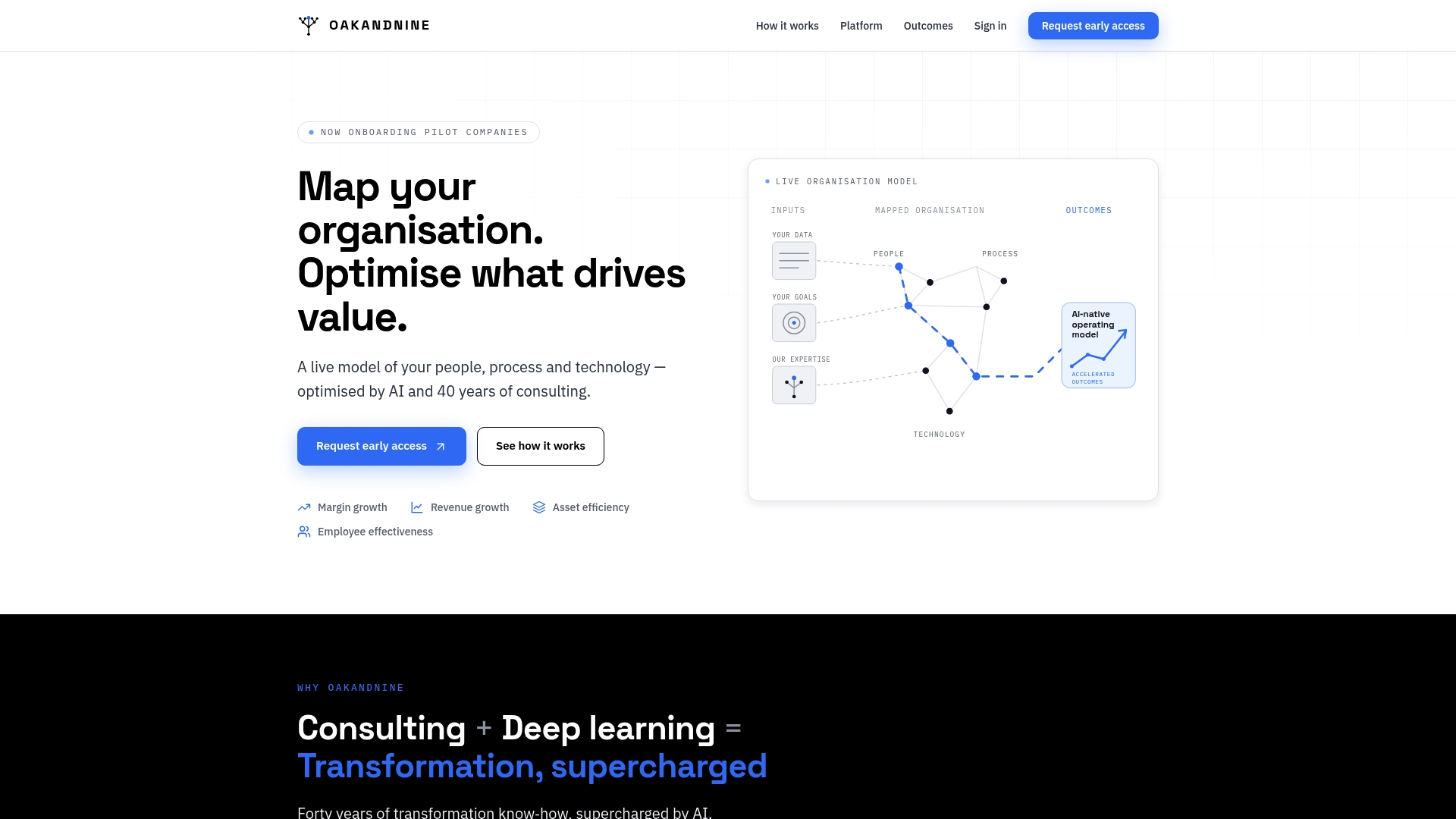
Oakandnine's discovery pilot runs over 30–90 days, scoped to your highest-friction workflows — typically AP automation and close orchestration — with defined success criteria agreed before day one. The platform's live organisational model connects those accounting workflows to the broader operating model, so the gains compound rather than plateau. Backed by four decades of consulting experience and a security posture that meets SOC 2 and ISO 27001 requirements, Oakandnine is built for mid-market organisations that need results, not a proof of concept that never reaches production.
Request a pilot or book a discovery session at oakandnine.com.
Sources and recommended further reading
- Process Automation in Accounting and Finance — IMA: the primary source for baseline close-time data and automation adoption rates; essential reading for any business case.
- Accounting automation's intelligent future — Journal of Accountancy: the clearest published definition of IPA and its distinction from rules-based RPA; recommended for procurement teams evaluating agentic capabilities.
- What is accounting automation? — IBM: comprehensive technical overview of OCR, IDP, machine learning, and agentic AI in finance workflows.
- AI in finance: intelligent process orchestration — SysGen: practical explanation of how orchestration coordinates multi-department financial close processes.
- Accounting automation glossary — Zuora: useful reference for standard definitions and the eleven accounting tasks most commonly automated.
- Automated document processing — Docsumo: detailed treatment of OCR/IDP and touchless AP implementation; useful for scoping the AP automation component of a pilot.
- Numos.ai platform overview: practitioner commentary on agentic platforms and semantic GL understanding.
- Silverfin — cloud post-accounting and compliance: context on cloud-native compliance workflows and the elimination of manual re-entry.