
Business process automation tools are software platforms that design, execute, and monitor business workflows to reduce manual effort and improve operational outcomes. For mid-sized companies in the UK, these platforms sit at the center of operational efficiency, connecting people, systems, and data into a single, manageable flow. The industry term you'll encounter most in analyst reports is BPA, though Gartner now segments the broader market into three distinct technology categories. Getting clear on those distinctions before you evaluate any platform will save you months of misdirected effort.
What key features define effective business process automation tools?
The most effective business process automation tools share five core capabilities that separate genuine workflow platforms from basic task schedulers.
- Visual workflow design. Drag-and-drop process mapping lets business users build and modify workflows without writing code. This matters because the people who understand a process best are rarely developers.
- Integration support. A platform that cannot connect to your existing ERP, CRM, or finance system creates more work than it removes. API-first architecture and pre-built connectors are non-negotiable for mid-market stacks.
- Low-code and no-code interfaces. Business user empowerment is the real productivity multiplier. When your operations team can build and iterate without raising an IT ticket, cycle times drop.
- AI and orchestration features. Modern platforms include AI-guided workflow design, context-aware routing, and agentic workflow capabilities that adapt processes dynamically.
- Governance and audit trails. Mid-sized companies face real compliance obligations. Every platform you evaluate should provide role-based access, version control, and a full audit log.
Reusable workflow components reduce redundancy and maintenance effort across teams. That means a workflow built for your finance team can be adapted for operations without rebuilding from scratch.
Pro Tip: Prioritize platforms that support reusable components and context-aware automation. A workflow you can deploy once and adapt across departments is worth ten single-use automations.
Scalability is the feature most mid-market leaders underweight at the point of purchase. Scalable BPA systems handle increasing volumes, more complex logic, and higher transaction throughput as your business grows. Buy for where you will be in three years, not where you are today.

How has the BPA market evolved and what are the current technology categories?
The automation market has undergone a significant structural shift. Gartner shifted in 2025 from a single "Intelligent Process Automation" category to three distinct segments: RPA, BOAT, and IDP. That change reflects how the market has matured and fragmented, and it has direct implications for how you should evaluate and budget for automation platforms.
| Category | Full Name | Primary Function |
|---|---|---|
| RPA | Robotic Process Automation | Executes predefined tasks by mimicking human interaction with software |
| BOAT | Business Orchestration and Automation Technologies | Converged platform layer integrating low-code, orchestration, and AI |
| IDP | Intelligent Document Processing | Extracts, classifies, and processes data from unstructured documents |
RPA tools specialize in executing predefined tasks such as logging into applications, entering data, and extracting information from documents. They are precise and reliable for high-volume, rule-based work. The limitation is that RPA operates at the task level. It does not coordinate across systems or adapt to changing conditions.
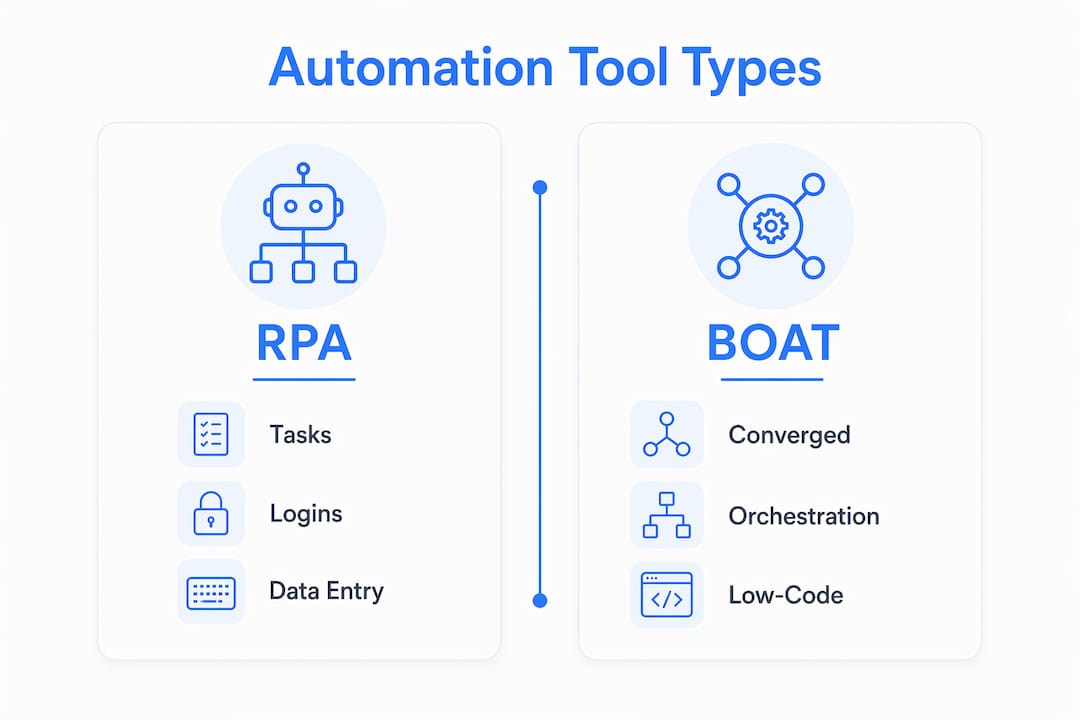
BOAT is the category that most mid-market leaders should focus on in 2026. BOAT represents a converged platform layer that integrates low-code development, process orchestration, and AI-driven automation into a unified control plane. It aligns business intent with technical execution, which is the gap that pure RPA cannot close.
IDP addresses a specific and persistent problem: unstructured data locked inside PDFs, emails, and scanned forms. IDP platforms extract, classify, and validate that data so it can feed into downstream workflows. For industries like financial services, legal, and logistics, IDP is not optional.
Market convergence of low-code platforms, RPA, and AI-driven automation means you should evaluate platforms on orchestration capabilities, not just individual features. A platform that excels at RPA but cannot orchestrate across systems will create a new layer of technical debt.
How should mid-sized businesses select and implement a BPA platform?
Selection and implementation are where most mid-market automation initiatives succeed or fail. A clear, phased approach removes the guesswork.
-
Map your processes first. Before you open a single vendor demo, document the workflows you want to automate. Identify volume, frequency, error rate, and business impact. The processes with the highest manual overhead and the clearest rules are your best starting candidates.
-
Define your evaluation criteria. Score every platform against ease of use, integration depth, scalability, governance features, and total cost of ownership. Weight these criteria against your specific environment, not a generic checklist.
-
Involve both business and IT from day one. The business team understands the process. IT understands the infrastructure. Implementations that exclude either group produce platforms that work technically but fail operationally. Cross-functional alignment is not a soft skill here. It is a delivery requirement.
-
Run a proof of concept on a real process. Pick one high-value, well-documented workflow and build it in your shortlisted platform. A proof of concept reveals integration friction, user experience gaps, and governance limitations that no demo will show you.
-
Phase your rollout. Move from proof of concept to a controlled pilot with one team, then to a broader rollout. Each phase should have defined success metrics before you proceed to the next.
-
Measure ROI with pre- and post-automation data. ROI measurement for BPA involves quantifying time saved, error reduction, and process throughput improvements. Capture your baseline metrics before you go live. Without them, you cannot calculate the return or build the business case for the next phase.
Pro Tip: Assign a process owner for every automated workflow, not just a technical owner. When a workflow breaks or needs updating, you need someone who understands the business logic, not just the configuration.
The workflow automation guide for managers covers platform evaluation in more depth if you are working through a formal procurement process.
How do BPA platforms enable orchestration beyond simple task automation?
Orchestration is the capability that separates a genuine business process automation platform from a collection of disconnected automations. Task automation replaces a single manual step. Orchestration coordinates the entire process across systems, teams, and decision points.
Automation should be viewed as orchestration, not just task replacement, to align business goals with technology execution. That framing changes how you design, govern, and measure your automation program.
Modern orchestration platforms deliver several capabilities that task-level tools cannot:
- Unified design and monitoring consoles. IT and business teams work from the same interface. Business users see process flows in plain language. IT sees the underlying technical configuration. Both groups act on the same data.
- AI-guided workflow construction. BPA tools with AI-guided design can generate workflow blueprints from plain language descriptions of business problems. You describe the outcome you need, and the platform proposes the process model.
- Context-aware routing. Workflows adapt based on real-time data, not just static rules. An invoice approval route changes based on value, supplier risk score, and approver availability, without manual intervention.
- Cross-system coordination. Orchestration platforms connect RPA bots, API calls, human tasks, and AI agents into a single process thread. The result is end-to-end visibility across what used to be fragmented automation islands.
Orchestration platforms unify IT and business teams by providing shared views that connect business intent to technical execution. That shared visibility reduces misalignment and accelerates delivery. For mid-market companies where IT resources are limited, that acceleration is a material operational advantage.
The shift from fragmented task automation to unified orchestration is not a technology upgrade. It is a change in how your organization thinks about process ownership, accountability, and continuous improvement. The technology enables it. The operating model has to support it.
Key Takeaways
Business process automation tools deliver the most value when they are selected for orchestration capability, implemented with cross-functional ownership, and measured against pre-automation baselines.
| Point | Details |
|---|---|
| Define the right category | Gartner's 2025 segmentation separates RPA, BOAT, and IDP. Match the category to your actual problem. |
| Prioritize orchestration over features | BOAT platforms unify low-code, AI, and process coordination into a single control layer. |
| Map processes before selecting tools | Document workflows, volumes, and error rates before opening any vendor demo. |
| Involve business and IT together | Cross-functional alignment during selection and deployment prevents operational failure post-launch. |
| Measure ROI from a baseline | Capture pre-automation metrics to calculate time saved, error reduction, and throughput gains. |
Why most BPA implementations miss the point
I have spent years working with mid-market leadership teams on automation strategy, and the pattern I see most often is this: companies buy a platform before they understand their processes. They get excited about AI features, low-code interfaces, and integration catalogs. Then they automate a broken process and wonder why the results disappoint.
The uncomfortable truth is that automation amplifies what already exists. A well-designed process becomes faster and more consistent. A poorly designed process becomes a faster source of errors. The technology is not the hard part. Process clarity is.
The second mistake I see is treating automation as an IT project. The best implementations I have worked on had a business sponsor who owned the outcome, not just a technical lead who owned the configuration. When the business owns the process, the automation stays aligned with what actually matters.
The third thing worth saying: the BOAT category is where mid-market companies should be placing their attention in 2026. Pure RPA is a point solution. Orchestration is an operating model capability. If you are evaluating platforms now, ask every vendor how their platform connects business intent to technical execution across your full process landscape. That question will tell you more than any feature comparison.
For teams thinking about improving operational efficiency beyond individual automations, the real prize is a coherent operating model where people, processes, and technology are visible and connected. That is where the margin lives.
— Ronan
How Oakandnine supports mid-market automation strategy
Mid-sized companies rarely lack ambition when it comes to automation. What they lack is a clear picture of their operating model before they commit to a platform.
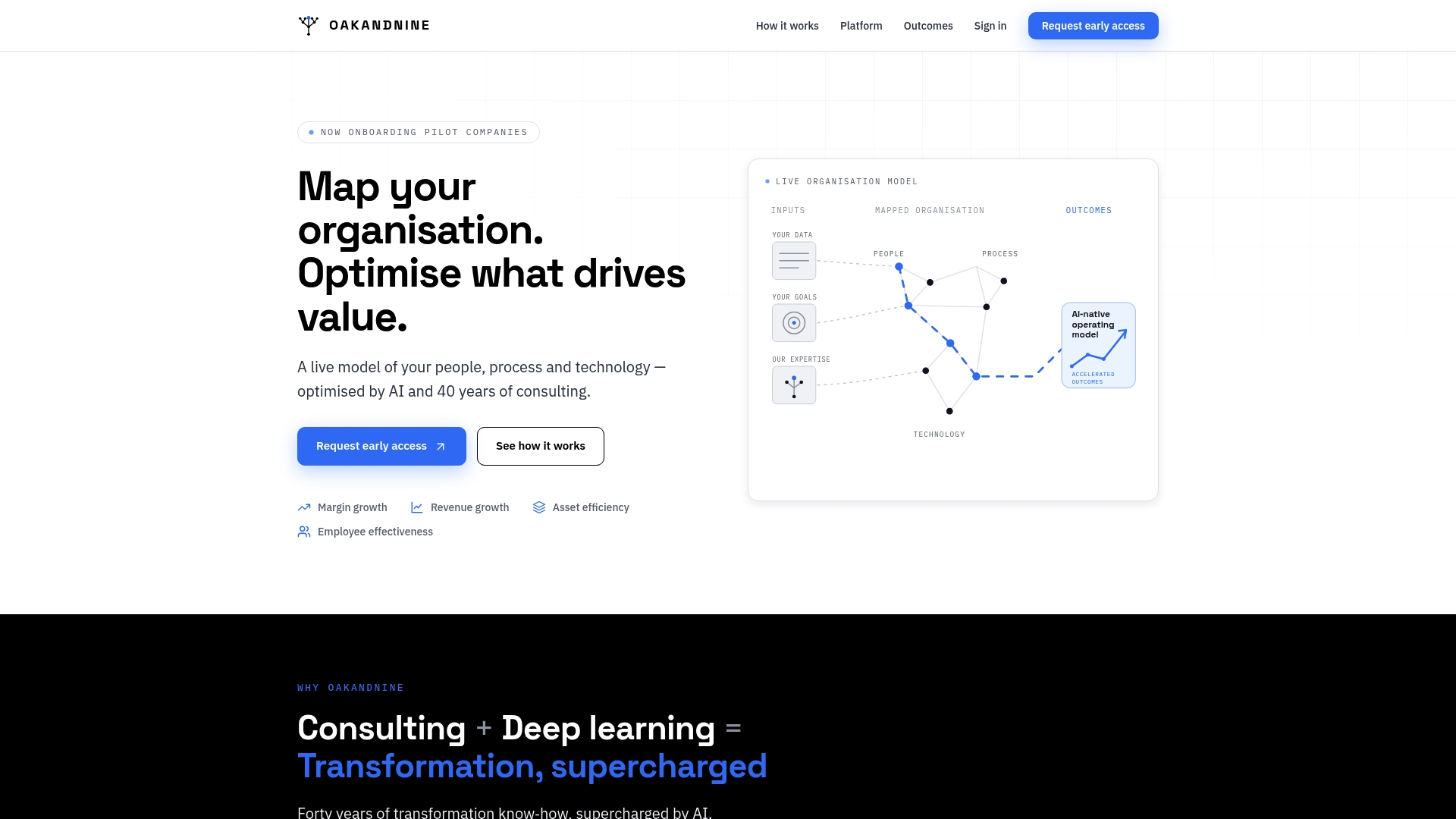
Oakandnine brings four decades of consulting experience to exactly that problem. The platform builds a live model of your organization, mapping people, processes, and technology into a single connected view. That model becomes the foundation for identifying where automation creates real value and where it would simply accelerate existing friction. If you are ready to move from scattered automations to a coherent operating model, Oakandnine gives you the structure and the expertise to do it well.
FAQ
What are business process automation tools?
Business process automation tools are software platforms that design, execute, and monitor workflows to reduce manual effort and improve operational consistency. They range from task-level RPA tools to full orchestration platforms that coordinate people, systems, and AI agents.
What is the difference between RPA and BOAT?
RPA executes predefined tasks by mimicking human interaction with software interfaces. BOAT is a converged platform layer that integrates low-code development, process orchestration, and AI-driven automation into a unified control plane.
How does Gartner categorize automation tools in 2025?
Gartner shifted in 2025 from a single "Intelligent Process Automation" category to three distinct segments: Robotic Process Automation, Business Orchestration and Automation Technologies, and Intelligent Document Processing.
How do mid-sized companies measure ROI from BPA?
ROI measurement involves quantifying time saved, error reduction, and process throughput improvements by comparing pre- and post-automation metrics. Capturing a baseline before go-live is the critical first step.
What should mid-market leaders prioritize when selecting a BPA platform?
Prioritize orchestration capability, integration depth, low-code interfaces for business users, and governance features. Evaluate platforms against your specific process landscape, not a generic feature checklist.