
The strongest SAP alternatives available to UK businesses right now are Sage, Xero, and Oracle NetSuite. Each addresses a distinct failure mode of traditional SAP deployments: cost, complexity, and the mismatch between enterprise-grade architecture and mid-market operational reality. Here is what each brings to the table:
- Sage — AI-powered ERP and accounting for SMEs; pricing starts at £2/month (then £20/month excluding VAT); includes Sage Copilot AI assistant, payroll, and HR; trusted by a large global user base; cloud and on-premises deployment.
- Xero — Award-winning cloud accounting used by over 4.9 million customers; AI finance partner (JAX) automates invoicing and receipt capture; strong fit for accountants, non-profits, and trades; multiple 2026 industry recognitions including G2 Users Love Us and TrustRadius Buyers Choice.
- Oracle NetSuite — The #1 AI Cloud ERP for mid-sized to large businesses; covers financials, CRM, ecommerce, inventory, and manufacturing in one platform; pricing on request; built for global financial consolidation and multi-entity operations.
All three are cloud-first, actively developed, and available to UK businesses today.
How Sage, Xero, and Oracle NetSuite compare as SAP alternatives
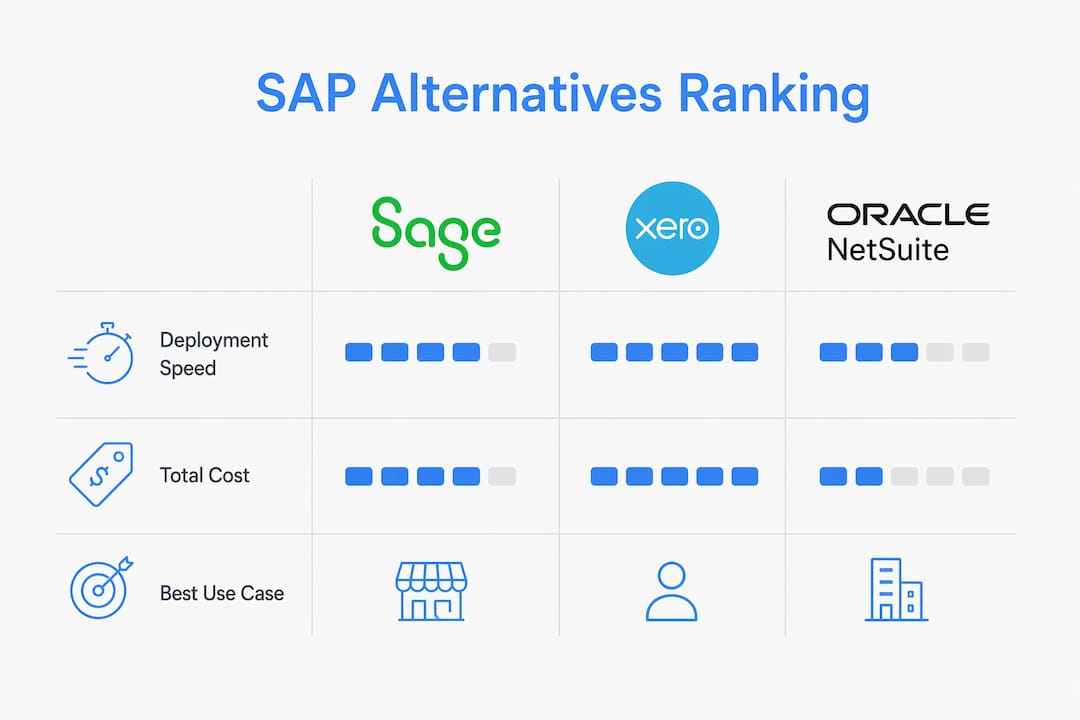
Three platforms, three distinct use cases. The table below maps the critical decision dimensions.

| Platform | Best for | Business size | Pricing | Core features | Deployment |
|---|---|---|---|---|---|
| Sage | Integrated accounting, payroll, HR with AI | Small to mid-market | From £2/month (excl. VAT) | Sage Copilot AI, payroll, HR, cloud finance | Cloud and on-premises |
| Xero | Cloud accounting, bookkeeping, trades | Small businesses, accountants | Tiered subscription plans | JAX AI partner, smart invoicing, app integrations | Cloud-only |
| Oracle NetSuite | Global financial consolidation, multi-function ERP | Mid-sized to large enterprises | Price on request | Financials, CRM, ecommerce, inventory, manufacturing | Cloud (SaaS) |
Sage is the most complete out-of-the-box option for UK SMEs that need accounting, payroll, and HR under one roof. Sage Copilot delivers AI-assisted financial automation across every business stage, from first invoice to multi-entity scale-up. Payroll and HR pricing details are available from Sage, which makes the total cost of entry genuinely accessible for growing businesses.
Xero wins on pure accounting usability. Its JAX AI finance partner and smart document capture automate the invoice and receipt workflows that consume hours of manual effort each week. The platform's 2026 recognition across G2, Capterra, SoftwareAdvice, and TrustRadius reflects consistent user satisfaction, particularly among accountants and sector-specific businesses like construction firms and non-profits.

Oracle NetSuite operates at a different scale entirely. It unifies financials, CRM, ecommerce, inventory, and manufacturing ERP in a single AI-driven platform, which is exactly what mid-sized companies with multiple subsidiaries or cross-border operations need. Pricing is not published; prospective customers request a demo and a tailored quote. For businesses outgrowing Sage or Xero but not ready for a full SAP S/4HANA commitment, NetSuite is the natural next step.
A note on implementation timelines: modern cloud ERP systems can often deploy much faster than legacy SAP migrations, with smaller business implementations sometimes completing in days; more complex mid-market deployments take longer but remain more rapid than traditional SAP projects.
How to choose the right SAP alternative for your UK business
Gartner's ERP research makes one point clearly: there is no universal best SAP alternative. The right choice depends on which SAP product you are replacing, your existing technology ecosystem, and your appetite for operational complexity. Work through these criteria before shortlisting:
- Business size and complexity. Sage and Xero serve SMEs well. NetSuite handles multi-entity, multi-currency operations. For large enterprises with regulated manufacturing, SAP competitors like IFS, Epicor, or Microsoft Dynamics 365 Business Central may be more appropriate.
- Industry fit. Xero has deep traction in trades, non-profits, and professional services. NetSuite covers manufacturing and distribution. Sage spans most SME verticals.
- Existing tech stack. If your organization runs on Microsoft 365, Dynamics 365 Business Central integrates natively with Teams, Outlook, and Power BI, reducing integration overhead significantly.
- Deployment preference. All three featured platforms are cloud-first. If you need on-premises or hybrid, Sage offers that flexibility; Xero and NetSuite do not.
- Budget. Sage's published pricing makes budgeting straightforward. Xero's tiered plans are similarly transparent. NetSuite requires a custom quote, which means you need a demo conversation before you can model total cost.
- Change management. Moving from entrenched SAP environments involves cultural and operational shifts, not just a technology swap. Budget time and resources for managing that transition alongside the technical deployment.
Pro Tip: Before you sign any contract, map your full ecosystem cost: integration fees, training, data migration, and ongoing support. These costs routinely exceed the licensing fee itself, and they are the number that determines whether your ERP investment actually delivers ROI.
Request demos from at least two vendors. Run a structured pilot against your real workflows, not a vendor-curated sandbox. The platform that your finance and operations teams actually adopt is the one that delivers value.
Total cost of ownership: the fees most businesses miss
Licensing is the visible cost. The real total cost of ownership includes integration, training, data migration, customization, and ongoing support, and those costs can dwarf the subscription fee. This is where SAP's complexity historically punished mid-market businesses: a system that required specialist consultants for every configuration change created a dependency that never ended.
Cloud-native alternatives shift that equation. SaaS ERP deployments replace large upfront licensing fees with predictable monthly subscriptions, which improves cash flow and makes cost modeling more reliable. But hidden costs still exist across all platforms:
- Integration overhead. Connecting your ERP to existing tools like CRM, payroll, ecommerce, or logistics platforms takes time and often requires middleware or developer hours. Xero's extensive app marketplace reduces this for small businesses. NetSuite's unified architecture reduces it for larger ones.
- Training and adoption. A system your team does not use is a system that generates no return. Budget for structured onboarding, not just a login and a help center link.
- Customization costs. Every deviation from standard configuration adds cost. Cloud ERPs with low-code or no-code customization tools, like Xero's app integrations or NetSuite's SuiteScript, keep these costs lower than traditional SAP customization via ABAP.
- Support tiers. Basic support is typically included. Priority or dedicated support costs more. For UK businesses with compliance obligations around payroll, VAT, and Making Tax Digital, responsive support is not optional.
Understanding why businesses plateau operationally often comes down to underestimating these ongoing costs and overestimating how quickly a new system will pay for itself. Build a three-year TCO model before you commit.
Oakandnine addresses what ERP systems alone cannot
ERP platforms manage transactions. What they rarely do is show you why your operations are underperforming, where friction lives in your processes, or how your people, systems, and workflows connect across the organization.
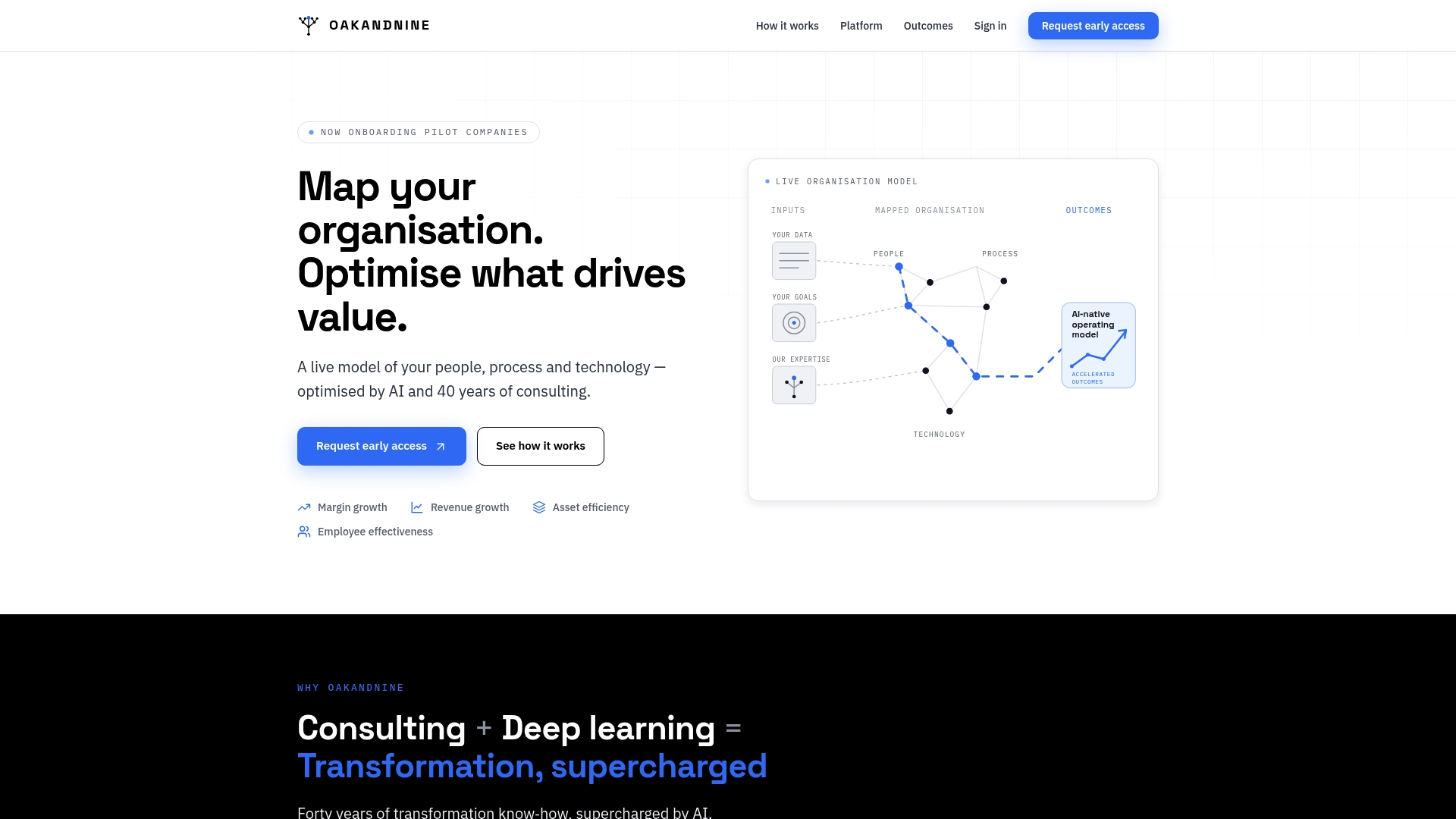
Oakandnine is built for exactly that gap. For mid-market companies that have deployed an ERP and still find themselves working around it rather than through it, Oakandnine's AI-driven platform maps your entire operating model in real time, connecting people, processes, and technology into a single coherent view. It identifies bottlenecks, surfaces asset inefficiencies, and turns scattered operational data into the kind of clarity that drives margin growth and revenue enablement. Backed by four decades of consulting experience, it is not a replacement for your ERP. It is the layer that makes your ERP investment actually work.
If you are evaluating workflow management options alongside your ERP decision, or if you have already deployed a system and want to understand where it is costing you more than it saves, explore the Oakandnine platform and see what a live organizational model looks like in practice.
Key Takeaways
The right SAP alternative depends on business size, existing tech ecosystem, and total cost of ownership, not just licensing price.
| Point | Details |
|---|---|
| Sage leads for UK SMEs | Pricing from £2/month with AI-powered accounting, payroll, and HR in one platform. |
| Xero wins on usability | Used by over 4.9 million customers; JAX AI automates invoicing for small businesses and accountants. |
| NetSuite suits complex operations | Best for mid-to-large businesses needing unified financials, CRM, ecommerce, and manufacturing ERP. |
| TCO goes beyond licensing | Integration, training, customization, and support costs often exceed the subscription fee itself. |
| Oakandnine fills the operational gap | Where ERP manages transactions, Oakandnine maps and connects your full operating model to drive efficiency and margin growth. |