
The five digital transformation best practices that consistently move the needle for UK mid-market companies are sustained leadership sponsorship, outcome-first strategy, trigger-based agility, structured change management, and finance integration from day one. Get these right and you have the operating model for a transformation that compounds. Miss any one of them and you are likely in the 48% of digital initiatives that fail to meet or exceed business targets, according to Gartner's 2026 CIO and Technology Executive Survey.
- Leadership sponsorship: Active, visible sponsor presence throughout, not just at launch
- Outcome-first strategy: Every initiative tied to a measurable value driver before a single pound is spent
- Trigger-based agility: Replace annual planning cycles with event-driven reprioritisation
- Structured change management: Budget, methodology (Prosci ADKAR), and adoption metrics built in from the start
- Finance integration: CFO co-owns the business case and controls stage-gate funding
Stat to anchor your board conversation: Only 18% of CIOs currently embrace dynamic, off-cycle reprioritisation, yet those who do are 24% more likely to be top performers.
Table of Contents
- Why do so many UK mid-market digital transformations fail?
- The evidence-backed best practices, in detail
- How do you start? A practical 90-day pilot plan
- How do you measure success and work with the CFO?
- Data, AI readiness, and UK compliance
- What do timelines and pilot budgets look like?
- What are the red flags that signal a stalling transformation?
- How do you secure genuine organisational buy-in?
- How do you close the skills gap before it closes the programme?
- How do you choose the right technology partner for a UK mid-market company?
- Oakandnine gives UK mid-market leaders a live operating model to work from
- Key takeaways
- Why culture-first, trigger-based planning works for UK mid-market firms
- Useful sources for UK mid-market leaders
Why do so many UK mid-market digital transformations fail?
The mismatch between ambition and delivery is stark. Gartner's 2026 survey shows 94% of CIOs expect major changes to their digital plans within 24 months, yet only 48% of digital initiatives meet or exceed business targets. The gap is not a technology problem. It is a governance, sequencing, and measurement problem.
The most common failure modes in UK mid-market programmes:
- Digitising broken processes: Automating a flawed workflow embeds the flaw at scale
- Governance confusion: No clear decision rights, no steering committee, no funding discipline
- Input metrics masquerading as outcomes: Tracking tools deployed or budget spent rather than revenue impact or error-rate reduction
- Underfunded change management: Treating training as an afterthought rather than a core workstream
- No finance co-ownership: Transformation budgets that sit outside the CFO's purview drift without accountability
The sequencing error costs more than the technology. Organisations that skip value-chain diagnostics before platform selection routinely discover duplicate approvals, manual workarounds, and broken handoffs only after they have committed capital to a system that locks those problems in.
The evidence-backed best practices, in detail
01. Leadership and sponsorship
Sustained sponsor presence is the single strongest predictor of transformation success, per Prosci benchmarking. That means the sponsor is visible at steering committee reviews, removes blockers personally, and communicates progress to the wider organisation. A transformation office with a dedicated owner, clear decision rights, and a direct line to the CFO is the structural expression of that commitment.
02. Outcome focus and portfolio governance
Treat transformation as an investment portfolio. Each initiative must map to a value driver (margin, revenue, asset efficiency, employee effectiveness) and pass a stage-gate before the next funding tranche is released. BCG recommends a transformation office with tight finance integration to sustain this discipline. Success metric: value delivered per initiative at each gate, not activities completed.
03. Trigger-based, event-driven planning
Static multi-year roadmaps are a liability in an AI-volatile market. Replace calendar-driven planning cycles with defined triggers: a competitor move, a regulatory change, an AI capability that materially shifts your cost base. McKinsey's guidance on steering committee cadence supports quarterly outcome reviews with the authority to reprioritise or stop initiatives between cycles.
04. Change management and capability building

People and culture are the decisive barrier in most programmes. Embed a structured change methodology with role-specific training, designated change champions in each workstream, and a weekly adoption pulse. Measure active users versus licensed users as your earliest leading indicator.
05. Data, AI, and technology foundations
Fix processes before you buy platforms. Run a value-chain diagnostic to surface broken workflows, then validate API connectivity, data lineage, and encryption standards before committing to a vendor. For AI pilots, align governance and ethical guardrails from the outset and measure AI outputs against business KPIs, not model accuracy alone.
06. Measurement and finance integration
Involve the CFO from day one. Use outcome-based KPIs tied to value drivers and enforce decision gates that require financial evidence before further capital is released. Separate monthly delivery reviews (are we building what we planned?) from quarterly outcome reviews (is it generating the value we projected?).
Pro Tip: Front-load a 90-day value play in your first pilot. A measurable operational gain within that window proves the operating model, builds board confidence, and gives the CFO the evidence needed to release the next funding tranche without a lengthy re-approval process.
How do you start? A practical 90-day pilot plan
The goal of the first 90 days is a proof-point, not a full deployment. Phased pilots reduce paralysis and give you the evidence to choose what to scale.
- Days 1–10: Define 3–5 measurable outcomes on a single page. Run a value-chain diagnostic to identify 1–2 high-impact pilot candidates. Secure executive sponsor and CFO alignment in writing.
- Days 11–20: Design the pilot scope, assign a transformation owner and workstream leads, and agree the measurement plan (leading and lagging KPIs).
- Days 21–30: Complete a readiness audit covering data quality, system integration capability, and change management resource. Finance sign-off on the pilot budget.
- Days 31–60: Execute the pilot. Track adoption weekly (active/licensed ratio). Hold a mid-point delivery review with the steering committee.
- Days 61–90: Collate the financial readout. Present adoption data, process improvement evidence, and a go/no-go recommendation to the steering committee.
Decision gate template at Day 90:
- Adoption rate above agreed threshold (active/licensed users)
- At least one process KPI improved versus baseline
- Finance-validated projection for the next phase
- Documented ownership handoffs for scale
How do you measure success and work with the CFO?
Outcome-based metrics, not input metrics, are the standard. The active/licensed user ratio is your most practical leading indicator within the first six months.
| Initiative | Value driver | Leading KPI | Target | Funding gate |
|---|---|---|---|---|
| Process automation pilot | Margin improvement | Active/licensed user ratio | — | Release Phase 2 budget |
| Data unification | Asset efficiency | Data completeness score | >90% by Day 90 | Proceed to integration |
| AI workflow assistant | Employee effectiveness | Tasks automated per week | Agreed baseline +30% | Scale to second team |
Cadence: Monthly delivery reviews confirm build progress. Quarterly outcome reviews confirm value delivery and trigger funding decisions. The CFO needs three things at each gate: adoption evidence, a process improvement delta, and a forecasted cash impact with sensitivity ranges.
Pro Tip: Translate operational gains into finance language early. A 15% reduction in manual processing time means nothing to a CFO until you express it as headcount redeployment value or throughput capacity released. Build that translation into your measurement plan from Day 1.
Data, AI readiness, and UK compliance
Readiness requires process optimisation, data quality, and governance before major platform purchases. For UK mid-market teams, GDPR compliance is a procurement constraint, not an afterthought.
Pre-scale checklist:
- Data lineage: Can you trace every data point from source to output?
- API and connector validation: Test integration capability in a sandbox before contract signature
- Encryption: At rest and in transit, confirmed in vendor security documentation
- ISO 27001: Require evidence of certification or equivalent for any vendor handling personal data
- Data residency: Confirm UK or EEA data storage for GDPR compliance; get it in the contract
- AI governance: Define human-in-the-loop requirements for any agentic or generative AI workflow
- Vendor due diligence: Review sub-processor lists and data processing agreements before sign-off
Pro Tip: Build a break-clause into vendor contracts at the 12-month mark, tied to integration performance metrics. It is the most effective lever against lock-in and it forces vendors to deliver on their integration promises early.
What do timelines and pilot budgets look like?
Pilots should be time-boxed at 90–180 days and funded as staged investments, with each tranche contingent on gate evidence.
| Phase | Typical duration | Budget band (illustrative) | Gate condition |
|---|---|---|---|
| Pilot | 90–180 days | £30k | Adoption + process KPI met |
| Controlled scale | 90–180 days | £150k | Financial readout positive |
| Enterprise rollout | 12–24 months | — | Portfolio value confirmed |
Scale by dependency and value-capture potential, not by enthusiasm. Front-load the capabilities that unblock the most downstream value.
Pro Tip: Size the next funding tranche using the pilot's adoption rate and throughput improvement as the primary inputs. A pilot that achieves 80% adoption and a 20% throughput gain gives the CFO a defensible extrapolation. A pilot that hits neither should not proceed.
What are the red flags that signal a stalling transformation?
Act on these early. Each one is recoverable if caught within the first 90 days; most are not recoverable at month 18.
- Low adoption (active/licensed ratio below 50% at Day 60): Remediation: pause deployment, run targeted change management sprint, identify and remove adoption blockers
- Governance confusion (no clear decision rights): Remediation: convene steering committee within two weeks, document RACI and funding rules
- No finance-owned KPIs: Remediation: schedule CFO working session to co-author the measurement plan
- Digitising broken processes: Remediation: halt platform configuration, run a two-week value-chain diagnostic first
- Patchwork integrations: Remediation: commission a system integration audit before adding further connectors
- Underfunded change management: Remediation: ring-fence a minimum of 15% of the programme budget for training and change resource
When to stop versus reshape: Stop an initiative when two consecutive gates produce no adoption improvement and the finance case has deteriorated. Reshape when adoption is growing but the scope was mis-sized; reduce scope, re-baseline, and re-gate.
How do you secure genuine organisational buy-in?
Stakeholder engagement is not a communications plan bolted onto a project plan. It is a governance function. Map stakeholders by influence and impact at the outset, then assign a named change champion to each high-influence group.
Communication cadence matters as much as content. Senior leaders need a monthly outcome narrative tied to business metrics. Middle managers need weekly operational updates that answer "what does this mean for my team?" Front-line staff need role-specific training before go-live, not after. The change management software you select should support this tiered communication model natively.
One often-overlooked lever: make resistance visible and safe to express. Transformation programmes that suppress dissent discover it later, at the worst possible moment, usually at go-live. Structured feedback loops, anonymous pulse surveys, and change champion debriefs give you early warning and a mechanism to act.
How do you close the skills gap before it closes the programme?
Run a skills gap assessment in parallel with your value-chain diagnostic, not after it. Map the capabilities your target operating model requires against your current workforce profile. The gap between those two states is your reskilling agenda.
For UK mid-market teams, the most common gaps in 2026 are: data literacy, AI prompt engineering and governance, process design, and change facilitation. Prioritise role-specific training over generic digital literacy programmes. A finance analyst who understands how to interrogate an AI-generated forecast is more valuable than one who has completed a broad "digital skills" module.
Build capability in waves aligned to your pilot sequence. The employee engagement strategies that sustain reskilling programmes share a common feature: they tie learning directly to a live work context, not a classroom simulation. Measure capability uplift as a programme KPI alongside adoption.
How do you choose the right technology partner for a UK mid-market company?
Vendor selection is a risk management decision as much as a capability decision. For UK mid-market firms, the evaluation criteria that matter most:
- Integration depth: Does the vendor's API library cover your existing systems? Test it in a sandbox, not a demo.
- UK data residency and GDPR compliance: Non-negotiable. Require written confirmation and review the data processing agreement before shortlisting.
- Mid-market fit: Enterprise platforms scaled down are rarely the right answer. Evaluate whether the vendor's implementation model, support tier, and pricing structure are designed for organisations of your size.
- Reference clients at comparable scale: Ask for references from UK mid-market deployments specifically, not global enterprise case studies.
- Exit provisions: Confirm data portability, contract break clauses, and transition support terms before signing.
- AI governance maturity: For any AI-enabled platform, review the vendor's model governance documentation, bias testing approach, and human-override capability.
The business process management platforms that perform best in UK mid-market deployments tend to be those with a strong integration layer, transparent pricing, and a named customer success contact from day one.
Oakandnine gives UK mid-market leaders a live operating model to work from
Most transformation programmes start with a static slide deck and end with a gap between what was planned and what was built. Oakandnine starts differently: with a live organisational model that maps your people, processes, and technology as they actually operate, not as they were designed to operate.
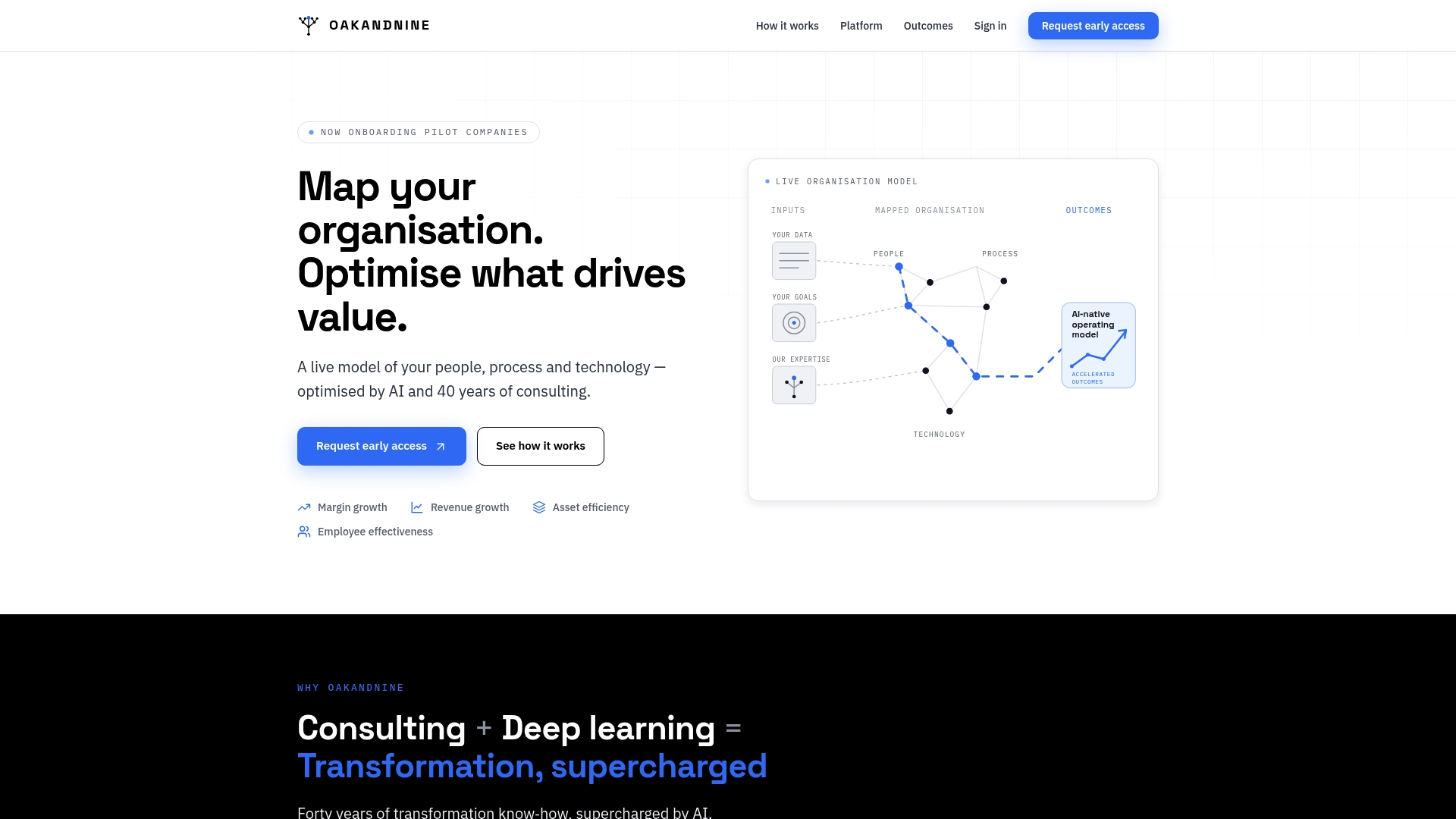
That live model is the foundation for everything the best practices above require. Friction points surface before you commit capital. Integration gaps appear before you sign a vendor contract. Adoption patterns are visible in real time, not in a quarterly report. Oakandnine's AI-driven platform connects structured and unstructured business data into a single operating model, so the CFO sees the same picture as the transformation owner, and funding decisions are grounded in evidence rather than optimism.
For UK mid-market leaders ready to move from planning to proof-point, Oakandnine supports the full pilot-to-scale journey: readiness diagnostics, outcome definition, measurement frameworks, and finance alignment. Start with a working session to map your operating model and identify your highest-value pilot candidate.
Key takeaways
The single most important discipline in mid-market digital transformation is measuring employee adoption (active/licensed user ratio) as your leading indicator from Day 1, because it predicts whether value will materialise before you have spent the budget to find out.
| Point | Details |
|---|---|
| Define outcomes first | Write 3–5 measurable outcomes before selecting any technology or vendor. |
| Secure CFO co-ownership | Finance must co-author the business case and control stage-gate funding from the outset. |
| Run a 90-day pilot | Time-box the first pilot to 90 days with a formal go/no-go gate at the end. |
| Measure adoption weekly | Track active/licensed user ratio as the earliest leading indicator of programme health. |
| Use Oakandnine's live model | Oakandnine maps people, processes, and technology in real time to surface friction and align capital to proven outcomes. |
Why culture-first, trigger-based planning works for UK mid-market firms
The conventional wisdom says digital transformation is a technology problem. It is not. Every programme I have seen stall does so because the operating model was never properly mapped, the change management budget was the first line cut, or the CFO was brought in too late to shape the business case. The technology was usually fine.
What works, consistently, is starting with the operating model as a live artefact rather than a static diagram. When you can see how work actually flows, where it slows, and which handoffs are costing you margin, the technology choices become obvious. The sequencing becomes defensible. The CFO can see the logic. That is precisely what Oakandnine's approach is built around: four decades of consulting experience expressed through an AI-driven platform that keeps the operating model current as the business changes.
Trigger-based planning is not a methodology preference. In a market where AI capabilities are shifting cost structures quarterly and geopolitical volatility is reshaping supply chains, a static three-year roadmap is a liability. The 24% performance advantage that Gartner attributes to dynamic reprioritisation is not a marginal gain. It is the difference between a transformation that compounds and one that stalls at the pilot stage.
If you are a UK mid-market leader with a transformation on the horizon or already in flight, the 90-day plan above is a place to start. Oakandnine can help you run it.
Useful sources for UK mid-market leaders
The claims in this article draw on primary research and practitioner frameworks. These are the sources worth reading in full:
-
Gartner 2026 CIO and Technology Executive Survey: The primary data source on initiative success rates, dynamic reprioritisation, and CIO priorities for 2026. Essential reading for board-level conversations about transformation investment.
-
Prosci — Digital transformation best practices: The most rigorous practitioner resource on change management methodology, sponsorship models, and adoption measurement. Use it to build your change management workstream.
-
BCG — How to create a transformation that lasts: BCG's guidance on transformation office design, stage-gate governance, and finance integration. Directly applicable to mid-market programme structures.
-
McKinsey — Five moves to make during a digital transformation: Practical guidance on steering committee design, decision rights, and ownership handoffs as programmes move from pilot to scale.
-
Business Transformation Strategy: A step-by-step guide: The clearest articulation of why value-chain diagnostics must precede platform selection, with a practical framework for sequencing initiatives.
-
Savvycom — Digital transformation checklist: A practitioner checklist covering KPI selection, adoption measurement, and pilot design. Useful as a working document for transformation owners.
"Digital transformation succeeds when it is governed like an investment portfolio: sequence initiatives, assign owners, and enforce funding gates." — Business Transformation Strategy: A step-by-step guide