
Which business process management platform leads in the UK?
The right business process management platform does more than automate tasks. It connects people, systems, and data into a coherent operating model that you can actually see, measure, and improve. For UK organizations evaluating options in 2026, three platforms stand out across different use cases and organizational profiles.
| Platform | monday.com | City Process Management | Business Process & Control Management Solutions LTD |
|---|---|---|---|
| Best for | SMBs and enterprises needing flexible AI-integrated workflow management | UK enterprises seeking localized, customizable BPM consultancy | Health sector organizations requiring specialized BPM tools |
| Industry focus | Retail, media, government, general enterprise | Cross-sector with UK market specialization | Healthcare and regulated industries |
| AI and automation | AI assistant, agent builder, workflow automations | Bespoke process control design | Process optimization with control management |
| Scalability | High — free tier to enterprise | Tailored to client scale | Specialized mid-to-large organizations |
| Pricing model | Free plan available; tiered paid plans | Not publicly listed | Not publicly listed |
| Customer support | Platform documentation, community, enterprise support | Consultancy-led engagement | Consultancy-led engagement |
| Google rating | 3.7★ (21 reviews) | — | — |
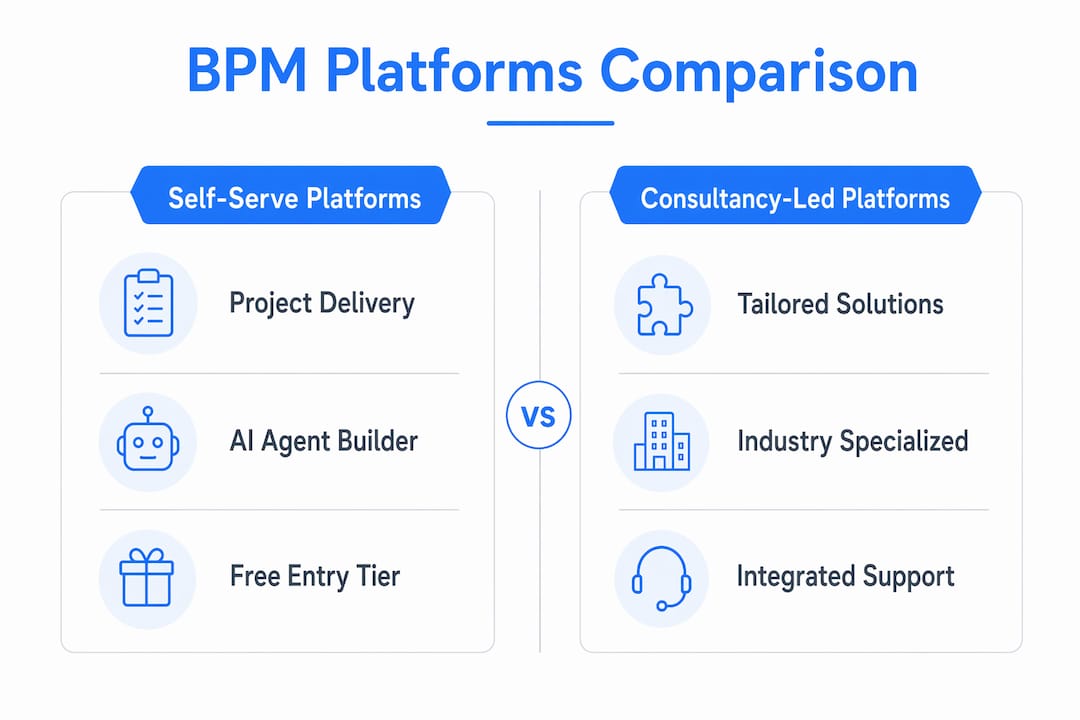
monday.com is the most feature-complete self-serve option, with an AI agent builder and a free entry tier that lets teams test the platform before committing. City Process Management takes a consultancy-first approach, building bespoke process control frameworks for UK clients rather than deploying off-the-shelf software. Business Process & Control Management Solutions LTD focuses specifically on the health sector, where process governance and compliance carry regulatory weight that generic platforms rarely address out of the box.

How do these platforms compare on features, AI, and support?
A BPM platform models, automates, executes, and monitors end-to-end processes coordinating people, software, and IoT devices for specific business outcomes. The three platforms above approach that definition from very different angles.
monday.com delivers a broad feature set: project delivery, marketing campaign management, IT ticketing, HR onboarding, and sales pipeline tools all sit within a single workspace. Its AI assistant handles task suggestions and workflow generation, while the Agent Builder lets teams configure autonomous agents for repeatable processes. Integration depth is a genuine strength, with native connectors across CRM, finance, and communication tools. For teams that want to automate workflows without heavy IT involvement, this is the most accessible starting point.

City Process Management operates differently. Rather than licensing software, it designs and implements tailored process control frameworks for UK clients. That consultancy model suits organizations with complex, non-standard processes that off-the-shelf tools handle poorly. The tradeoff is implementation time and cost, which depend entirely on project scope.
Business Process & Control Management Solutions LTD applies the same consultancy model to healthcare specifically. Health sector BPM carries requirements around clinical governance, audit trails, and regulatory compliance that demand domain expertise, not just workflow tooling. For NHS-adjacent or private health organizations, that specialization is the deciding factor.
Pro Tip: When comparing BPM vendors, separate the platform's native AI capabilities from its integration with third-party AI tools. Native AI, like monday.com's Agent Builder, is faster to deploy. Third-party integrations offer more flexibility but add configuration overhead.
Modern BPM suites from vendors like IBM Business Automation Workflow, Appian, and Oracle BPM have evolved to include visual modeling, real-time analytics, and process monitoring. That broader market context matters when you're evaluating scalability: monday.com competes in this space through ease of use and AI accessibility, while the two UK consultancies compete on depth of local expertise.
What are the key benefits of BPM software for UK organizations?
Process standardization is the most immediate payoff. When every team follows the same documented workflow, errors drop and onboarding accelerates. Business process automation reduces reliance on manual intervention, freeing staff to focus on work that requires judgment rather than repetition.
Beyond efficiency, BPM software delivers:
- Operational transparency. Every process step is visible, logged, and auditable, which matters for UK organizations subject to GDPR and sector-specific regulations.
- Cost reduction. Automated handoffs and exception handling cut the labor cost of routine processes without requiring headcount changes.
- Compliance support. Audit trails and access controls built into BPM platforms make regulatory reporting faster and more defensible.
- Agility. When a process needs to change, a well-modeled BPM environment lets you update the workflow without rebuilding the underlying system.
- Scalability. As transaction volumes grow, automated processes scale without proportional increases in operational overhead.
The combination of BPM and business process automation (BPA) is particularly powerful; for expert guidance on leveraging these technologies, consider Tech Business Development's IT & Automation Services. As Red Hat explains, BPM maps and templates the full process landscape, while BPA executes automation at the task level. Together, they create a framework for continuous improvement rather than one-time fixes.
What core and advanced features should you prioritize?
Core features are non-negotiable. Any credible BPM platform must include process modeling with visual design tools, an execution engine that runs workflows reliably, and monitoring dashboards that surface bottlenecks in real time. Without these three, you're managing processes manually with a digital wrapper.
Advanced features separate the platforms worth investing in from those you'll outgrow:
- AI-driven bottleneck detection. Modern BPM platforms have evolved into intelligent process automation suites that use machine learning to identify friction points before they become failures.
- AI agent orchestration. Platforms like monday.com let you configure agents that execute multi-step processes autonomously, reducing human touchpoints in predictable workflows.
- Real-time analytics. Process performance data should update continuously, not in batch reports. Live dashboards let operations teams respond to deviations as they happen.
- Low-code customization. Business users should be able to modify workflows without raising IT tickets. Low-code interfaces are now standard in leading platforms.
- Integration with existing systems. BPM platforms must connect with enterprise applications to maintain data consistency across the organization.
- Role-based access controls. Granular permissions protect sensitive process data and support compliance requirements.
Usability deserves equal weight alongside features. A platform your teams won't adopt consistently delivers no value regardless of its technical capabilities.
What emerging trends are reshaping BPM in 2026?
Hyperautomation is the defining shift. The term describes the combination of AI, machine learning, robotic process automation (RPA), and BPM into a single orchestration layer that manages both human and digital workers. Intelligent process automation goes further, applying AI to unstructured data, like emails, documents, and voice inputs, to trigger and route workflows that previously required human interpretation.
Three trends worth tracking for your BPM investment decisions:
- Agent-run processes. AI agents that execute multi-step workflows without human approval at each stage are moving from experimental to production-ready in platforms like monday.com.
- Process mining integration. Leading vendors are embedding process mining directly into their platforms, so the system discovers actual process behavior from system logs rather than relying on manually documented workflows.
- Generative AI in process design. Tools like Newgen's NewgenOne Marvin use generative AI to accelerate application and workflow design, cutting the time from process discovery to deployment.
For forward-looking BPM investments, the question isn't whether your platform supports AI. It's whether the AI capabilities are native to the process execution layer or bolted on as an afterthought.
How should you evaluate security and compliance in BPM platforms?
UK organizations face a specific compliance environment. GDPR governs how process data involving personal information is stored, accessed, and deleted. Sector-specific regulations, particularly in financial services and healthcare, add further requirements around audit trails and data residency.
Key security and compliance criteria to evaluate:
- Audit trail completeness. Every process action should be logged with timestamp, user identity, and outcome. BPM platforms that support governance include immutable audit logs as a core feature.
- Access controls. Role-based permissions should extend to individual process steps, not just platform-level access.
- Data residency. For UK organizations post-Brexit, confirm where your process data is stored and whether the vendor offers UK or EU data centers.
- Vendor security credentials. Look for ISO 27001 certification and SOC 2 compliance as baseline indicators of security maturity.
- Risk identification tools. Some platforms include process risk scoring that flags non-compliant workflow designs before deployment.
The consultancy-led providers, City Process Management and Business Process & Control Management Solutions LTD, address compliance through bespoke design rather than platform controls. That approach can be more thorough for complex regulatory environments but requires ongoing engagement to maintain.
What criteria should guide your BPM platform selection?
Matching platform capability to organizational need is where most BPM selections go wrong. Teams evaluate features in isolation rather than against their actual process complexity, integration requirements, and growth trajectory.
Work through these criteria before shortlisting vendors:
- Process complexity. Simple approval workflows suit low-code platforms like monday.com. Complex, multi-system processes with exception handling may require a full BPM suite or consultancy engagement.
- Integration requirements. Map your existing IT landscape before evaluating platforms. A BPM tool that doesn't connect to your ERP or CRM creates data silos rather than eliminating them. For guidance on workflow management software selection, the integration question is usually the most consequential.
- Total cost of ownership. Licensing cost is only part of the picture. Factor in implementation, training, ongoing configuration, and the cost of switching if the platform doesn't scale.
- Vendor support model. Self-serve platforms suit teams with internal technical capability. Organizations without dedicated process owners benefit more from consultancy-led engagements.
- Pilot testing. Run a structured pilot on one high-volume process before committing to full deployment. The pilot reveals integration gaps and usability issues that demos never surface.
For change management alongside BPM adoption, plan for user training and process ownership assignment from day one.
How long does BPM implementation typically take?
Implementation timelines vary significantly by platform type and organizational complexity. A self-serve platform like monday.com can reach initial deployment in days for simple workflows, with broader organizational rollout taking weeks to a few months depending on integration scope and team size.
Consultancy-led implementations, like those delivered by City Process Management or Business Process & Control Management Solutions LTD, follow a different model. Discovery and process mapping typically precede any technical deployment, adding weeks to the front end of the project. For healthcare organizations, compliance validation extends the timeline further. Expect three to six months for a full consultancy-led BPM deployment in a mid-to-large organization, though pilots can move faster.
The most common delay is not technical. It's organizational. Process ownership disputes, incomplete process documentation, and resistance to workflow standardization slow implementations more reliably than any platform limitation.
How BPM platforms perform across industries
Healthcare is the clearest case for specialized BPM. Business Process & Control Management Solutions LTD exists precisely because generic platforms don't address clinical governance requirements. In health settings, process failures carry patient safety implications, and audit trail requirements are non-negotiable.
Financial services organizations in the UK use BPM platforms to manage compliance workflows, client onboarding, and exception handling across high transaction volumes. Platforms with strong business process automation capabilities, including RPA integration, handle the volume and auditability requirements that manual processes cannot.
Retail and media organizations, two of monday.com's named industry verticals, use BPM primarily for campaign management, project delivery, and cross-team coordination. The emphasis here is speed and visibility rather than regulatory compliance, which is why a flexible, self-serve platform fits better than a consultancy engagement.
For mid-market organizations across sectors, the gap between what their processes actually do and what their operating model says they should do is often the biggest source of margin loss. That's the problem a live organizational model is built to solve.
Oakandnine gives mid-market organizations a live operating model
Mid-market companies don't need another workflow tool. They need to see their entire operation, people, processes, and technology, as a connected system they can actually act on.
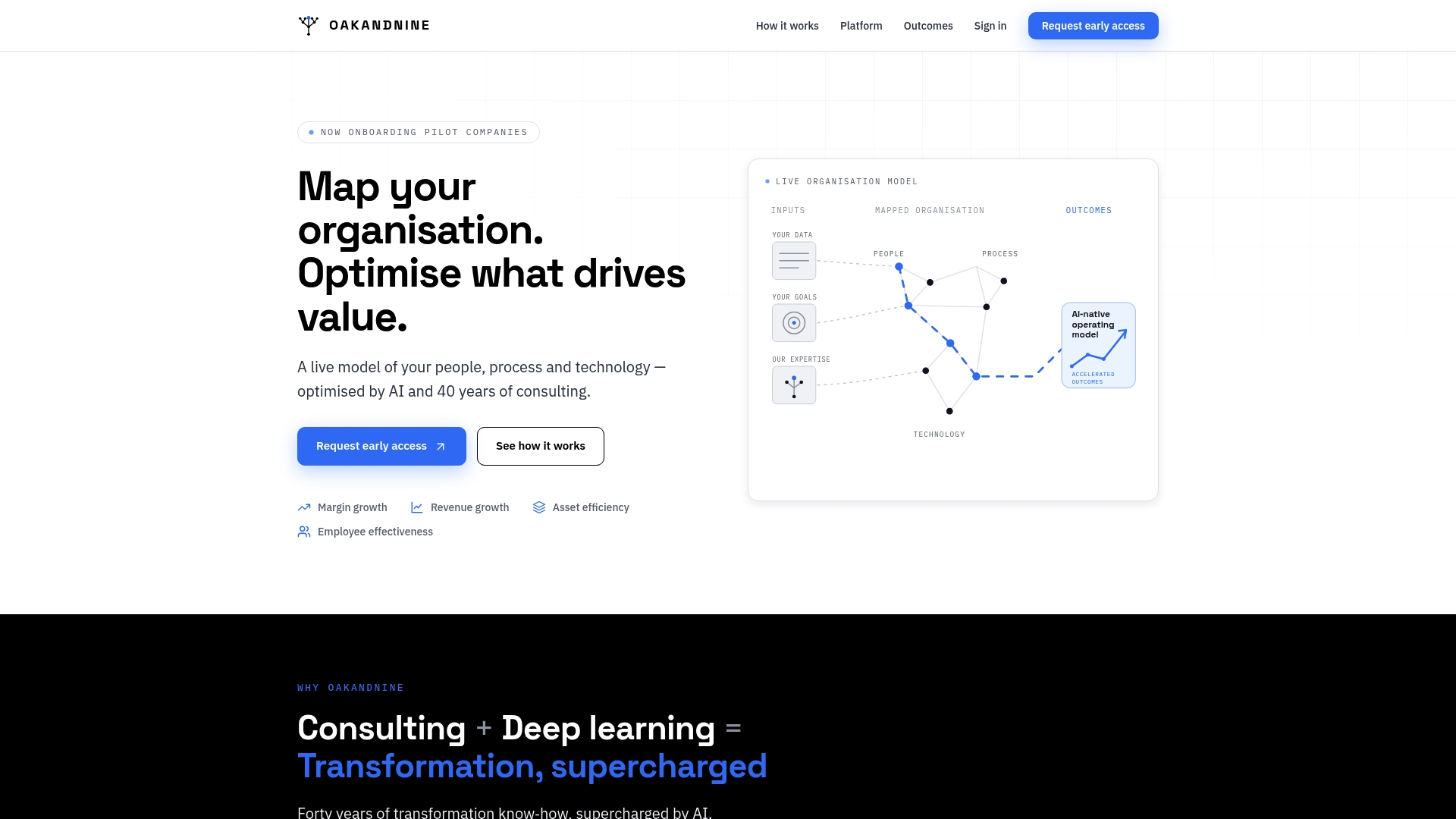
Oakandnine delivers exactly that. Built on four decades of consulting experience and powered by AI, the Oakandnine platform transforms scattered organizational data into a live operating model that surfaces friction points, identifies margin leakage, and connects process improvement directly to revenue and asset outcomes. Where monday.com excels at task-level workflow management and the UK consultancies serve specific verticals, Oakandnine sits at the intersection: a platform with the depth of a consulting engagement and the speed of a modern AI system.
Key advantages for mid-market UK organizations:
- Live org modeling that connects people, processes, and technology in real time, not in a static diagram updated once a year.
- AI-powered bottleneck detection that identifies where work stalls and quantifies the operational cost.
- Margin and revenue insights tied directly to process performance, not just workflow completion rates.
- Consulting expertise embedded in the platform, so you're not configuring software in isolation.
If your operating model is held together by spreadsheets and tribal knowledge, Oakandnine is the place to start rebuilding it properly. Explore how it works and see what a live model reveals about your organization.
Key Takeaways
The strongest BPM platform for your organization is the one that matches your process complexity, integration needs, and compliance requirements, not the one with the longest feature list.
| Point | Details |
|---|---|
| Platform fit by use case | monday.com suits flexible SMB and enterprise workflows; City Process Management and BPCM Solutions serve UK-specific and health sector needs. |
| AI capabilities matter | Native AI features like agent orchestration and bottleneck detection separate modern BPM platforms from basic workflow tools. |
| Compliance is non-negotiable | UK organizations must verify GDPR support, audit trail completeness, and data residency before selecting any BPM platform. |
| Implementation timeline | Self-serve platforms deploy in weeks; consultancy-led BPM engagements typically run three to six months for full organizational rollout. |
| Oakandnine for mid-market | Oakandnine combines a live AI-driven operating model with consulting depth, purpose-built for mid-market organizations optimizing people, processes, and technology together. |