
What is system integration software and why does it matter for UK businesses?
UK businesses typically operate six or more disparate software tools daily, each holding fragments of data the others cannot see. The result is duplicate data entry, slowed decisions, and operational drag that compounds quietly until it becomes a genuine competitive liability.
System integration software solves this by creating connectivity and interoperability among those disconnected applications, databases, and data sources. The industry term is enterprise application integration, or EAI, and it covers everything from lightweight API connectors to full middleware platforms that orchestrate data flows across an entire technology stack.
The strategic case for UK businesses is concrete:
- Real-time data access across CRM, ERP, finance, and operations, without manual exports
- Improved decision-making because leadership sees one version of the truth, not five
- Compliance readiness under UK GDPR, where fragmented data creates audit and breach risk
- Reduced manual effort, with modern integration platforms cutting a significant amount of manual data entry per employee weekly
- Scalability as the business adds systems without rebuilding connections from scratch
The UK market in 2026 is also shaped by post-Brexit data sovereignty requirements, which push enterprises toward hybrid deployment models that keep sensitive data on UK infrastructure while connecting to cloud services. That regulatory context makes the choice of integration architecture a legal consideration, not just a technical one.
Which types of integration software do UK companies actually deploy?
The architecture you choose determines your long-term flexibility and maintenance burden. Four models dominate UK deployments.
Point-to-point integration connects two systems directly. It is fast to build and cheap upfront, but every new system added multiplies the number of connections exponentially. The hidden cost here is ongoing maintenance of brittle links, which grows faster than most IT budgets anticipate.
Hub-and-spoke routes all data through a central hub, reducing connection complexity. It works well for mid-sized organizations with a defined core system, typically an ERP or CRM, acting as the hub.

Enterprise Service Bus (ESB) is the traditional enterprise-grade model, using a shared communication layer to decouple systems. ESBs offer strong governance and message routing but carry significant infrastructure overhead, making them better suited to large enterprises than UK SMEs.
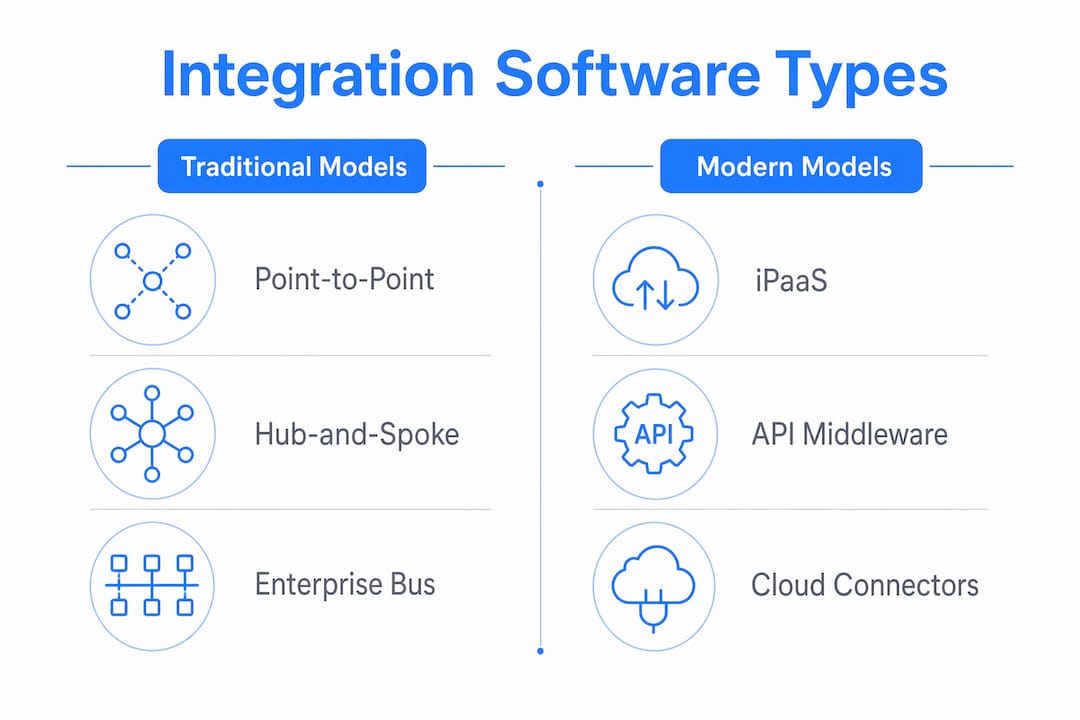
iPaaS (Integration Platform as a Service) is the fastest-growing model in the UK mid-market. Cloud-based, subscription-priced, and pre-built with hundreds of connectors, iPaaS platforms let teams integrate SaaS tools without writing custom code. They also support hybrid deployment for organizations that need data sovereignty alongside cloud flexibility.
Underpinning all four are the same technical building blocks: REST and SOAP APIs, middleware message brokers, cloud connectors, and event-driven data synchronization. GDPR compliance considerations run through every layer, particularly around data residency and access logging.
What operational and strategic benefits does integration actually deliver?
The productivity case is well established. Eliminating manual data re-entry alone recovers meaningful hours per employee per week. But the deeper gains are structural.
Operational benefits:
- Automated workflows replace manual handoffs between systems
- Data accuracy improves because a single source of truth eliminates conflicting records
- Process transparency lets managers see bottlenecks in real time rather than discovering them in monthly reports
- Faster onboarding of new tools, since a connected architecture absorbs additions without custom builds
Strategic benefits:
- Accelerated product and service innovation, because teams spend less time reconciling data and more time acting on it
- Better customer experience, driven by a unified view of each customer across sales, support, and billing
- Risk reduction in compliance and security audits, where integrated logging and access controls replace fragmented manual records
- Long-term agility, as the business can swap or add systems without rebuilding the integration layer from scratch
For UK decision-makers building a business case, the workflow automation gains from integration compound over time. The first year recovers labor hours. The second year reveals process improvements that were invisible when data lived in silos.
Leading UK system integration software providers compared
Seven providers cover the main segments of the UK market in 2026, from global IT consultancies to industrial automation specialists.
| Provider | Services offered | Specializations | Location | Certifications/Recognitions | Customer ratings |
|---|---|---|---|---|---|
| CGI | Business consulting, AI solutions, managed IT, cloud, data analytics | Digital reengineering, AI-powered IT, cyber resilience | Global, UK offices | Gartner recognized | 4.4★ (63 reviews) |
| Systems Integration Ltd | IT support contracts, Microsoft services, VoIP, cloud, disaster recovery | Business IT support, managed IT services | Swindon, UK | Microsoft Partner, SSAIB Accredited | 5★ (24 reviews) |
| Integrate Solutions | Custom software, AI integration, web/app development, consulting | Bespoke software, AI-enabled integrations, digital transformation | UK | — | 5★ (21 reviews) |
| Phoenix Control System Ltd. | Industrial automation, PLC systems, SCADA, robotic automation, control panels | Manufacturing and process industry automation | UK | — | 4.9★ (15 reviews) |
| Databricks | Unified data, analytics and AI platform, data engineering, BI, governance | Data and AI teams, AI-powered application development | Global, UK available | — | 4.6★ (15 reviews) |
| ISETech | CRM software, cloud technology services | Strategic IT alignment, CRM and cloud integration | UK | — | 5★ (13 reviews) |
| Oracle NetSuite | AI Cloud ERP, ERP, CRM, ecommerce, financial management | Enterprise resource planning, AI-powered business management | Global, UK available | — | 2.8★ (5 reviews) |
CGI operates at the large-enterprise end of the market, delivering AI-powered digital reengineering alongside managed IT outsourcing and cyber resilience services. Its Gartner recognition and breadth of industry-specific expertise make it a credible choice for organizations running complex, multi-system environments where a single integrator needs to own the full delivery lifecycle.
Systems Integration Ltd holds both Microsoft Partner status and SSAIB accreditation, a combination that signals verified competence in Microsoft-stack environments and physical security systems. Its flat-fee IT support contracts with no fixed tie-in period suit UK SMEs that need predictable costs and reliable maintenance without long-term commitment risk.
Integrate Solutions focuses on bespoke software and AI-driven digital solutions shaped around specific business needs. For organizations that have outgrown off-the-shelf connectors and need a custom integration architecture built from the ground up, this is a natural fit.
Phoenix Control System Ltd. operates in a distinct segment: industrial automation for UK manufacturing and process industries. Its work spans PLC programming, SCADA systems, and robotic automation, areas where generic software integration tools simply do not apply. If your integration challenge lives on a factory floor rather than in a SaaS stack, Phoenix is the specialist.
Databricks brings a unified data, analytics, and AI platform that goes beyond traditional middleware. UK enterprises using it typically need to connect large-scale data engineering pipelines with machine learning workflows, making it the right tool for data-heavy integration rather than application-to-application connectivity.
ISETech translates strategic business objectives into CRM and cloud IT solutions. It suits organizations where the integration challenge is fundamentally about aligning technology to business goals rather than pure technical plumbing.
Oracle NetSuite integrates ERP, CRM, and ecommerce into a single AI-powered platform used by over 43,000 customers globally. Its integration platform module connects external applications to NetSuite as the system of record, making it most relevant for businesses that have already adopted or are evaluating NetSuite as their core ERP.
How to choose the right integration software or provider for your UK business
The selection decision has more failure modes than most IT projects. Here is where to focus.
Start with a needs assessment. Map every system currently in use, the data flows between them, and where manual workarounds exist. That map reveals whether you need a lightweight iPaaS, a full ESB, or a specialist integrator.
Evaluate technology compatibility early. A provider's reference architecture should align with your existing stack. A Microsoft-heavy environment points toward partners like Systems Integration Ltd. A data engineering challenge points toward platforms like Databricks.
Check for UK-specific credentials. Microsoft Partner status, SSAIB accreditation, and ISO 27001 certification are concrete signals of verified competence, not just marketing claims.
Key selection criteria:
- Proven UK case studies in your sector
- Clear data sovereignty and GDPR compliance posture
- Support model and response time commitments
- Vendor lock-in risk, particularly with proprietary SaaS-only connectors
- Scalability as your system count grows
Pro Tip: Evaluate total cost of ownership across a three-year horizon, not just the upfront license or project fee. Maintenance of brittle integrations, security patching, and staff training consistently exceed initial estimates on under-specified projects.
Align the integration architecture to your strategic business goals before selecting a vendor. An integration that solves today's data problem but cannot accommodate next year's ERP migration will cost more to replace than it saved.
How AI is reshaping system integration for UK enterprises
The shift from passive middleware to active, AI-driven coordination is the defining integration trend of 2026, as explained in how to streamline operations for your consumer brand. This concept, called agentic integration, involves AI agents that autonomously operate across integrated systems, triggering decisions and executing workflows without human intervention at each step.
Practically, this means:
- Real-time anomaly detection that flags data inconsistencies across systems before they propagate
- Automated workflow optimization where AI adjusts routing rules based on observed patterns
- Intelligent document processing converting unstructured inputs like invoices and purchase orders into automated workflows
- Natural language configuration reducing the technical barrier for non-developer teams to build and modify integrations
For UK IT teams, the investment implication is clear: platforms that support AI agent orchestration alongside traditional API and middleware connectivity will deliver compounding returns, while legacy ESB architectures will require costly modernization. Security and compliance considerations are amplified too, since AI agents operating across systems need tightly scoped permissions and full audit trails to satisfy UK GDPR obligations.
UK market realities and typical project costs

Integration project costs in the UK vary considerably by scope and complexity. Cloud-heavy integration projects typically range from £5,000 to £100,000 or more, with the lower end covering straightforward iPaaS deployments connecting a handful of SaaS tools and the upper end reflecting custom enterprise integrations across legacy systems.
Mid-market organizations should budget for three cost categories: initial build, ongoing maintenance, and periodic upgrades as connected systems evolve. The maintenance category is consistently underestimated. Point-to-point architectures in particular accumulate technical debt rapidly, and the cost of maintaining brittle links often exceeds the original build cost within two to three years.
Hybrid deployment models add infrastructure cost but are increasingly necessary for UK businesses subject to data sovereignty requirements. Factor in the cost of UK-hosted data plane infrastructure when comparing cloud-only iPaaS pricing against self-hosted or hybrid alternatives.
Steps and best practices for implementing integration software
Successful implementation follows a disciplined sequence, regardless of the platform chosen.
- Define the integration scope before any vendor engagement. Document which systems must connect, what data flows between them, and what the success criteria are.
- Choose your architecture based on the needs assessment: iPaaS for cloud-first SMEs, ESB or custom middleware for complex enterprise environments, specialist integrators for industrial or sector-specific needs.
- Pilot with a single integration pair before scaling. A controlled pilot surfaces compatibility issues, data quality problems, and governance gaps at low cost.
- Establish data governance standards early, including field-level mapping, transformation rules, and error handling protocols.
- Build monitoring in from day one. A single control plane for observability across all integrations prevents the visibility gaps that cause incidents to escalate.
- Plan for change management. Teams whose manual workflows are replaced by automated data flows need training and clear communication about what changes and why. The change management dimension of integration projects is consistently underweighted relative to the technical work.
Security considerations in system integration
Every integration point is a potential attack surface. The more systems you connect, the larger the perimeter you must defend.
Authentication and authorization deserve the most attention. OAuth 2.0 and API key management should be enforced at every connection point, with least-privilege access scoped to the specific data each integration requires. Shared credentials across multiple integrations are a common and dangerous shortcut.
Data in transit must be encrypted end-to-end, and data at rest in any integration middleware layer must meet the same standard. For UK businesses, this is a GDPR baseline, not an optional enhancement. Audit logging at the integration layer, capturing who accessed what data and when, is the mechanism that makes compliance demonstrable rather than assumed.
Vendor lock-in risk carries a security dimension too. Proprietary connectors that route data through a third-party cloud introduce data residency uncertainty. Open-standard platforms that support self-hosted deployment give UK organizations full control over their data perimeter.
Examples of successful UK system integration implementations
CGI has delivered AI-powered integration programs for UK public sector and financial services clients, connecting legacy government systems with modern cloud platforms as part of broader digital reengineering programs. The complexity of those environments, spanning decades of accumulated technical debt, makes CGI's end-to-end delivery model particularly relevant.
Systems Integration Ltd has built its track record in UK SMEs, where its Microsoft Partner credentials and SSAIB accreditation translate directly into reliable IT infrastructure for businesses that cannot afford integration failures. Its flat-fee model removes the financial unpredictability that derails many SME IT projects.
Phoenix Control System Ltd. represents a different kind of integration success: a UK manufacturer deploying PLC and SCADA systems to connect production line equipment with operational management software, creating real-time visibility into manufacturing efficiency that was previously impossible. That kind of operational efficiency gain is the industrial automation equivalent of what iPaaS delivers in a SaaS environment.
For data-intensive organizations, Databricks has enabled UK enterprises to unify data engineering, analytics, and machine learning in a single platform, replacing fragmented pipelines with a coherent data architecture that supports both operational reporting and AI model development.
Oakandnine takes a different approach to integration
Most of the providers compared above solve the technical wiring problem. Oakandnine addresses what happens after the systems are connected.
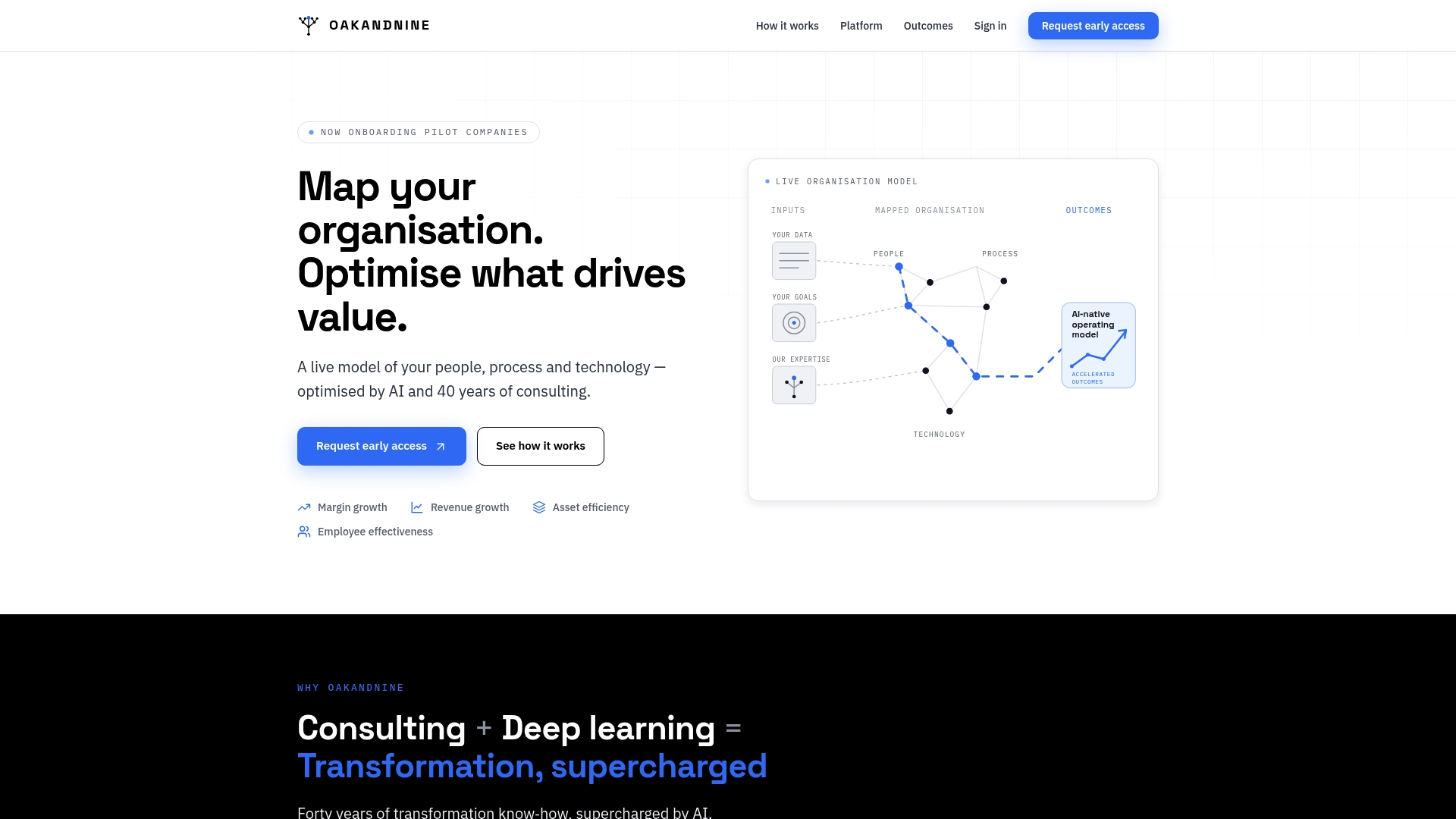
Mid-market companies often find that connecting their systems surfaces a harder question: the data is now flowing, but the operating model it reveals is fragmented, inefficient, and misaligned with where the business is trying to go. Oakandnine's AI-driven platform maps people, processes, and technology into a live organizational model, turning connected data into visible friction points, margin leaks, and growth opportunities. It is backed by four decades of consulting experience and built specifically for mid-market organizations that need more than a technical integration. If you are past the wiring stage and ready to act on what your integrated data is telling you, explore Oakandnine as the next layer of your operating model work.
Key Takeaways
The most effective system integration strategy for UK businesses in 2026 combines the right architecture for your scale, a provider with verified UK credentials, and an AI-ready platform that moves beyond data transport to active process coordination.
| Point | Details |
|---|---|
| Integration recovers real time | Successful integration reduces manual data entry by 10-15 hours per employee weekly. |
| Architecture choice drives long-term cost | Point-to-point links accumulate maintenance debt; iPaaS and centralized models reduce it. |
| UK project costs span a wide range | Cloud integration projects typically run from £5,000 to £100,000 or more depending on scope. |
| AI agents are the next integration layer | Agentic integration platforms autonomously execute workflows, not just move data between systems. |
| Oakandnine for post-integration clarity | Oakandnine maps the operating model that integrated data reveals, helping mid-market firms act on it. |