
The fastest way to improve your margin strategy is to combine three levers this week: a targeted pricing reset for underpriced customers, a focused OpEx audit across payroll, software and marketing, and a small margin management office (MMO) to enforce weekly ownership. Pricing flows directly to EBITDA at 100% of the uplift — no volume required, no capital committed. A targeted price increase on your most underpriced cohort is typically visible within one billing cycle.
Three actions to delegate now:
- Appoint an MMO chair (CFO or COO) with a mandate to convene weekly and own the value tracker.
- Pull your gross margin by customer and SKU — most mid-market firms find 15–25% of revenue is margin-dilutive on first analysis.
- Identify your bottom 20% of customers by contribution margin and flag them for pricing review before the next billing cycle closes.
Table of Contents
- What does margin improvement actually mean for your board?
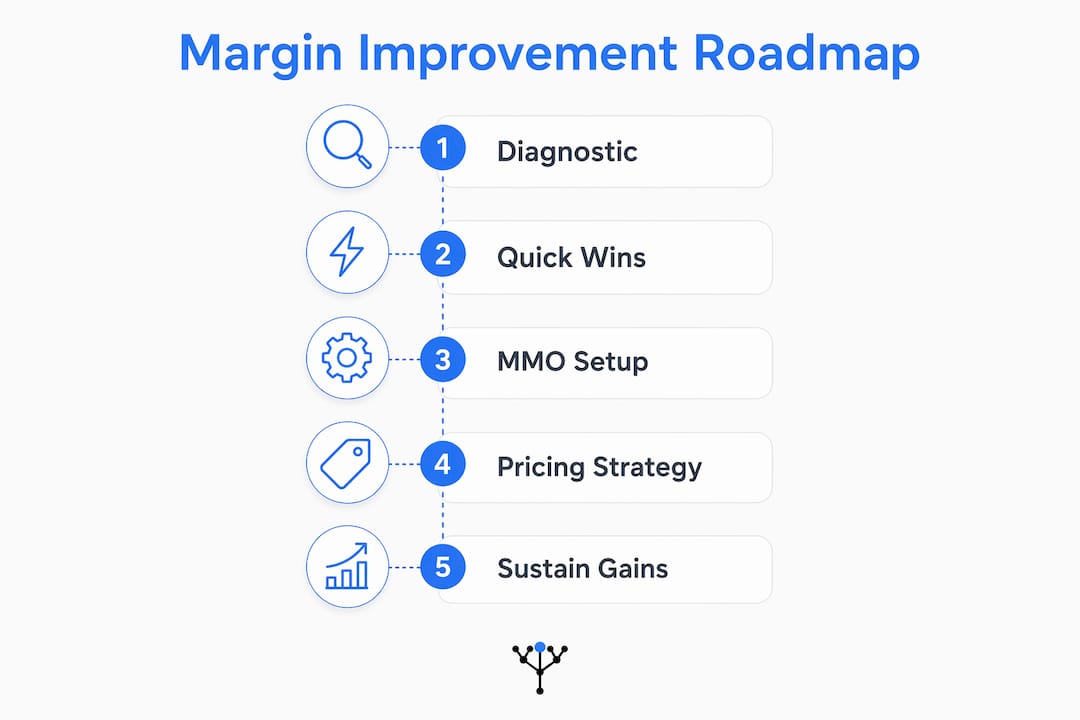
- How to run a rapid diagnostic audit in 30–90 days
- Quick wins you can deploy within one billing cycle
- How to set up a margin management office that actually works
- Price for margin: how to test increases without losing core accounts
- How an AI-driven live operating model sustains margin gains
- Phased implementation roadmap: timelines and expected payback
- What to measure: a simple KPI dashboard for weekly reporting
- Key takeaways
- What margin programmes actually teach you
- Oakandnine: a live operating model built for margin work
- Curated sources and further reading
What does margin improvement actually mean for your board?
Margin improvement is not a cost-cutting exercise. It is a structured programme that increases the percentage of revenue that survives as profit, measured at gross, contribution, and operating levels. Each metric tells a different story.
| Metric | Formula | What it reveals |
|---|---|---|
| Gross margin | (Revenue – COGS) / Revenue | Production and procurement efficiency |
| Contribution margin | (Revenue – Variable costs) / Revenue | Per-product or per-customer profitability |
| Operating margin | (Revenue – COGS – OpEx) / Revenue | Overhead discipline and structural cost health |
The board-level case is straightforward. A small gross margin improvement on typical revenue can generate meaningful EBITDA uplift and translate to a multiple increase in enterprise value. That is the ROI framing your CFO needs.
Set a realistic target range for a multi-month programme: a credible improvement trend shows consistent quarterly movement, not a single spike. Guardrails matter — protect volume on A-tier accounts while you test increases on lower-elasticity cohorts.
How to run a rapid diagnostic audit in 30–90 days
A diagnostic does not need to be elaborate. It needs to be honest.
- Pull a clean P&L bridge — starting margin, discount leakage, returns, COGS changes, and operating overhead. Segment by product and customer before you draw any conclusions.
- Build gross margin by customer and SKU. Averages hide the truth. One customer segment may be carrying your portfolio while another quietly erodes value after returns and service costs.
- Apply the binary OpEx filter. For every significant cost line — payroll, software subscriptions, marketing — ask one question: does this line generate revenue or sustain essential operations? If the answer is neither, it is a candidate for reduction or elimination.
- Isolate the dilutive tail. Flag a portion of revenue by contribution margin. This cohort is your first pricing and renegotiation target.
- Assign owners and build an action backlog. Every identified lever needs a named owner, a deadline, and a value estimate before the diagnostic closes.
Pro Tip: Run the customer-margin analysis before you touch pricing. Firms that skip this step often raise prices on their most price-sensitive accounts first — the exact opposite of what the data would have told them.
A 30-day sprint covers data pull and segmentation. Days 31–60 are for supplier and customer conversations. By day 90, you should have a live action backlog with at least three costed initiatives in flight.
Quick wins you can deploy within one billing cycle
Speed matters. These interventions are low-friction and measurable quickly.
Pricing
- Target a 5–8% increase on the most underpriced 20% of customers, fenced to new deals or premium service tiers to test elasticity before a broader rollout.
- Tighten discount governance: replace ad-hoc approvals with rule-based rate cards and a named sign-off above a threshold.
OpEx
- Audit software subscriptions against active usage data — unused licences are pure waste.
- Reallocate marketing spend from brand awareness to demand-generation channels with measurable contribution margin per lead.
- Delay non-essential hires; redeploy existing headcount to higher-margin activities before adding payroll cost.
Procurement and cash conversion
- Renegotiate payment terms with your top five suppliers by spend. Even a 15-day extension on AP terms improves cash conversion without touching the P&L.
- Offer early-payment discounts to customers who consistently pay late — shortening your cash conversion cycle has a direct impact on working capital and effective margin. For complex repricing or tax-aware vendor negotiations, a specialist such as Keystone Financial Advisory can accelerate the process.
How to set up a margin management office that actually works
The MMO is the centrepiece of any margin programme that lasts beyond the initial diagnostic. BCG recommends a small, cross-functional team that tracks value weekly and enforces owner accountability — not a committee, not a project team, but a standing governance function.

| Role | Responsibility | Cadence |
|---|---|---|
| MMO lead (CFO/COO) | Chairs weekly review, owns escalation | Weekly |
| Finance analyst | Maintains value tracker and single source of truth | Daily/weekly |
| Product or merchant owner | Owns pricing and mix decisions | Weekly |
| Ops owner | Owns COGS, fulfilment and process efficiency | Weekly |
| Commercial/sales liaison | Monitors realised price vs. list price | Weekly |
The weekly artefact is a value tracker: a single dashboard showing gross margin by customer and product, discount leakage, COGS movement, and the status of each initiative in the action backlog. No initiative moves forward without a named owner and a weekly update. That discipline is what separates programmes that generate sustained operating-margin improvement from those that stall after the first quick win.
Price for margin: how to test increases without losing core accounts
Value-based pricing raises customers' willingness to pay while supplier collaboration reduces suppliers' willingness to sell. The HBS framing is useful precisely because it reframes pricing as a two-sided negotiation, not a unilateral decision.
- Segment your accounts into A, B and C tiers based on contribution margin, payment behaviour, service cost and strategic value. A-tier clients typically accept price increases when the value case is clear.
- Fence increases to new business first. Apply revised pricing to new contracts or renewals before touching existing accounts. This limits churn risk and generates clean elasticity data.
- Introduce premium tiers or outcome-based fees for services that customers already value but are not paying for explicitly — implementation support, priority response, dedicated account management.
- Monitor realised price versus list price weekly. Discount leakage is often invisible until you measure it. Smart segmentation lets firms reset pricing without jeopardising core revenues.
Pro Tip: Equip your sales team with a value calculator before any price conversation. A rep who can show a customer the quantified outcome of your service will close a price increase far more reliably than one who leads with the number.
How an AI-driven live operating model sustains margin gains
Tactical wins erode without a system to sustain them. BCG is explicit that operational AI creates value only when processes, data and ownership are strong enough to act on its outputs. The sequence matters: data discipline and governance first, AI amplification second.
Oakandnine's live operating model is built for exactly this phase. It unifies structured and unstructured business data into a single operating view, surfaces bottlenecks in real time, and runs scenario analysis across price and cost-of-sale variables before you commit to a change. Margin-by-customer and margin-by-SKU views update continuously, and automated alerts flag when a supplier cost movement or discount pattern is eroding a previously improved line.
Consider a mid-market distributor that, after completing its 90-day diagnostic, discovered a long-tenured customer segment generating strong revenue but negative contribution margin after returns and service costs. The live model made the segment visible in a single dashboard view. A staged price reset, monitored weekly through the MMO, recovered the margin without a single account loss — because the data showed exactly which customers in that segment had low price sensitivity before the conversation started.
Phased implementation roadmap: timelines and expected payback
| Phase | Timeline | Key actions | Expected outcome |
|---|---|---|---|
| Diagnostic and quick wins | Days 1–30 | P&L bridge, customer/SKU margin build, pricing fences on new deals | First pricing uplift visible; action backlog live |
| Structural improvements | Days 31–90 | Supplier renegotiation, subscription audit, MMO stood up | COGS reduction in progress; MMO cadence established |
| Trend confirmation | Months 3–6 | Pricing rollout to existing accounts, OpEx reductions landing | Gross margin trend visible in management accounts |
| Sustained gains | Months 6–12 | AI operating model integrated, scenario modelling active | Operating margin improvement confirmed; board narrative ready |
Resourcing is lighter than most leaders expect. The MMO requires one part-time finance analyst, a committed chair (four hours per week), and functional owners who attend a 60-minute weekly review. Operational efficiency improvements at this scale do not require a transformation programme — they require consistent ownership. For change management tooling to support MMO adoption, mid-market buyers have several practical options.
Pricing corrections are quicker — visible in 30–90 days. Structural cost improvements need 3–6 months to implement and 6–12 months to show a reliable trend in the management pack.
What to measure: a simple KPI dashboard for weekly reporting
| Metric | Owner | Reporting cadence |
|---|---|---|
| Realised price vs. list price | Commercial lead | Weekly |
| Gross margin by product/customer | Finance analyst | Weekly |
| Contribution margin per order | Finance analyst | Weekly |
| Discount leakage (£ and %) | Sales liaison | Weekly |
| COGS trend by supplier | Ops owner | Weekly |
| Cash conversion days | CFO | Monthly |
The weekly MMO pack covers the top six metrics above plus a watchlist of any product or customer segment that has slipped below its target contribution margin threshold. The monthly executive summary connects those movements to EBITDA. The quarterly board narrative closes the loop: margin improvement to EBITDA to enterprise value, in the language your investors and non-executives understand.
Key takeaways
The single most important principle in any margin programme is this: price first, because it is the only lever that flows to EBITDA at 100% with no capital required and results visible within one billing cycle.
| Point | Details |
|---|---|
| Price first, always | A targeted 5–8% increase on underpriced customers is visible within one billing cycle — start there. |
| Diagnose before you cut | Build gross margin by customer and SKU; 15–25% of revenue is typically dilutive on first analysis. |
| MMO is the governance engine | A cross-functional margin management office with weekly cadence is what separates sustained gains from one-off wins. |
| Sequence structural changes second | COGS and vendor improvements take 3–6 months to implement and 6–12 months to show a reliable trend. |
| Oakandnine as the sustaining layer | Oakandnine's live operating model unifies data, detects margin drags in real time, and keeps the MMO accountable beyond the initial diagnostic. |
What margin programmes actually teach you
There is a pattern I have seen repeat across mid-market UK engagements: the diagnostic is never the hard part. The data, once you build it properly, is usually clear. The hard part is what happens in the room when the analysis shows that a long-standing customer relationship is margin-dilutive, or that a product line the sales director built his career on is destroying value.
Three things consistently determine whether a programme succeeds or stalls. First, cultural ownership: when merchants, operations, supply chain and marketing do not own margin outcomes personally, the programme stays in finance and never scales. Second, sequencing: firms that attack structural costs before pricing corrections burn political capital on slow-moving initiatives and lose momentum before the quick wins land. Third, data quality: a single source of truth is not a luxury — it is the prerequisite for every conversation that follows.
The most common political friction during price resets comes from sales teams who fear losing accounts. The way through it is not to override them. It is to show them the segmentation data before the conversation with the customer, so they walk in knowing which accounts will absorb the increase and which need a different approach.
Oakandnine: a live operating model built for margin work
Mid-market leaders who have completed their diagnostic and stood up an MMO face a common next challenge: keeping the gains visible, the owners accountable, and the data current as the business moves. That is the gap Oakandnine is built to close.
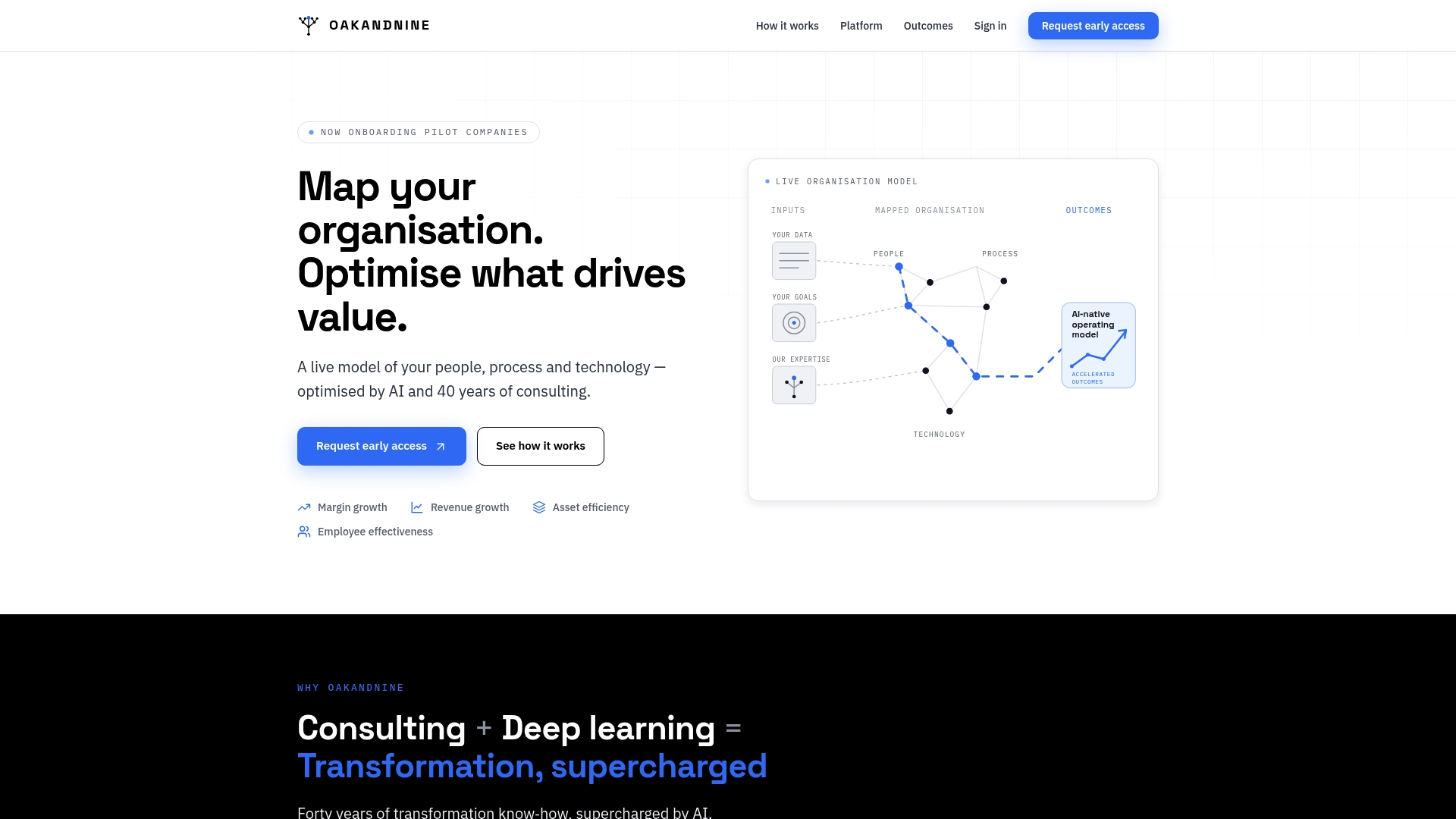
Oakandnine's platform maps your people, processes and technology into a live operating model, updated continuously and surfaced through AI-driven analytics. Margin-by-customer views, bottleneck detection, and scenario modelling for price and cost-of-sale changes are built in — not bolted on. A typical pilot runs over eight to twelve weeks, with a governance structure aligned to your MMO from day one, and measurable margin insights delivered before the engagement closes.
Backed by four decades of consulting experience, Oakandnine works alongside your leadership team rather than replacing it. The outcome is a margin programme that does not depend on a consultant being in the room to function.
Request a pilot assessment and see what your operating model looks like when the data is finally in one place.
Curated sources and further reading
| Source | What you will find there |
|---|---|
| Glacier Lake Partners — Gross Margin Improvement Playbook | Detailed sequencing guidance and the 15–25% dilutive revenue finding used in this guide. |
| BCG — How retailers can improve margins to drive returns | The MMO governance model, cross-functional ownership principles, and the AI-readiness sequencing argument. |
| Harvard Business School Online — How to increase profit margin | The willingness-to-pay / willingness-to-sell framework and value-based pricing foundations. |
| DealHub — What is margin optimisation? | Segmentation, pricing fences, and discount governance guidance for protecting core accounts during price resets. |
| Jumpstart Partners — How to improve profit margins | The binary OpEx filter methodology for payroll, software and marketing cost lines. |
| Oakandnine — Live operating model | Platform overview, pilot structure, and AI-enabled margin analytics for mid-market firms. |
Ronan's detailed credentials and case study references are available on request. This article provides general guidance for informational purposes; confirm specific financial, legal or tax implications with a qualified adviser for your own situation.