
What are employee engagement measurement tools, and which features matter most for UK mid-market companies?
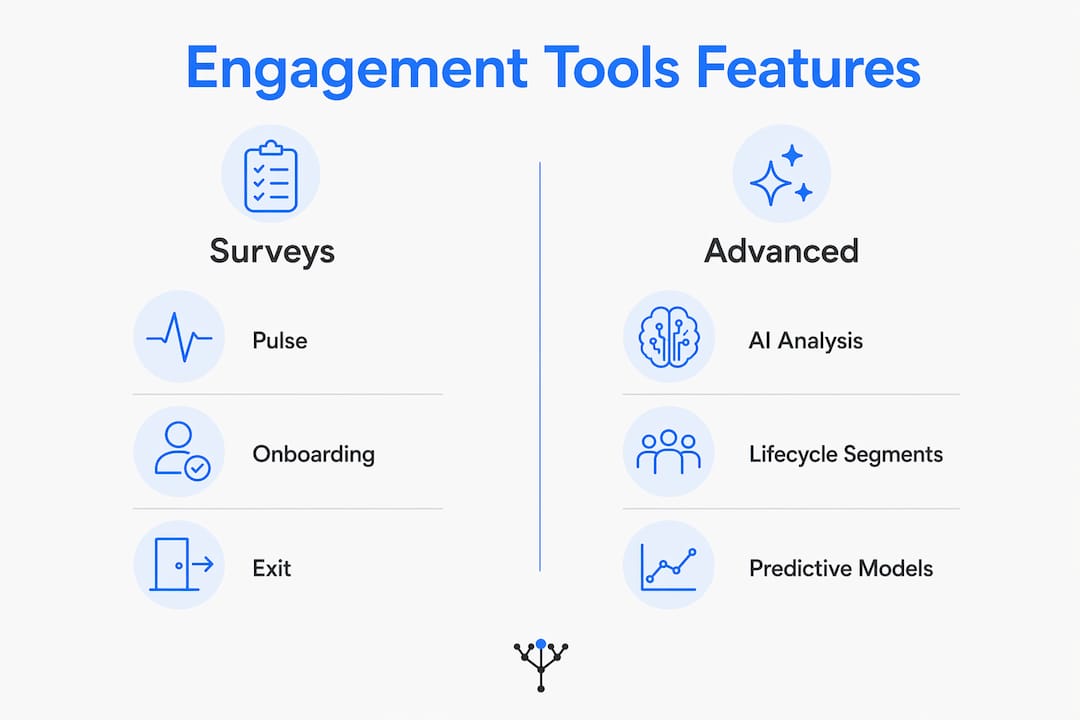
Employee engagement measurement tools are platforms that combine survey methodologies with AI analytics to capture, interpret, and act on continuous workforce feedback. For UK mid-market organisations, the right platform does more than run an annual survey. It connects sentiment data to operational outcomes.
Key selection criteria for the UK context include:
- Demographic filtering by team, location, and manager for hyper-local recommendations
- Predictive turnover analysis powered by AI modelling to flag disengagement early
- Business performance data integration linking people data to margin and revenue metrics
- Multi-language support and pre-built question banks validated by organisational psychologists
The shift from annual surveys to continuous pulse surveys reflects a more fundamental change in how mid-market leaders think about organisational agility. Real-time sentiment detection allows faster, more targeted responses. As Dr Jim Harter of Gallup has emphasised, tracking engagement trends is a critical leadership responsibility. Drops in engagement foreshadow reduced productivity and turnover before either shows up in financial data.
AI accelerates this further. Platforms that automate thematic analysis of open-text comments save significant HR time and surface patterns no manual review would catch quickly enough to matter.
Table of Contents
- How do leading engagement platforms compare for UK mid-market use?
- What does good implementation look like in a mid-sized company?
- How do you turn engagement data into real organisational improvements?
- What does the ROI case look like for AI-powered engagement tools?
- Oakandnine connects engagement measurement to your operating model
- Key takeaways
How do leading engagement platforms compare for UK mid-market use?
The market offers a range of capable tools. What separates them is how deeply they connect survey feedback to process improvements and operational workflows.
Lattice offers pulse surveys, onboarding and exit surveys, eNPS measurement, and AI-powered analysis that surfaces key drivers and recommended actions in seconds. Its benchmarking, powered by Mercer data, gives UK mid-market HR teams credible external context.
15Five takes a science-backed approach, with psychometrically validated surveys, a Predictive Impact Model that identifies which engagement factors will move the needle most, and built-in coaching tools for managers. Its heat maps and filtered dashboards make it straightforward to spot where disengagement is concentrated.

Qualtrics supports sophisticated continuous listening strategies, segmenting feedback by lifecycle stage and location with AI predictive modelling. It is well-suited to organisations that need enterprise-grade analytics at mid-market scale.
Oakandnine operates differently. Rather than treating engagement as a standalone diagnostic, its AI-driven platform maps people, processes, and technology together, converting survey insights into integrated operational workflows. Engagement data feeds directly into the live organisational model, connecting workforce sentiment to margin growth and asset efficiency in real time.
GDPR compliance is non-negotiable across all platforms. Anonymity protocols, minimum group sizes for segmentation, and secure data handling are baseline requirements for building employee trust in any UK deployment.
What does good implementation look like in a mid-sized company?
Deployment fails most often not because the tool is wrong, but because follow-through is absent. Failure to act on engagement data produces survey fatigue and declining participation. Accountability and manager coaching are what convert measurement into movement.
Three practices separate effective implementations from expensive ones. First, anchor the rollout to a specific business problem, not a general desire to "improve culture." Second, give managers their own team-level dashboards and guided action plans rather than routing everything through HR. Third, treat the first survey cycle as a baseline, not a verdict. Linking pulse survey cadences to workflow automation enables rapid organisational adjustment between cycles.
How do you turn engagement data into real organisational improvements?
Data without a decision framework is noise. The most effective approach is to connect engagement insights to operational efficiency metrics, not treat them as separate reporting streams. When a team's sentiment scores drop alongside a rise in process bottlenecks, the correlation points directly to where intervention is needed.
Prioritise by impact, not by volume of feedback. AI-driven thematic analysis of open-text responses identifies the issues that recur across teams and geographies, which is where systemic fixes deliver the most return.
What does the ROI case look like for AI-powered engagement tools?
The financial case rests on retention. Replacing a mid-level employee typically costs a significant proportion of their annual salary when recruitment, onboarding, and lost productivity are factored in. Predictive turnover modelling, embedded in AI engagement platforms, allows organisations to intervene before resignation decisions are made.
Beyond retention, integrating engagement initiatives into the operating model drives measurable margin and revenue growth. Engagement measurement that stays inside the HR function rarely reaches that threshold. Platforms that connect people data to process and technology improvements are where the financial return becomes visible to the board.
Oakandnine connects engagement measurement to your operating model
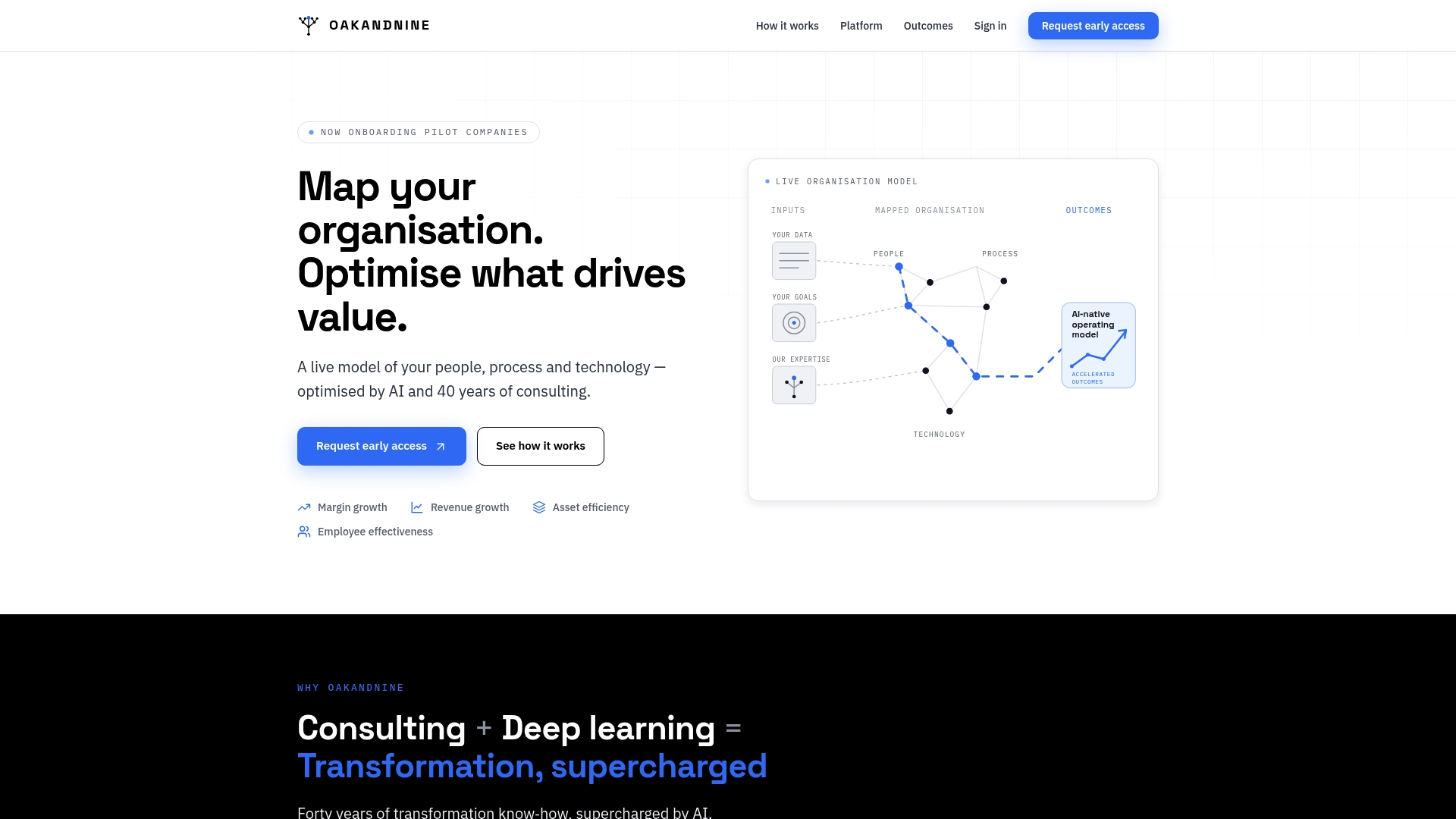
Most engagement platforms stop at the survey. Oakandnine starts there and goes further. The platform's live organisational model integrates employee feedback with real-time process mapping, system data, and AI-powered analytics, so sentiment signals translate directly into operational decisions rather than sitting in an HR report.
For UK mid-market leaders who need engagement measurement to drive margin growth, not just satisfaction scores, Oakandnine offers four decades of consulting experience embedded in an AI-driven platform built for exactly this scale. GDPR compliance, data unification, and embedded coaching tools are built in from the start.
Map your organisation with Oakandnine and see where people, process, and technology connect.
Key takeaways
The most effective employee engagement measurement strategy connects real-time workforce sentiment directly to operational workflows, enabling UK mid-market leaders to act on data before disengagement becomes attrition.
| Point | Details |
|---|---|
| Continuous listening over annual surveys | Pulse surveys detect sentiment shifts in real time, enabling faster leadership response. |
| AI accelerates insight extraction | Automated thematic analysis of open-text feedback saves HR time and surfaces systemic issues. |
| Act on data or lose participation | Failure to follow through on survey results drives survey fatigue and declining engagement. |
| Connect people data to operations | Linking engagement insights to process and margin metrics is where measurable ROI appears. |
| Oakandnine integrates both | Oakandnine's live organisational model connects engagement feedback to operational workflows and margin growth. |