
For UK mid-market operations leaders who need a live organisational model rather than a data-pipeline tool, the recommended shortlist is:
- Outcome-led platform with built-in organisation modelling — Oakandnine, which unifies people, processes and technology through an AI-driven live model backed by consulting, certified to ISO 27001 and SOC 2 standards.
- Integration plus ontology layer — platforms that connect your existing application estate via iPaaS connectors and add a semantic layer for process mapping and decision intelligence.
- Managed consulting plus platform engagement — firms such as Celonis, orgvue, LeanIX, and ServiceNow that combine licensed software with significant professional services to build and maintain an operating model.
Mid-market organisations increasingly prefer selective modernisation and hybrid cloud integration over wholesale replacement, which makes an ontology-first, incremental approach the practical default for most UK businesses.
Table of Contents
- What does "Fivetran alternatives" actually mean here?
- Which approach fits your organisation?
- How the categories compare on what actually matters
- Implementation that avoids rip-and-replace
- A practical 90-day pilot plan
- Key takeaways
- Why the live model approach changes what you should be buying
- Start your live organisational model with Oakandnine
- Useful sources for procurement teams
What does "Fivetran alternatives" actually mean here?
The open web returns database-replication and EL(T) pipeline tools when you search for Fivetran alternatives. That is a different buyer journey entirely, aimed at data engineers moving rows between warehouses. This article is for operations leaders, C-suite, HR heads and IT decision-makers who want a platform that builds a live organisational model: a connected, real-time view of people, processes and technology that drives operational decisions.
The scope here covers platforms that:
- Unify structured and unstructured business data from across your application estate.
- Map your organisation's people, roles, skills and reporting lines.
- Surface process bottlenecks, asset inefficiencies and margin opportunities.
- Deliver AI-driven insights with explainable outputs.
Database replication, raw data ingestion and warehouse connectors are excluded. Fragmented and siloed data is a leading barrier to AI adoption, but the answer for operations leaders is not more pipelines — it is a governed, question-first operating model.
Pro Tip: Before you speak to any vendor, write down the single business question you most need answered (for example, "Where are our order-to-cash delays?"). Then define three governance rules: a unique ID format, a date standard, and a named dataset owner. Vendors who cannot map their product to that question in a 30-minute demo are not the right fit.
Which approach fits your organisation?
Three categories cover the realistic options for UK mid-market firms.
Outcome-led platform with built-in organisation modelling
This category leads with a pre-built live model that connects people, processes and technology from day one. The platform ingests data from your existing systems, applies an ontology layer to resolve identities and relationships, and surfaces AI insights without requiring a large internal data team. Oakandnine sits here: a B2B SaaS platform plus consulting service that runs structured pilots for mid-market organisations, with process optimisation and org mapping built into the product rather than bolted on afterwards. Typical time to value is a few months from pilot kick-off to first production insight.
Pros: Fast pilot, low internal resource requirement, consulting backstop, measurable outcomes from the start. Cons: Requires commitment to a defined pilot scope; not suited to organisations that want to build a bespoke data architecture from scratch.
Integration plus ontology layer
This approach starts with an iPaaS or middleware layer that connects your existing six-plus commercial applications, then adds a semantic or ontology layer for process mapping. iPaaS solutions are often the practical sweet spot for UK SMEs given the typical multi-app estate and the need for connectors and webhooks. Time to value generally ranges from a few months depending on data quality and internal engineering capacity.
Pros: Preserves existing investments, flexible architecture, strong connector ecosystem. Cons: Requires internal or partner engineering resource; org modelling and AI insights typically need additional modules or a separate vendor.
Managed consulting plus platform engagement
Platforms such as Celonis (process mining), orgvue (org design), LeanIX (enterprise architecture) and ServiceNow (workflow and ITSM) each address a slice of the operating model. Deploying them to cover the full people-process-technology picture usually requires a systems integrator and a multi-year programme. Managed services that embed expertise and scalable capacity help organisations adopt new operating models without disruptive churn, but the investment is proportionally larger.
Pros: Deep capability in specific domains (process mining, enterprise architecture, ITSM), large partner ecosystems. Cons: High total cost of ownership, long implementation timelines, risk of scope creep without a clear outcome owner.
| Category | Primary strength | Typical time to value | Implementation model |
|---|---|---|---|
| Outcome-led platform | Full live org model, AI insights, consulting | 60–90 days | SaaS + managed pilot |
| Integration + ontology | Connector breadth, architecture flexibility | 90 days | Self-serve + partner engineering |
| Managed consulting + platform | Domain depth (process, architecture, ITSM) | multi-months | Consulting-led programme |
How the categories compare on what actually matters
| Dimension | Outcome-led platform | Integration + ontology | Managed consulting + platform |
|---|---|---|---|
| Core capabilities | Data unification, org mapping, process mining, AI insights in one product | Data unification strong; org mapping and AI require add-ons | Strong in one domain; full coverage needs multiple products |
| Integration footprint | Pre-built connectors for common mid-market apps; system integration guidance available | Broad connector library; webhooks and APIs | Varies by vendor; enterprise connectors strong, SME connectors patchy |
| Implementation model | SaaS + consulting pilot | Self-serve SaaS + partner | Consulting-led; SI required |
| Typical time to value | several months | 90 days | multi-months |
| Pricing model | Subscription + pilot fee | Subscription + connector tiers | Licence + significant services spend |
| UK data residency | Confirmed | Varies by vendor | Varies by vendor and deployment |
| Services and support | Consulting embedded; customer success included | Community + paid support tiers | Large SI ecosystem; internal team required |
Hidden costs to budget for: onboarding and data cleansing (often underestimated), training for operations and HR teams, ongoing connector maintenance, and the internal programme management time that consulting-led engagements demand.
Implementation that avoids rip-and-replace
SME integration projects deliver highest value when focused on specific business questions such as joining sales to finance or consolidating operational reporting. The same principle applies here: start with an ontology layer that interprets and connects existing systems rather than replacing them.
A pragmatic timeline:
Days 1–30 (Pilot scoping): Data hygiene audit, single source of truth defined, connector setup for two to three priority systems, business sponsor confirmed. Stakeholders: IT lead, operations manager, business sponsor.
Days 31–60 (Org mapping and process discovery): Live org model populated, first process bottleneck identified, AI insight validated against known operational data. Stakeholders: HR lead, finance, IT.
Days 61–90 (Validation and handover): KPI baseline established, at least one automated decision validated, production readiness checklist signed off. Stakeholders: C-suite sponsor, IT, operations.
Pro Tip: Keep a human in the loop for every customer-facing and financial use case. Require explainable AI outputs as a contractual deliverable, not a nice-to-have. If a vendor cannot show you the reasoning chain behind an insight, that insight cannot safely drive a business decision.
A practical 90-day pilot plan
Pilot objectives: One trusted dataset for a priority process (e.g. order-to-cash or headcount planning), one process bottleneck identified and quantified, one real-time org heatmap validated by HR.
Minimum team: IT lead, operations manager, HR representative, finance contact, one C-suite sponsor.
Weekly activities:
- Weeks 1–4: Data audit, governance rules set, two connectors live, pilot scope signed off.
- Weeks 5–8: Org model populated, process discovery running, first AI insights reviewed.
- Weeks 9–12: KPI baseline confirmed, automated decisions validated, production handover checklist completed.
| Pilot metric | Target threshold |
|---|---|
| Data quality score | 85%+ records with complete unique IDs and date fields |
| Latency | Org model refreshes within 4 hours of source change |
| Process bottlenecks identified | At least 2 quantified with root-cause evidence |
| Automated decisions validated | At least 1 signed off by business sponsor |
| AI explainability | flagged insights include reasoning chain |
Exit criteria for production readiness: UK data residency confirmed in contract, ISO 27001 or SOC 2 certificate reviewed, at least one integration running in production, business sponsor sign-off on KPI baseline.
Pro Tip: Require a live demonstration of explainable AI outputs during the pilot, not a recorded walkthrough. Ask the vendor to show the reasoning chain for a specific insight using your own data. If they cannot do it in the room, it will not happen in production.
Key takeaways
The fastest path to a live organisational model for UK mid-market firms is an outcome-led platform with an embedded ontology layer, a 90-day pilot, and ISO 27001 or SOC 2 certification confirmed before contract signature.
| Point | Details |
|---|---|
| Scope matters first | Define one business question and three governance rules before evaluating any vendor. |
| Score by time to insight | Ask vendors how many days to a CFO-ready insight, not how many features they have. |
| Demand compliance proof | Require ISO 27001 or SOC 2 certification and UK data residency in writing, not as an option. |
| Budget for hidden costs | Onboarding, data cleansing and training often add significantly to year-one cost. |
| Oakandnine as outcome-led option | Oakandnine delivers a live org model via SaaS plus consulting, with a structured 90-day pilot for mid-market organisations. |
Why the live model approach changes what you should be buying
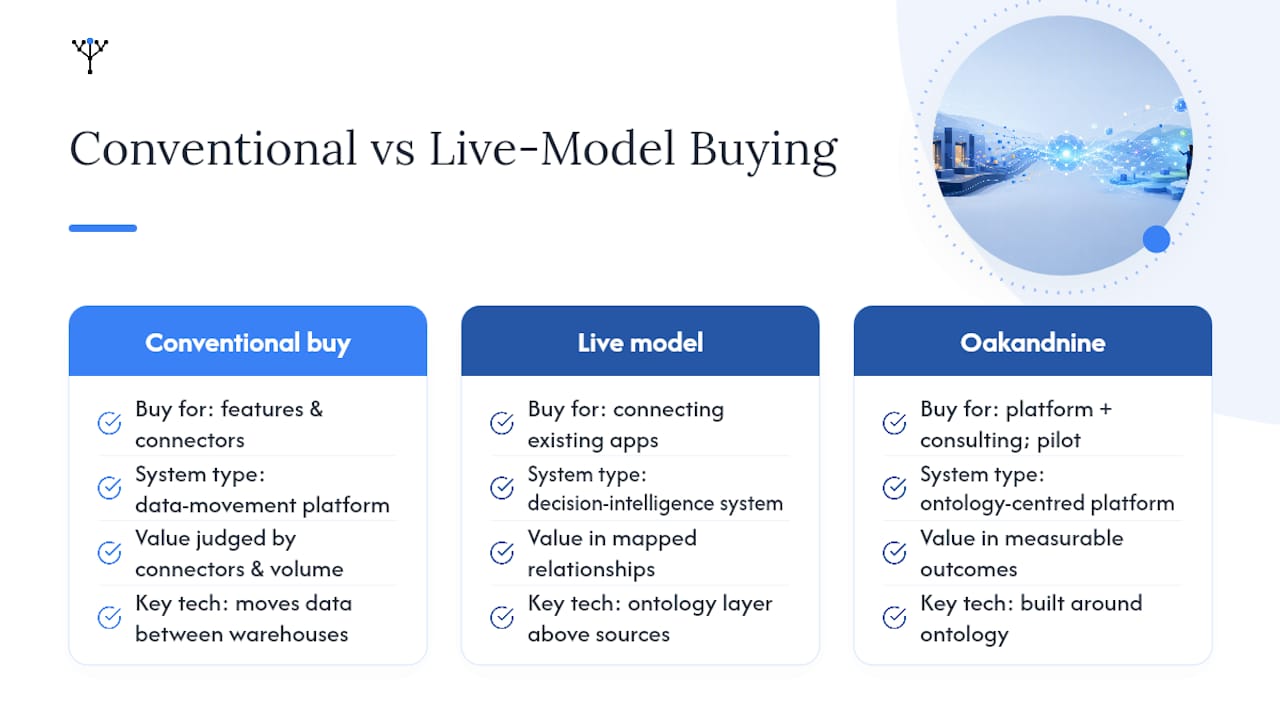
The conventional procurement instinct is to buy the platform with the longest feature list and the biggest connector library. That instinct is wrong for this problem. A live organisational model is not a data product — it is a decision-intelligence system. The value is not in the data it holds; it is in the relationships it maps between people, processes, assets and outcomes. A platform that excels at moving data between warehouses (the Fivetran-style tools this article deliberately excludes) cannot tell you why your order-to-cash cycle is three days slower in one region, which team is carrying a hidden skills gap, or where your margin is leaking.
What mid-market operations leaders actually need is a system that connects the dots across their existing application estate without forcing a rip-and-replace project. The ontology layer is the key architectural idea: it sits above your source systems, resolves identities, and builds the living map. Oakandnine's approach — platform plus consulting, structured pilot, measurable outcomes — is built around that idea rather than around data volume or connector count. The workflow automation and process optimisation capabilities that matter most are the ones that feed directly into that live map, not the ones that impress in a demo.
Start your live organisational model with Oakandnine
Mid-market operations leaders who want a live org model without a 12-month consulting programme have a direct route: Oakandnine combines an AI-driven platform with four decades of consulting experience to map your people, processes and technology in a structured 90-day pilot. You get measurable outcomes, ISO 27001 and SOC 2 compliance, and UK data residency confirmed from day one — not as optional extras.
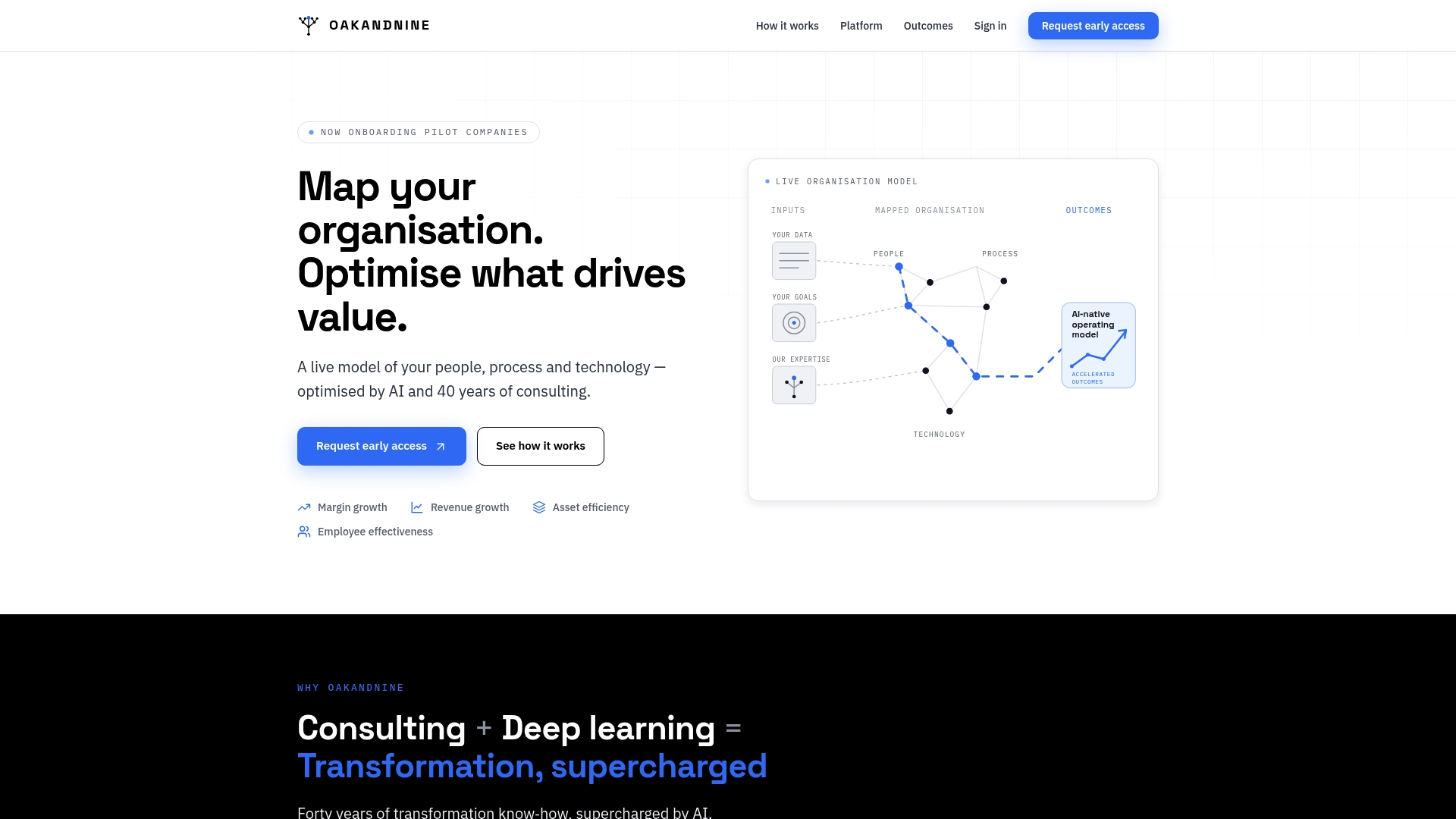
The pilot is scoped around your single most pressing operational question, connected to your existing systems, and validated against your own KPIs before you commit to a full deployment. No rip-and-replace, no open-ended consulting engagement. Request a pilot with Oakandnine and have a production-quality insight your leadership team can act on within 90 days.
Useful sources for procurement teams
Market reports and operating model research
- The Data Question Every SME Owner Now Faces
- Introducing the next‑generation operating model (McKinsey)
- Scattered data costing your business (AI Applied)
- System integration: Complete guide for UK businesses (2026)
- Node4 mid‑market report 2025
- From transformation to operating advantage | Baker Tilly
- Oakandnine — Map and optimise your organisation
System integration and data guidance
Oakandnine
- Oakandnine — map and optimise your organisation — platform and consulting service overview; starting point for pilot enquiries.