
For UK mid-market organisations evaluating their options, Oakandnine is the recommended WorkBoard alternative: an AI-native live operating model that closes the strategy–execution gap by connecting people, processes, and technology in real time, backed by four decades of consulting experience.
TL;DR
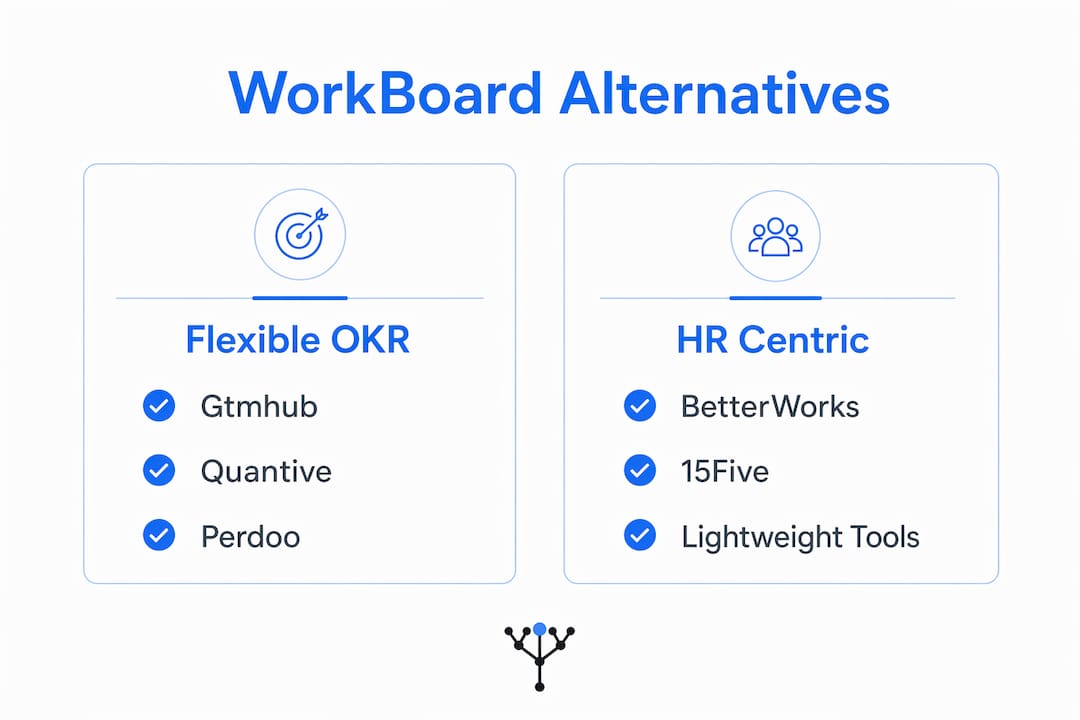
- Flexible OKR platforms (e.g. goal-management suites like Gtmhub/Quantive, Perdoo, BetterWorks): strong OKR depth, but limited system-of-record capability; you will still need a separate integration layer.
- HR-centric performance suites (e.g. 15Five): excellent for people-led performance cycles, weaker on operational process mapping and cross-functional data unification.
- Lightweight starter OKR tools: low entry cost, but they rarely scale past 200 users without significant configuration overhead.
One critical point before you shortlist: switching platforms is an operating-model change, not a product swap. Teams that treat it as a straight migration frequently revert to spreadsheets within six months. See the migration checklist below.
Table of Contents
- Which WorkBoard alternatives suit UK mid-market teams?
- How do you choose the right alternative for your organisation?
- Migration checklist: how do you avoid the shadow-system trap?
- What do pricing and timelines look like for UK mid-market customers?
- Why Oakandnine is the recommended choice for UK mid-market teams
- How do licensing and upgrade options work across these platforms?
- What training and onboarding support do vendors actually provide?
- How do you assess customer support quality before you sign?
- What contract terms should you negotiate for WorkBoard alternatives?
- Key takeaways
- The operating model is the product
- Start your Oakandnine pilot
Which WorkBoard alternatives suit UK mid-market teams?
WorkBoard is enterprise-grade but rigid, with narrow customisation, steep learning curves, and pricing built for large enterprises. Mid-market organisations need something that maps work to strategy automatically, integrates with existing HRIS, CRM, and project tools, and can be piloted without a six-figure commitment.

| Oakandnine | Flexible OKR platforms (Gtmhub / Quantive, Perdoo) | HR-centric suites (BetterWorks, 15Five) | Lightweight OKR tools | Enterprise execution suites | |
|---|---|---|---|---|---|
| Best for | Mid-market teams needing a live operating model with consulting support | OKR-first teams with existing integration infrastructure | People-led performance cycles | Small teams starting with OKRs | Large enterprises with dedicated IT |
| AI & contextual intelligence | Live AI mapping of tasks, processes, and strategy; real-time bottleneck detection | Contextual intelligence varies; mostly goal-tagging automation | AI-assisted check-ins and performance insights | Minimal; rule-based automation | Advanced, but requires heavy configuration |
| OKR & goal management | Full OKR support within a broader operating model | Core strength; deep OKR frameworks | Strong performance-OKR alignment | Basic OKR tracking | Comprehensive but complex |
| Integrations & data unification | System-of-record integrations: HRIS, CRM, ERP, PM tools; real-time data flow | Good connector libraries; limited real-time sync | HR-stack focused; weaker on ops tools | Limited | Broad, but often summary-level only |
| Scalability for mid-market | Designed for mid-market organisations | Scales well for OKR use cases | Scales for HR; less so for ops | Caps out at growth stage | Over-engineered for mid-market |
| Implementation & onboarding | Consulting-led pilot; 4–8 weeks to first value | Largely self-serve; 2–6 weeks | Guided onboarding; 4–8 weeks | Days to weeks | 3–12 months with SI partner |
| Security & compliance | GDPR-aligned; SOC 2 compliance; UK data residency options | SOC 2; GDPR | SOC 2; GDPR | Varies; check vendor | SOC 2 |
| Pricing model | Subscription SaaS + consulting; pilot-entry pricing | Seat-based or tiered; freemium tiers available | Seat-based; enterprise tiers | Per-user; low entry cost | Enterprise licence |
How do you choose the right alternative for your organisation?
Start with your operating priorities, not the feature checklist. A team whose primary pain is strategy–execution misalignment needs a different solution from one whose pain is manager–employee feedback cycles.
Procurement scorecard
| Criterion | Weight | What to verify |
|---|---|---|
| Contextual AI (auto-mapping of work to strategy) | — | Live demo with your own data structure |
| Integration depth (HRIS, CRM, ERP, PM tools) | — | Real-time sync confirmation; data lineage audit |
| Implementation model (consulting vs. self-serve) | — | Named implementation lead; change management plan |
| Security & compliance (GDPR, SOC 2, ISO) | 15% | Certifications current; UK data residency confirmed |
| Pricing flexibility (pilot entry, scale-up terms) | — | Pilot pricing available; no forced annual lock-in at pilot stage |
| Support & consulting availability | 5% | SLA response times; dedicated CSM for mid-market |
60-minute demo questions
- Show me contextual intelligence live: map a task from our sample data to a departmental goal and a company strategy without manual tagging.
- Demonstrate real-time sync from an HRIS or CRM. How long is the data lag?
- Who owns the implementation? Is there a named consultant, or is it self-serve documentation?
- How do you handle AI agent governance — what data does the agent access, and who audits it?
- What does your change management support look like beyond go-live?
Red flags to watch for
- The vendor cannot demonstrate contextual intelligence live; they show a pre-built demo environment only.
- Integrations are connector libraries, not real-time data flows; dashboards pull from summary exports.
- No named implementation lead for mid-market accounts.
- Pricing requires a 12-month enterprise commitment before a pilot is even possible.
Migration checklist: how do you avoid the shadow-system trap?
Pilot-first migrations achieve materially higher long-term adoption than organisation-wide swaps. The shadow-system trap — in which teams quietly rebuild their old spreadsheets alongside the new platform — is the single most common failure mode.
Roles and responsibilities
| Activity | Owner | Timing |
|---|---|---|
| Data export from WorkBoard | IT / Ops lead | Week 1 |
| Field mapping (legacy OKRs to new model) | Operations manager | Weeks 1–2 |
| Integration configuration (HRIS, CRM, PM) | IT + vendor | Weeks 2–4 |
| Change management and communications | HR / Ops lead | Weeks 1–8 |
| Training (managers and teams) | HR + vendor CSM | Weeks 3–6 |
| Executive dashboard validation | C-suite sponsor | Week 6–8 |
| Adoption monitoring (active users, goal updates) | Ops lead | Ongoing |
Pilot steps
- Export all active OKRs, goal hierarchies, and dashboard configurations from WorkBoard.
- Map legacy fields to the new platform's data model; flag any goals with no owner or no linked metric.
- Run a four-week pilot with one business unit; track active users, goal update frequency, and dashboard refresh rates as adoption signals.
- Validate executive dashboards against source data before presenting to the board.
- Iterate on field mapping and integration configuration based on pilot feedback before full roll-out.
Pro Tip: Set a "shadow system audit" at week three of the pilot. Ask each team lead to show you where their team's actual progress data lives. If the answer is a spreadsheet or a separate Slack channel rather than the new platform, you have a change management problem, not a technology problem. Address it with role clarity and training, not more features.
What do pricing and timelines look like for UK mid-market customers?
Pricing shapes vary significantly across the category. Seat-based models suit teams with stable headcounts and predictable user counts; tiered per-feature models work for organisations that want to start with OKR tracking and add integrations later; enterprise licences make sense only when the platform is replacing multiple tools simultaneously.
For mid-market teams, freemium or pilot-entry pricing is now widely available and is the right starting point. Committing to an annual enterprise licence before a pilot is validated is a procurement risk.
Implementation timeline callout
- Pilot phase: 4–8 weeks. Covers one business unit, core integrations, and initial dashboards.
- Phased roll-out: 3–6 months. Adds remaining business units, deeper integration configuration, and manager training.
- Full executive dashboards: 6–12 months. Includes cross-functional data unification, automated reporting, and board-ready views.
The primary cost drivers are integration depth (each additional system-of-record connection adds configuration time), custom reporting requirements, consulting hours for change management, and data migration complexity. Platforms that surface presentation-ready dashboards with minimal manual assembly reduce long-term maintenance overhead significantly.
Why Oakandnine is the recommended choice for UK mid-market teams
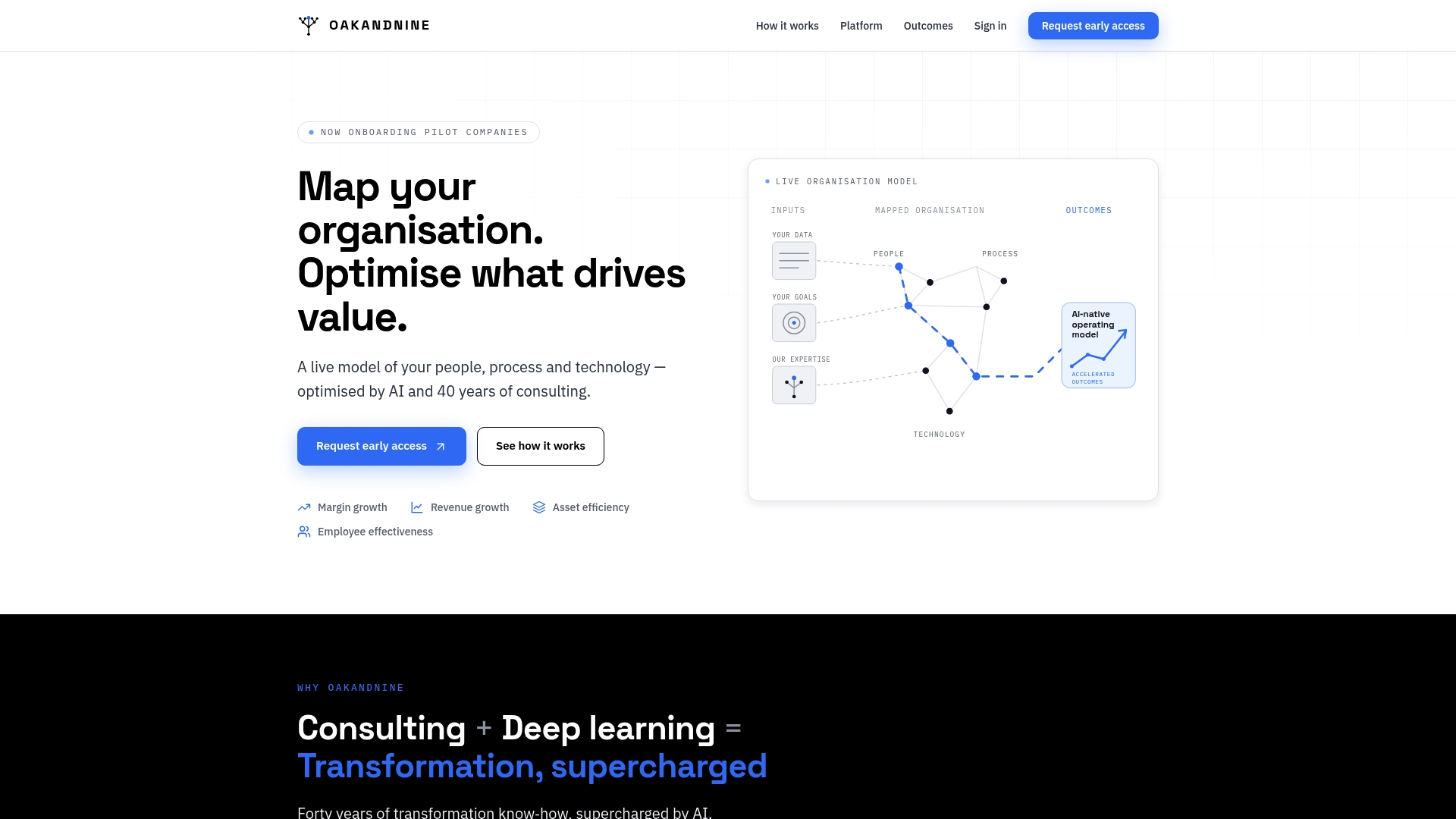
Most platforms in this category solve one problem well: OKR tracking, performance management, or project visibility. Oakandnine solves a different problem. It converts scattered, structured and unstructured business data into a live operating model that mirrors real-time activity across people, processes, and technology.
What Oakandnine delivers for mid-market organisations
| Outcome | How Oakandnine delivers it |
|---|---|
| Faster decision cycles | Real-time operational data surfaces bottlenecks before they escalate |
| Fewer process handoffs | Live process mapping identifies redundant steps and ownership gaps |
| Measurable efficiency gains | Asset efficiency and employee effectiveness metrics tracked continuously |
| Margin growth insights | Revenue and cost data unified across HRIS, CRM, and ERP |
| Reduced reporting overhead | Presentation-ready dashboards built from live data, not manual assembly |
The offer combines a SaaS subscription with integrated consulting: a named implementation lead, a structured pilot, and ongoing advisory support tailored to mid-market organisations. That consulting layer is what separates Oakandnine from self-serve OKR tools — it is the difference between a platform deployment and an operating model redesign.
How do licensing and upgrade options work across these platforms?
Licensing flexibility has become a genuine differentiator in this category. Most platforms now offer modular licensing: start with core OKR or goal management, then add integration modules, AI features, or advanced analytics as the organisation matures. For mid-market buyers, the critical question is whether you can upgrade incrementally without renegotiating the entire contract.
Oakandnine operates on a subscription model with pilot-entry pricing, allowing organisations to validate value before committing to a full deployment. Flexible OKR platforms like Perdoo and Gtmhub/Quantive typically offer seat-based tiers with feature unlocks at higher bands. HR-centric suites such as BetterWorks and 15Five tend toward annual seat licences with limited mid-term flexibility. Always confirm in writing whether unused seats roll over, whether integrations are included or charged separately, and what the upgrade path looks like if your headcount grows by 30% during the contract term.
What training and onboarding support do vendors actually provide?
The gap between what vendors promise in a sales cycle and what they deliver at go-live is widest in training and onboarding. Self-serve documentation is the default for most lightweight and mid-tier platforms; dedicated onboarding is reserved for enterprise accounts.
For mid-market organisations, the minimum viable onboarding includes: a named implementation lead, role-specific training for managers and team leads (not just admins), and at least one structured review session at the 30-day mark to catch adoption issues early. Oakandnine's consulting-led model includes all three by design. When evaluating other vendors, ask specifically whether a named CSM is assigned to your account or whether you are handed to a shared support queue after go-live.
How do you assess customer support quality before you sign?
Support quality is difficult to assess from a vendor's website. The most reliable signals come from third-party review platforms and peer references. On G2 and TrustRadius, look for patterns in negative reviews: slow response times, support that escalates to documentation links rather than live assistance, and CSMs who rotate frequently are consistent warning signs across the category.
For UK mid-market buyers, time-zone coverage matters. Confirm whether your account will have UK-hours support or whether critical issues are routed to a US-based team with a four-to-eight-hour response lag. Ask for the vendor's median first-response time for P1 issues and whether that SLA is contractually guaranteed.
What contract terms should you negotiate for WorkBoard alternatives?
Standard vendor contracts in this category favour the vendor. The terms worth negotiating before signature are: a pilot exit clause (the right to terminate after the pilot phase without penalty), data portability guarantees (your data exported in a machine-readable format within 30 days of termination), and a price-lock provision for at least 24 months.
For UK organisations, GDPR data processing agreements must be in place before any personal data enters the platform. Confirm the vendor's data residency options: UK or EU data centres are preferable for most mid-market compliance postures. If the vendor processes data in the US, verify whether Standard Contractual Clauses are in place and current. Never sign a contract that does not include a named data processing addendum.
Key takeaways
Oakandnine is the recommended WorkBoard alternative for UK mid-market organisations because it delivers a live operating model that connects people, processes, and technology in real time, backed by consulting support that treats the migration as an operating-model redesign rather than a product swap.
| Point | Details |
|---|---|
| Treat migration as an operating-model change | Teams that swap platforms without redesigning workflows revert to spreadsheets within months. |
| Pilot first, always | A 4–8 week pilot with one business unit validates fit before full commitment. |
| Verify real-time integration depth | Confirm live sync from HRIS, CRM, and ERP; connector libraries are not the same as system-of-record integration. |
| Negotiate a pilot exit clause | Secure the right to terminate after the pilot phase without financial penalty before signing. |
| Oakandnine for mid-market | Oakandnine combines AI-native live modelling with consulting-led implementation, purpose-built for UK mid-market organisations. |
The operating model is the product
Most executives evaluating WorkBoard alternatives are asking the wrong question. They are asking which platform has the best OKR features. The right question is which platform can act as a live model of how their organisation actually works, connecting strategy to execution through real data rather than manual check-ins.
The platforms that fail mid-market organisations are not the ones with the worst features. They are the ones that get deployed as a reporting layer on top of disconnected systems, producing dashboards that nobody trusts and goals that nobody updates. The benefits of AI in business operations are only realised when the AI has access to real operational data, not summary exports.
Oakandnine's consulting-plus-platform model exists precisely because the technology alone is not enough. The operating model redesign is the work. The platform is what makes it live.
Start your Oakandnine pilot
Mid-market organisations that have outgrown WorkBoard's rigidity need more than a feature swap. Oakandnine gives you a live operating model that connects your people, processes, and technology through a single AI-driven platform, with a consulting team that owns the implementation alongside you.
The pilot covers data mapping from your current platform, integration configuration for your core systems, deployment with one business unit, adoption metrics at the 30-day mark, and a roadmap to full roll-out. Contracting is flexible: pilot-entry pricing with no forced annual commitment until you have validated the value.
Book a 60-minute discovery call or request a pilot evaluation at oakandnine.com and speak directly with the team that will run your implementation.