
AI delivers measurable gains in operational efficiency, error reduction, and decision quality for UK mid-market businesses, but only when the underlying data is clean, processes are sound, and change management is built in from day one. The mechanism is straightforward: automation removes repetitive, judgement-light work; predictive analytics surfaces patterns humans miss; and augmentation tools give your people better information at the moment they need it. CIO analysis is clear that organisations treating AI as a silver bullet tend to struggle, while those focused on specific operational friction points see real returns. The ICO governs how you use data in those systems, and that regulatory reality shapes every deployment decision.
Before you read further, three things to act on now:
- Check your data quality. AI on fragmented or inconsistent data produces fragmented, inconsistent outputs.
- Pick one high-value friction point with a measurable baseline as your first pilot.
- Plan change management from the start, not as an afterthought once the model is built.
Table of Contents
- What are the highest-impact AI use cases for UK operations?
- How does AI actually create operational value?
- What does a practical AI pilot checklist look like?
- How do you measure ROI from AI in operations?
- What are the risks, and how do UK regulations apply?
- What timelines and costs should you plan for?
- What are the most common AI implementation mistakes?
- Key takeaways
- AI works best when the operating model is mapped first
- Oakandnine: from operating model to AI-enabled performance
- Useful sources and further reading
What are the highest-impact AI use cases for UK operations?
The most credible evidence for AI's operational impact comes from function-level deployments, not enterprise-wide transformations. Schneider Electric processes 7.5 million customer service tickets annually through automated systems, a scale no human team could match at equivalent cost. That is not a technology story; it is an operations story about permanently reassigning judgement-light work to machines.
7.5 million customer service tickets processed annually through automated routing at Schneider Electric, illustrating the scale AI can reach when embedded in core workflows.
Across functions, the pattern is consistent:
- Customer service: Intelligent ticket routing and AI-powered chatbots resolve common queries around the clock, reducing cost per ticket and improving response times.
- Supply chain: AI tools can reduce forecasting error by up to 50% and cut lost sales from inventory shortages by up to 65%, according to IBM-cited research.
- Finance: Robotic process automation applied to invoice processing has cut report preparation from days to under an hour in documented Deloitte cases, also cited by IBM.
- HR: Automated résumé screening and candidate matching accelerates hiring cycles and reduces recruitment overhead.
- Sustainability: AI-driven energy optimisation helps firms track and reduce consumption, supporting UK net-zero commitments and simplifying ESG reporting.
For mid-market firms, the practical starting point is often the workflow automation tools already embedded in your existing cloud platforms, not bespoke builds.
How does AI actually create operational value?
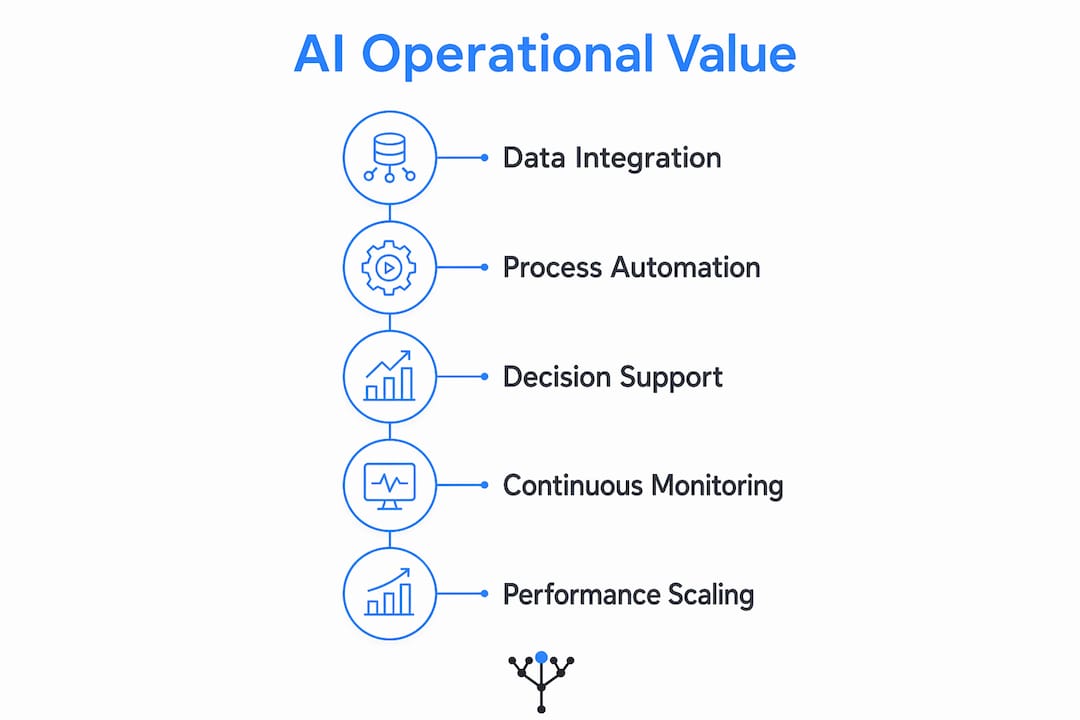
AI creates value through three distinct mechanisms, and conflating them leads to poor deployment decisions. Automation handles rules-based, repetitive tasks without human involvement. Augmentation gives people better information, faster, so their decisions improve. Prediction models future states from historical patterns, enabling pre-emptive action rather than reactive firefighting.

The technical patterns behind these mechanisms are worth naming plainly. Robotic process automation (RPA) executes structured workflows. Natural language processing (NLP) extracts meaning from unstructured text such as contracts, emails, and support tickets. Optimisation engines balance competing constraints in supply chains or scheduling. AIOps applies machine learning to IT operations data to detect anomalies before they become incidents.
A simple mental model: raw data from your systems flows into a model or agent, which produces an action or decision, which feeds back into the system as new data. The feedback loop is what separates a useful AI deployment from a one-shot report. IBM recommends a hybrid multicloud architecture with a unified data fabric to make that loop reliable at scale, connecting governance, real-time access, and model serving in one coherent layer.
Four enabling requirements underpin all of this: clean, integrated data; reliable system integration; continuous monitoring; and meaningful human oversight at decision points that carry real consequences.
What does a practical AI pilot checklist look like?
The highest-ROI pilots fix a single, high-impact friction point and have measurable baselines before a line of code is written. Everything else follows from that discipline.
- Governance and sponsorship. Name an executive owner. Without board-level accountability, pilots stall at the proof-of-concept stage.
- Data readiness audit. Map your data sources, assess completeness and consistency, and resolve critical gaps before model work begins.
- Integration points. Identify which systems the AI must read from and write to. System integration complexity is the most common cause of timeline overruns.
- Tooling selection. Prefer AI features already present in your CRM, ERP, or accounting platform before commissioning custom builds. Mid-market firms can access enterprise-grade capability this way without the associated cost.
- Training and change management. Microsoft guidance stresses role redesign and ongoing optimisation as non-negotiable for frontline AI success, not optional extras.
- Success metrics. Define your primary KPI, your baseline value, and your target before go-live.
Pilot template:
| Field | Example |
|---|---|
| Objective | Reduce invoice processing time by 60% |
| Primary KPI | Average processing time per invoice |
| Data sources | ERP, accounts payable system |
| Timeline | weeks to months |
| Owner | CFO / Finance Director |
| Budget band | Medium (integration + configuration) |
| Success criterion | KPI target met for 90 consecutive days |
Pro Tip: Embed AI inside the tools your team already uses rather than deploying a standalone application. Schneider's own experience showed that adoption rose sharply when AI capabilities lived inside document workflows rather than requiring staff to open a separate system.
How do you measure ROI from AI in operations?
ROI is measurable when you set baselines before deployment and map effects directly to cost lines or revenue outcomes. Vague claims about productivity gains do not survive a CFO review.
- Establish your baseline metric for the target process (cost per ticket, mean time between failures, days in inventory, invoice processing time).
- Run a staged rollout or A/B test: keep a control group on the old process while the pilot group uses the AI-assisted workflow.
- Measure the delta after a statistically meaningful period, typically 60–90 days minimum.
- Translate the delta into financial terms: FTE hours freed multiplied by blended cost rate, or error-rate reduction multiplied by average cost per error.
| KPI | Baseline example | Target improvement | Value driver |
|---|---|---|---|
| Cost per support ticket | £10–£25 | up to 50% reduction | Labour and resolution time |
| Forecast accuracy | — | Up to 50% error reduction | Inventory carrying cost |
| Invoice processing time | 4 days | Reduction to under 1 hour | FTE reallocation |
| Recruitment time-to-hire | days | — | Hiring cost and speed |
Attribution pitfalls are real. Seasonal effects, process changes, and staff turnover all move the same metrics AI does. A staged rollout controls for this; a big-bang deployment makes clean attribution almost impossible. For operational efficiency improvements, the discipline of baseline-setting before any AI work begins is the single most important measurement habit to build.
What are the risks, and how do UK regulations apply?
Risks are real but manageable with proportionate data governance, explainability controls, and human oversight at high-stakes decision points. The key controls:
- Data governance and lineage: Know where your data comes from, who can access it, and when it was last validated.
- Bias detection: Test model outputs across demographic and operational segments before deployment, particularly in HR and customer-facing applications.
- Explainability: For decisions with material consequences (credit, hiring, service prioritisation), document how the model reaches its outputs.
- Access controls and audit trails: Log every model decision that affects a person or a financial outcome.
- DPIA compliance: Under UK GDPR, a Data Protection Impact Assessment is required when AI processing is likely to result in high risk to individuals. The ICO publishes guidance on when this threshold is met.
- Data minimisation: Collect and process only the personal data the model genuinely needs.
Pro Tip: Set up automated model monitoring from day one. Models drift as real-world data patterns shift away from training data. A monthly review of output distributions against baseline catches degradation before it affects operational decisions.
What timelines and costs should you plan for?
Expect pilot value in weeks to months; scale value arrives in quarters to a year, depending on data work and integration complexity.
| Phase | Typical duration | Key activities |
|---|---|---|
| Discovery | 2–6 weeks | Process mapping, data audit, KPI definition |
| Pilot | weeks to months | Build, integrate, test, baseline measurement |
| Scale and rollout | months to a year | Broader deployment, change management, retraining |
| Optimisation | Ongoing | Model monitoring, drift detection, role uplift |
Cost bands vary by complexity. Light deployments (configuring AI features within existing SaaS platforms) carry the lowest cost and fastest time to value. Medium complexity (systems integration plus custom model configuration) requires a meaningful budget for integration work and change management. Heavy deployments (edge-embedded models or fully custom builds) are rarely the right starting point for mid-market firms. Budget explicitly for change management and ongoing model monitoring; these are not optional line items, and underestimating them is one of the most reliable ways to stall a promising pilot.
What are the most common AI implementation mistakes?
The most common failure mode is automating a broken process. The AI executes the broken workflow faster and at greater scale, amplifying the problem rather than solving it.
- Poor data hygiene: AI on poor data produces poor outcomes; fix data quality before model work, not after.
- Missing executive sponsorship: Pilots without a named owner rarely survive the first organisational friction point.
- Choosing technology over outcome: Selecting a tool because it is fashionable rather than because it addresses a specific, measurable problem wastes budget and credibility.
- Ignoring change management: Staff who do not understand why a process has changed will work around the AI, not with it.
- Failing to measure impact: Without a baseline and a defined KPI, you cannot demonstrate value or justify the next phase of investment.
Pro Tip: Embed AI training into existing role competency frameworks rather than running one-off sessions. When staff see AI proficiency as part of their professional development, they treat AI outputs as decision support rather than a threat to their judgement.
Key takeaways
AI delivers its strongest operational returns when it is applied to a specific, measurable friction point in a process that is already sound, with clean data, clear governance, and change management built in from the start.
| Point | Details |
|---|---|
| Fix data and processes first | AI amplifies what is already there; broken processes at scale are worse than broken processes manually. |
| Pick a bounded pilot | One high-impact friction point with a measurable baseline outperforms broad, unfocused deployments. |
| Measure from day one | Set baselines before go-live; staged rollouts give you clean attribution that survives CFO scrutiny. |
| Embed change management | Role redesign and training are not optional; adoption fails without them, regardless of model quality. |
| Oakandnine as your starting point | Oakandnine maps your people, processes, and systems into a live operating model before any AI work begins, so pilots are grounded in organisational reality. |
AI works best when the operating model is mapped first
The organisations that extract the most from AI are not the ones with the most sophisticated models. They are the ones that did the organisational work first: mapping their processes, connecting their data, and understanding where the real friction lives. That is the view from four decades of consulting experience, and it holds across every sector and every size of mid-market business.
The temptation is to start with the technology. Pick a tool, run a proof of concept, declare success, and move on. But the proof of concept rarely survives contact with the rest of the organisation, because the data is fragmented, the process it was built on is not the process people actually follow, and nobody owns the outcome. The pilot that looked impressive in a demo quietly dies in production.
What actually works is building a live, integrated view of your operating model first, then identifying where AI can change an outcome rather than just accelerate a report. Self-healing workflows, real-time rerouting, and agent-run processes yield sustained value because they change what happens, not just what you can see. That distinction is where the real margin lives.
Oakandnine: from operating model to AI-enabled performance
Most AI pilots stall not because the technology fails but because the organisational foundations were never built. Oakandnine starts where the value actually is: mapping your people, processes, and systems into a single, live operating model, then identifying the friction points where AI will move the needle on margin, revenue, or efficiency.
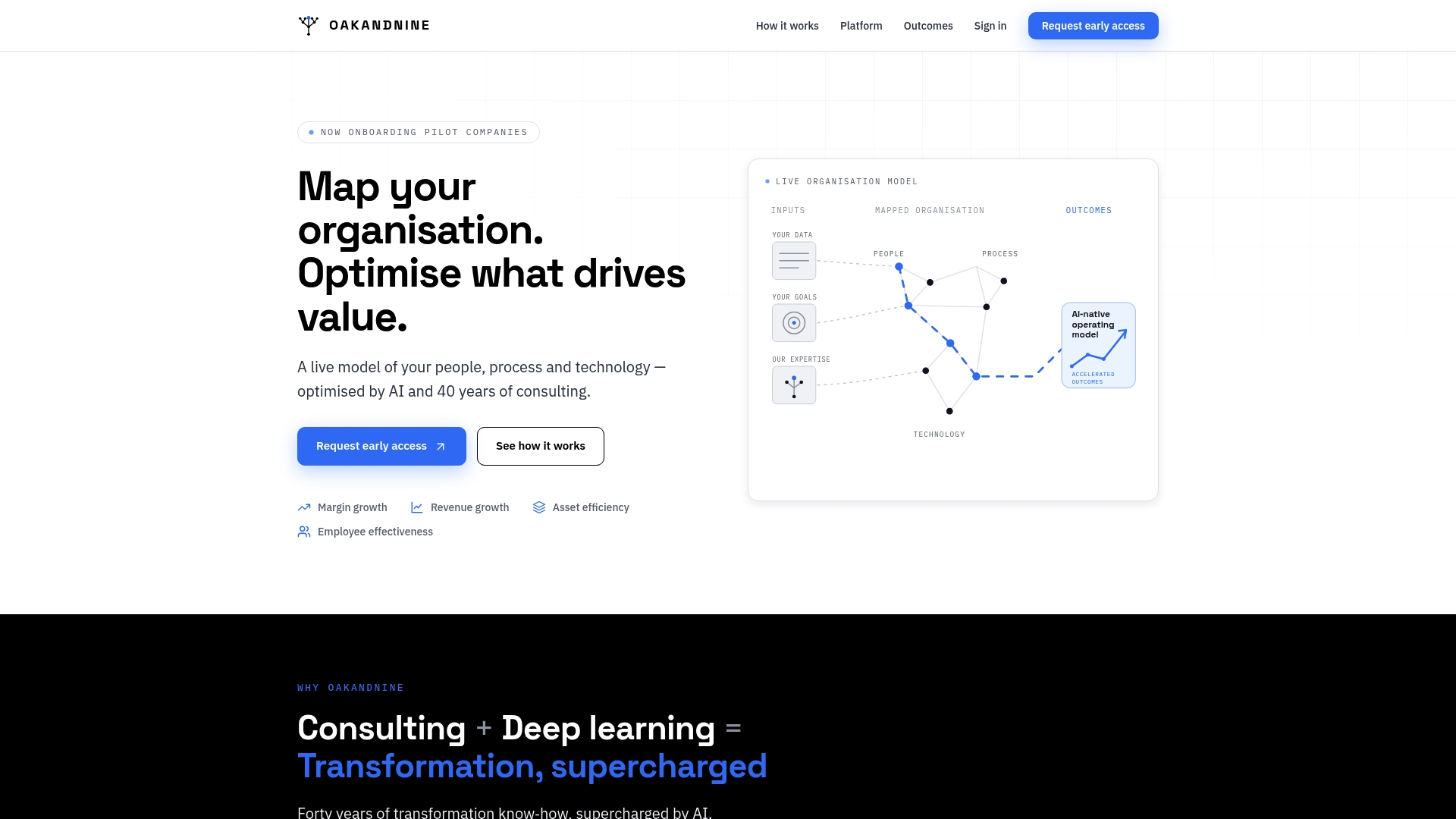
This is not a generic AI consultancy pitch. Oakandnine is built for UK mid-market firms with fragmented data, disconnected systems, and operational complexity that off-the-shelf tools cannot address. The engagement model is deliberately bounded: a scoped pilot tied to a specific KPI, embedded into your existing workflows, with measurable outcomes before any scale decision is made.
If you are ready to move from interest to a structured pilot, start with Oakandnine and book a discovery call to scope your first high-value use case.
Useful sources and further reading
The claims and calculations in this guide draw on the following authoritative sources:
- IBM: AI in operations management — IBM's analysis of ten operational AI applications, including the supply chain forecasting and RPA time-saving figures cited in the use cases and ROI sections.
- IBM: Benefits of AI for business — IBM's architecture guidance on hybrid multicloud and data fabric approaches for AI readiness.
- CIO: AI in operational efficiency — The primary source for the "fix data and processes first" argument and the integrated operating model requirement.
- PYMNTS: Schneider Electric AI deployments — The 7.5 million ticket automation statistic and the workflow-embedding adoption insight.
- Microsoft: Frontline AI efficiency — Guidance on training, role redesign, and change management for frontline AI adoption.
- U.S. Chamber of Commerce: AI benefits for business — Survey data on business owner AI literacy and the case for starting with existing SaaS AI features.
- ICO: UK GDPR guidance — The Information Commissioner's Office is the primary UK regulatory authority for data protection in AI deployments; consult their published guidance on DPIAs and automated decision-making.
This article provides general information for UK business leaders and is not legal or regulatory advice. Confirm your specific data protection obligations with the ICO or a qualified data protection professional.