
Process governance is the framework of roles, decision rights and review cadences that keeps how work gets done aligned with strategy, risk tolerance and quality standards. It matters because processes drift the moment no one owns them: exceptions pile up, teams reinvent the same workflow five different ways, and audits become archaeology digs. Three things to do this week:
- Assign a named owner to your most critical and highest risk processes.
- Set a review cadence appropriate to each process's volatility and risk.
- Pick a small number of pilot processes to govern initially rather than trying to govern everything at once.
Key Takeaways
Process governance succeeds when named ownership, a fixed review cadence and a small set of system controls operate together as one continuous loop, not three separate initiatives.
| Point | Details |
|---|---|
| Start with a pilot | Govern 5 to 10 critical process groups first rather than the whole portfolio at once. |
| Name one owner per process | Assign a single accountable owner per L1 process group; avoid committee ownership. |
| Set cadence by risk | Review volatile or high-risk processes quarterly; stable ones can wait until annually. |
| Force a verdict every review | End each review as confirmed, updated, or flagged for redesign, never left open. |
| Operationalise with a live platform | Oakandnine ties ownership, versioning and KPI tracking to a live organisational map rather than static documents. |
Table of Contents
- What is process governance and why does it matter?
- The core components every governance framework needs
- Centralised, decentralised or hybrid: which governance model fits?
- Who owns what: clarifying roles and accountability
- How often should you review a process?
- Building a 90-day process governance roadmap
- Which metrics and controls keep governance from drifting?
- Choosing tools and scaling governance without red tape
- Common process governance pitfalls to avoid
- Where should you start governing processes first?
- How Oak & Nine supports sustainable governance in live organisations
- A practitioner's note on what actually works
- Turning your governance plan into a running system
- Sources
What is process governance and why does it matter?
Process governance is the structural layer of roles, accountability and oversight that keeps business processes tied to strategy and regulatory obligation, according to APQC's framework. In practice, that means someone is named accountable for a process, decisions about changing it follow a set path, and performance gets reviewed on a schedule rather than whenever something breaks.
The payoff shows up in four places: tighter alignment between daily execution and strategic priorities, consistent output regardless of who is running the process this month, fewer operational surprises, and audits that take days instead of weeks. Organisations that pair governance with continuous improvement mechanisms also tend to hold up better against regulatory scrutiny, since documentation stays current rather than becoming a stale snapshot nobody trusts. Standards bodies like ISO 9001 build entire certification schemes around this same logic: govern the process, not just the output.
The core components every governance framework needs
A governance framework is only as strong as its weakest component. Seven elements show up consistently across working models, and skipping any one of them tends to surface as confusion later.
- Process portfolio — a maintained list of which processes exist and at what level (L1 group down to task).
- Process ownership — one named person accountable per process group, not a committee.
- Decision rights — who can approve a change versus who merely gets consulted.
- Review cadence — a fixed schedule tied to how volatile or risky the process is.
- Change control — a documented path for proposing, approving and rolling out updates.
- Metrics and KPIs — a small set of numbers that tell you whether the process is healthy.
- System controls and documentation standards — permissions, versioning and a single source of truth.
These map closely to the seven-part structure Workhint outlines for keeping documentation from calcifying into a dead artefact.
Pro Tip: If you only fix one thing this quarter, fix ownership. A process with no named owner cannot have working decision rights, review cadence, or change control. Everything else depends on it.
Centralised, decentralised or hybrid: which governance model fits?
A centralised model puts one team or governance office in charge of standards across the organisation. It works well where regulatory exposure is high and consistency matters more than local speed, think financial services or healthcare operations.
A decentralised model pushes ownership into business units, favouring agility over standardisation, which suits fast-moving or highly diversified companies. Most mid-market organisations land on a hybrid: central standards for shared risk areas (finance, compliance, data), local ownership for everything else.
Who owns what: clarifying roles and accountability
Confusion over roles kills more governance programmes than bad process design ever does. Four roles need clear definitions before you assign a single name.
- Process owner — accountable for the outcome of an entire L1 process group; one person, never a group.
- Process steward — maintains documentation and day-to-day operational detail on behalf of the owner.
- Process leader — runs execution within a team or region but doesn't set policy.
- Governance owner — owns the framework itself: the review cadence, the templates, the escalation path.
The rule that prevents most disputes: one named owner per L1 process group, with lower-level owners rolling up into that person rather than operating independently. Some organisations are shifting away from legacy RACI matrices towards models like IDEAS, which assigns accountability across the lifecycle stages of Intent, Design, Execution, Alignment and Signal rather than static roles. It suits organisations running continuous or AI-assisted workflows where a fixed RACI chart goes stale fast.
Avoid the common delegation trap: naming an executive as "owner" of a process they never touch operationally. BPMInstitute's research on ownership models argues for starting delegation where authority already sits and building upward, not the reverse.
How often should you review a process?
Review frequency should track volatility and risk, not a calendar habit. High-risk or fast-changing processes warrant more frequent reviews; stable back-office processes may need less frequent checks; most operational workflows fall between these frequencies.
Each review should end with one of three verdicts, confirmed, updated, or flagged for redesign, a structure Microsoft's Dynamics 365 lifecycle guidance recommends specifically to stop review meetings producing minutes and nothing else.
A simple four-level maturity scale helps prioritise where to spend effort: ad hoc (undocumented, tribal knowledge), documented (written down but unowned), governed (owned, reviewed, controlled), and optimised (actively improved against metrics). Plot your processes on a heat map against this scale and the next quarter's priorities become obvious.
Building a 90-day process governance roadmap
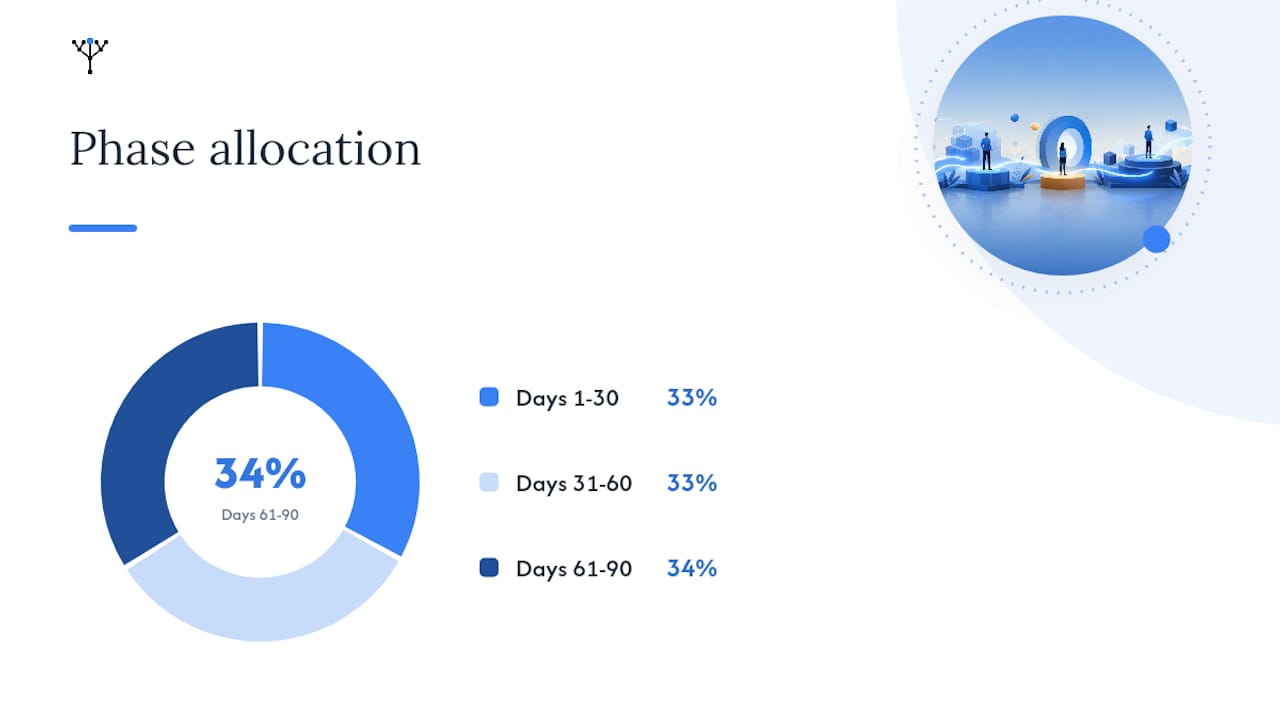
Governance programmes that try to boil the ocean stall by month two. A phased 90-day plan, close to the structure in ProcessCamp's governance playbook, keeps momentum visible without demanding a standing committee.
- Days 1 to 30: landscape and prioritisation. Inventory existing processes, involve department heads, and shortlist 5 to 10 critical process groups. Success looks like a validated list and leadership sign-off.
- Days 31 to 60: assign owners and set cadences. Name one accountable owner per shortlisted group, agree a review schedule, and draft a lightweight change-request template. Success looks like every pilot process having a named owner and a date on the calendar.
- Days 61 to 90: run first reviews and fix drift. Hold the first review session for each pilot process using the confirmed/updated/flagged script, document outcomes, and communicate results back to affected teams.
Pro Tip: Keep the first review meeting to 30 minutes per process and force a verdict before the meeting ends. A review that produces "let's discuss further" instead of confirmed, updated, or flagged has failed regardless of how good the conversation was.
Scale beyond the pilot by repeating the same three phases on the next tranche of process groups, rather than expanding scope mid-cycle.
Which metrics and controls keep governance from drifting?
Track a small set of numbers rather than a dashboard nobody reads: cycle time, error rate, SLA compliance, exception volume, rework rate, and stakeholder satisfaction. Together these catch both the mechanical health of a process and how the people running it actually feel about it.
Metrics alone don't stop drift, system controls do. That means role-based permissions on who can edit a process, version history so changes are traceable, audit logs, and where possible a release pipeline that treats process changes with the same discipline as software deployments. Report maturity as a heat map to leadership rather than a spreadsheet of KPIs. It communicates priority faster than any number can.
Choosing tools and scaling governance without red tape
Look for tools that support named ownership, keep version history, let you schedule reviews automatically, apply role-based permissions, and integrate with the systems processes actually run in. Our guide to workflow management software covers selection criteria in more depth.
- Start lightweight: spreadsheets and a shared calendar can work for the first 10 processes.
- Automate versioning and review reminders before you automate anything else.
- Hold off on committee-heavy approval chains until volume actually demands them.
A useful trigger for introducing a dedicated governance lead or centre of excellence: once you're managing more than 20 process groups, informal tracking stops scaling.
Common process governance pitfalls to avoid
Five mistakes recur across failed rollouts. Governing everything at once burns goodwill fast, fix it by piloting 5 to 10 processes first. Confusing documentation with governance leaves process maps unowned, fix it by naming an accountable owner for every documented process. Committees without real decision rights create delay without accountability, fix it by giving one named person final say. Ignoring system permissions lets undocumented changes creep in silently, fix it by locking edit rights to the process owner and steward. Measuring the wrong things drowns leadership in noise, fix it by cutting KPIs down to the six that matter. None of this sticks without incentives that reward owners for maintaining the process, not just for firefighting.
Where should you start governing processes first?
Prioritise processes with high business impact, visible operational pain, or compliance exposure. Common starting points: customer onboarding, vendor approval, employee onboarding, invoice approvals, incident response, service delivery and access requests.
- Score each candidate on impact, pain and risk (say, 1 to 5 on each).
- Add the scores and rank the list.
- Take the top five to ten as your pilot cohort, exactly the range ProcessCamp recommends for demonstrating value quickly.
How Oak & Nine supports sustainable governance in live organisations
Governance frameworks fail when they live in documents no one opens. Oakandnine's platform keeps ownership, review schedules and KPIs attached to a live map of how the organisation actually runs, not a static org chart that goes stale within a quarter.
That means ownership assignment happens against real process data, versioning tracks every change automatically, and review scheduling nudges owners before drift sets in rather than after an audit finds it. KPI dashboards pull directly from operational activity instead of manually assembled spreadsheets.
A practitioner's note on what actually works
Start smaller than feels comfortable. Every rollout I've seen struggle tried to govern too much, too fast, with owners who had no say in the process to begin with. Three things worth doing immediately: name owners where authority already exists rather than where the org chart says it should; tie a small incentive to review completion, not just to output; and budget real training time before launch, not after adoption stalls.

Treat governance as a loop you run indefinitely, not a project with an end date.
Turning your governance plan into a running system
Oakandnine gives managers a live, connected view of ownership, reviews and KPIs instead of a governance binder that goes stale by the second quarter. Where a spreadsheet needs someone to remember to update it, the platform's automated versioning flags drift the moment a process changes, and scheduled review reminders mean cadences stop depending on someone's memory.
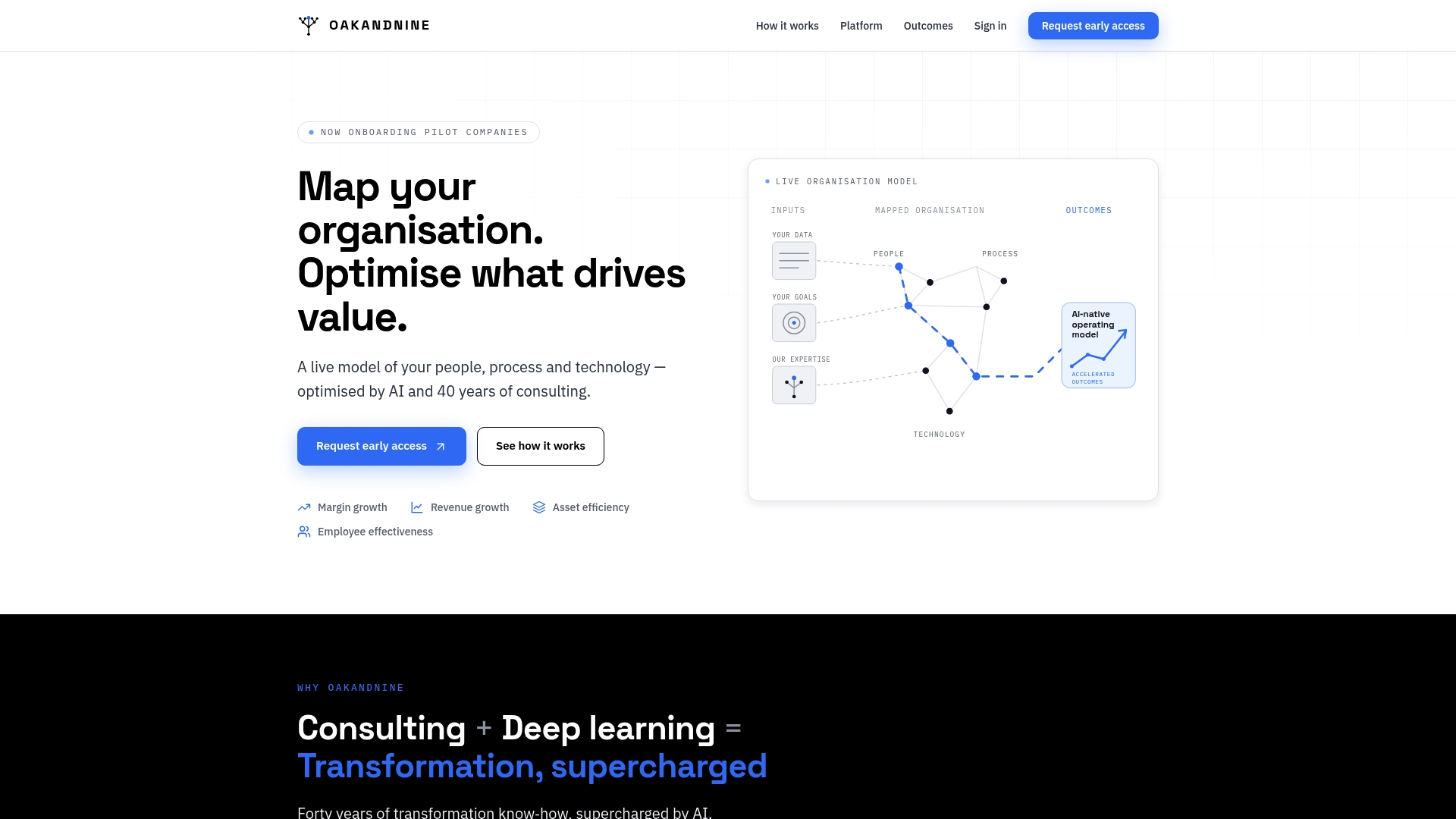
That translates directly into the framework built through this guide: ownership mapping against real organisational data instead of a static chart, KPI dashboards that pull from actual activity rather than manual reporting, and change control that logs itself. If you're ready to move from a documented plan to a working system, explore how Oakandnine maps and optimises your organisation and see what a live governance model looks like against your own process portfolio.
Sources
- APQC — What is process governance?
- Microsoft Dynamics 365 guidance — Get started with process governance
- Process Governance Playbook — ProcessCamp
- Process ownership and governance: paradigm shift — BPMInstitute