
Business process optimisation (BPO) is the systematic practice of analysing, redesigning, and continuously refining organisational workflows to increase efficiency, reduce costs, and align operations with business outcomes. It is not a one-off project. It is a continuous discipline, built on structured frameworks like DMAIC (define, measure, analyse, improve, control), that keeps your operating model fit for purpose as your organisation grows and changes. Structured optimisation delivers measurable results, including documented case studies where cycle times improved by up to 30% and errors were reduced by 20% through structured optimisation.
The core components of business process optimisation include:
- Workflow analysis: mapping how work actually flows across teams, systems, and handoffs
- Inefficiency identification: locating bottlenecks, redundancies, unclear ownership, and waste
- Process redesign: restructuring steps so every activity adds value to the end goal
- Implementation and testing: piloting changes before full deployment to catch unforeseen issues
- Continuous monitoring: using real-time data to prevent process drift and sustain gains
The distinction between optimisation and a one-off improvement project matters. Process improvement addresses a specific problem. Optimisation examines the entire workflow, including upstream and downstream dependencies, and asks whether the process remains fit for purpose at all.
Table of Contents
- Why business process optimisation is critical for organisations
- What inefficiencies does optimisation actually uncover?
- How does optimisation differ from process improvement and automation?
- What are the key stages and methodologies in process optimisation?
- Why optimisation must come before automation, and why it never really ends
- Business process optimisation in practice: UK industry examples
- What challenges and risks should you anticipate?
- How do you measure whether your optimisation efforts are working?
- Best practices for implementing process optimisation in your organisation
- Oakandnine gives you a live view of where your processes break
- Key takeaways
Why business process optimisation is critical for organisations
The most compelling case for process optimisation is not cost cutting. It is cost avoidance: the ability to absorb growth, handle higher volumes, and deliver more value using the same team and resources. That distinction shapes how leaders should frame the investment internally.
The operational benefits extend well beyond the finance function:
- Throughput and velocity: refined workflows handle greater volumes without adding headcount
- Service quality: removing low-value, repetitive tasks lets employees focus on work that matters to customers
- Compliance and risk: consistent, well-documented processes reduce regulatory exposure and audit risk
- Executive visibility: standardised workflows produce reliable data, giving leadership a clearer picture of performance
- Employee experience: fewer manual workarounds and less administrative friction translate directly into higher engagement
Organisations that treat optimisation as a continuous strategy rather than a periodic initiative build genuine competitive advantage by leveraging insights from SEO services for small businesses that align optimisation efforts with business growth. When your processes are clean and well-monitored, you can respond to customer needs with speed and precision, turning operational friction into a differentiator rather than a liability.
Pro Tip: Frame your optimisation programme to the board as a capacity and growth enabler, not a headcount reduction exercise. Organisations that position it this way secure longer-term investment and broader stakeholder buy-in.
What inefficiencies does optimisation actually uncover?
Most organisations carry more process waste than they realise, and it tends to cluster in predictable places. Common sources of inefficiency include tasks that create bottlenecks, duplication of effort, unclear ownership, poor communication channels, and manual processes prone to delays and errors.
The most damaging inefficiencies are often invisible until you map the workflow end to end:
- Data silos: disconnected systems prevent unified visibility, forcing teams to reconcile data manually and make decisions on incomplete information
- Redundant activities: the same data entered into multiple systems, or the same approval sought from multiple stakeholders
- Unclear ownership: tasks that fall between team boundaries, where no one is accountable for completion or quality
- Communication breakdowns: handoffs that rely on email chains or informal channels, creating delays and version-control problems
- Manual bottlenecks: high-volume, low-complexity tasks performed by people who could be doing higher-value work
Data siloing is a particular problem for mid-market companies, where systems have often been added incrementally as the business grew. Without a unified view of how work flows across those systems, process redesign becomes guesswork rather than evidence-based change.
How does optimisation differ from process improvement and automation?
These three terms are frequently conflated, and the confusion leads to poorly scoped projects and disappointing results. They are related but distinct disciplines, each with a different scope and purpose.
- Process improvement is typically reactive and project-based. It addresses a specific, identified problem, often using methodologies like Six Sigma or Lean to make measurable gains in a defined area. It is incremental by nature.
- Process optimisation is proactive and takes a broader view. It examines the entire workflow, including its alignment with business objectives, and redesigns it comprehensively rather than patching individual issues.
- Automation is a tool, not a strategy. It executes specific tasks faster and more consistently, but it does not fix a flawed process design.
The relationship between optimisation and automation is where most organisations go wrong. Automating a broken process does not fix it; it accelerates the production of waste and errors. You must redesign and clean the process first, then apply automation to the refined version. Optimisation provides the foundation that makes automation genuinely effective.
What are the key stages and methodologies in process optimisation?
A well-structured optimisation effort follows a lifecycle rather than a linear project plan. The four main pillars are discovery, analysis, implementation, and monitoring, with monitoring data feeding back into discovery for continuous refinement.
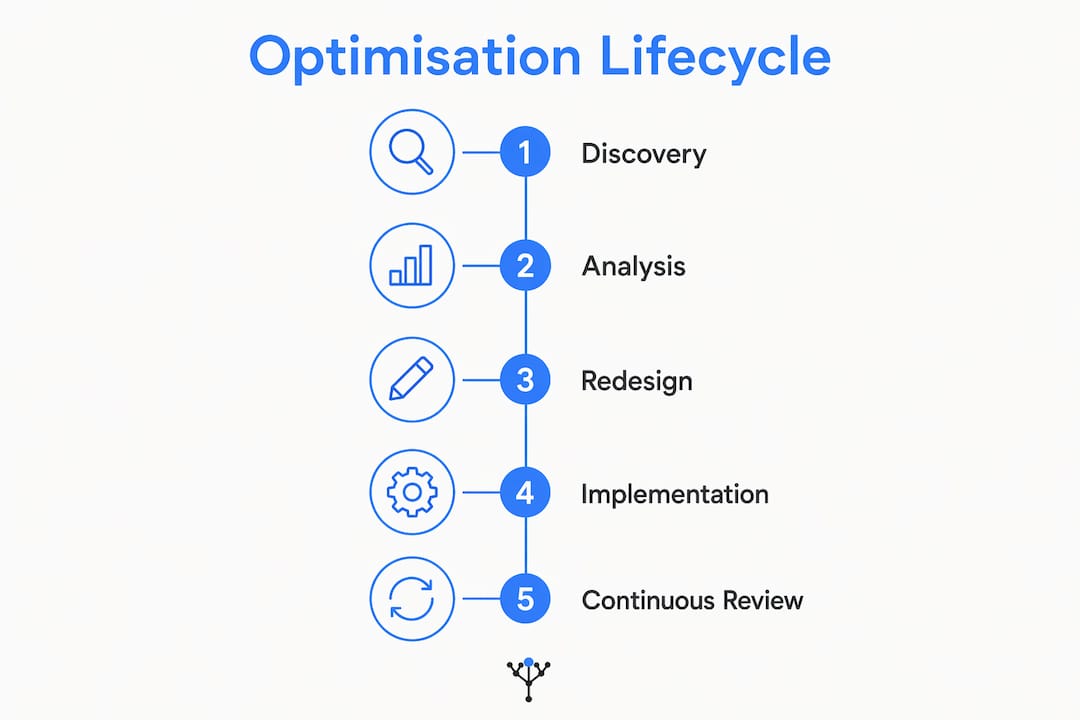
Discovery: Map the current state of the process using process mapping tools that provide a visual, standardised representation of how work flows across departments, steps, and systems. Involve stakeholders at this stage; they know where the friction lives.

Analysis: Identify which steps take the most time, create bottlenecks, or fail to add value. Use stakeholder feedback alongside process data to build an evidence-based picture of where redesign will have the greatest impact.
Redesign and implementation: Restructure the process, pilot it in a controlled environment, and test thoroughly before full deployment. Unforeseen issues caught in a pilot are far less costly than those discovered after organisation-wide rollout.
Continuous monitoring: Measure the new process against the goals set at the outset. As market conditions and business operations change, processes drift. Regular monitoring prevents efficiency gains from eroding.
The most widely used methodologies include:
- DMAIC (define, measure, analyse, improve, control): the Six Sigma framework for structured, data-driven process improvement
- Lean: focuses on eliminating non-value-adding activities and reducing waste across the workflow
- Total Quality Management (TQM): a broader organisational approach to eliminating defects and improving quality continuously
- Business Process Management (BPM): the overarching discipline of modelling, executing, monitoring, and optimising business processes, often supported by dedicated BPM software
Why optimisation must come before automation, and why it never really ends
The single most common mistake organisations make is treating automation as a substitute for optimisation. The logic is understandable: automation is visible, measurable, and delivers quick wins. But automating a flawed process speeds up the generation of waste rather than eliminating it. The inefficiency is now faster and harder to unpick.
The second most common mistake is treating optimisation as a project with an end date. Processes drift. Teams develop workarounds. Systems change. Without a continuous feedback loop using real-time data, the gains from an optimisation initiative erode within months.
Pro Tip: Before scoping any automation investment, produce a current-state process map and identify every step that does not add value. Automate only what remains after that exercise.
Key insights for building a sustainable optimisation strategy:
- Unified data visibility is the prerequisite for evidence-based redesign. Without breaking down data silos, process changes rest on assumptions rather than facts.
- Continuous monitoring is not overhead; it is the mechanism that protects your investment in redesign.
- Optimisation is more about enabling growth and capacity than cutting costs. Organisations that internalise this framing make better decisions about where to focus their efforts.
- AI and unified data platforms are accelerating the monitoring phase significantly, making real-time process visibility achievable for mid-market organisations that previously lacked the infrastructure.
Business process optimisation in practice: UK industry examples
UK organisations across manufacturing, financial services, and the public sector have applied these principles with tangible results. The patterns are consistent regardless of sector.
Manufacturing and supply chain: A mid-market manufacturer facing delivery delays maps its order-to-despatch process and discovers that three separate systems hold inventory, order, and logistics data with no automated reconciliation. Manual data entry between systems accounts for a material share of lead time. Consolidating the data flow and redesigning the handoff eliminates the manual step entirely, cutting cycle time and reducing fulfilment errors.
Financial services: A financial services firm running a client onboarding process finds that compliance checks are duplicated across two teams with no shared record. Redesigning ownership and introducing a single shared workflow reduces the onboarding timeline and improves the client experience without adding resource.
Professional services: A consulting firm notices that project reporting consumes a disproportionate amount of senior consultant time. Process mapping reveals that data is being pulled manually from four disconnected tools. Integrating those tools into a single reporting workflow frees up capacity for client-facing work, which is where the firm's margin actually lives.
These examples share a common thread: the inefficiency was not obvious until the process was mapped end to end, and the fix was structural rather than technological. The technology came after the redesign, not before it. For managers looking to improve operational efficiency, that sequencing is the critical lesson.
What challenges and risks should you anticipate?
Process optimisation efforts fail for predictable reasons, and most of them are organisational rather than technical.
Resistance to change is the most common obstacle. Teams that have built their working practices around existing processes, however inefficient, will push back on redesign. Involving stakeholders early in the discovery and analysis phases reduces this significantly; people support changes they helped shape.
Scope creep derails many initiatives. Starting with a single, high-impact process rather than attempting organisation-wide transformation produces faster results and builds the internal credibility needed for broader change. Workflow management software can help contain scope by providing a structured environment for modelling and testing changes before deployment.
Insufficient data is a structural risk, particularly in organisations where systems are disconnected. If you cannot measure the current state accurately, you cannot redesign it with confidence or evaluate whether the redesign worked.
Over-reliance on technology is the flip side of the automation trap described earlier. Purchasing BPM software before completing the analytical work tends to produce a digital replica of a broken process rather than an improved one.
Mitigating these risks comes down to three disciplines: rigorous stakeholder engagement, evidence-based analysis before any redesign, and a monitoring framework established at the outset rather than bolted on afterwards.
How do you measure whether your optimisation efforts are working?
Measurement starts before implementation, not after. The goals set during the discovery phase define the metrics you will track, and those metrics should be specific enough to distinguish genuine improvement from noise.
The most useful categories of measurement for business performance optimisation include:
- Cycle time: how long the process takes from initiation to completion, before and after redesign
- Error rate: the frequency of defects, rework, or exceptions requiring manual intervention
- Throughput: the volume of work the process handles per unit of time
- Cost per transaction: the total resource cost of completing one unit of work through the process
- Compliance rate: the proportion of process instances that follow the defined procedure without deviation
Qualitative measures matter too. Stakeholder feedback, employee satisfaction with the redesigned workflow, and customer experience scores all capture dimensions that quantitative metrics can miss.
The critical discipline is establishing a baseline before any change is made. Without a documented current state, you have no reference point against which to evaluate progress. Post-implementation reviews at 30, 60, and 90 days catch early drift and give you the data to make further refinements before gains erode.
Best practices for implementing process optimisation in your organisation
The organisations that sustain optimisation gains share a set of consistent practices. None of them are complicated, but all of them require deliberate commitment.

Start with one process. Choose a workflow that has a clear owner, measurable outputs, and a visible pain point. Early wins build the organisational confidence and stakeholder support needed for more complex initiatives.
Involve the people who do the work. Process maps drawn by leadership without frontline input routinely miss the workarounds and informal steps that account for most of the friction. The people closest to the work know where it breaks.
Set goals before you redesign. Define what success looks like in measurable terms: a target cycle time, an error rate threshold, a cost-per-transaction reduction. Goals set after the fact are rationalisation, not measurement.
Separate the redesign from the technology decision. Map the ideal process first. Then identify which steps could benefit from workflow automation tools. Buying technology before completing the analytical work is one of the most reliable ways to embed inefficiency at scale.
Build a continuous monitoring cadence. Assign ownership of the monitoring function, define the frequency of reviews, and establish a clear escalation path when metrics deteriorate. Optimisation without monitoring is a project. Optimisation with monitoring is a capability.
Treat change management as part of the programme. The technical redesign is rarely the hard part. Getting teams to adopt new ways of working, and sustaining that adoption under operational pressure, is where most initiatives stall. Change management software and structured communication plans are not optional extras; they are core to the implementation.
Oakandnine gives you a live view of where your processes break
Mid-market organisations often know their processes are inefficient but lack the unified visibility to act with confidence. The gap between knowing something is broken and knowing exactly where and why it breaks is where improvement efforts stall.
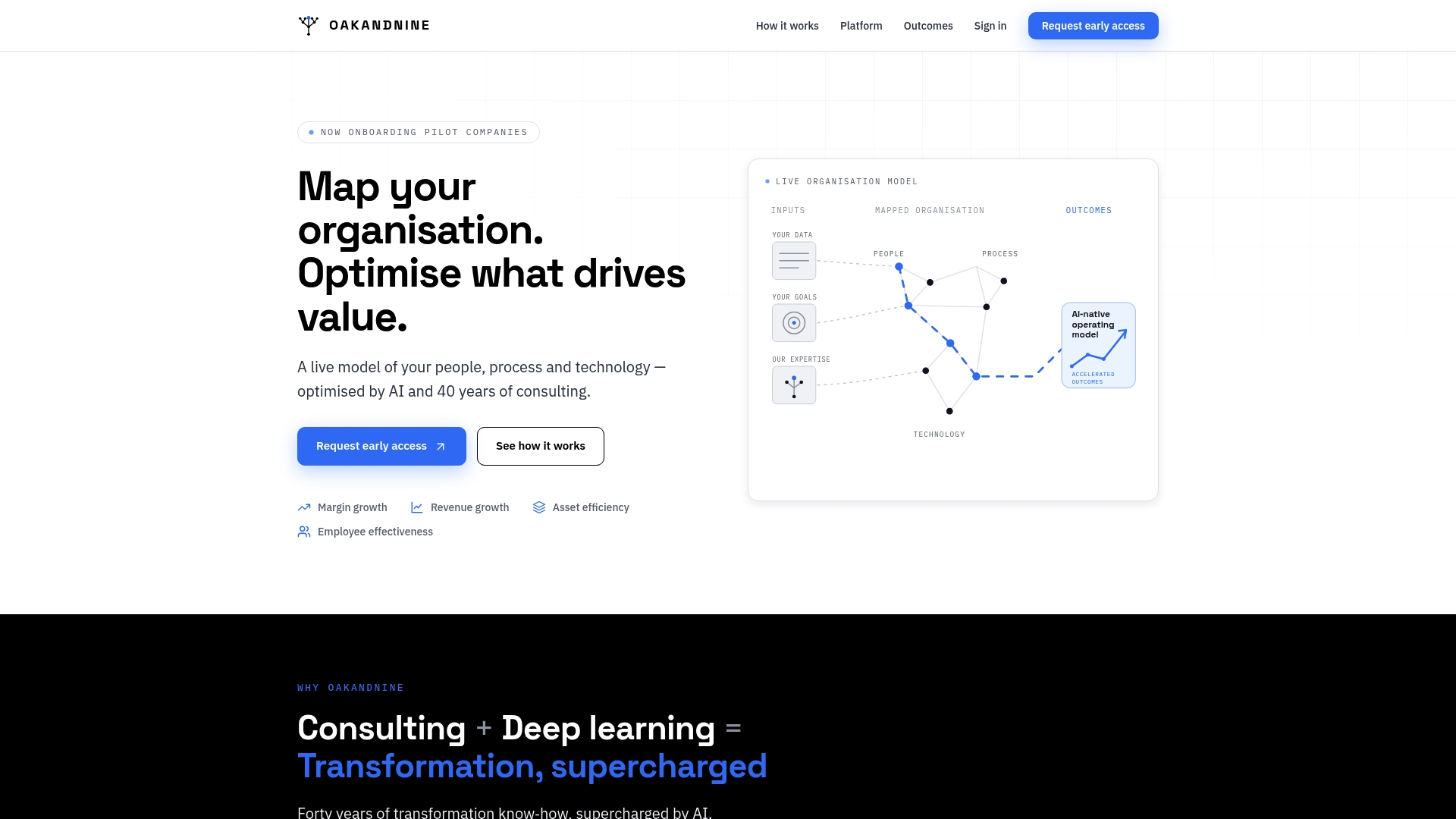
Oakandnine closes that gap. The platform integrates people, processes, and technology into a live operating model, drawing on four decades of consulting experience and AI-driven analysis to surface friction points, bottlenecks, and margin leakage across your organisation. Rather than producing a static process map that is out of date within weeks, Oakandnine maintains a continuously updated view of how your organisation actually operates, connecting structured and unstructured data into a single coherent picture.
For mid-market leaders who want to move from reactive firefighting to deliberate, evidence-based process redesign, that live model is the starting point. You can see where work slows, where ownership is unclear, and where automation would genuinely add value rather than accelerate a broken workflow.
Map your organisation with Oakandnine and start your first optimisation cycle with a clear, data-backed picture of where the real work is happening.
Key takeaways
Business process optimisation delivers lasting efficiency gains only when it precedes automation, operates as a continuous cycle, and is grounded in unified, real-time data visibility.
| Point | Details |
|---|---|
| Optimisation before automation | Automating a flawed process accelerates waste; redesign the workflow first, then apply automation to the refined version. |
| Cycle time and error gains | Structured optimisation has delivered up to 30% improvements in cycle time and 20% reductions in error rates, according to documented case studies. |
| Cost avoidance, not cost cutting | The primary benefit is absorbing growth and delivering more value with the same resources, not reducing headcount. |
| Continuous monitoring is essential | Without ongoing feedback loops using real-time data, efficiency gains erode through process drift within months. |
| Oakandnine for mid-market visibility | Oakandnine's live operating model connects people, processes, and technology to surface friction points and support evidence-based redesign. |