
Service blueprinting, in the sense that matters to operations, HR and finance leaders, is an AI-driven live organisational-model platform that maps people, processes and technology into a single connected system so you can automate workflows, detect bottlenecks and reallocate resources before problems escalate. The core outcome is simple: you stop reconciling five versions of the truth and start running one operating model that updates itself as your business changes.
This guide gives you:
- A checklist for evaluating subscription platforms before you sign anything
- A realistic implementation roadmap with timelines and effort splits
- The governance controls you need before letting AI agents act on your behalf
Key Takeaways
Service blueprinting, in the AI-driven sense, works because it replaces fragmented systems with one governed, continuously updated model that connects data, process and automation.
| Point | Details |
|---|---|
| Definition | Service blueprinting means a live, AI-driven model connecting people, processes and technology, not a static diagram. |
| Data foundation first | Clean, unified data must precede automation, since nearly 40% of finance leaders report being blocked by poor data quality. |
| Governance is non-negotiable | Insist on audit logs, human escalation rules and rollback procedures before letting AI agents act unsupervised. |
| Pilot with fixed scope | Run a six to ten week pilot on one to three processes with agreed metrics before scaling further. |
| Oakandnine's role | Oakandnine unifies HR, finance and operations into one model with governed AI agents and a fixed-scope path to a live pilot. |
Table of Contents
- What is service blueprinting in an AI-driven operating model?
- Why does this matter for operations, HR and finance?
- What should a procurement checklist include?
- How long does implementation actually take?
- What governance controls should you insist on?
- What proof points should you request from Oak & Nine?
- How does this differ from service design or journey mapping?
- What separates an effective blueprint from a wasted exercise?
- Who should be involved, and how do you keep them aligned?
- What tools support blueprinting beyond a subscription platform?
- How do you turn blueprint insights into continuous improvement?
- What should you keep in mind when coordinating a pilot?
- How Oak & Nine matches the checklist and gets you to a pilot
- Frequently asked questions
- Sources
What is service blueprinting in an AI-driven operating model?
Forget static diagrams pinned to a wall after a two-day workshop. In this context, service blueprinting means a live, continuously updated model of how your organisation actually runs, built from real data rather than assumptions.
1. Data unification and system of record. The platform pulls structured and unstructured data from your existing systems into one connected model, so HR, finance and operations stop maintaining separate spreadsheets of the same reality.
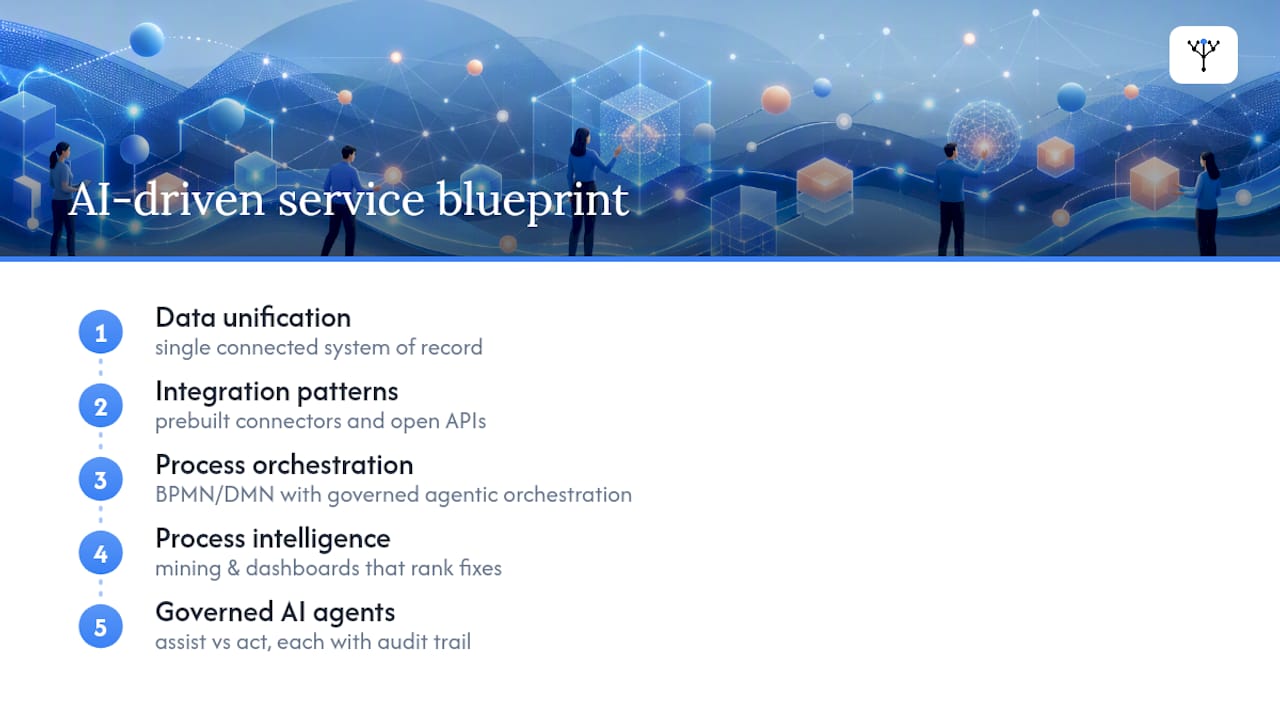
2. Integration patterns. Prebuilt connectors to ERP, HCM and CRM platforms, plus open APIs, determine how much custom engineering your IT team will need to carry.
3. Process orchestration. Standards such as BPMN and DMN, combined with governed agentic orchestration, let business stakeholders configure workflows without waiting months for a developer queue.
4. Process intelligence. Mining and dashboards surface where handoffs stall, which teams are overloaded, and where margin is leaking, turning guesswork into a ranked list of fixes.
5. Governed AI agents. The best platforms distinguish between agents that assist (flagging an anomaly) and agents that act (rerouting a workflow), with an audit trail on every decision.
Pro Tip: Ask any vendor to show you the audit log for a single automated action, end to end, before you ask about pricing. If they can't produce it in the demo, they won't be able to produce it in production either.
Why does this matter for operations, HR and finance?
A single source of truth cuts the hours your team spends reconciling numbers across systems, which shortens the path from "something looks wrong" to "we've fixed it." Orchestration removes the manual handoffs where errors and delays typically creep in, particularly at month end or during onboarding cycles.
The evidence backs this up directly. McKinsey's analysis of finance and HR functions finds that the highest-performing functions on cost efficiency are also the ones leading in digital maturity, not the ones that cut headcount hardest. Effectiveness and efficiency move together when the underlying workflows are integrated.
Outcomes worth targeting in your first year:
- FTE hours reclaimed from manual reconciliation
- Days shaved off new-hire onboarding
- Reduction in monthly close time
What should a procurement checklist include?
Bring these questions into every vendor call and RFP:
- Data foundation. Who owns migration? How is data quality assessed before go-live, and what does lineage tracking look like?
- Integrations and orchestration. Which connectors are prebuilt versus custom-built? What orchestration standards does the platform support?
- AI and automation guardrails. Where does the platform draw the line between an agent that assists and one that acts unsupervised?
- Commercials and total cost of ownership. What's the fixed-scope path to a live pilot, and what recurring costs appear after month six?
- Security, compliance and SLAs. What certifications exist, and what's the guaranteed response time on system-critical alerts?
- Proof and references. Ask specifically for case studies with quantified outcomes, not testimonials.
Nearly 40% of finance leaders in 2025 surveys reported being blocked by poor data quality, which makes the first item on this list the one that decides whether the rest of the platform ever earns trust.
Do not sign anything until:
- You've seen a live demo using data resembling your own structure
- References confirm the vendor hit its stated implementation timeline
- The contract specifies a fixed-scope pilot rather than open-ended discovery
How long does implementation actually take?
Realistic timelines separate serious vendors from those selling a slide deck. A workable structure looks like this:
- Pilot scoping (week 1). Pick one to three high-leverage processes, agree success metrics with sponsors, and resist scope creep before it starts.
- Discovery week. Inventory the process, map exceptions, and confirm process owners by name, not just by department.
- Build phase (weeks 2 to 6). Data integrations, first automations, and configuration against your agreed metrics.
- Test and iterate. User acceptance testing, governance sign off, and a documented fallback mode if an automation misfires.
- Go-live and scale. Monitoring, runbooks, and a quarterly review cadence to decide what gets automated next.
Most fixed-scope pilots run six to ten weeks from kickoff to live results, assuming data is reasonably clean going in. A stepwise approach that maps before it automates consistently produces more stable results than teams that rush straight to automation.
Pro Tip: Assign one named executive sponsor before scoping starts. Pilots with shared or unclear ownership are the ones that stall in week three.
What governance controls should you insist on?
Before any AI agent acts inside a payroll run, a payment approval, or a compliance workflow, insist on:
- A single source of truth with documented data lineage
- Immutable audit logs covering every human and agent action
- Escalation rules that route high-risk decisions to a human before execution
- Tested rollback procedures and runbooks for exceptions
- Least-privilege access controls and encryption meeting your compliance standards
Camunda's guidance on agentic orchestration is blunt on this point: agents need human oversight and testable escalation paths before they're trusted with anything touching money or compliance. Leaders who consolidate HR, payroll and finance onto one governed platform report far less integration pain than those bolting governance onto a patchwork of point solutions afterwards.
What proof points should you request from Oak & Nine?
Oak & Nine's platform connects HR, finance and operations into one framework, removing the silos that force teams to manually reconcile the same numbers three times over. Real-time insights and preemptive alerts mean issues surface while they're still cheap to fix, not after they've become a board-level problem.
In a manufacturing context, this typically means mapping the target operating model against actual shop-floor and back-office workflows, then automating the routine reporting that used to consume a supervisor's morning.
When you request a pilot, ask for:
- Expected savings tied to your specific process scope, not industry averages
- A written timeline with named milestones
- Success metrics agreed before the pilot starts, not after
Ronan puts it plainly: request the case study with the numbers attached, not the one with the logo attached. A vendor confident in its outcomes will show you the before-and-after metrics without you having to ask twice.
How does this differ from service design or journey mapping?
Service design and customer journey mapping are visual, workshop-driven methods. They diagram frontstage and backstage activities, touchpoints, and customer emotions on a static canvas, usually refreshed once every year or two. They're genuinely useful for redesigning a single customer experience, and many operations teams still use them for that narrow purpose.
The AI-driven model described throughout this guide solves a different problem. It doesn't ask "what should the ideal customer experience look like on paper." It asks "what is actually happening across our systems right now, and where is it breaking down." The distinction matters because a journey map goes stale the moment a process changes, while a live organisational model updates continuously from real transactional data.
Use journey mapping when you're redesigning a specific customer interaction from scratch. Use a live operational model when you need to see, connect and act on how work actually flows across HR, finance, operations and IT simultaneously, including the exceptions and handoffs no workshop ever captures. Most mid-market leaders eventually need both, but they solve different jobs. Confusing the two is how organisations end up with a beautifully designed customer journey sitting on top of an operational engine nobody has actually mapped.
What separates an effective blueprint from a wasted exercise?
The best-run programmes share a few habits. They start narrow, with one or two processes that have visible, measurable pain, rather than attempting to map the entire organisation on day one. They involve the people who actually do the work, not just the managers who think they know how it's done, because frontline staff routinely reveal workarounds nobody documented.
They also treat the blueprint as a living artefact rather than a one-off deliverable. A model built once and never revisited is functionally a journey map with extra steps.
Common pitfalls to watch for:
- Mapping the process as it should work, not as it does. Exception handling gets ignored until it causes a production incident.
- Migrating dirty data without cleaning it first. Automation built on bad data just produces bad outcomes faster.
- Over-automating too early. Automating a broken process locks in the inefficiency rather than removing it.
- No named owner. Processes with shared or ambiguous ownership are the ones that drift back to manual workarounds within months.
Reviewing the model quarterly, rather than annually, catches drift before it compounds into a full re-mapping project.
Who should be involved, and how do you keep them aligned?
Blueprinting touches every department it maps, which means stakeholder alignment has to happen before build work starts, not after.
Executive sponsor. Usually a COO or CFO, this person owns the budget decision and resolves cross-departmental disputes over process ownership. Without this role filled by name, pilots stall.
Process owners. The department heads whose workflows are being mapped. They need veto power over how their process is represented, because an inaccurate map produces automations nobody trusts.
IT and data teams. Responsible for integration quality and data governance. Bring them in during scoping, not after the build phase, because integration constraints often reshape what's realistically achievable.
Frontline staff. The people executing the process daily. Skipping this group is the single most common reason blueprints miss real-world exceptions.
HR. Where the blueprint touches headcount, role design or change management, HR needs early visibility to manage the human side of process change well before go-live.
A short weekly sync during the discovery and build phases, with each role represented, catches misalignment while it's still a five-minute fix rather than a rebuild.
What tools support blueprinting beyond a subscription platform?
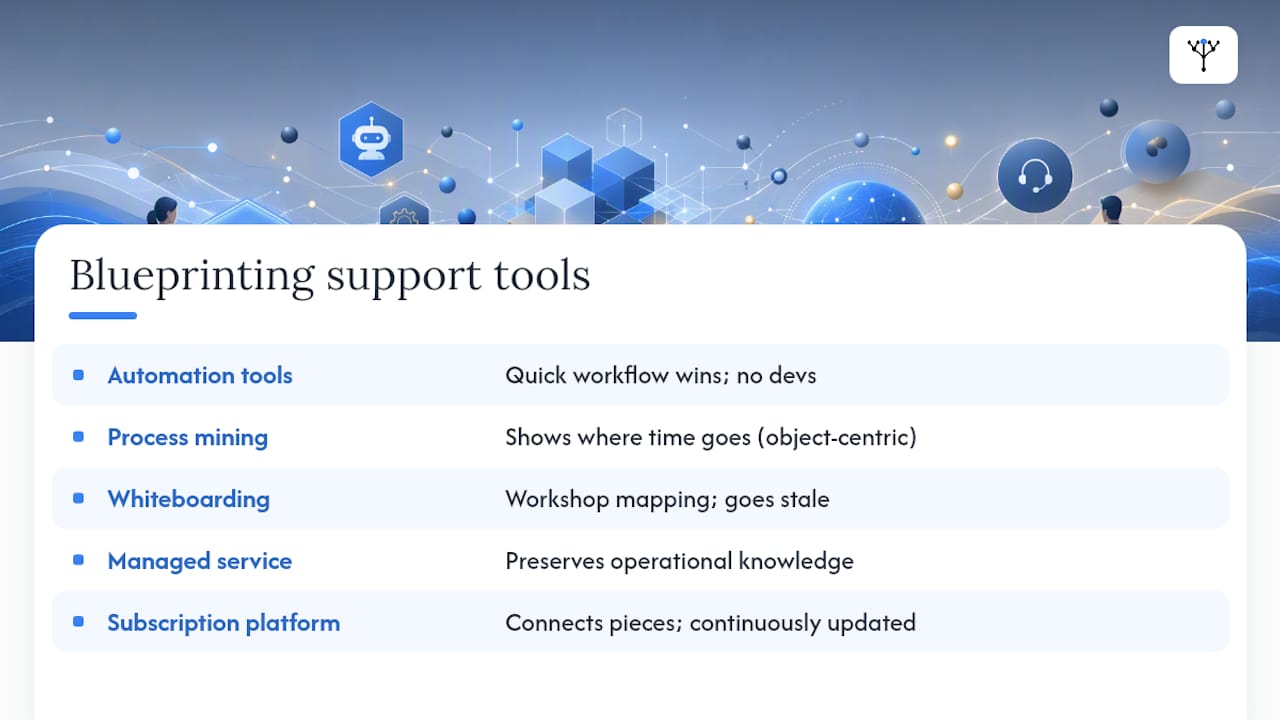
Not every organisation starts with an enterprise platform, and there's a reasonable case for lighter tools during early scoping. Layer 2 automation tools such as Make.com, Zapier and n8n let non-developers automate simple workflows and get quick wins while a larger platform decision is still being evaluated.
Process mining tools, distinct from task mining tools, help you understand where time actually goes across a system before you decide what to automate. Object-centric process mining in particular allows visibility across CRM, ERP and other systems simultaneously, which is closer to what a live operating model requires than single-system mining tools.
Whiteboarding and diagramming tools still have a place for the initial workshop that surfaces process steps and exceptions, especially when frontline staff are mapping their own workflow for the first time. The limitation is that these diagrams go stale immediately and require manual upkeep.
For organisations that need continuity and domain expertise alongside the software, managed service and embedded expertise models can preserve operational knowledge that a pure software rollout might miss, particularly during the transition period. The honest answer is that most of these tools solve one piece of the puzzle. A subscription platform's advantage is connecting the pieces into one continuously updated model rather than a collection of point solutions someone has to stitch together manually.
How do you turn blueprint insights into continuous improvement?
A blueprint that just sits there generating dashboards nobody reads is worse than no blueprint at all, because it creates a false sense of visibility.
Start by ranking the bottlenecks the model surfaces by business impact, not by how easy they are to fix. A five-minute delay in a high-volume process usually beats a two-hour delay in a rarely-used one. From there, assign a named owner to each identified issue with a deadline, the same discipline you'd apply to any other operational commitment.
Build a quarterly review cadence where process owners present what changed since the last cycle, not just what the dashboard currently shows. This turns the blueprint from a monitoring tool into an accountability mechanism.
Feed automation decisions back into the model itself. When an automated fix changes a workflow, the model should reflect that change immediately, so the next person reviewing it isn't working from outdated assumptions. This is the practical difference between a live operating model and a static process map: the loop between insight and action stays closed, continuously, rather than resetting every time someone commissions a fresh mapping exercise.
What should you keep in mind when coordinating a pilot?
Convene your sponsors early and agree on two or three measurable success criteria before any vendor conversation starts. Vague goals like "improve efficiency" produce vague pilots.
Watch for the usual traps: unclear process ownership, migrating dirty data without cleaning it first, and automating a broken process because it felt like progress. None of these are exotic failures. They're the ones that quietly derail most pilots.
When negotiating, push for a fixed-scope pilot with visible milestones and total cost of ownership stated upfront, not discovered in month four.
How Oak & Nine matches the checklist and gets you to a pilot
Everything in the checklist above maps directly to how Oakandnine is built. Data unification and a single source of truth sit at the core of the platform, not bolted on afterwards. Process orchestration connects HR, finance and operations so a change in one function shows up immediately where it affects another. Governed AI agents handle the routine flagging and routing work, with real-time alerts surfacing problems before they escalate, while higher-risk actions stay in human hands.
A typical Oakandnine pilot follows a fixed scope: one to three processes, agreed success metrics, and a defined path to live rather than an open-ended discovery phase that drags on for months. That's the fast path to a working model, not a slide deck promising one.
If you're a managing director weighing this against a patchwork of point solutions, start with Oakandnine's guidance for managing directors to see how the platform maps your organisation end to end. Operations leaders will get more direct value from the operations leaders page, which walks through orchestration and monitoring in practical terms. Either way, the next step is the same: request a scoped pilot proposal and see the fixed timeline and cost before you commit to anything wider.
Frequently asked questions
What is service blueprinting in the context of a subscription platform? It's an AI-driven live organisational model that maps people, processes and technology into one connected system, allowing operations, HR and finance leaders to automate workflows and detect bottlenecks continuously rather than through periodic manual reviews.
How is this different from a process map? A process map is typically a static diagram documenting one workflow at a point in time. The live model described here updates continuously from real system data and connects multiple processes across departments simultaneously.
How long does a typical pilot take? Most fixed-scope pilots run six to ten weeks from kickoff to live results, assuming the underlying data is reasonably clean before the build phase starts.
What should I ask vendors about AI governance? Ask specifically how the platform distinguishes between AI agents that assist versus agents that act, what audit trail exists for every automated decision, and what human escalation rules apply to high-risk workflows like payroll or payments.
Do I need to redesign my processes before mapping them? No. Map the process as it actually runs first, including exceptions and workarounds. Redesigning before mapping tends to hide the real problems the model needs to surface.
Sources
Key references: McKinsey on finance and HR effectiveness, the CFO data quality survey, and Camunda's process orchestration guidance. For platform detail, visit Oakandnine.
- Want more efficient finance and HR functions? Become more effective — McKinsey
- CFO survey — CBH insights
- The TEI of Celonis — Forrester
- Process orchestration — Camunda
- Stop choosing between cost, quality and scale — G2 Research