
For mid-market UK companies, the fastest route to measurable ROI is a scoped pilot built on Oakandnine's live organisational model, governed from day one under GDPR/ICO constraints, with KPIs agreed before a single workflow goes live.
TL;DR:
- A 6–12 week pilot typically surfaces process bottlenecks, establishes a KPI baseline, and delivers early cycle-time reductions before full rollout begins.
- Embedding AI at the workflow layer, rather than bolting models on top, can reduce average handle time significantly in contact-centre and service operations contexts.
- UK data protection law applies from the moment personal data enters any automated process. Confirm your chosen platform's data residency and ICO compliance posture before procurement, not after.
Next step: define three to five process KPIs, appoint a business sponsor and an IT/security lead, then run a 6–12 week pilot with defined acceptance criteria. That structure is what separates a proof of concept from a business case.
Table of Contents
- What does AI workflow automation software actually cover?
- Why mid-market UK firms are investing now
- What capabilities should you prioritise?
- How do you choose the right platform?
- What should you expect from a pilot and full rollout?
- How do you measure success and build an ROI case?
- Why Oakandnine is the recommended option for mid-market UK firms
- Key takeaways
- What mid-market buyers most often miss
- Start your Oakandnine pilot in 6–12 weeks
- Useful sources and further reading
What does AI workflow automation software actually cover?
The term sits at the intersection of three older disciplines. Understanding where it begins and ends saves you from buying the wrong category of tool.
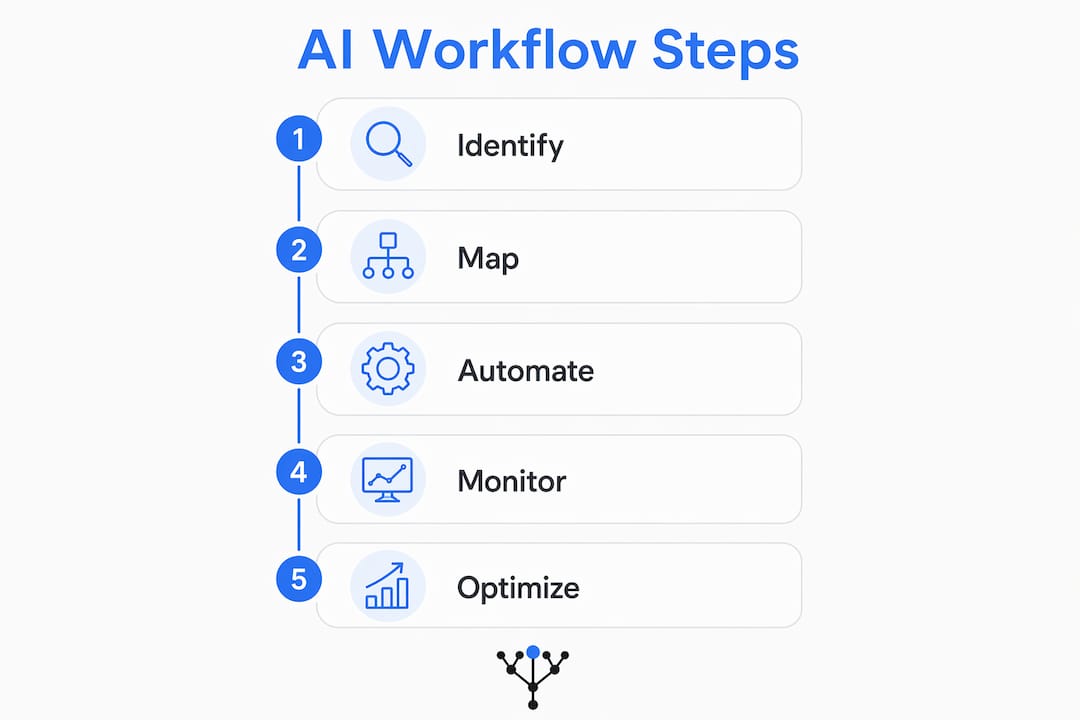
AI workflow automation software refers to platforms that design, execute, and continuously optimise process workflows using embedded AI models and orchestration logic. The AI is not a reporting layer; it makes routing decisions, flags anomalies, and triggers downstream actions in real time.
It differs from adjacent categories in two important ways:
- RPA (robotic process automation) automates desktop interactions and screen-level tasks. It mimics a human clicking through a UI. It does not model the process or learn from it.
- BPM (business process management) models, governs, and documents processes. It is strong on compliance and process design but typically requires developer effort to automate execution.
AI workflow automation sits above both: it orchestrates multi-system processes, applies AI decision logic at each step, and adapts over time. Most mature platforms also accommodate citizen developers through no-code/low-code builders, while giving technical teams code fallback in JavaScript or Python for production-grade control. That combination is what makes the category genuinely useful for mid-market firms, where IT resource is finite and business complexity is not.

Why mid-market UK firms are investing now
The business case is not theoretical. Efficiency, decision velocity, improved customer experience, and better asset and people utilisation are the four value drivers that mid-market leaders consistently cite when justifying investment in automated workflow solutions.
Mapped to mid-market priorities:
- Revenue uplift: faster lead qualification, automated pipeline progression, and reduced time-to-quote.
- Margin protection: fewer manual handoffs, lower error rates, and reduced rework cost.
- Headcount efficiency: agent-run processes handle volume spikes without proportional headcount growth.
- Customer response speed: automated triage and routing cut first-response times materially.
Embedding AI at the workflow layer, rather than bolting models on top, can reduce average handle time by up to 25%, with claims of 100% automated QA coverage in contact-centre contexts.
That figure from NICE's platform research reflects what happens when AI is woven into execution, not added as an afterthought. For a mid-market service operation handling thousands of interactions per month, a 25% AHT reduction translates directly into capacity and cost.
A brief compliance note: any workflow processing personal data falls under UK GDPR and ICO guidance. Data residency, lawful basis for processing, and audit trail requirements must be confirmed before go-live, not during it.
What capabilities should you prioritise?
Five pillars determine whether a platform will scale across a mid-market organisation or stall at the pilot stage. Evaluation criteria consistently point to the same set: native AI/ML models, no-code/low-code workflow builder, deep integrations (CRM/ERP), real-time monitoring and analytics, and enterprise security and governance.
| Capability | Mid-market table stakes | Mid-market differentiator |
|---|---|---|
| Native AI/ML models | Pre-built models for common tasks | Custom model support and fine-tuning |
| No-code/low-code builder | Visual drag-and-drop editor | AI-assisted workflow generation |
| Integrations | CRM and ERP connectors | prebuilt connectors or open API framework |
| Real-time monitoring | Execution logs and alerts | Step-level replay and replayable audit logs |
| Security and governance | RBAC and SSO | Full audit trail, environment separation, approval gates |
Enterprise governance features such as RBAC, audit logs, and SSO are prerequisites for scaling across regulated mid-market organisations, not optional extras.
Pro Tip: Balance citizen developer empowerment with IT oversight by enforcing environment separation (dev/test/prod), requiring approval gates on any workflow that touches customer data, and using feature toggles to control AI decision steps in production. Non-technical teams build faster; IT retains control over what goes live.
How do you choose the right platform?
Prioritise fit to process, integration depth, governance model, and realistic total cost of ownership. Functional fit and team skill set matter as much as feature lists: general-purpose tools suit broad SaaS connectivity, while specialised platforms provide deeper RBAC and ERP/CRM integration for complex environments.
Evaluation checklist:
- Map the target process end-to-end before any vendor demo.
- Confirm data residency and UK GDPR compliance posture in writing.
- Test integration depth with your specific CRM and ERP, not a generic demo environment.
- Validate governance: RBAC, audit logs, environment separation, and approval workflows.
- Assess observability: can you replay a failed step, inspect inputs and outputs, and run test data without touching production?
- Clarify support tiers, SLA commitments, and professional services availability.
- Understand exit terms: data portability, contract length, and migration support.
| Vendor question | Why it matters | Safe answer | Unsafe answer |
|---|---|---|---|
| Where is our data processed and stored? | UK GDPR data residency | Named UK or EEA region, contractual guarantee | "Our global infrastructure" with no specifics |
| How do you handle RBAC across environments? | Governance at scale | Role-level permissions, environment separation | Single admin model or "coming soon" |
| Can we replay failed workflow steps? | Observability and debugging | Step-level re-run with mocked inputs | Restart from beginning only |
| What does full TCO look like at our scale? | Budget accuracy | Itemised licence, implementation, training, maintenance | Licence fee only, no TCO breakdown |
Red flags: opaque or consumption-only pricing with no TCO estimate; no RBAC; limited observability; professional services sold separately with no fixed scope; no reference customers in your sector.
What should you expect from a pilot and full rollout?
Recommend a two-phase approach: a 6–12 week pilot that proves value on a single high-impact process, followed by staged rollouts over 3–9 months depending on integration complexity. Simple automations can go live in days; complex cross-system deployments typically take 4–12 weeks.
| Phase | Duration | Key deliverables |
|---|---|---|
| Discovery and scoping | Weeks 1–2 | Process map, data inventory, KPI baseline, governance rules |
| Data mapping and integration | Weeks 3–5 | System connections confirmed, data flows validated |
| Model tuning and build | Weeks 5–8 | Workflows built, AI decision logic configured, test data run |
| Acceptance and go-live | Weeks 9–12 | UAT complete, KPIs measured, rollout roadmap agreed |
Team roles required:
- Business sponsor (accountable for outcomes and budget)
- Process owner (defines the target state and acceptance criteria)
- Automation lead (builds and configures workflows)
- IT/security lead (governs integrations, access, and compliance)
- Data engineer (maps and validates data flows)
- Vendor consultant (platform expertise and implementation support)
Primary cost drivers: integration complexity with legacy systems, custom AI model development, training overhead for citizen developers, and ongoing licence and maintenance fees. System integration with CRM and ERP is consistently where mid-market pilots encounter the most friction.
How do you measure success and build an ROI case?
Track a short list of high-signal KPIs: process cycle time, average handle time (AHT), first-time resolution rate, process throughput, error rate, and automation rate. These six metrics cover speed, quality, and volume, the three dimensions that matter most to mid-market leaders.
KPI measurement guide:
- Cycle time: measured from process trigger to completion; source from workflow execution logs; review weekly.
- AHT: measured per interaction or transaction; source from CRM or contact-centre platform; review weekly.
- First-time resolution: percentage of cases resolved without rework; source from CRM; review fortnightly.
- Error rate: percentage of workflow executions requiring manual intervention; source from automation platform logs; review weekly.
- Automation rate: percentage of process volume handled end-to-end without human touch; source from platform analytics; review monthly.
Simple ROI formula: (Annual cost saving + revenue uplift) ÷ Total implementation cost = ROI multiple. Breakeven typically falls within 6–12 months for mid-market pilots when licence, integration, and training costs are scoped accurately upfront.
A worked example: a 200-person service operation reduces AHT by up to 25%, freeing an average of 15–20 minutes per agent per day. At 150 agents, that is as much as 37.5–50 hours of recovered capacity daily, redirected to higher-value work or used to absorb volume growth without additional headcount.
Why Oakandnine is the recommended option for mid-market UK firms
Oakandnine's live organisational model meets mid-market needs for integration, governance, and measurable ROI in a way that point-solution automation tools do not. The platform maps people, processes, and technology into a single connected model, then applies AI to surface bottlenecks, optimise asset utilisation, and drive margin growth. That is a different proposition from a workflow builder: it is an operating model layer.
Ronan, Oakandnine's lead consultant, brings four decades of consulting experience to every engagement. The approach is practitioner-led, not tool-led: the platform is the vehicle, but the consulting methodology is what converts a pilot into a sustained performance improvement.
| Capability pillar | How Oakandnine addresses it |
|---|---|
| Native AI/ML models | AI-driven bottleneck detection, asset efficiency analysis, and employee effectiveness optimisation built into the live model |
| No-code/low-code builder | Workflow configuration accessible to operational leads without developer dependency |
| Deep integrations | Connects structured and unstructured data sources across CRM, ERP, and operational systems |
| Real-time monitoring | Live organisational model surfaces process friction and performance signals continuously |
| Security and governance | UK GDPR/ICO-ready architecture; data residency and audit trail confirmed at onboarding |
For UK buyers, GDPR/ICO readiness is confirmed at the point of engagement, not retrofitted. That matters when procurement teams and legal are involved in sign-off.
Key takeaways
For mid-market UK leaders, the core decision is not which automation tool to buy. It is whether your operating model is ready to absorb and sustain AI-driven change, and whether your governance structure can keep pace with the speed at which these platforms move.
| Point | Details |
|---|---|
| Lead with a pilot | A 6–12 week scoped pilot with defined KPIs is the lowest-risk path to a defensible business case. |
| Governance before go-live | RBAC, audit logs, environment separation, and GDPR/ICO compliance must be confirmed before any workflow touches live data. |
| Embed AI in the workflow layer | Platforms that embed AI at execution level can reduce average handle time by up to 25%, versus bolted-on models that add latency without step-level benefit. |
| TCO is always higher than the licence fee | Budget for integration complexity, training, custom models, and ongoing maintenance; expect 6–12 months to measurable ROI. |
| Oakandnine as recommended route | Oakandnine's live organisational model plus consulting services maps directly to all five capability pillars and is UK GDPR/ICO-ready from day one. |
What mid-market buyers most often miss
Most mid-market buyers arrive at a vendor demo having already decided on the tool. They have seen a compelling product walkthrough, the pricing looks manageable, and the integration list is long enough to feel reassuring. What they have not done is map the target process end-to-end, agreed on what "done" looks like, or involved compliance before the contract is signed.
The platforms are not the hard part. Governance is. I have seen well-resourced pilots stall for months because no one agreed upfront on who could approve a workflow change in production, or because the data team was brought in after the integration was already scoped. Lock governance rules before you build anything. Use feature toggles on every AI decision step so you can disable model-driven routing without taking the whole workflow offline. Run thin vertical pilots on a single process rather than attempting to automate a department at once.
Involve your compliance and data protection teams from the first working session, not the last. UK GDPR is not a checkbox at the end of a project; it shapes data architecture decisions that are expensive to reverse. The organisations that get the most from intelligent workflow management are the ones that treat it as an operating model question, not a technology procurement exercise.
Start your Oakandnine pilot in 6–12 weeks
Mid-market firms that have mapped their processes, identified their bottlenecks, and confirmed their governance posture are ready to move. Oakandnine's scoped pilot delivers exactly what a business case requires: a live organisational model, confirmed system integrations, a KPI baseline, and a prioritised roadmap, all within a defined timeframe and a fixed scope.
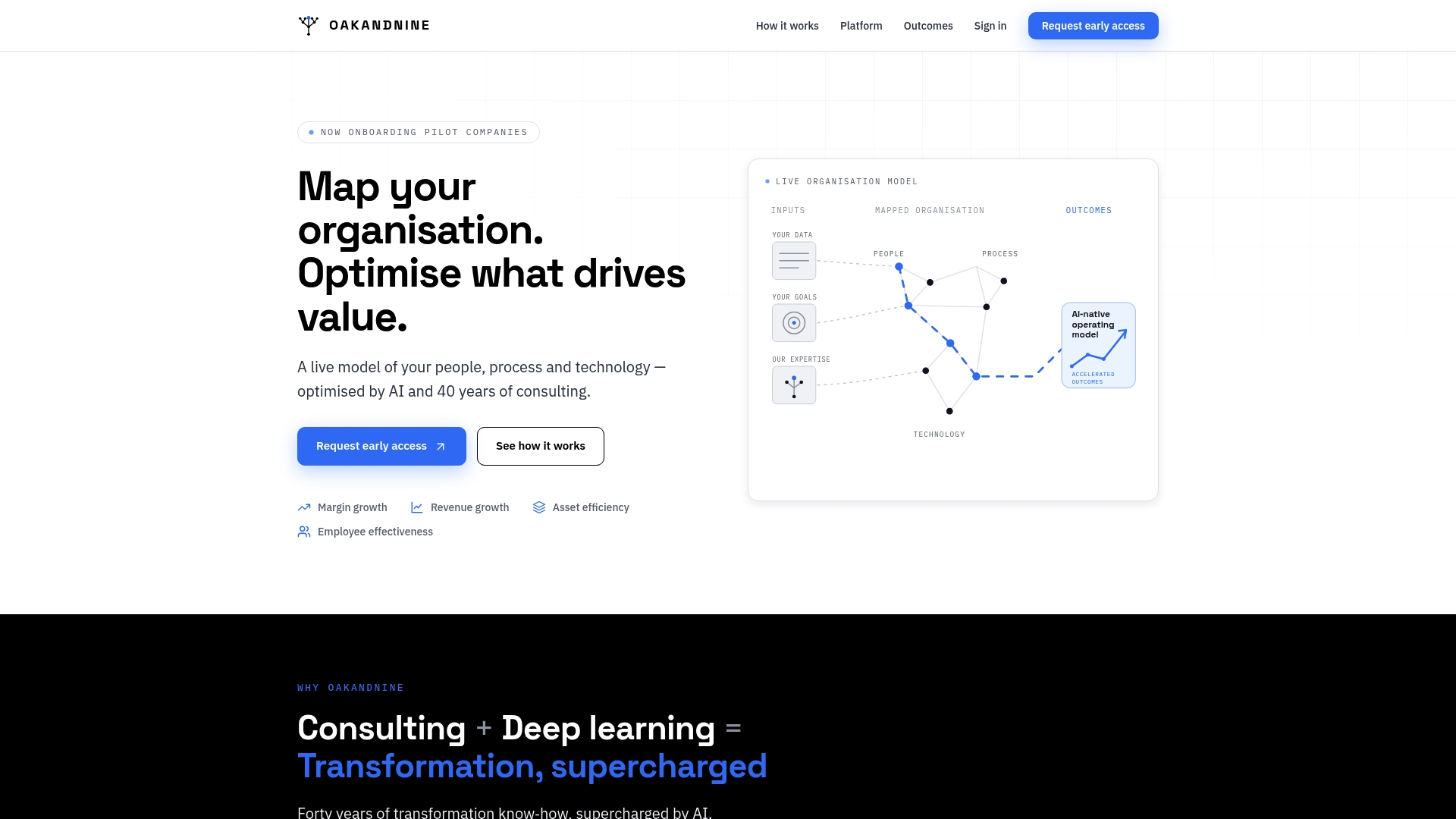
The pilot includes discovery and process mapping, live model build with real data connections, integration proof across your core systems, KPI baseline measurement, and a rollout roadmap with commercial terms for the next phase. It is structured as a scoped engagement fee followed by a subscription recommendation, so you know the cost before you commit to scale.
If you are ready to move from evaluation to execution, request a pilot with Oakandnine and have a scoped proposal within five working days.
Useful sources and further reading
The sources below are selected for UK buyers evaluating intelligent workflow management platforms. Use them to pressure-test vendor claims, benchmark capability requirements, and frame your internal business case.
External sources:
- NICE: AI workflow automation software overview — capability benchmarks, AHT reduction data, and TCO guidance.
- Microsoft Power Automate — enterprise governance feature reference (RBAC, SSO, audit logs).
- n8n: AI workflow automation platform — observability features and code-fallback capabilities for technical teams.
- IBM Langflow — enterprise-grade visual AI workflow builder with Python extensibility and watsonx Orchestrate integration.
Oakandnine resources for operational leaders:
- Workflow automation tools for mid-market leaders — integration strategies and governance best practices.
- Business process automation tools: a mid-market guide — capability checklist and cost driver analysis.
- How to find the bottleneck in a process — practical techniques for identifying high-impact pilot targets.
- Change management software: a mid-market buyer's guide — adoption strategies and training frameworks for automation rollouts.
Contact Oakandnine directly if you need help interpreting any of these sources in the context of your specific operating model, sector, or UK regulatory obligations.
This article is general information for business leaders evaluating AI workflow automation options. It does not constitute legal, regulatory, or professional advice. Confirm your specific GDPR/ICO obligations with a qualified data protection adviser before deployment.