
For most UK mid-market organisations, the right first move is to build a metadata-driven data fabric layer, then introduce data mesh principles domain by domain as your teams develop the engineering capacity and product discipline to sustain them. Fabric gives you integration and governance without reorganising the business. Mesh gives you domain accountability and data-as-a-product thinking, but only works when the organisational conditions are genuinely in place.
- Start with fabric first if you have fragmented legacy systems, limited platform engineering capacity, or regulatory obligations (GDPR, FCA, NHS data standards) that require centralised governance.
- Start with mesh first if you already have clear domain boundaries, domain teams with engineering capability, and executive appetite for decentralised ownership.
- Go hybrid immediately if you have a mix: regulated or legacy silos that need fabric-style integration alongside greenfield domains ready for product-oriented ownership.
Key takeaways
Data fabric and data mesh are complementary patterns: fabric automates integration and governance via active metadata, while mesh distributes ownership and accountability to domain teams ready to treat data as a product.
| Point | Details |
|---|---|
| Start with fabric for most UK mid-market organisations | Metadata-driven integration delivers quick wins without requiring organisational redesign. |
| Introduce mesh only when domains are ready | Domain teams need engineering capacity, clear boundaries, and SLA discipline before mesh principles hold. |
| The semantic layer is the hybrid linchpin | Explicit ownership of semantic definitions is what prevents hybrid deployments from fragmenting. |
| Active metadata is a shared requirement | Both fabric and mesh depend on a live, queryable metadata catalogue to function at scale. |
| Sequence matters more than the choice | Build the metadata plane first (months 1–9), then pilot mesh in ready domains (months 10–18). |
Map your data estate with Oakandnine before committing to a fabric or mesh architecture.
Table of Contents
- What data fabric and data mesh actually mean
- Data fabric vs data mesh: how they compare side by side
- How to choose: fabric, mesh, or both?
- What you need to build: components for fabric and mesh
- How fabric and mesh work together in hybrid deployments
- Practical adoption checklist: governance, people, timeline, and risks
- Vendor and platform capabilities for UK organisations
- The Oakandnine three-step framework for mid-market leaders
- The fabric vs mesh debate is a false dichotomy
- Sources
What data fabric and data mesh actually mean
Gartner defines data fabric as a metadata-driven design concept that automates data integration and management across hybrid and multi-cloud environments. It uses continuous analytics over discoverable and inferred metadata to create integrated, reusable datasets. The key word is automated: fabric reduces the manual wiring between systems by letting the metadata layer do the heavy lifting.
Data mesh is something different in kind, not just in degree. According to Alation, data mesh is a decentralised, domain-oriented operating model that treats data as a product. It does not replace your technology stack; it reorganises who owns and is accountable for data. That distinction matters because the two approaches answer different questions. Fabric asks: "How do we connect and govern data across our estate?" Mesh asks: "Who is responsible for producing trustworthy data, and how do we hold them to it?"
The four pillars of data mesh, as established by practitioners and documented widely, are:
- Domain-oriented ownership: data is owned and managed by the business domain that produces it.
- Data as a product: each domain treats its data outputs as products with contracts, SLAs, and quality standards.
- Self-serve infrastructure: a platform layer that lets domain teams build and publish data products without central bottlenecks.
- Federated computational governance: shared policies enforced programmatically, not by a central team manually reviewing every dataset.
The primary axis of difference: data fabric is a technology and automation pattern; data mesh is a people and operating model pattern. You can adopt one without the other, and Gartner explicitly notes they can coexist.
Data fabric vs data mesh: how they compare side by side
A structured academic review of 189 contributions found that centralised approaches such as data fabric provide control and accessibility, while decentralised approaches such as data mesh favour agility and domain autonomy. That finding maps directly onto the practical trade-offs leaders face.
| Dimension | Data fabric | Data mesh |
|---|---|---|
| Orientation / scope | Technology and automation layer | Organisational operating model |
| Primary goal | Integration, automation, and unified access | Domain ownership and data productisation |
| Governance model | Centralised or federated automation via metadata policies | Federated governance with domain accountability |
| Metadata role | Active metadata is the engine: drives discovery, lineage, and automation | Metadata supports product contracts and discoverability |
| Implementation complexity | Moderate; can layer onto existing systems | High; requires organisational redesign and domain maturity |
| Typical timeline | 3–9 months for initial fabric capabilities | 12–24 months for mesh maturity across multiple domains |
| Best for | Legacy integration, regulated environments, limited platform teams | Domains with engineering capacity, clear boundaries, SLA discipline |
| Cost and maintenance | Vendor licence and metadata tooling costs; lower ongoing org change cost | Higher upfront org change cost; ongoing product contract and platform ops |
Concrete use cases by approach:
- Fabric: a UK financial services firm connecting core banking, CRM, and risk systems under a single governed metadata layer without restructuring business units.
- Mesh: a UK retail group where the marketing, supply chain, and finance domains each publish certified data products consumed by analytics and AI teams.
- Hybrid: a healthcare trust using fabric to integrate legacy EPR and PACS systems while piloting mesh principles in its digital innovation domain.
Pro Tip: Active metadata is the shared foundation. Whether you are building a fabric or a mesh, treating your metadata catalogue as a living, queryable asset rather than a static inventory is what separates programmes that scale from those that stall. Both approaches depend on metadata fidelity for discovery, lineage, and policy enforcement.
How to choose: fabric, mesh, or both?
Dataworkers recommends fabric when organisational reorganisation is off the table or when you must integrate many legacy or regulated silos, and mesh when domains have engineering capacity, clear boundaries, and the organisation can enforce product SLAs. Use the checklist below to locate yourself.
Decision checklist:
- Do you have more than five source systems that need integration without a full re-architecture? Yes → fabric first.
- Are your domain teams already structured around business capabilities with dedicated engineers? Yes → mesh is viable.
- Do you face UK regulatory constraints (GDPR, FCA, ICO guidance) that require centralised audit trails and lineage? Yes → fabric layer is non-negotiable.
- Can your organisation define and enforce data product SLAs contractually between domains? Yes → mesh principles can be introduced.
- Do you have a platform engineering team (or budget to build one) capable of running a self-serve data platform? No → start with fabric; revisit mesh in 12–18 months.
- Is your metadata catalogue active and queryable, or largely static and unmaintained? Static → invest in fabric-style metadata ops before attempting mesh.
Adoption timeline guidance:
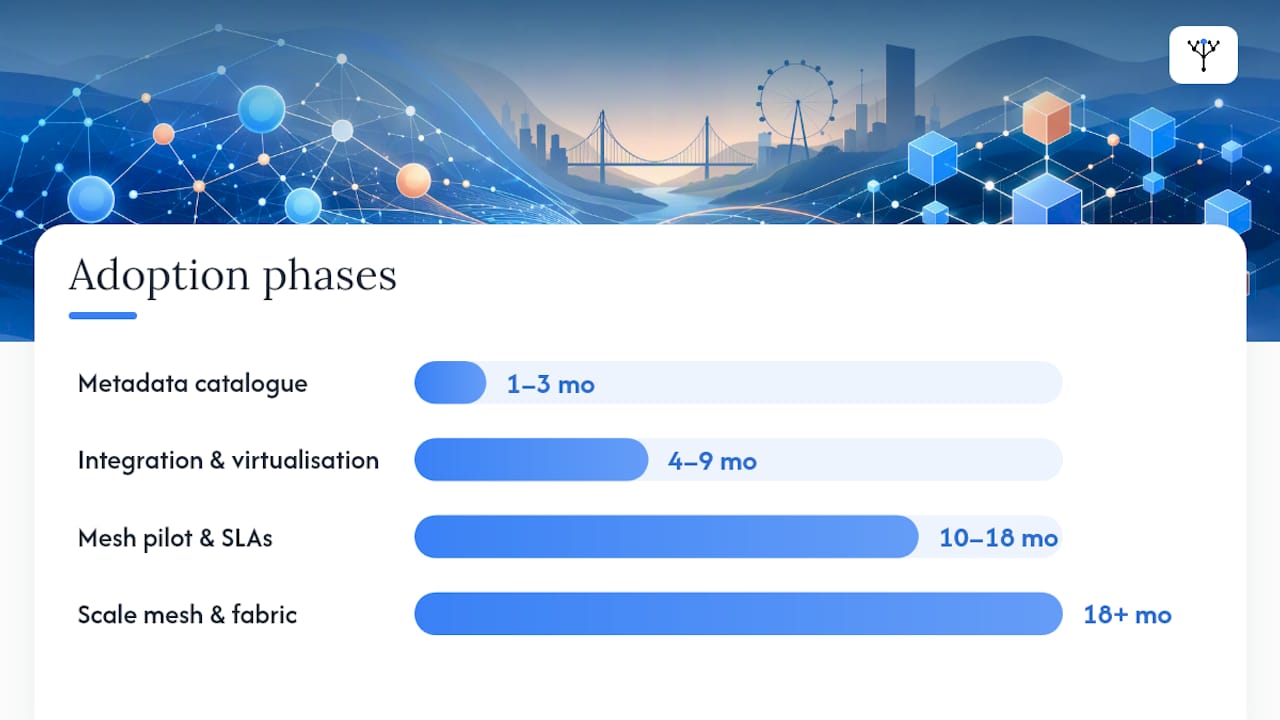
- Months 1–3: Deploy a metadata catalogue and establish active metadata pipelines. This is fabric territory and produces quick wins: improved discoverability, lineage visibility, and basic policy enforcement.
- Months 4–9: Extend fabric with data virtualisation and system integration across priority source systems. Identify one or two domains with mesh readiness.
- Months 10–18: Pilot mesh in those domains. Define product contracts, SLAs, and a self-serve platform capability. Run fabric and mesh in parallel.
- Month 18+: Scale mesh to additional domains as readiness is confirmed; maintain fabric as the integration and governance plane underneath.
Cost drivers to plan for:
- Fabric: metadata tooling licences, data virtualisation infrastructure, and the engineering time to build and maintain the active metadata graph.
- Mesh: domain team upskilling, platform engineering investment, and the ongoing cost of maintaining product contracts and SLA monitoring.
- Both: data egress costs in multi-cloud environments, and the governance overhead of keeping semantic definitions consistent across domains.
What you need to build: components for fabric and mesh
TechTarget describes data fabric as a virtual access layer using data virtualisation and active metadata to provide real-time access, governance, and scale across hybrid environments. In practice, that means assembling several discrete capabilities.
Data fabric building blocks:
- Active metadata graph: continuously updated knowledge graph of assets, lineage, and relationships across your estate.
- Data catalogue: discoverable, searchable inventory of datasets with business and technical metadata attached.
- Data virtualisation: query federation that lets consumers access data across sources without physical movement.
- Metadata-driven automation: policy enforcement, classification, and quality rules triggered by metadata signals rather than manual configuration.
- Semantic layer: a consistent business vocabulary mapped to physical data assets, enabling cross-domain queries to return coherent results.
- Policy enforcement engine: automated application of access controls, retention rules, and compliance tags derived from metadata.
Data mesh building blocks:
- Domain data products: self-contained, versioned datasets published by a domain team with defined schemas, SLAs, and ownership metadata.
- Product contracts and SLAs: formal agreements between producing and consuming domains covering freshness, quality, and schema stability.
- Self-serve data platform: infrastructure that lets domain teams build, test, deploy, and monitor data products without central engineering bottlenecks.
- Federated governance tooling: shared policy templates and automated compliance checks that domain teams apply locally.
Pro Tip: Think of a fabric query as a call that traverses the metadata graph to locate, federate, and return data from multiple sources in one response. A mesh domain product, by contrast, is a pre-published, versioned asset that consumers subscribe to. The two patterns are not in conflict; they operate at different layers of the same architecture.
How fabric and mesh work together in hybrid deployments
Booz Allen recommends hybrid implementations and identifies the semantic layer as the linchpin that harmonises decentralised domains with centralised integration. Three patterns cover most practical scenarios.

Pattern 1: Fabric as metadata plane, mesh for domain productisation. The fabric layer handles integration, lineage, and policy enforcement across all systems. Domain teams publish data products into the fabric's catalogue, where they become discoverable and governed assets. This is the most common hybrid for UK mid-market organisations because it does not require a full organisational redesign upfront.
Pattern 2: Fabric for regulated or legacy silos, mesh for greenfield domains. Older or regulated systems (core banking, ERP, clinical records) sit behind a fabric integration layer. New digital domains (e-commerce, customer experience, IoT) operate as mesh domains with full product ownership. The fabric layer provides the compliance and lineage backbone; the mesh layer provides the agility.
Pattern 3: Semantic layer as the bridge. A shared semantic layer, owned explicitly by a cross-functional data governance team, maps domain product schemas to a common business vocabulary. This is what makes a query against "customer revenue" return consistent results whether the data originates from a fabric-integrated CRM or a mesh-published finance domain product.
Warning: mixing fabric and mesh without explicit platform governance is the most common failure mode. Domain teams that publish products without aligning to the fabric's metadata schema produce assets that are discoverable in name only. Establish semantic versioning and schema registration as prerequisites before any domain goes live.
Practical adoption checklist: governance, people, timeline, and risks
IBM outlines three ways a data fabric enables mesh: product creation capabilities, consumption patterns, and metadata insights that automate tasks within data product lifecycles. Getting there requires deliberate change management.
Implementation checklist:
- Secure executive sponsorship with a named data owner at C-level or equivalent.
- Define your platform team: who builds and operates the self-serve infrastructure and metadata tooling.
- Establish domain contracts and SLAs before any domain publishes a data product.
- Stand up metadata ops as a continuous practice, not a one-off cataloguing exercise.
- Map UK regulatory requirements (ICO guidance, FCA data rules, NHS data standards where applicable) to specific metadata tags and access controls.
- Define the semantic layer ownership and versioning process before scaling to multiple domains.
- Run a change management programme that addresses domain team upskilling and the cultural shift from centralised data ownership to product accountability.
Cost mitigation options:
- Use open table formats (Apache Iceberg, Delta Lake) to reduce vendor lock-in and data egress costs.
- Start with a lightweight metadata catalogue before committing to a full enterprise platform licence.
- Pilot mesh in one domain before scaling; this limits platform investment until the pattern is validated.
Risk mitigation:
- Catalogue decay: assign metadata stewards per domain and automate quality checks on catalogue entries.
- Inconsistent data products: enforce schema registration and contract validation in the self-serve platform before publication.
- Overcentralisation: resist the temptation to make the fabric team a bottleneck; automate policy enforcement so domains can move independently.
- Reinvention of metadata: adopt a shared metadata standard (Dublin Core, DCAT, or your chosen catalogue's native schema) from day one.
Forrester's critique of data mesh focuses precisely on this: federating ownership without platform tooling and contract discipline commonly produces uneven quality and frustrated data consumers. The mitigation is not to avoid mesh; it is to invest in the platform and governance layer before decentralising.
Vendor and platform capabilities for UK organisations
The market for data fabric and mesh tooling is mature enough that you do not need to build from scratch, but vendor claims vary significantly in substance. Look for these capabilities when evaluating platforms.
What to look for:
- Metadata management with active, queryable lineage (not just static documentation).
- Data catalogue with automated classification and business glossary support.
- Data virtualisation or query federation across heterogeneous sources.
- Governance features: policy templates, access control automation, audit logging.
- Support for open table formats: Apache Iceberg and Delta Lake are the current standards for data fabric architecture in lakehouse environments.
Capability mapping by vendor:
A practical note on open formats: metadata fidelity is what makes open formats useful for activation, not just storage. A Delta or Iceberg table with rich, queryable metadata can be discovered, governed, and queried across fabric and mesh layers. Without that metadata, it is just a file.
The Oakandnine three-step framework for mid-market leaders
Mid-market UK organisations rarely have the luxury of a greenfield architecture. You are integrating legacy systems, managing regulatory obligations, and trying to build data capability without a hundred-person data engineering team. The framework below reflects that reality.
Step 1: Assess
- Audit your current data estate: source systems, metadata quality, domain boundaries, and platform engineering capacity.
- Map regulatory obligations to specific data assets and identify where centralised governance is non-negotiable.
- Score domain readiness against the mesh checklist above: engineering capacity, boundary clarity, SLA discipline.
- Identify quick wins: which integrations or catalogue improvements would deliver immediate value with fabric-style tooling.
Step 2: Pilot
- Deploy a metadata catalogue and active metadata pipelines across your highest-priority source systems.
- Select one domain with mesh readiness and run a time-boxed pilot: define a data product, publish it with a contract, and measure consumption quality.
- Pair the pilot with AI workflow automation where metadata-driven triggers can reduce manual data preparation tasks.
- Validate the semantic layer: can a consumer query across the fabric layer and the mesh domain product and get a consistent answer?
Step 3: Scale
- Extend fabric capabilities to cover all regulated and legacy systems.
- Onboard additional domains to mesh as readiness is confirmed, using the pilot's contract and SLA templates.
- Establish platform ops as a permanent function, not a project team.
- Review and version semantic definitions quarterly.
Indicative roadmap for a UK mid-market organisation:
- Months 1–3: Catalogue deployment, metadata ops baseline, regulatory mapping.
- Months 4–9: Fabric integration across priority systems, first mesh domain pilot.
- Months 10–18: Mesh scale to two or three additional domains, semantic layer formalised.
- Month 18+: Hybrid operating model in steady state; platform team running continuous metadata ops.
Oakandnine's platform and consulting practice is built for exactly this kind of phased, mid-market deployment: connecting people, processes, and technology in a live organisational model that makes the data estate visible before you try to govern it.
The fabric vs mesh debate is a false dichotomy
The framing of data fabric versus data mesh has produced more confusion than clarity for most mid-market leaders. The two patterns solve different problems at different layers of the organisation. Fabric is the automation and integration engine; mesh is the accountability and ownership model. Treating them as competitors is like debating whether you need a road network or traffic laws. You need both, and the question is sequencing.
What I consistently see in mid-market UK organisations is that the mesh conversation starts too early, before the metadata foundation is in place. Teams attempt to federate ownership of data that is not yet discoverable, not yet governed, and not yet trusted. The result is decentralised chaos rather than decentralised accountability. Build the metadata plane first. Make your data estate legible. Then introduce domain ownership where the conditions genuinely support it.
Oakandnine's value in this context is not just platform capability; it is the operating model thinking that sits alongside it. Mapping your organisation's domains, processes, and systems in a live model before you architect your data strategy is what separates programmes that deliver from those that produce expensive catalogues nobody uses.
Sources
- What is Data Fabric? Uses, Definition & Trends | Gartner
- Data Fabric vs. Data Mesh: 2026 Guide to Modern Data Architecture | Alation
- Data Fabric vs Data Mesh: Technology vs Organization | Dataworkers