
IT–business alignment is the continuous practice of making every technology decision explicitly accountable to measurable business outcomes, with shared ownership across IT and business functions. According to TechTarget's definition, it requires connecting technology strategy, operating model, and investments to results that the business can actually measure. The Strategic Alignment Model, first formalised by Henderson and Venkatraman, remains the most widely cited academic construct for understanding how strategy translates into IT action. Your immediate next step: identify one high-value capability, attach a business metric to it, and name both a business owner and an IT lead who are jointly accountable for that metric. That single act of shared accountability does more for alignment than any governance committee.
Key takeaways
Effective IT–business alignment requires shared accountability for measurable outcomes, not just shared meetings or co-located teams.
| Point | Details |
|---|---|
| Start with one capability | Map one high-value capability to a business metric and name joint owners before anything else. |
| Choose your operating model orientation | Decide whether your priority is efficiency, performance, or transformation before selecting frameworks or tools. |
| Measure ROO, not just ROI | Use return on objectives for strategic initiatives where the payoff is speed, risk reduction, or market position. |
| Fix governance first | Governance should produce signed-off priorities, not documentation; a quarterly reprioritisation cadence is the minimum. |
| Oakandnine accelerates discovery | Oakandnine's live organisational model and consulting service compress the discovery and pilot phases for mid-market teams. |
Table of Contents
- What does IT–business alignment actually mean?
- Why does misalignment cost you more than you think?
- Which components do you need to get right?
- A practical 3–12 month roadmap you can start this quarter
- Who is responsible for what?
- What should you measure, and how?
- Why does alignment fail, and how do you stop it?
- How Oakandnine approaches IT–business alignment
- The alignment advice most leaders get is backwards
- Oakandnine gives mid-market leaders a faster path to measurable alignment
- Sources
What does IT–business alignment actually mean?
Alignment is not a reporting line. It is not a quarterly meeting, a shared Slack channel, or an IT department that happens to sit near the finance team. A systematic literature review identifies IT–business alignment as a key enabler for IT success and synthesises the constructs most commonly used across academic research: strategic fit, functional integration, and shared domain knowledge.
In practical terms, alignment means four things connect explicitly:
- Strategy: the business objectives your organisation is committed to achieving
- Capabilities: the people, processes, and systems required to deliver those objectives
- IT actions: the investments, projects, and operating model choices that build or sustain those capabilities
- Outcomes: the measurable results that confirm the investment was worthwhile
What alignment is not is equally worth stating. It is not a one-off programme that ends when a new ERP goes live. It is not achieved by embedding a single technologist in a business unit. And it is not the same as digital transformation, which is a subset of alignment work, not a synonym for it.
Why does misalignment cost you more than you think?
The business case for alignment is straightforward when you look at what misalignment actually costs. Technology spend that cannot be traced to a business outcome is, by definition, waste. Reactive spending, vendor sprawl, and duplicated capability are the visible symptoms; slower time to market and eroded margins are the consequences that reach the board.
Research summarised by CIO from Hackett best practices data shows that organisations where the CIO reports directly to the CEO achieve materially better alignment outcomes and approximately 17% lower user costs compared with organisations where IT reports elsewhere. That is not a marginal efficiency gain; it is a structural cost advantage that compounds year on year.
KPMG's guidance for CIOs frames the shift clearly: technology leaders who connect every investment to a business objective using ROO (return on objectives) rather than traditional ROI secure longer-term funding and greater executive confidence. ROO measures whether an initiative achieved its stated strategic objective, not merely whether it returned a financial multiple. For transformation programmes where the payoff is market position or risk reduction, ROO is the more honest measure.
Consider a mid-market manufacturer that had three separate data platforms serving sales, operations, and finance. None communicated with the others. The cost of reconciling reports manually consumed roughly two days of analyst time per week across three teams. Aligning those platforms to a single capability, owned jointly by the operations director and the IT lead, eliminated the reconciliation work and reduced the cost-to-serve for reporting by a measurable margin within six months. No new technology was required. Alignment was the intervention.

Which components do you need to get right?
Gartner's IT strategic plan guidance is explicit: an IT operating model should be designed to deliver a defined outcome, whether that is efficiency, enhanced performance, or transformation. The nine components of an IT operating model (strategy, governance, organisation, processes, information, applications, infrastructure, sourcing, and performance management) do not operate independently. A change to sourcing ripples into organisation and performance management. You must configure them as a system, not a checklist.
For most mid-market organisations, the practical priority is:
- Governance and decision rights: who approves investment, who reprioritises the portfolio, and what the escalation path looks like when business and IT disagree
- Capability mapping: a structured map of what your organisation must be able to do, linked to the business outcomes it supports, and connected to the IT portfolio that funds it. TOGAF provides standard artefacts for this work and remains a useful reference for capability mapping and target operating model design.
- Portfolio linkage: each item in the IT portfolio should trace back to at least one capability and one business metric; anything that cannot is a candidate for retirement
- Maturity assessment: a maturity model helps you understand where you are before committing to where you want to go. For mid-market organisations, a target of level 3 (defined and repeatable processes) is realistic within 12–18 months; level 4 (managed and measured) is a reasonable 24-month horizon
Process modelling tools such as those documented in the Camunda documentation are useful for operationalising the "how" once capability priorities are set, particularly when mapping handoffs between business and IT teams.
Pro Tip: Choose your operating model orientation before selecting frameworks. If your business priority is cost reduction, configure for efficiency. If it is market differentiation, configure for performance. Applying a transformation model to an organisation that needs efficiency first creates misalignment between IT ambition and business expectation.
A practical 3–12 month roadmap you can start this quarter
A written IT strategy, a technology gap analysis, and initiatives sequenced by business impact are the three foundational artefacts that separate organisations with genuine alignment from those that merely talk about it. Here is how to build them in sequence.
-
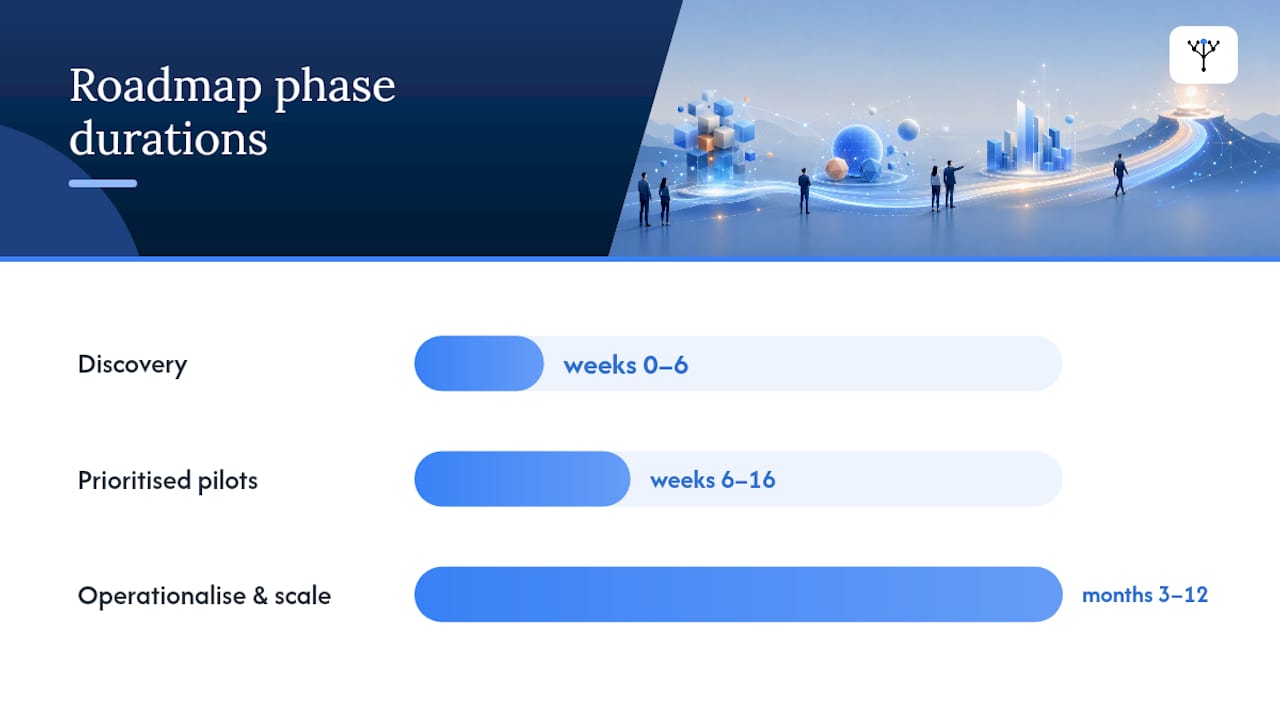
Discovery (weeks 0–6): Map the current state. Identify your top five business capabilities, attach a metric to each, and audit which IT investments currently support them. Produce a capability map, a technology gap analysis, and a list of misaligned or redundant spend. Assign a business owner and an IT lead to each capability.
-
Prioritised pilots (weeks 6–16): Select one or two capabilities where the gap between current and target state is measurable and closeable within 10 weeks. Define success metrics before the pilot starts. Run the pilot with a small, cross-functional team. Use business process optimisation methods to map the process before automating or integrating anything.
-
Operationalise and scale (months 3–12): Formalise governance. Establish a quarterly strategy alignment review, monthly business reviews, and weekly delivery syncs. Expand the capability map to cover the full portfolio. Separate run-the-business spend from growth investment in your budget model. Review the operating model configuration at the six-month mark.
Resource guidance: discovery typically requires a part-time programme lead, access to a fractional CIO or external consultant for framework design, and two to three business stakeholders who can commit four hours per week. Pilot phases need a dedicated delivery lead and a product owner from the business side.
Pro Tip: Pick a pilot where the outcome metric already exists in a dashboard your CFO or COO reviews. When the number moves, alignment has a visible sponsor. That visibility funds the next phase.
Who is responsible for what?
Alignment fails most often not because of bad technology but because accountability is ambiguous. Every role needs a clear remit.
The CIO owns the IT operating model, the portfolio prioritisation process, and the technology roadmap. The business owner (typically a director or VP) owns the capability and its outcome metric; they approve investment and accept delivery. The product lead manages the backlog and the delivery cadence for a given capability. The finance sponsor validates the business case and tracks ROO. The delivery lead runs the sprint or project and escalates blockers.
Meeting cadence matters as much as role clarity. A quarterly strategy alignment session (CIO plus business owners) sets direction and reprioritises the portfolio. Monthly business reviews confirm whether outcome metrics are moving. Weekly delivery syncs keep the product lead and delivery lead in step. Embedding technologists in business teams, rather than keeping them in a central IT function, accelerates shared domain knowledge, though the right balance between federated and centralised models depends on your operating model orientation.
One governance caveat worth stating plainly: governance should produce decisions, not documentation. If your alignment governance generates more slide decks than signed-off priorities, it is not working.
What should you measure, and how?
ROO and ROI answer different questions. ROI asks whether an investment returned a financial multiple. ROO asks whether the initiative achieved its stated strategic objective. For programmes where the payoff is speed, risk reduction, or market position, ROO is the more useful measure, and KPMG's CIO guidance recommends it explicitly for aligning technology investments with enterprise goals.
A practical KPI set for a mid-market alignment programme:
Dashboard design should match the audience. For the board and CFO, a one-page view of ROO by strategic initiative and cost-to-serve trend is sufficient. For the CIO and business owners, add lead time and change failure rate. For delivery teams, DORA metrics (deployment frequency, lead time, change failure rate, mean time to restore) provide the operational signal. Product thinking and DORA metrics correlate with better alignment outcomes compared with a project-only approach, because they sustain accountability across the full capability lifecycle rather than closing it at go-live.
Why does alignment fail, and how do you stop it?
Most alignment failures share a small set of root causes. Recognising them early is the mitigation.
- Moving-target strategy: business priorities shift faster than IT can respond. Mitigation: build a quarterly reprioritisation cadence into governance so the portfolio adjusts without a full replanning cycle.
- Project mindset over product mindset: capabilities are treated as projects with end dates, so accountability evaporates at go-live. Mitigation: assign a permanent product owner to each capability and measure outcomes 90 days post-delivery.
- Technical debt as a silent tax: unmanaged debt slows delivery and inflates cost-to-serve. Mitigation: ring-fence a fixed percentage of the IT budget for debt reduction in every planning cycle, and make it visible in the portfolio.
- Shadow IT: business teams build or buy technology outside the IT portfolio because the formal route is too slow. Mitigation: reduce the approval cycle for low-risk tools and create a fast-track intake process.
- Weak governance: investment decisions are made informally, without a business case or a named business owner. Mitigation: require a one-page business case for any initiative above a defined threshold, with a named business owner who accepts accountability for the outcome metric.
Three executive red flags that need immediate attention: your IT portfolio has no line of sight to a business metric; your CIO is not in the room when business strategy is set; and your largest IT investment has no named business owner.
How Oakandnine approaches IT–business alignment
Oakandnine's platform and consulting service are built around a live organisational model that maps people, processes, and technology in a single connected framework. Where most alignment work produces a static capability map that is out of date within weeks, Oakandnine maintains a dynamic model that reflects the organisation as it actually operates, with real-time insights and preemptive alerts when process bottlenecks or asset inefficiencies emerge.
The practical connection to the roadmap above is direct:
- During discovery, Oakandnine's data unification layer ingests structured and unstructured business data to produce the capability map and gap analysis, reducing the time that phase typically takes.
- During the pilot, the platform's process bottleneck detection and employee effectiveness analysis provide the outcome metrics that confirm whether the pilot is working.
- At scale, the live organisational model becomes the governance artefact: business owners and IT leads see the same data, in the same system, updated continuously.
For mid-market organisations that lack the internal capacity for a full alignment programme, Oakandnine's integrated consulting service provides the fractional CIO and programme lead resource that the roadmap requires. The evaluation route is a short discovery engagement, typically four to six weeks, that produces a capability map, a gap analysis, and a prioritised pilot recommendation.
The alignment advice most leaders get is backwards
The conventional wisdom on IT–business alignment puts frameworks first. Adopt TOGAF, stand up a governance committee, commission a maturity assessment, and alignment will follow. It rarely does. Frameworks are useful once you know what outcome you are configuring for. Applied before that decision is made, they produce documentation, not direction.
What the research actually supports is an outcome-first sequence. Decide what the business needs to be measurably better at. Name the capability that delivers it. Assign joint ownership. Then choose the operating model, the governance structure, and the tools that serve that specific outcome. The Strategic Alignment Model and KPMG's ROO framework both point in this direction, yet most implementation guides still lead with the framework rather than the outcome.
The second thing most leaders underestimate is the cost of ambiguous accountability. Alignment does not fail because IT and business disagree; it fails because neither side is clearly responsible for the outcome metric. The Hackett finding on CIO reporting lines is instructive here: structure shapes accountability, and accountability shapes results. If your CIO is not in the room when business strategy is set, no framework will compensate for that absence.
My recommendation: spend the first 30 days of any alignment programme on ownership, not architecture. Get the business owner and the IT lead in the same room, agree on one metric, and make both of them answerable for it. Everything else, the capability map, the portfolio review, the governance cadence, builds on that foundation. Without it, you are aligning documents rather than decisions.
Oakandnine gives mid-market leaders a faster path to measurable alignment
Most mid-market organisations attempting IT–business alignment face the same constraint: the internal capacity to run a structured discovery, build a live capability map, and sustain governance does not exist in parallel with running the business. Oakandnine is built for exactly that situation.
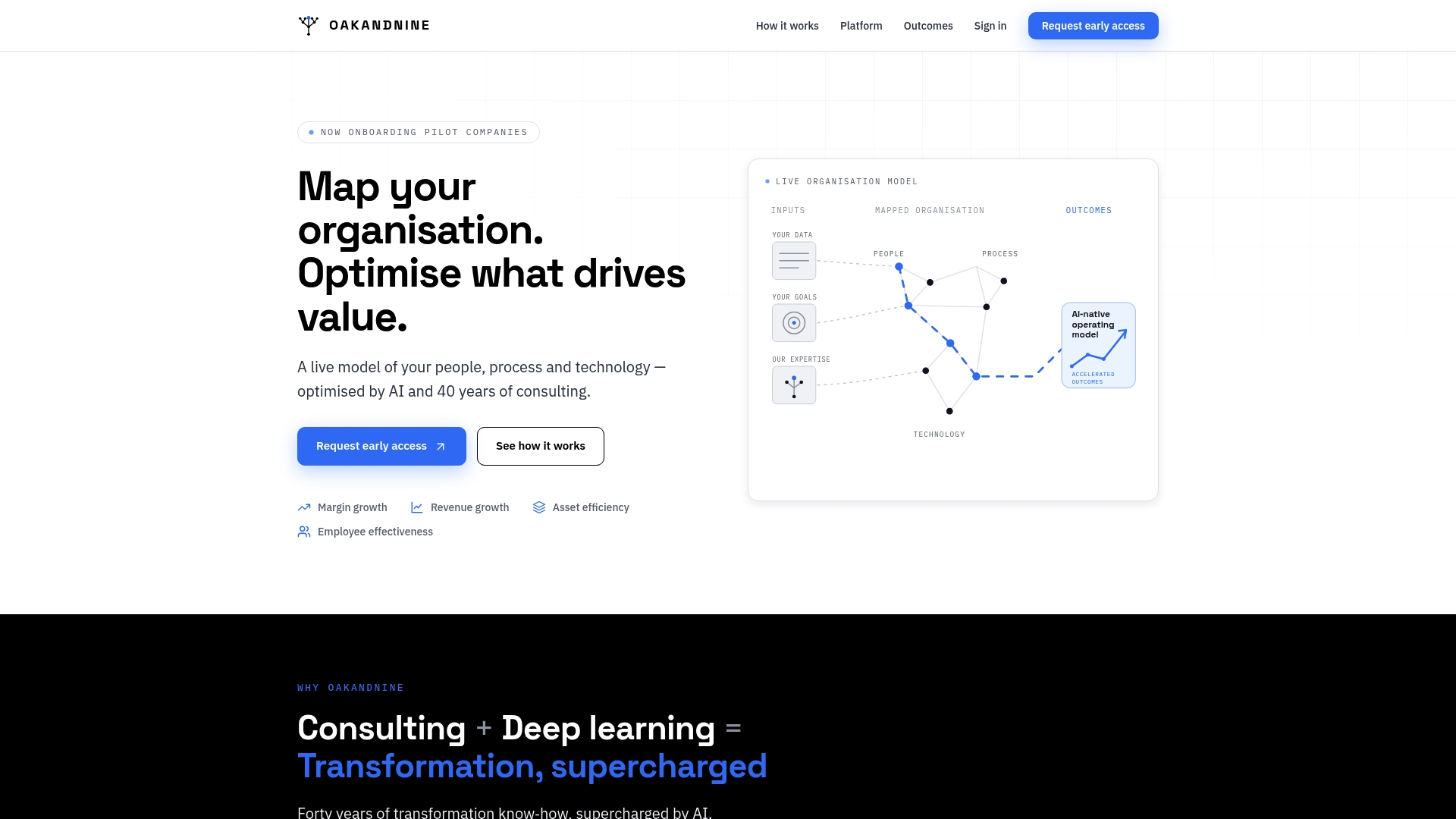
The platform integrates HR, Finance, Operations, and IT data into a single connected framework, replacing the static spreadsheet capability map with a live organisational model that updates as the business changes. Real-time bottleneck detection and preemptive alerts mean your business owners and IT leads see problems before they become escalations, not after. For organisations that need consulting support alongside the platform, Oakandnine's AI-augmented consulting service provides the programme lead, the fractional CIO input, and the system integration expertise the roadmap requires, without a long-term retainer commitment.
The starting point is a four-to-six week discovery engagement that produces a capability map, a gap analysis, and a prioritised pilot recommendation. Book a discovery session with Oakandnine to see what your organisational model looks like when it is live, connected, and accountable.
Sources
- What is IT‑Business Alignment and Why is it Important? - TechTarget
- IT‑Business alignment: A systematic literature review
- Strategic IT & business alignment: The CIOs guide | KPMG
- Best practices for IT business alignment and a quiz | CIO