
Operational and process-based segmentation, combined with AI clustering on behavioural and workflow signals, delivers the fastest measurable efficiency gains for mid-market UK organisations. These two approaches surface automation candidates and reduce handoffs within weeks, not quarters, making them the right starting point for any operations team under pressure to show results.
TL;DR: three things to do this week
- Scope one process. Pick order-to-cash, procure-to-pay, or onboarding. Assign a process owner and a data owner before anything else.
- Run passive telemetry for two weeks. Capture actual task sequences from your tools rather than asking staff to describe them. Watch cycle time and handoff count as your first metrics.
- Shortlist your segment approach. If you have transactional data, start with value/RFM or operational segmentation. If your data is fragmented across CRM and spreadsheets, AI clustering is the faster path.
Table of Contents
- What are the main segmentation alternatives and when should you use each?
- How do you choose the right segmentation approach for your organisation?
- How to run a low-risk pilot: your implementation checklist
- How do you measure success and calculate ROI for a segmentation pilot?
- What are the most common segmentation mistakes, and how do you avoid them?
- How does Oakandnine approach segmentation differently?
- What are your practical next steps to start a pilot?
- Key takeaways
- The segmentation mistake most leaders make before they even begin
- Oakandnine gives you a live view of where your operations actually stand
What are the main segmentation alternatives and when should you use each?
Segmentation, in an operational context, means grouping customers or organisational units by a shared characteristic that predicts how they should be served or managed. The seven viable approaches for mid-market organisations each suit a different objective and data environment.
Behavioural segmentation groups by usage frequency, feature adoption, or interaction patterns. It is the strongest foundation for automation because it tells you which cohorts repeat the same steps, making those steps prime candidates for agent-run processes.
Value / RFM segmentation (recency, frequency, monetary value) prioritises resource allocation. It answers the question: which customers or accounts justify premium service levels, and which should move to lower-touch channels?
Needs-based segmentation groups by the outcome a customer or unit is trying to achieve. It is best applied to service design and onboarding consistency, where a single process template fails because different cohorts need different inputs.
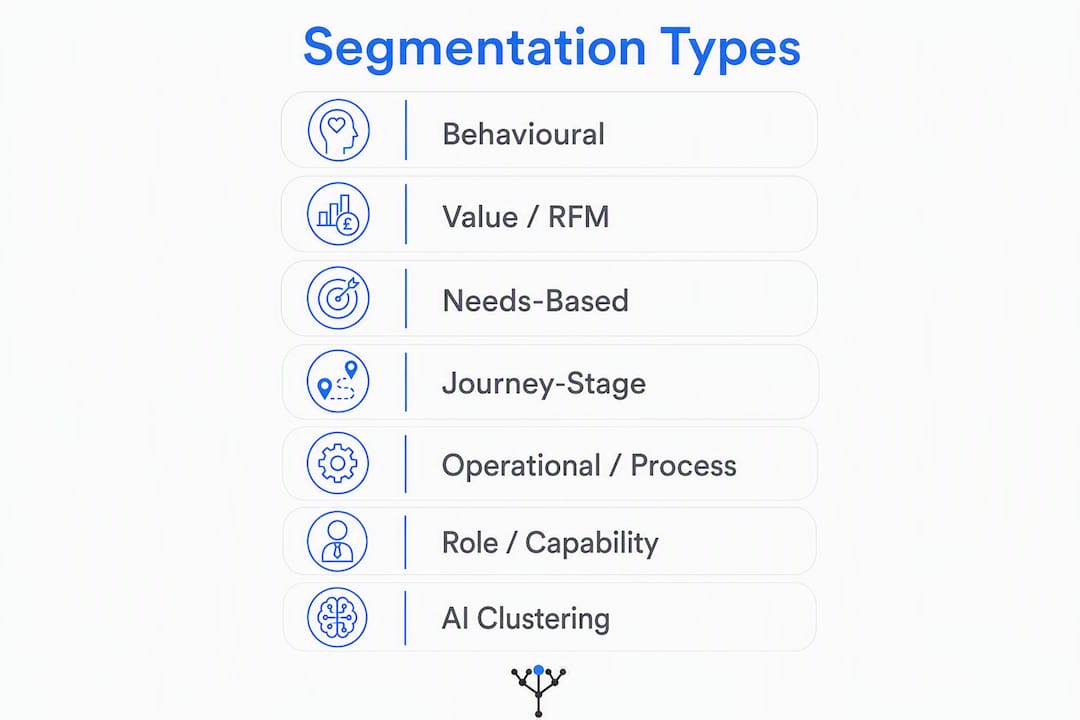
Journey-stage segmentation maps cohorts to a lifecycle position, from first contact through to renewal or exit. It is most useful for targeted process redesign at the moments where drop-off or delay is highest.
Operational / process-based segmentation groups by workflow characteristics: volume, complexity, exception rate, number of handoffs. This is where hidden rework lives. Passive telemetry uncovers micro-tasks, copy-paste chains and shadow processes that interviews routinely miss, and these frequently yield the highest-ROI automation candidates.
Role / capability segmentation reorganises units by what they can actually do rather than where they sit on the org chart. It is the right tool for capacity planning and allocation when the chart no longer reflects real capability distribution; learn more about effective approaches in Management Consulting.

AI clustering applies unsupervised learning to behavioural and operational signals simultaneously, surfacing non-obvious groupings that no predefined category would have found. For mid-market firms whose process knowledge is distributed across CRM, spreadsheets and collaboration tools rather than a single ERP event log, AI clustering often outperforms traditional process mining.
| Approach | Best for | Data required | Quick payoff |
|---|---|---|---|
| Behavioural | Automation targeting | Event logs, clickstream, tool usage | Automation candidates in weeks |
| Value / RFM | Resource prioritisation | Transaction records, CRM fields | Revenue focus within one cycle |
| Needs-based | Service design | Survey data, support tickets, CRM notes | Consistent onboarding outcomes |
| Journey-stage | Lifecycle intervention | CRM stage data, time-stamped interactions | Reduced drop-off at key transitions |
| Operational / process-based | Handoff and rework reduction | Workflow logs, exception reports | Cycle time reduction in pilot process |
| Role / capability | Capacity planning | Skills data, task completion records | Better allocation within weeks |
| AI clustering | Non-obvious micro-segments | Mixed structured and unstructured data | New segment hypotheses in days |
How do you choose the right segmentation approach for your organisation?
Start with your primary objective, not your available data. The approach should follow the problem; the data inventory comes second.
Ask your steering group these five questions before selecting a method:
- Are we trying to reduce cost, increase revenue, or improve service consistency?
- Do we have observed data (logs, telemetry) or only self-reported data (surveys, interviews)?
- How much time can the pilot team commit in the next eight weeks?
- Which single process or customer cohort causes the most operational pain right now?
- Is our process knowledge held in one system or scattered across multiple tools?
If your answer to question five is "scattered," document-based and AI-assisted approaches produce a first actionable insight within hours to days, compared with months for enterprise event-log process mining. That speed difference matters enormously when you need a pilot result before the next board review.
Pro Tip: Frame the segmentation exercise as a system improvement, not a performance audit. Managers who feel they are being assessed present "justified headcount" versions of processes rather than honest ones. The data you collect from frontline staff will be far more accurate when the framing is neutral.
A practical data checklist by approach:
- Behavioural: application event logs, session duration, feature-use frequency
- Value / RFM: invoice dates, transaction values, account tenure from CRM
- Needs-based: support ticket categories, onboarding survey responses, sales call notes
- Operational / process-based: workflow system logs, exception and escalation records, handoff timestamps
- AI clustering: any combination of the above, plus unstructured documents such as email threads and process notes
How to run a low-risk pilot: your implementation checklist
Run a focused pilot on one process or one customer cohort before any broad rollout. Scope is the single biggest risk factor; teams that try to segment everything at once produce nothing usable.
Timeline bands:
- Discover (weeks 1–4): Map the current state using 60–90 minute sessions with daily operators, covering triggers, actors, tools, handoffs, and failure modes. Collect passive telemetry in parallel.
- Pilot (weeks 5–12): Apply the chosen segmentation to the scoped process or cohort. Measure baseline KPIs in week five before any changes.
- Review (weeks 13–14): Compare pre/post metrics. Validate segment stability. Decide whether to adjust or scale.
- Scale (months 4–9): Roll out to adjacent processes or cohorts with the same governance structure.
| Role | Responsibility |
|---|---|
| Steering sponsor | Owns the business case and removes blockers |
| Data owner | Ensures data access, quality, and compliance |
| Process owner | Defines scope and validates segment definitions |
| Change lead | Manages communications and staff engagement |
Pilot checklist:
- Scope defined to one process or cohort (written, signed off)
- Baseline KPIs captured before week five
- Data collection method agreed (telemetry, log extraction, or document synthesis)
- Success thresholds set (e.g., 15% cycle time reduction, two fewer handoffs per transaction)
- Communications plan shared with all affected teams before the pilot begins
- Service-level protection in place: no changes to live customer-facing steps until review is complete
How do you measure success and calculate ROI for a segmentation pilot?
The core ROI formula is straightforward: (hours saved per week × fully loaded hourly cost × 52) minus pilot cost = annualised return. Use this structure with your own figures rather than illustrative numbers, and validate it against two independent data sources before presenting to the board.
Key KPIs to track from day one of the pilot:
- Cycle time per transaction or case (end-to-end, not just active time)
- Handoffs per transaction (each handoff adds latency and error risk)
- Error or exception rate within the scoped process
- Automation candidates surfaced (count of repeatable micro-tasks identified)
- Time to resolution for exceptions and escalations
Measurement principle: frequency × time per occurrence × people affected = total hours at stake. A task that takes 30 seconds but runs 400 times a day across 10 people represents 3,000 hours a year. Self-reporting bias in interviews means these high-frequency, trivial tasks are almost always invisible until you measure them passively.
For validation, run an A/B or holdout cohort approach: apply the new segmentation to half the pilot population and hold the other half at baseline for the full pilot window. Pre/post measurement windows should be equal in length, and sample sizes should be large enough to detect a meaningful difference in your primary KPI.
What are the most common segmentation mistakes, and how do you avoid them?
Three failure modes account for the majority of wasted segmentation efforts in mid-market organisations.
First: skipping current-state diagnosis. Jumping to future-state redesign without a robust baseline risks codifying existing inefficiencies into the new model. You end up automating the wrong things faster.
Second: self-reporting bias. When you ask people how they work, they describe how they think they should work. Repeated 30-second manual entries scale into thousands of hours of hidden automation opportunity that interviews never surface. Passive telemetry is the corrective.
Third: over-reliance on ERP event logs. Traditional cross-functional mapping methods are associated with a 70% failure rate for SME ERP implementations, largely because they lack the operational detail and data linkage that real process improvement requires.
Do not:
- Map processes using only manager input
- Begin segmentation before agreeing on a primary objective
- Treat the first segment definition as permanent
- Skip the communications plan (staff who do not understand why the exercise is happening will game it)
Pro Tip: Include staff from the process trigger all the way to the final approver in your discovery sessions. Frontline participation surfaces workarounds and redundant data entry that managers are often unaware of, and it builds the internal credibility the pilot needs to survive politically.
How does Oakandnine approach segmentation differently?
Oakandnine combines observed workflow telemetry, document synthesis, and AI clustering inside a live operating model to produce testable segment definitions, not static reports. The methodology integrates business processes, organisational structure, and human resource allocation simultaneously, because treating them in isolation produces fragile solutions.
The platform's approach in practice:
- Data ingestion: structured data (CRM, ERP, HRIS) and unstructured data (process documents, email threads, collaboration tool exports) ingested together
- Observed workflow mapping: actual task sequences captured via telemetry, not reconstructed from interviews
- AI clustering: unsupervised learning applied to combined behavioural and operational signals to surface non-obvious groupings
- Operational fit checks: segment definitions validated against real capacity and capability data before any redesign begins
- Pilot metrics: baseline KPIs locked before the pilot starts, with a live dashboard tracking cycle time, handoffs, and automation candidates throughout
A typical mid-market engagement surfaces between three and seven high-confidence automation candidates within the first pilot cycle, with measurable cycle time reductions visible before the review gate. The workflow automation guidance Oakandnine publishes reflects the same methodology applied across sectors.
What are your practical next steps to start a pilot?
For most mid-market UK organisations, the right pilot scope is one process plus one customer cohort or one organisational unit. That combination is small enough to complete in eight weeks and large enough to produce a result worth scaling.
Week-by-week pilot activities:
- Week 1: Confirm scope, assign roles, agree baseline KPIs, and begin telemetry collection.
- Weeks 2–3: Run discovery sessions (60–90 minutes each) with frontline operators and process owners.
- Week 4: Synthesise telemetry and session outputs into a current-state map. Identify segment hypotheses.
- Weeks 5–10: Apply segmentation to the pilot cohort. Track KPIs weekly.
- Weeks 11–12: Review results against success thresholds. Prepare scale recommendation.
To engage Oakandnine, prepare:
- A one-paragraph description of the process or cohort you want to pilot
- Your current data sources (CRM, ERP, spreadsheets, collaboration tools)
- The primary metric you need to move (cycle time, cost per transaction, error rate)
- Your timeline and any governance constraints
Reach Oakandnine through oakandnine.com to book an initial discovery call. The first session is a working conversation, not a sales presentation.
Key takeaways
Operational and process-based segmentation, combined with AI clustering, gives mid-market UK organisations the fastest path from diagnosis to measurable efficiency gains.
| Point | Details |
|---|---|
| Start with one process | Scope to a single workflow before any broad rollout to keep the pilot manageable and results credible. |
| Observe, do not ask | Passive telemetry surfaces high-frequency hidden tasks that interviews and surveys consistently miss. |
| Avoid the 70% trap | Traditional cross-functional mapping methods are associated with a 70% failure rate for SME ERP implementations; use document-based or AI-assisted approaches instead. |
| Measure from day one | Lock baseline KPIs before the pilot begins; cycle time and handoff count are the fastest indicators of progress. |
| Oakandnine as your pilot partner | Oakandnine's AI-driven live operating model combines telemetry, document synthesis, and four decades of consulting experience to produce testable segment definitions within a single pilot cycle. |
The segmentation mistake most leaders make before they even begin
Most mid-market operations teams approach segmentation as a classification exercise. They gather the team, draw the categories, assign the cohorts, and move on to implementation. The problem is that the categories are almost always built from beliefs about how the organisation works, not from evidence of how it actually works.
The gap between documented processes and real execution is nearly always larger than expected. Managers describe the process they designed. Frontline staff execute the process that survived contact with reality, complete with workarounds, informal handoffs, and shadow tools that never appear in any system of record. When segmentation is built on the former, the redesign that follows is built on fiction.
The practical fix is not complicated: observe before you classify. Two weeks of passive telemetry will tell you more about your real process segments than two months of workshops. The political fix is harder. Framing the exercise as a system audit rather than a performance review is the difference between getting honest data and getting a polished presentation of what people wish were true. That framing is a leadership decision, not a technical one, and it is the one most leaders skip.
Oakandnine gives you a live view of where your operations actually stand
Most segmentation projects stall because the data is scattered, the map is out of date before it is finished, and the pilot never gets a fair test. Oakandnine solves all three problems in a single engagement.
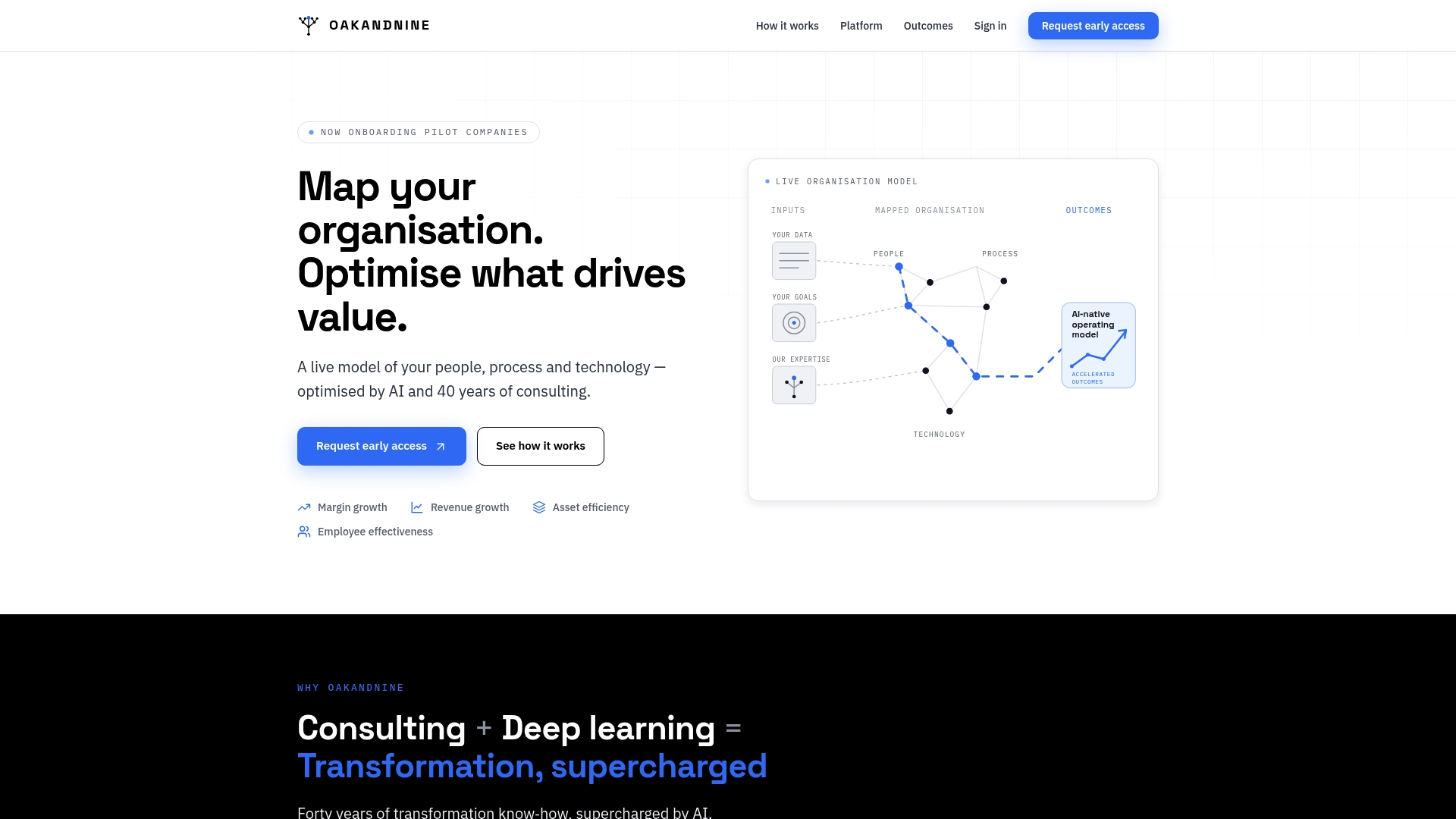
The platform ingests your structured and unstructured data, builds a live operating model from observed workflows rather than documented ones, and applies AI clustering to surface the segment definitions most likely to reduce cost and cycle time in your specific context. Backed by four decades of consulting experience, the Oakandnine team runs the discovery, the pilot, and the measurement, so your operations team focuses on decisions rather than data wrangling.
The pilot is scoped to one process or cohort, runs in eight to twelve weeks, and produces a board-ready result. Subscription and consulting are bundled, so there is no separate agency retainer to manage alongside the platform.
Book your discovery call at oakandnine.com and come with your one target process and your primary metric. That is all you need to start.