
Effective shadow IT governance is the discipline of identifying, assessing, and managing ungoverned technology assets that touch corporate data, with the primary objective of reducing unknown risk without killing the productivity that drove adoption in the first place. If you need to act now, here is the short version:
- Discover continuously using layered signals: firewall logs, CASB, endpoint telemetry, SSO logs, and procurement spend.
- Assess each discovered asset against risk factors: data sensitivity, compliance posture, and user count.
- Prioritise using a risk-versus-business-value matrix to decide what to block, sanction, or monitor.
- Remediate and manage by applying identity controls, DLP, and fast-path approval workflows.
- Monitor with weekly dashboards and quarterly executive reporting to prove progress.
Point-in-time audits cannot keep pace with SaaS adoption velocity. Discovery must be continuous and multi-layered, combining CASB, identity logs, and procurement data to create a signal that scales with the organisation.
Start this week: pull your firewall or proxy logs and run a basic cloud-traffic analysis. You will almost certainly find services your team did not know existed.
Table of Contents
- What actually counts as shadow IT?
- Why shadow IT risks demand senior attention
- How do you discover shadow IT across your estate?
- How do you assess and prioritise what you find?
- What controls actually reduce shadow IT risk?
- A 90-day starter roadmap you can use now
- Which KPIs prove your governance programme is working?
- How Oakandnine supports shadow IT governance in practice
- Key takeaways
- The case for governance that enables rather than polices
- What an Oakandnine pilot delivers for your organisation
- Useful sources and further reading
What actually counts as shadow IT?
The NCSC defines shadow IT (sometimes called "grey IT") as unknown assets used for business purposes, and frames it explicitly as an unmanaged risk rather than a simple policy violation. The practical scope is broader than most IT managers initially assume.
Concrete UK-relevant examples include:
- A marketing team using a personal Google Workspace account to share campaign assets with an agency, bypassing the organisation's approved file-sharing controls.
- Researchers storing datasets on a personal OneDrive or Dropbox account because the corporate SharePoint quota is too restrictive.
- Contractors connecting unmanaged personal laptops to the corporate Wi-Fi network to access internal systems.
- A finance analyst using a consumer-grade AI assistant to summarise sensitive board papers, with no data processing agreement in place.
- A sales team running a SaaS CRM on a departmental credit card, outside the procurement process entirely.
The boundary cases matter. Sanctioned BYOD, where the device is enrolled in mobile device management (MDM) and subject to corporate policy, is not shadow IT. Business-managed external IT, such as a vendor-hosted system procured through proper channels, is not shadow IT either. The defining characteristic is ungoverned contact with corporate data, not simply the fact that IT did not build the tool.
IBM describes shadow IT as the unauthorised use of IT resources by employees, and the risk profile it creates is distinct precisely because the organisation has no visibility into what data is flowing where.
Why shadow IT risks demand senior attention
The consequences of ungoverned technology are not theoretical. They fall into four categories that resonate at board level.
Security exposure. Every unsanctioned application is a potential credential-harvesting surface. Misconfigured cloud storage, weak authentication on consumer SaaS tools, and unpatched personal devices all expand the attack surface in ways that are invisible to your security operations team until something goes wrong.
Compliance failures. Under UK GDPR, your organisation is responsible for personal data regardless of which tool processed it. A team member uploading customer records to an unsanctioned cloud service creates a data processing relationship your organisation has not assessed, contracted for, or logged. The ICO does not accept "we didn't know" as a mitigating factor in enforcement decisions.
Operational disruption. When a shadow tool becomes load-bearing, its sudden removal creates service disruption. The FFIEC IT Examination Handbook explicitly warns that removal of shadow IT must be planned carefully to avoid business disruption, because by the time it is discovered, it is often deeply embedded in a team's workflow.
Reputational and financial harm. A breach originating in an unsanctioned tool carries the same regulatory and reputational weight as one from a sanctioned system, with the added embarrassment that the organisation did not know the tool existed.
The NCSC and ICO both expect UK organisations to maintain visibility over their technology estate. Shadow IT governance is the mechanism that makes that visibility real.
How do you discover shadow IT across your estate?
Discovery is the operational baseline for everything else. Without it, you are governing a fiction. The challenge is that no single method finds everything, so a layered approach is the only one that works at scale.
Step-by-step discovery rollout
- Start with firewall and proxy log analysis. This is the quickest win. Export traffic logs and filter for cloud destinations not on your approved list. Most organisations find dozens of unknown services within the first analysis run.
- Deploy a CASB or cloud discovery tool. Microsoft Defender for Cloud Apps provides a structured cloud discovery playbook: integrate with your firewall or proxy, deploy log collectors, and connect to Microsoft Entra ID. Its app catalogue covers more than 31,000 cloud services, each scored against risk criteria including security certifications, data location, and compliance posture.
- Enable endpoint telemetry. Endpoint detection and response (EDR) agents can surface applications installed on managed devices that are not in your software register.
- Analyse SSO and identity logs. OAuth grants and SSO federation logs reveal which third-party applications users have authorised to access corporate identity. These are often the most sensitive shadow connections because they carry real credentials.
- Reconcile procurement and spend data. Cross-reference corporate card statements, expense claims, and departmental budgets against your approved vendor list. Departmental SaaS subscriptions paid on a team credit card are a classic discovery gap.
Limitations to plan for
Encrypted traffic over personal devices or off-network connections will not appear in proxy logs. Personal accounts used on managed devices create a blind spot in SSO analysis. Contractors and third parties may use tools on their own networks entirely. Mitigations include identity-first signals (monitoring what corporate credentials are used to authenticate against), network access control using 802.1x and WPA2/3 Enterprise to enforce device compliance at the network layer, and periodic supplier questionnaires.
When you discover an asset, capture a minimum metadata set immediately: application name, URL, user count, data types accessed, business unit, and the date first observed. This forms the basis of your shadow IT register and feeds the prioritisation step.
How do you assess and prioritise what you find?
Not everything discovered is equally dangerous, and not everything dangerous is equally urgent. A prioritisation matrix prevents remediation effort from being wasted on low-risk tools while genuinely high-risk assets wait.
Prioritisation matrix
| Risk level | Business value | Recommended action |
|---|---|---|
| High | Low | Block immediately; provide a sanctioned alternative |
| High | High | Remediate urgently; apply compensating controls while a migration plan is built |
| Low | High | Sanction formally; complete information governance checks |
| Low | Low | Monitor; deprioritise unless user count grows |
Before taking action on any high-business-value tool, validate the justification with the relevant business owner. The ISACA governance framework recommends an evaluation process that converts valuable shadow tools into sanctioned ones rather than simply prohibiting them. That conversation also builds the cross-functional trust the governance model depends on.
What controls actually reduce shadow IT risk?
Controls fall into two categories: process controls that reduce the friction driving adoption, and technical controls that enforce boundaries on what is already in use.
Process controls
- Fast-path approval workflows: a lightweight approval process for low-risk SaaS tools, targeting a 48-hour turnaround, removes the procurement friction that is the single biggest driver of shadow adoption. Workflow automation tools can handle routing and approvals without manual intervention.
A 90-day starter roadmap you can use now
Most shadow IT programmes stall because they try to solve everything at once. A phased approach with clear 30-day checkpoints keeps momentum and delivers early wins that build executive confidence.
90-day timeline
| Phase | Weeks | Key activities | Owner | Output |
|---|---|---|---|---|
| Prepare | 1–2 | Stakeholder buy-in, policy draft, committee charter | IT + Legal | Governance committee formed |
| Discover | 3–6 | Firewall/proxy log analysis, CASB pilot in one business unit | IT + Security | Shadow IT register (first cut) |
| Assess | 5 | Risk scoring of discovered apps, business owner interviews | IT + Security + BU owners | Prioritised remediation list |
| Remediate | — | Block top 5 high-risk/low-value apps; fast-path pilot for low-risk requests | IT + Procurement | First measurable risk reduction |
| Embed | 9 | Policy published, fast-approval workflow live, training delivered | IT + HR + Procurement | Repeatable governance process |
Quick wins in the first 30 days:
- Run a firewall log analysis and present findings to the governance committee.
- Identify the three highest-risk unsanctioned tools and initiate a block or remediation plan.
- Launch a fast-path approval pilot for one business unit to demonstrate that IT can say "yes" quickly.
- Publish a one-page shadow IT policy so staff know the rules and the approval path.
For digital transformation programmes already under way, shadow IT governance integrates naturally into the broader change management workstream, using the same stakeholder maps and communication channels.
Which KPIs prove your governance programme is working?
Metrics serve two audiences: the IT team needs operational indicators to manage the programme day-to-day; the board needs evidence of risk reduction and compliance progress. Both need to be served by the same data, presented differently.
Operational KPIs (weekly dashboard):
- Number of previously unknown applications discovered in the period.
- Percentage of high-risk applications remediated or under active remediation plan.
- Average risk score trend across the shadow IT register (should decline over time).
- Number of fast-path approval requests received and average time to resolution.
- Number of incidents or near-misses originating in unsanctioned tools.
Governance reporting (monthly committee):
- Shadow IT register size and composition by risk tier.
- Applications sanctioned, blocked, or migrated in the period.
- Outstanding items requiring escalation.
- Policy exceptions granted and their expiry dates.
Executive summary (quarterly board pack):
- Risk reduction: percentage of high-risk apps resolved since programme start.
- Cost visibility: estimated spend on shadow SaaS now captured in procurement.
- Compliance posture: number of data processing gaps identified and closed.
- Productivity wins: fast-path approvals that replaced shadow adoption.
Presenting shadow IT governance outcomes in terms of risk reduction and cost visibility, rather than purely as a security exercise, is what secures continued executive sponsorship. Connecting governance to margin improvement makes the business case concrete.
How Oakandnine supports shadow IT governance in practice
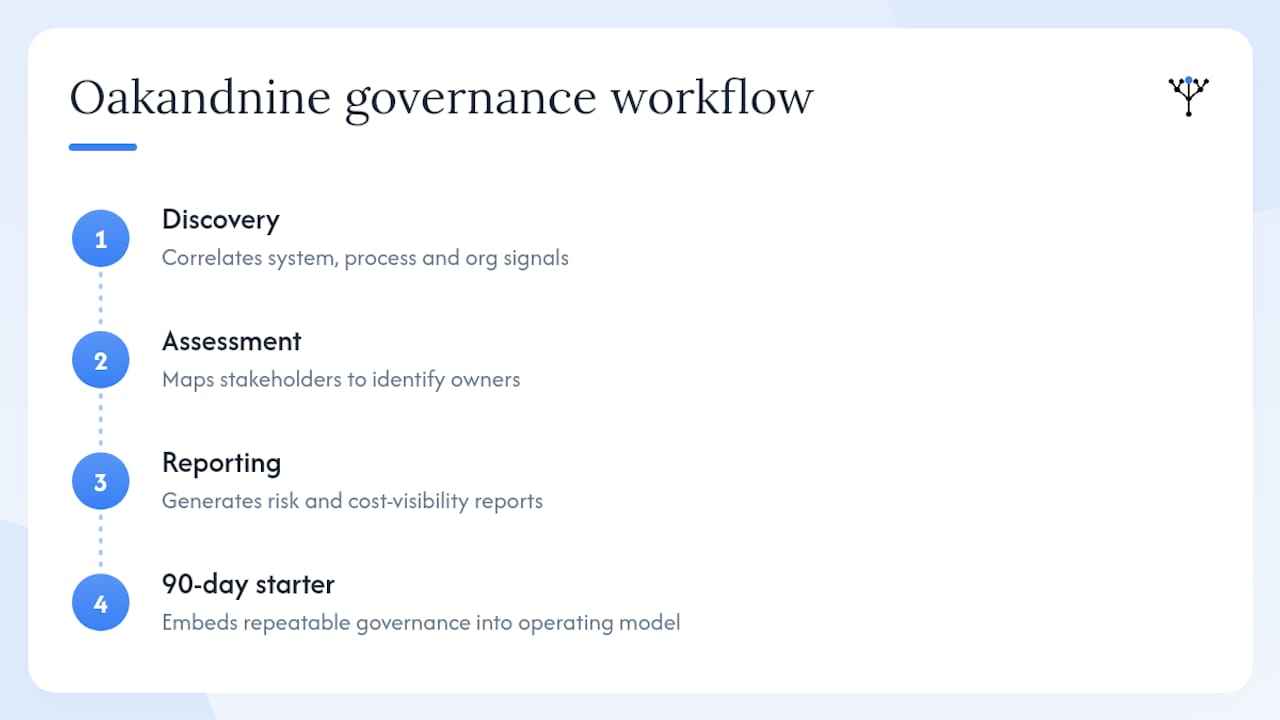
Oakandnine's platform is built around a live organisational model that maps people, processes, and technology in real time, which makes it a natural fit for the discovery and governance work described in this article. The platform surfaces friction points and undocumented tooling by connecting structured and unstructured data sources across the organisation, giving IT and security teams a coherent picture of what is actually in use rather than what is supposed to be in use.
In the discovery phase, Oakandnine correlates signals from multiple sources, including system integration data, process telemetry, and organisational maps, to identify where unofficial tools have become embedded in workflows. In the assessment phase, the platform's stakeholder mapping capability identifies the right business owners to consult before a remediation decision is made, reducing the risk of blocking a tool that a critical team depends on. In the reporting phase, Oakandnine's live model generates the kind of risk-reduction and cost-visibility outputs that board-level reporting requires, without manual data assembly.
For mid-market organisations that lack a dedicated shadow IT programme, Oakandnine's consulting team can run the 90-day starter project described above, from governance committee formation through to the first measurable risk reduction, using the platform as the operational backbone. The result is a repeatable governance process embedded in the organisation's operating model, not a one-time audit that goes stale within months.
Key takeaways
Effective shadow IT governance requires continuous discovery, risk-based prioritisation, a cross-functional governance committee, and measurable KPIs, all aligned to NCSC and ICO expectations for UK organisations.
| Point | Details |
|---|---|
| Discover continuously | Combine firewall logs, CASB, endpoint telemetry, SSO logs, and procurement data; point-in-time audits cannot keep pace with SaaS adoption. |
| Prioritise by risk and value | Use a risk-versus-business-value matrix to decide what to block, sanction, or monitor before committing remediation resource. |
| Enable a fast-approval path | A 48-hour lightweight approval process removes the procurement friction that drives shadow adoption in the first place. |
| Embed cross-functional governance | A committee spanning IT, Security, Legal, HR, and Procurement is the only model with enough authority and context to make decisions that stick. |
| Oakandnine as your operational backbone | Oakandnine's live organisational model surfaces undocumented tooling, maps stakeholders for approvals, and generates board-ready risk-reduction reporting. |
The case for governance that enables rather than polices
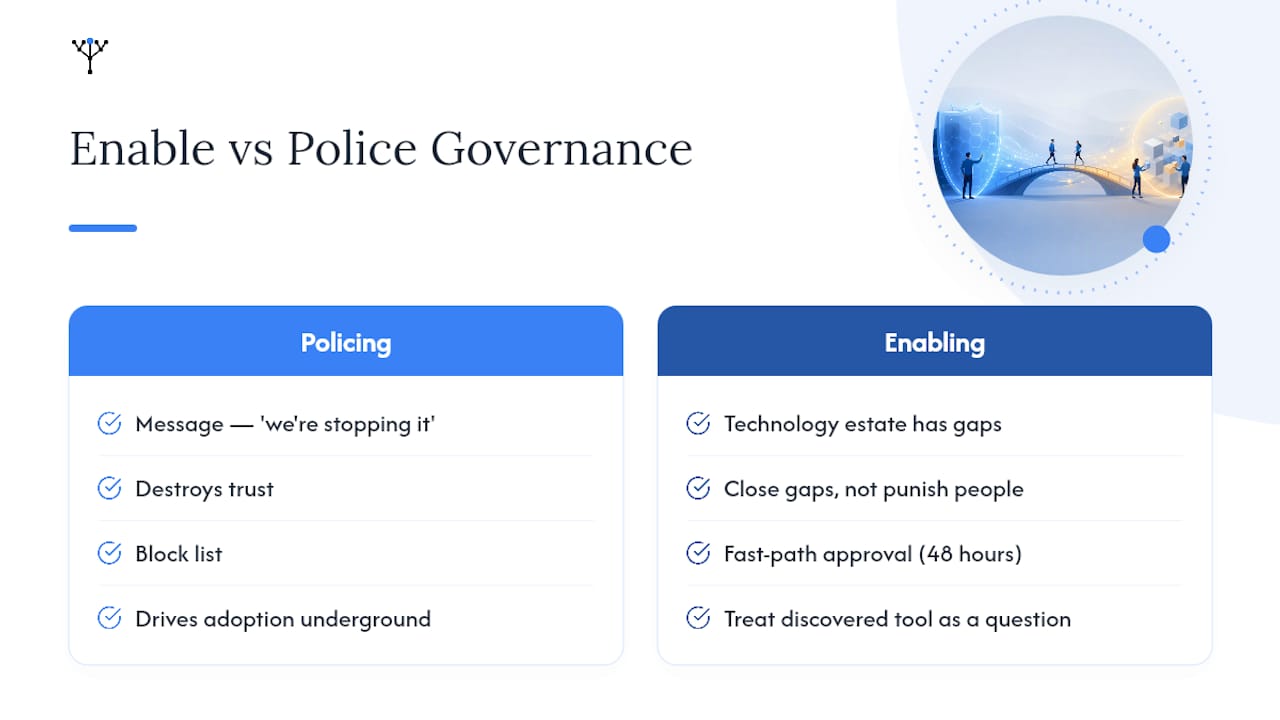
Shadow IT governance is almost universally framed as a risk management exercise, and that framing is part of why so many programmes fail. When IT arrives with a list of blocked applications and a new policy document, the message the organisation receives is: "We found out what you were doing, and we're stopping it." That message destroys trust and drives the next wave of shadow adoption underground, where it is even harder to find.
The more useful frame is this: shadow IT is evidence that your organisation's technology estate has gaps. The governance programme's job is to close those gaps, not to punish the people who found them first. A fast-path approval process that says "yes" in 48 hours is a more effective control than a block list, because it removes the incentive to go around IT entirely.
The organisations that govern shadow IT well are the ones that treat every discovered tool as a question: "What need is this meeting, and are we meeting it better?" Sometimes the answer is to sanction the tool. Sometimes it is to build a better alternative. Occasionally it is to block the tool and accept the short-term friction. But the question always comes first.
Over-blocking is a real failure mode. An IT team that blocks a tool used by 200 people without a migration plan, a communication strategy, or a sanctioned alternative will spend the next month managing escalations, exceptions, and workarounds. The governance model described in this article is designed to prevent that: assess before you act, involve business owners, and build the fast-approval path before you start enforcing the policy.
What an Oakandnine pilot delivers for your organisation
Governing shadow IT without visibility into your operating model is like auditing a building you have never mapped. Oakandnine gives mid-market IT leaders the live organisational model they need to make governance decisions with confidence, not guesswork.
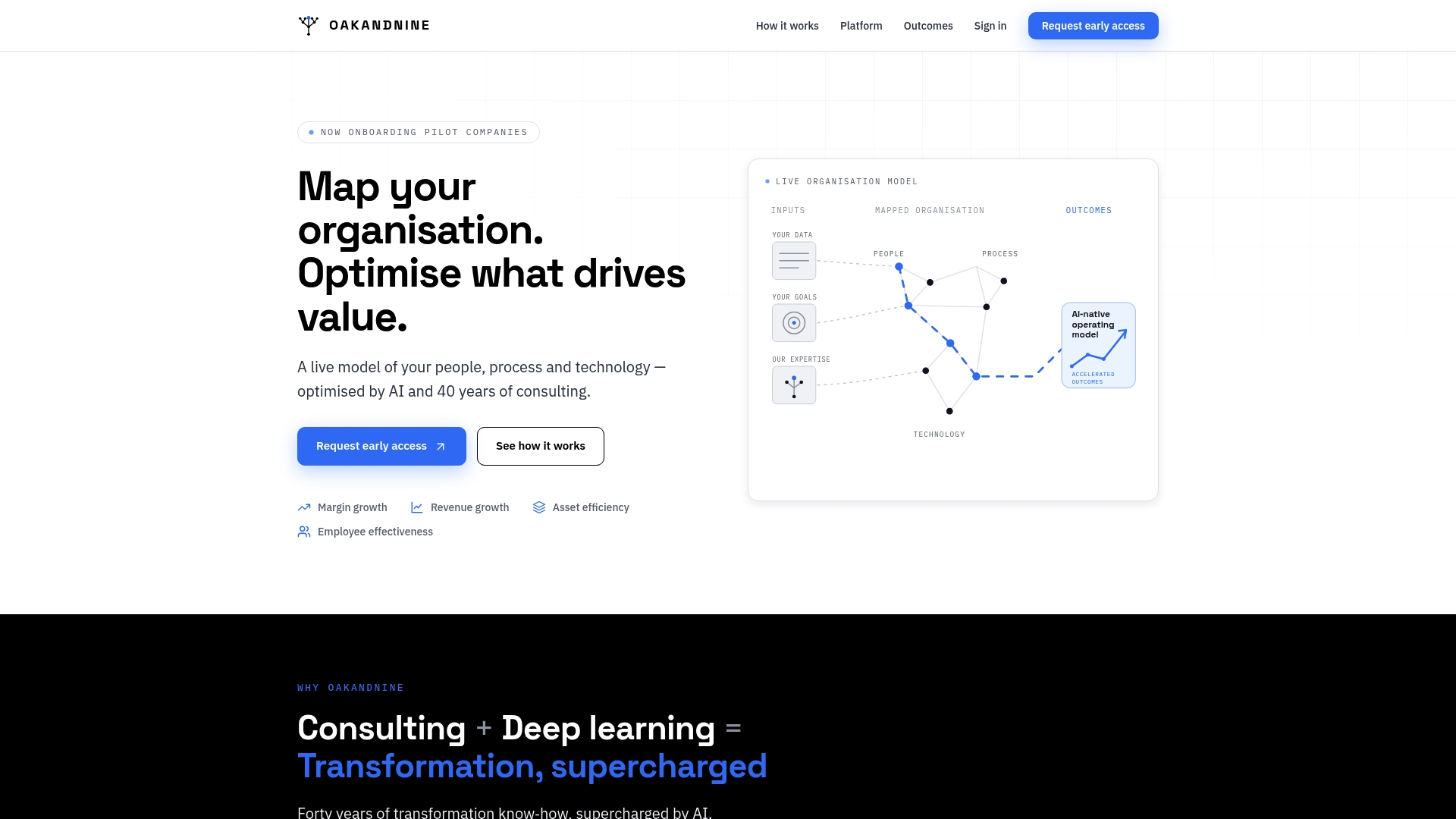
A typical Oakandnine pilot runs across 90 days and delivers a shadow IT register built from real organisational data, a prioritised remediation roadmap, governance committee templates, and the KPI reporting framework your board needs to see progress. The platform's AI-driven approach connects people, processes, and technology data that currently sits in silos, surfacing the undocumented tooling and workflow dependencies that a manual audit would miss entirely.
If your organisation is ready to move from reactive discovery to a repeatable governance model, start with an Oakandnine pilot and have a measurable risk-reduction outcome within 90 days.
Useful sources and further reading
- How to discover and manage Shadow IT in your network — Microsoft Defender for Cloud Apps tutorial
- 2024 Volume 6 Navigating the shadows
- FFIEC IT Examination Handbook InfoBase — III.B.3 Shadow IT
- Shadow IT Management: Discover, Govern & Reduce Risk | Adaptive Security
- Shadow IT Management: How to Manage & Control Shadow IT Risks
- What Is Shadow IT? | IBM
- Shadow IT: 6 dangers and how to avoid them — TechTarget / SearchCIO