
For UK mid-market and enterprise teams evaluating their integration stack, Oakandnine is the recommended pick: it combines AI-driven operating model intelligence with hands-on consulting, giving operations and IT leaders a single platform that connects people, processes, and systems rather than just wiring APIs together. If your priority is pure API-led integration at enterprise scale, MuleSoft is the heavyweight. For self-hosted, code-first automation with predictable pricing, n8n is the standout. Teams already embedded in the Microsoft 365 ecosystem will find Microsoft Power Automate the path of least resistance. Make suits mid-market teams that want visual, affordable workflow automation without Workato's governance overhead. Tray.io is the closest like-for-like enterprise alternative for technical teams who want deeper API control and a credible AI-native story.
The core trade-offs come down to three axes: cost predictability (Workato's usage-based pricing and cloud-only model frequently drive organisations to explore alternatives that offer self-hosting or clearer pricing), governance depth (enterprise controls, audit trails, and UK data residency), and team capability (citizen-developer-friendly visual tools versus developer-native platforms). Scenarios that demand heavyweight API management and a full enterprise service bus point toward MuleSoft or Dell Boomi. Teams that want open-source flexibility and data ownership point toward n8n or Pipedream. Embedded iPaaS for SaaS products points toward Paragon or Prismatic.
Table of Contents
- How do the top Workato alternatives compare at a glance?
- Vendor-by-vendor breakdown: what each platform actually delivers
- How were these alternatives evaluated?
- How do you pick the right alternative for your organisation?
- What does migration from Workato actually cost and how long does it take?
- Key takeaways
- Why the "best integration platform" question is usually the wrong one
- Oakandnine: a different starting point for mid-market teams replacing Workato
- Useful sources and vendor documentation to consult next
How do the top Workato alternatives compare at a glance?
| Platform | Best for | Pricing model | Ease of use | Deployment | Connectors | Enterprise features | Scalability | AI/agent features | Support & services | UK compliance |
|---|---|---|---|---|---|---|---|---|---|---|
| Oakandnine | UK mid-market ops & IT transformation | Subscription SaaS + consulting | Moderate (guided onboarding) | Cloud + consulting-led | Process, people & system integrations | Governance, org mapping, audit | Mid-market to enterprise | AI-driven org model, process intelligence | Dedicated consulting team | UK data handling; GDPR-aligned |
| MuleSoft | Large enterprise, API-led architecture | Licence + professional services | Developer-first | Cloud, on-prem, hybrid | 1,000+ pre-built connectors | Full enterprise suite, SOC2, ISO | Very high | Anypoint AI, MuleSoft Copilot | Global SI partner network | EU/UK data residency options |
| Dell Boomi | Hybrid enterprise integration | Subscription (connection-based) | Low-code, moderate | Cloud, on-prem, hybrid | — | SOC2, ISO 27001, FedRAMP | High | Boomi AI, AI-assisted mapping | Global support + partner network | UK/EU data residency available |
| Tray.io | Technical teams, API-heavy enterprise | Usage-based (operations) | Developer-leaning | Cloud | — | SOC2 Type II, GDPR | High | AI-native agent builder | Enterprise support tiers | GDPR-compliant, EU hosting |
| Make | Mid-market, visual automation | Scenario-based (operations) | Citizen-developer-friendly | Cloud | 1,000+ apps | Basic governance | Moderate | AI modules (limited governance) | Community + paid support | EU data centres |
| Microsoft Power Automate | Microsoft 365 / Dynamics shops | Per-user or per-flow | Citizen-developer | Cloud (Azure) | 900+ connectors | Microsoft compliance suite | High (Azure-backed) | Copilot, AI Builder | Microsoft support + partner network | UK Azure regions, GDPR |
| Zapier | SMB to lower mid-market | Task-based | Very easy | Cloud only | — | Limited enterprise controls | Moderate | AI actions (basic) | Email/chat support | US-hosted; limited UK residency |
| n8n | Developer teams, self-host priority | Self-host free; cloud subscription | Developer-first | Cloud or self-hosted | — | Moderate (self-managed) | High (self-hosted) | LLM nodes, agent workflows | Community + enterprise support | Full data residency control |
| Pipedream | Developer-first, compute-led pricing | Compute-based | Developer-first | Cloud + self-hosted | 1,000+ triggers | Moderate | High | Code-level AI integration | Community + paid tiers | US-hosted primarily |
| Paragon | SaaS product teams (embedded iPaaS) | Per-connector / usage | Developer-moderate | Cloud (embedded SDK) | — | SOC2 Type II | Moderate | Workflow AI features | Dedicated onboarding | GDPR-aligned |
| Prismatic | B2B SaaS embedded integration | Per-customer usage | Developer-moderate | Cloud + embedded | — | SOC2 Type II | Moderate-high | AI-assisted component building | Dedicated support | GDPR-aligned |
| Automation Anywhere | Enterprise RPA + intelligent automation | Licence + consumption | Moderate (RPA-trained) | Cloud, on-prem, hybrid | 1,000+ bots/connectors | SOC2, ISO 27001, FedRAMP | Very high | AARI, Autopilot, GenAI process | Global enterprise support | UK/EU data residency |
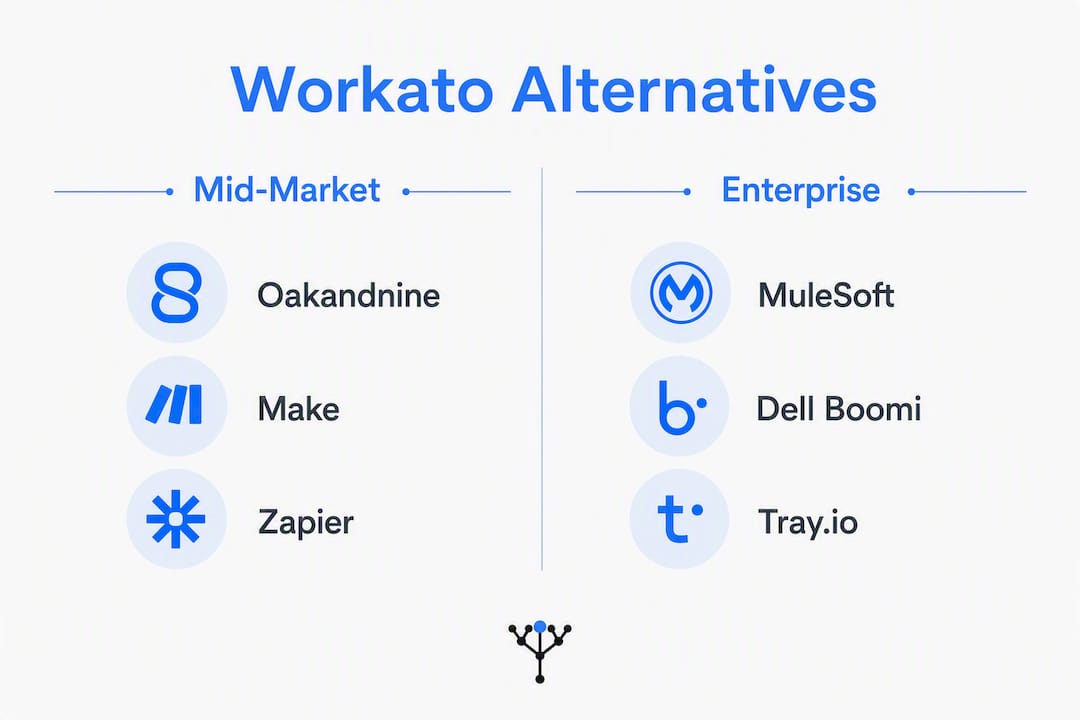
A note on this grid: pricing figures vary significantly by contract size, usage volume, and negotiated terms. Treat connector counts as indicative; validate specific connectors during a proof of concept. AI feature maturity ranges from production-ready agent orchestration to basic LLM API calls, and that distinction matters far more than the marketing label.
Key selection signals by platform:
- Oakandnine: choose when your priority is connecting operational data, people, and processes into a live model, not just wiring point-to-point APIs.
- MuleSoft: choose when you need a full API management layer and have the engineering budget to support it.
- Dell Boomi: choose when you need hybrid deployment with a lower-code experience than MuleSoft.
- Tray.io: choose when you need Workato-like enterprise automation with stronger API control and a genuine AI-native roadmap.
- Make: choose when cost and visual simplicity matter more than enterprise governance.
- Microsoft Power Automate: choose when your stack is already Microsoft-heavy and you want native Copilot integration.
- Zapier: choose for lightweight, fast-to-deploy automations; reconsider when governance or data residency is a hard requirement.
- n8n: choose when self-hosting and code control are non-negotiable and your team has the engineering capacity to manage it.
- Pipedream: choose when you want compute-led pricing and code-level flexibility without the overhead of a full iPaaS.
- Paragon / Prismatic: choose when you are building a SaaS product and need embedded integration capabilities for your own customers.
- Automation Anywhere: choose when your use case is primarily RPA-led with intelligent document processing and enterprise bot orchestration.
Vendor-by-vendor breakdown: what each platform actually delivers
Oakandnine
Oakandnine takes a different starting point from every other platform on this list. Where traditional integration tools ask "which systems do you want to connect?", Oakandnine asks "how does your organisation actually operate, and where is value leaking?" The platform builds a live operating model by ingesting structured and unstructured data from across your business, then surfaces friction points, asset inefficiencies, and process bottlenecks in a single view. For mid-market UK firms, that means operations managers and C-suite leaders get real-time visibility into where margin is being lost, not just a dashboard of completed workflow runs.
The commercial model is subscription-based SaaS with integrated consulting, which means you are not buying a tool and working out how to use it alone. Pilots typically begin with a focused discovery engagement, mapping the operating model before automating anything. Data handling is GDPR-aligned, and the consulting-led deployment model means data residency and processing boundaries are agreed upfront.
Choose Oakandnine over a Workato renewal when your goal is operational transformation rather than point-to-point integration maintenance. If your Workato estate is primarily a collection of recipes connecting SaaS apps, and the business question is "are we actually running efficiently?", Oakandnine addresses the upstream problem that Workato was never designed to solve.
MuleSoft
MuleSoft's Anypoint Platform is the market's most complete API-led integration solution, covering API design, management, runtime, and monitoring in a single suite. Its connector library includes a large number of pre-built integrations, and its DataWeave transformation language gives developers precise control over data mapping. The trade-off is cost and complexity: MuleSoft typically requires dedicated integration engineers and a significant professional services investment to deploy well.
For UK enterprise buyers, MuleSoft offers EU and UK data residency options and carries SOC2, ISO 27001, and FedRAMP certifications. Gartner consistently positions it as a leader in the iPaaS and API management categories. Choose MuleSoft over Workato when you need a full API gateway layer, have complex on-premises systems to integrate, and have the engineering headcount to support it. The TCO for integration platforms extends well beyond licence fees to include specialised talent and connector maintenance, and MuleSoft's total cost of ownership is among the highest on this list.
Dell Boomi
Dell Boomi occupies the space between MuleSoft's engineering-heavy approach and the lighter visual tools. Its AtomSphere platform uses a low-code visual interface for building integrations, with Atoms (runtime engines) deployable on-premises, in the cloud, or in hybrid configurations. This makes it particularly attractive for organisations with legacy on-premises systems that cannot move entirely to cloud-based automation.

Boomi AI adds intelligent data mapping suggestions and anomaly detection, though its agent capabilities are less mature than some competitors' offerings. SOC2 Type II and ISO 27001 certifications are in place, and UK/EU data residency is available. Enterprise-grade alternatives split between hybrid iPaaS and API-led strategies, and Boomi sits firmly in the hybrid iPaaS camp. Choose Boomi over Workato when hybrid deployment is a hard requirement and you want a lower-code experience than MuleSoft without sacrificing enterprise governance.
Tray.io
Tray.io is the platform most frequently shortlisted as a near like-for-like enterprise alternative to Workato, targeting technical teams that need deeper API control alongside an AI-native automation story. Its Universal Automation Cloud supports complex, multi-step workflows with branching logic, error handling, and real-time monitoring. The AI-native agent builder allows teams to construct agent-run processes, though governance around agent state and tool-use security warrants careful validation before production deployment.
Pricing is usage-based (operations-counted), which means cost predictability requires careful capacity planning. SOC2 Type II and GDPR compliance are in place, with EU hosting available. For UK buyers, Tray.io's partner ecosystem is smaller than MuleSoft's or Boomi's, so factor in internal engineering capacity when scoping implementation. Choose Tray.io when you want Workato's enterprise automation depth with stronger API programmability and are prepared to invest in technical configuration.
Make (formerly Integromat)
Make occupies the visual, affordable middle ground of the market. Its scenario-based builder is genuinely accessible to citizen developers, and its connector library covers more than 1,000 applications. Pricing is scenario-operations-based, making it one of the more cost-predictable options for mid-market teams with defined, repeatable workflows.
The limitations are real. Make lacks Workato's enterprise governance and on-premises options, and its error handling and observability tooling is less mature than enterprise-grade platforms. Data centres are EU-based, which satisfies basic GDPR requirements, but enterprise audit trails and role-based access controls are limited compared to MuleSoft or Boomi. Choose Make when cost and speed-to-value matter more than governance depth, and your workflows are well-defined rather than complex, branching automations.
Microsoft Power Automate
Microsoft Power Automate is the natural choice for organisations already running Microsoft 365, Dynamics 365, or Azure. Its native Copilot integration means users can describe a workflow in plain language and have it drafted automatically, which genuinely accelerates citizen-developer adoption. The connector library covers more than 900 applications, and Azure-backed infrastructure means enterprise-grade scalability is available without additional architecture work.

Pricing is per-user or per-flow, which is more predictable than task-based billing. UK Azure regions are available, and Microsoft's compliance suite covers GDPR, ISO 27001, SOC2, and a broad range of sector-specific certifications. The platform's weakness is outside the Microsoft ecosystem: connectors to non-Microsoft SaaS tools are functional but rarely as deep as native integrations. Choose Power Automate over Workato when your stack is Microsoft-centric and you want Copilot-assisted automation without a separate platform licence.
Zapier
Zapier offers one of the broadest app connector libraries available, and its no-code interface means non-technical staff can build automations in minutes. For SMB and lower mid-market use cases, it remains one of the fastest paths to automated workflows. However, its task-based pricing scales poorly at enterprise volumes, and its governance controls, audit logging, and data residency options are limited.
Zapier is US-hosted, which creates complications for UK organisations with strict data residency requirements under UK GDPR. Enterprise controls such as SSO, advanced permissions, and observability are available on higher tiers but remain less mature than dedicated enterprise platforms. Choose Zapier for lightweight, fast-to-deploy automations where governance is not a hard constraint. Reconsider it when you are moving more than a handful of sensitive data types or need reliable error handling at scale.
n8n
n8n's self-hosted model is its defining characteristic. Teams wanting self-hosting and code control find its execution pricing more cost-predictable for complex workflows compared with step-based billing models. The open-source core means you own your data entirely, which is a genuine advantage for UK organisations with strict data residency or sovereignty requirements.
Its LLM nodes and agent workflow support are genuinely useful for teams building AI-augmented automations, though production-readiness depends on your engineering team's capacity to manage the infrastructure. The cloud-hosted version removes the operational overhead but reduces the cost advantage. Choose n8n when self-hosting is a non-negotiable requirement, your team has the engineering capacity to manage it, and you want code-level flexibility without paying per-task or per-step.
Pipedream
Pipedream targets developers who want compute-led pricing and code-first workflow building. Developer-first platforms like Pipedream are compelling when teams want code flexibility and predictable compute-led pricing rather than task or step billing. Its trigger library covers more than 1,000 sources, and workflows are written in Node.js or Python, giving engineers full control over logic and error handling.
The platform is primarily US-hosted, which limits its appeal for UK buyers with strict data residency requirements. Enterprise governance features are less developed than dedicated iPaaS platforms. Choose Pipedream when your team is developer-native, your workflows are code-heavy, and you want to avoid the overhead of a full enterprise integration platform.
Paragon
Paragon is built for SaaS product teams that need to offer native integrations to their own customers, an embedded iPaaS model rather than an internal automation tool. Its SDK allows product teams to embed integration workflows directly into their product UI, with SOC2 Type II certification and GDPR alignment. Connector coverage focuses on the SaaS applications most commonly requested by B2B software customers.
Choose Paragon when you are building a SaaS product and need to deliver integrations as a product feature, not when you are solving internal enterprise automation challenges.
Prismatic
Prismatic occupies the same embedded iPaaS space as Paragon, with a stronger emphasis on component-based workflow building and per-customer usage pricing. Its AI-assisted component builder accelerates connector development, and SOC2 Type II certification is in place. Like Paragon, it is designed for B2B SaaS companies delivering integrations to their customers rather than for internal enterprise automation.
Choose Prismatic over Paragon when your product team wants more granular control over component architecture and pricing per customer instance.
Automation Anywhere
Automation Anywhere leads the RPA-plus-intelligent-automation segment. Its platform combines traditional robotic process automation with AI-driven document processing, natural language understanding, and its AARI (Automation Anywhere Robotic Interface) for human-in-the-loop workflows. For UK enterprise buyers with large volumes of document-heavy, rules-based processes, it offers a depth of bot orchestration that pure iPaaS tools cannot match.
SOC2, ISO 27001, and FedRAMP certifications are in place, and UK/EU data residency is available. The platform's complexity and licence cost place it firmly in the enterprise segment. Choose Automation Anywhere over Workato when your primary use case is RPA-led automation with intelligent document processing, not API-to-API integration.
How were these alternatives evaluated?
The evaluation used a consistent set of criteria applied across all twelve platforms, drawing on vendor documentation, analyst commentary from Gartner and Forrester, and practitioner analysis from sources including Adopt.ai and Composio.
- Connector depth and ecosystem breadth: number of pre-built connectors, quality of connector maintenance, and availability of connectors for UK-specific SaaS applications.
- Governance and enterprise controls: role-based access control, audit logging, SSO/SAML support, error handling, and observability tooling.
- Pricing model shape and TCO drivers: licence structure, usage-based cost triggers, and total cost of ownership including talent, maintenance, and connector lifecycle costs.
- Deployment models: cloud-only, self-hosted, on-premises, hybrid, and embedded SDK availability.
- AI and agent capabilities: distinction between platforms that manage agent state, context, and tool-use security versus those that simply call an LLM API. Treating these as equivalent leads to fragile production automations, so each platform's AI claims were assessed against this governance standard.
- Scalability and performance: ability to handle high-volume, low-latency workflows at mid-market and enterprise scale.
- Support and partner ecosystem: availability of dedicated support tiers, third-party implementation partners, and UK-based consultants.
- Security and compliance: SOC2, ISO 27001, FedRAMP, and UK GDPR / data residency documentation.
Limitations to note: pricing is highly variable and contract-dependent. Connector counts change frequently. AI feature maturity is evolving rapidly across all platforms. This evaluation is qualitative and should be validated with a structured proof of concept before any procurement decision.
Recommended PoC scope: select two to three high-volume, representative workflows. Test connector reliability, error handling behaviour, run cost at realistic volumes, and the time your engineering team spends on configuration and maintenance. That combination gives you credible TCO inputs that no vendor briefing can replicate.
How do you pick the right alternative for your organisation?
Team technical capacity is the single biggest determinant of which alternative will succeed in practice. A platform that is technically superior on paper will underperform if your team lacks the skills to configure and maintain it. Start there before evaluating features.
Selection criteria mapped to mid-market and enterprise priorities
- TCO predictability: can you model your annual cost based on known workflow volumes, or does pricing scale unpredictably with task counts, API calls, or connector usage? Prefer platforms where the pricing model is transparent and testable in a PoC.
- Governance depth: does the platform provide audit trails, role-based access, SSO, and error alerting that your security and compliance teams will accept? For UK organisations, confirm UK GDPR data processing agreements are available.
- Connector depth for your specific stack: breadth figures are marketing. What matters is whether the connectors for your ERP, CRM, and core SaaS tools are maintained, well-documented, and handle authentication patterns your IT team uses.
- Self-hosting or data residency: if UK data residency is a hard requirement, cloud-only US-hosted platforms are disqualifying. Confirm data residency options in writing before shortlisting.
- AI and agent capability maturity: validate agent state management and governance before treating AI features as production-ready. Ask vendors to demonstrate how their platform handles agent failures, context window limits, and tool-use security.
- SLA and support availability: what is the vendor's committed response time for P1 incidents? Is UK-based or European support available? What is the escalation path?
Questions to ask vendors in RFPs and PoCs
- Which authentication patterns does your connector for [specific system] support, and how are credential rotations handled?
- What happens when a workflow step fails mid-execution? Show us the error handling, retry logic, and alerting.
- At what volume does your pricing model change materially? Show us a cost model at 2x and 5x our current workflow volume.
- Where is our data processed and stored? Can you provide a data flow diagram and a signed DPA?
- What observability tooling is built in? Can we export logs to our SIEM?
- What is your audit trail retention period, and is it configurable?
- How many UK-based or European implementation partners do you have, and can you provide references?
Red flags in sales conversations
- Opaque usage pricing with no ability to model costs against your actual workflow volumes.
- Inability to provide a signed UK GDPR Data Processing Agreement before contract.
- No SOC2 Type II or ISO 27001 certificate available on request.
- AI features demonstrated only in controlled demos, with no production case studies showing agent governance.
- A partner ecosystem that consists entirely of global SIs with no regional presence.
- Pricing that requires a multi-year commitment before you have validated the platform in your environment.
Stakeholder mapping and minimum PoC success metrics
Involve IT architecture, security/compliance, operations, and finance from the start. IT architecture owns connector and deployment decisions. Security owns data residency and compliance artefacts. Operations owns workflow logic and business outcome metrics. Finance owns TCO modelling. Minimum PoC success metrics should include: workflow completion rate at target volume, error rate and mean time to resolution, engineering hours spent on configuration per workflow, and run cost per 1,000 executions.
What does migration from Workato actually cost and how long does it take?
Complex Workato recipes rarely migrate cleanly. Many organisations discover they must rebuild business logic rather than rewire it, which amplifies both migration effort and cost. Plan for rebuilds on any workflow with conditional branching, custom error handling, or bespoke data transformations.
Phased migration timeline
| Phase | Activities | Typical duration |
|---|---|---|
| Discovery | Audit existing recipes, map dependencies, identify high-risk workflows | Weeks 1–3 |
| Connector mapping | Validate target platform connectors against your specific systems and auth patterns | Weeks 2–4 |
| Proof of concept | Rebuild 2–3 high-volume recipes, measure run cost and engineering hours | Weeks 3–8 |
| Pilot | Migrate a defined workflow set, run in parallel with Workato | Weeks 6– |
| Cutover | Decommission Workato recipes progressively, monitor for errors | Weeks 12– |
| Optimisation | Refine error handling, observability, and cost management | Ongoing from week — |
TCO line items teams routinely underestimate
- Licence fees: the visible cost, but rarely the largest one.
- Task/compute pricing drivers: at scale, per-task or per-operation billing can exceed licence costs. Model this against your actual workflow volumes.
- Connector rebuild costs: connectors that worked in Workato may require significant reconfiguration or custom development on a new platform.
- Engineering time for recipe logic rebuilds: budget for full rebuilds on complex workflows, not just configuration time.
- Maintenance and monitoring: ongoing connector updates, error triage, and platform upgrades require dedicated engineering time.
- Training and change management: citizen developers who built Workato recipes need retraining on the new platform's paradigm.
- Third-party consultant costs: if your team lacks the capacity to manage migration, factor in SI or specialist consultant fees.
Gartner analyst commentary consistently highlights that TCO must include specialised talent, connector maintenance, and scaling costs, not just licence fees. For mid-market buyers, this distinction often determines whether a migration delivers its expected savings.
Pro Tip: Structure your PoC around two to three of your highest-volume, most business-critical recipes. Measure actual run costs and the engineering hours required to build and maintain them on the target platform. That data gives you a credible TCO model and surfaces integration risks before you commit to a full migration.
Key takeaways
For UK mid-market and enterprise teams, the right Workato alternative depends on three factors above all others: team technical capacity, TCO predictability, and data residency requirements.
| Point | Details |
|---|---|
| Team capability drives platform fit | No-code visual tools suit citizen developers; developer-native platforms suit engineering teams — match the platform to your actual team, not your aspirational one. |
| TCO extends well beyond licence fees | Talent, connector maintenance, recipe rebuilds, and scaling costs are often larger than the subscription; model all of them before committing. |
| AI features require governance validation | Validate agent state management and tool-use security before treating any platform's AI capabilities as production-ready. |
| Data residency is a hard filter for UK buyers | Cloud-only US-hosted platforms may not satisfy UK GDPR requirements; confirm a signed DPA and data residency options before shortlisting. |
| Oakandnine addresses the upstream problem | Where other platforms connect systems, Oakandnine maps the operating model first, making it the recommended pick for mid-market UK teams focused on operational efficiency and margin growth. |
Why the "best integration platform" question is usually the wrong one
The market's framing of this decision as a feature comparison misses something important. Most organisations evaluating Workato alternatives are not primarily suffering from a connector gap or a pricing model problem. They are suffering from a visibility problem: they do not have a clear picture of how their people, processes, and systems interact, which means they automate the wrong things first and discover the real bottlenecks later.
The platforms on this list are genuinely capable tools. MuleSoft will handle your API architecture. n8n will give your engineers the control they want. Power Automate will satisfy your Microsoft-aligned stakeholders. But none of them start by asking whether the process you are about to automate is the right one to automate. That is the question that determines whether a migration delivers its promised efficiency gains or simply moves the same friction to a new platform.
The organisations that get the most from an integration platform replacement are the ones that do the operating model work first: mapping where value is created, where it leaks, and which workflows are genuinely worth automating at scale. That upstream work is what separates a successful migration from an expensive infrastructure project that leaves the business running the same way it always did.
For mid-market UK teams, the practical implication is this: treat the PoC not just as a technical validation exercise, but as a business model audit. The workflow automation tools that deliver lasting results are the ones deployed against a clear picture of the operating model, not just a list of recipes to migrate.
Oakandnine: a different starting point for mid-market teams replacing Workato
Most Workato migrations focus on replicating what already exists on a cheaper or more flexible platform. Oakandnine offers a different entry point: before automating anything, the platform maps your operating model, connecting data from your people, processes, and systems into a live view of how the business actually runs. For UK mid-market operations and IT transformation leads, that means you identify which workflows are worth automating, where process bottlenecks are costing you margin, and which systems are generating friction before you commit engineering time to rebuilding recipes.
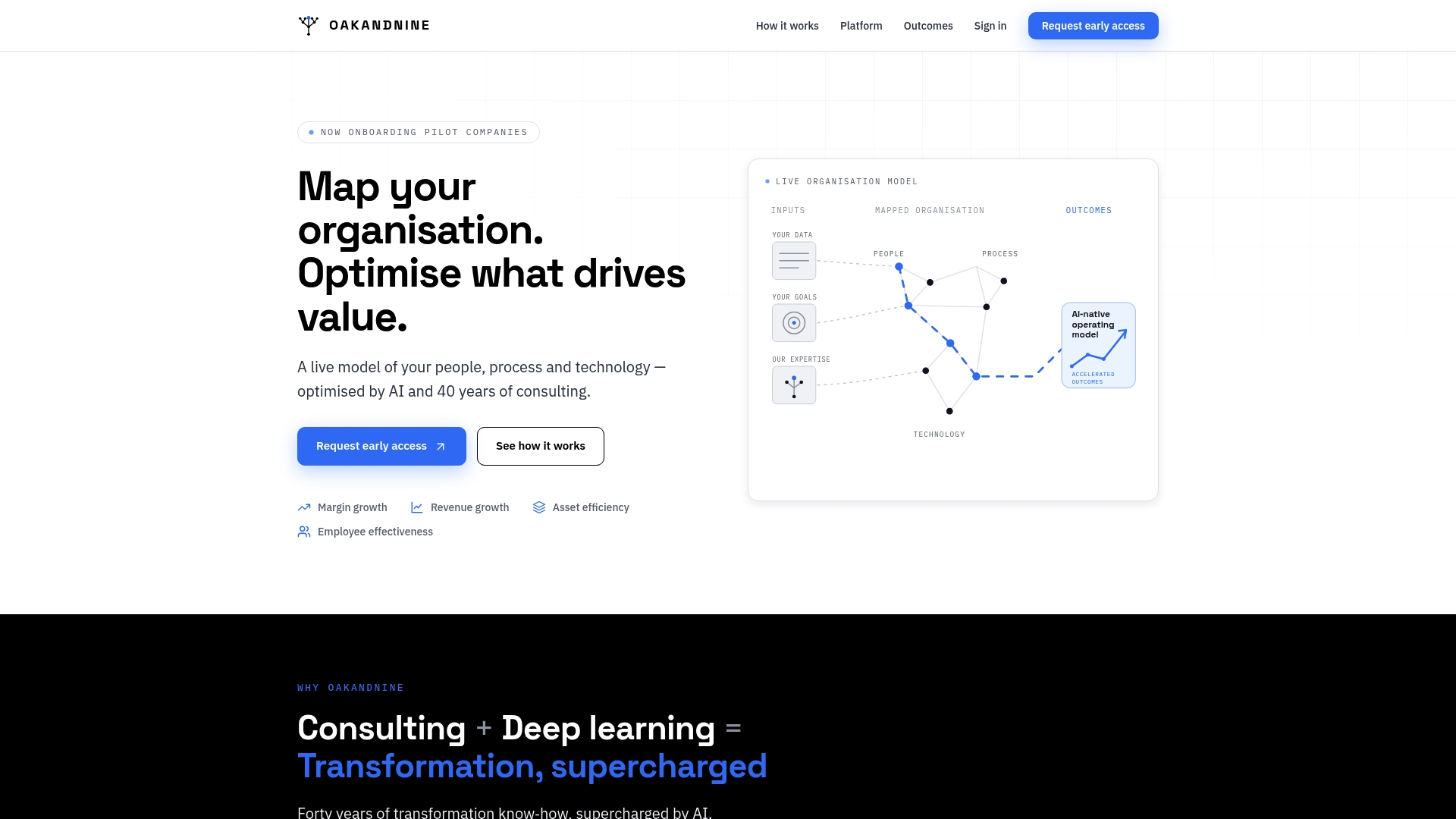
A typical Oakandnine pilot runs as a focused engagement: discovery, operating model mapping, and a defined set of integration and optimisation use cases scoped to your highest-impact areas. Data handling is GDPR-aligned, and the consulting-led model means data residency and processing boundaries are agreed at the outset, not retrofitted. Clients typically see measurable reductions in process cycle time, lower operational cost per transaction, and improved cross-functional visibility within the pilot period.
If you are a UK mid-market operations manager, IT leader, or transformation executive evaluating your integration stack, book a pilot conversation with Oakandnine to see how the operating model approach applies to your specific environment.
Useful sources and vendor documentation to consult next
Before finalising your shortlist, request specific artefacts from each vendor: a signed Data Processing Agreement, SOC2 Type II or ISO 27001 certificates, data flow diagrams showing where your data is processed and stored, and run cost examples based on your actual workflow volumes. Vendor pricing is variable and contract-dependent; a measured PoC is the only reliable way to produce accurate TCO estimates.
- Microsoft Power Automate product page — official feature documentation, deployment options, and compliance information for Power Automate.
- Microsoft Power Automate pricing — per-user and per-flow pricing tiers; use to model cost at your expected workflow volumes.
- Gartner peer reviews: Workato alternatives — analyst commentary and peer reviews covering TCO, enterprise features, and competitive positioning.
- G2 reviews: Microsoft Power Automate — practitioner reviews covering ease of use, connector reliability, and enterprise governance.
- G2 reviews: Zapier — practitioner reviews covering use cases, pricing experience, and limitations at scale.
- Capterra: Microsoft Power Automate — independent user reviews with ratings on value for money, ease of use, and customer support.
- Capterra: Zapier — independent user reviews; useful for validating ease-of-use claims and identifying governance limitations.
- ICO guidance on UK GDPR — the UK Information Commissioner's Office guidance on data residency, processing agreements, and compliance obligations for organisations using cloud-based platforms.
- Oakandnine: workflow automation tools for mid-market leaders — practitioner analysis comparing integration approaches and Oakandnine's consulting methodology.
- Oakandnine: system integration software guide for UK businesses — guidance on selecting integration tools for hybrid architectures and consulting engagements.
This article provides general information for technology decision-makers evaluating integration platforms. Pricing, compliance certifications, and feature availability change frequently. Verify current details directly with vendors and confirm UK GDPR compliance requirements with a qualified data protection adviser before making procurement decisions.