
AI converts routine operational data into continuous, measurable improvement across forecasting, maintenance, quality and workflow automation. That's the honest answer, and it holds whether you run a 200-person manufacturing site or a distributed logistics network.
The highest-impact starting points are:
- Demand and inventory forecasting
- Predictive maintenance on critical assets
- Computer vision for quality inspection
- Workflow automation and AIOps for IT/infrastructure
- Supply chain and logistics optimisation
- Scheduling and labour rostering
The rest of this guide explains how to pilot these use cases without wasting six months on a proof of concept that never scales.
Key Takeaways
AI improves operations most reliably when pilots are scoped tightly, tied to one KPI, and backed by clean data before any model goes into production.
| Point | Details |
|---|---|
| Start with one metric | Pick a KPI leadership already tracks and tie your first pilot to it directly. |
| Prioritise by data readiness | Choose use cases where you already hold 12 to 24 months of clean history. |
| Pilot small, measure hard | Run pilots on one line or shift, and expect double-digit improvement before scaling. |
| Govern models like assets | Assign an owner, a rollback rule and a retraining cadence to every model in production. |
| Oakandnine maps before it automates | Oak & Nine builds a live organisational model first, so pilots target real bottlenecks. |
Table of Contents
- Why AI matters for operations management
- High-impact AI use cases in operations
- How to move an AI pilot from test to scale
- Why AI pilots stall and how to govern them properly
- Technology patterns that actually fit operations
- How Oak & Nine approaches AI in operations: a client sketch
- A 90-day starter plan for your first AI pilot
- How Oak & Nine supports your AI pilot from day one
- Sources
Why AI matters for operations management
Efficiency gains from AI show up as fewer hours spent chasing information and more spent acting on it. AI can evaluate large volumes of operational data, automate regular tasks and connect processes that used to sit in separate silos, which is precisely what shortens decision cycles on a factory floor or in a distribution centre.
Three benefits tend to matter most to an operations leader:
- Lower cost per unit through better resource allocation
- Faster decisions because data reaches the right person sooner
- Higher uptime through earlier failure detection
Consider the mechanics: a plant that improves forecast accuracy typically frees up working capital because it stops over-ordering safety stock. A facility that catches equipment degradation early sees uptime climb because failures get scheduled rather than discovered. Research applying AI across forecasting, inventory, transportation and risk analysis consistently frames the value the same way: better prediction plus better decision support equals fewer surprises downstream.
Pro Tip: Pick one metric your board already tracks, tie your first AI pilot to it, and skip anything that only produces a "nice dashboard" without a number attached.
High-impact AI use cases in operations
Not every use case deserves equal attention in year one. Rank them by how quickly they produce a defensible number, not by how impressive they sound in a strategy deck.
- Demand forecasting: needs 12 to 24 months of clean sales history; test it against your current planning error rate before touching inventory policy.
- Predictive maintenance: requires sensor or maintenance-log data on your worst-performing assets; a quick win is flagging the three machines with the highest unplanned downtime.
- Quality inspection (computer vision): works best where defects are visual and repetitive; pilot on a single line before touching the whole plant.
- Inventory and replenishment optimisation: pairs well with forecasting data you already have; test it on your highest-value SKUs first.
- Scheduling and rostering: needs historical demand and labour-availability data; a fast pilot is one shift pattern in one location.
- Process automation and AIOps: suited to IT and infrastructure teams drowning in alerts; start by automating triage on your noisiest system, not everything at once.
Industry overviews consistently group these into the same broad categories: forecasting, optimisation, monitoring and automation, which is a useful filter when a vendor pitches something outside those buckets. If you're unsure where your own process losses concentrate, finding the bottleneck first is a better use of week one than shortlisting software.
How to move an AI pilot from test to scale
Most operations teams skip steps and pay for it later. Follow this order:
- Define the outcome in business terms, not technical ones, before touching any tool.
- Map the workflow the AI will sit inside, including every handoff between people and systems.
- Inventory the data you actually have, not the data you wish you had.
- Run a small pilot on one line, shift, or SKU group, not the whole operation.
- Measure against baseline using KPIs agreed before the pilot started.
- Iterate or kill it based on the numbers, not on sentiment.
A realistic pilot-to-scale timeline typically covers several months for proof of value, system integration, and change management before wider rollout, with each phase treated as a genuine decision point. Treat each gate as a genuine decision point, not a formality.
Track these KPIs from day one:
- Forecast error (MAPE or similar)
- Mean time between failures
- Cycle time per unit or transaction
- First-time quality rate
- Cost per unit processed
A pilot worth scaling usually shows a significant improvement on at least one core metric within the first measurement window. Anything vaguer than that isn't a result, it's a hope. For a broader framework on sequencing these steps, business process optimisation guidance is worth reading alongside your pilot plan.
Why AI pilots stall and how to govern them properly
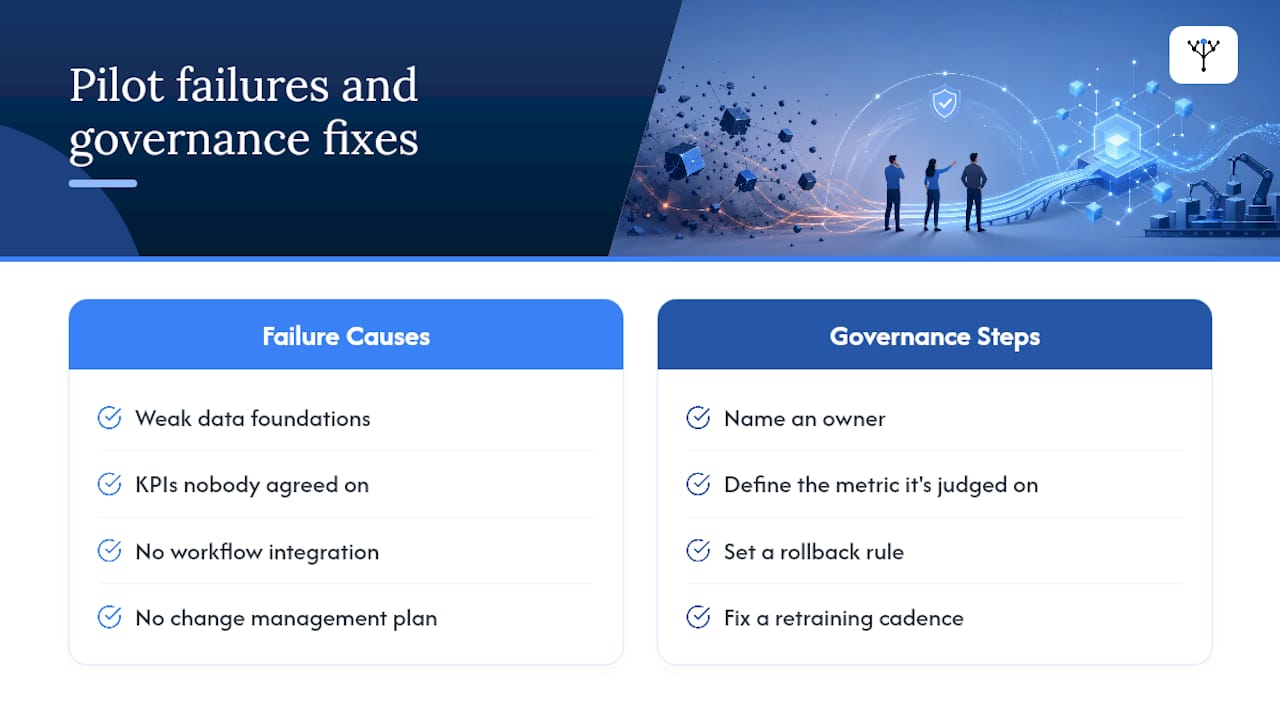
Most failed pilots die from the same five causes: weak data foundations, KPIs nobody agreed on upfront, no integration into the actual workflow, no change management plan, and skills gaps on the team meant to run it day two after launch. Research on strategic integration confirms this pattern: pilots stall when leaders treat AI as an isolated experiment rather than mapping it explicitly to workflows, data and governance from the start.

Pro Tip: Run a lightweight governance checklist for every model in production: name an owner, define the metric it's judged on, set a rollback rule, and fix a retraining cadence before drift becomes visible in your output.
Model drift, biased training data and unclear accountability are operational risks, not abstract ethics debates. Privacy and security obligations vary by sector and jurisdiction, so loop in legal counsel before any model touches personal or regulated data.
Technology patterns that actually fit operations
Skip the vendor comparisons and think in patterns instead. Six components recur across almost every serious deployment:
- A data layer or warehouse that unifies structured and unstructured operational data
- A streaming or event bus for real-time signals like sensor feeds
- Model serving and MLOps to deploy, monitor and retrain models reliably
- Digital twins for simulating physical assets or processes before changing them live
- RPA plus AI agents for rules-based tasks layered with judgment
- AIOps and observability stacks for IT and infrastructure monitoring
Predictive maintenance typically needs IoT sensors, time-series modelling and solid MLOps discipline. Quality inspection leans on computer vision models paired with an image pipeline. No-code agent platforms have lowered the cost of launching first pilots for teams without deep engineering resources, which matters if your organisation doesn't have a data science function yet. For the automation layer specifically, AI workflow automation software built for mid-market teams tends to fit better than enterprise platforms designed for a different scale of operation.
How Oak & Nine approaches AI in operations: a client sketch
A mid-market manufacturer came to Oakandnine with a familiar problem: three departments running three separate spreadsheets, none of them agreeing on where the real bottleneck sat. The approach followed four steps:
- Map the live organisational model across operations, finance and HR data
- Integrate the disconnected systems into one working view
- Automate the manual reporting that was consuming a day per week per manager
- Measure cycle time and resource allocation against the pre-project baseline
Early indicators pointed to faster cross-team visibility and fewer manual reporting hours within the first measurement cycle, consistent with what operations management frameworks predict when process redesign accompanies the technology rather than trailing behind it.
A 90-day starter plan for your first AI pilot
Structure the first quarter around three phases, each with its own gate.
- Days 1 to 30: set the target outcome and metric, audit your data sources, and pick one workflow narrow enough to finish in eight weeks.
- Days 31 to 60: build and run the pilot, track your chosen KPI weekly, and fix data gaps as they surface rather than waiting for a perfect dataset.
- Days 61 to 90: validate results against baseline, brief IT on integration requirements, and train the team who will own the process once it's live.
Bring stakeholders in early rather than presenting a finished pilot as a surprise, and hand off cleanly to IT before headcount or budget decisions get made on the back of it. A change management framework built for mid-market teams helps here more than a generic project plan borrowed from a much larger organisation.
Author perspective: priority guidance for operations leaders
Put your attention on data and workflows before models. Three rules I'd apply immediately: fix your data foundations before buying anything, tie every pilot to one KPI leadership already trusts, and treat the people affected by the change as part of the rollout plan, not an afterthought.

How Oak & Nine supports your AI pilot from day one
Oakandnine gives operations leaders something most AI vendors don't: a live organisational model that already shows where your bottlenecks, data gaps and manual workarounds sit, before you write a single line of pilot scope.
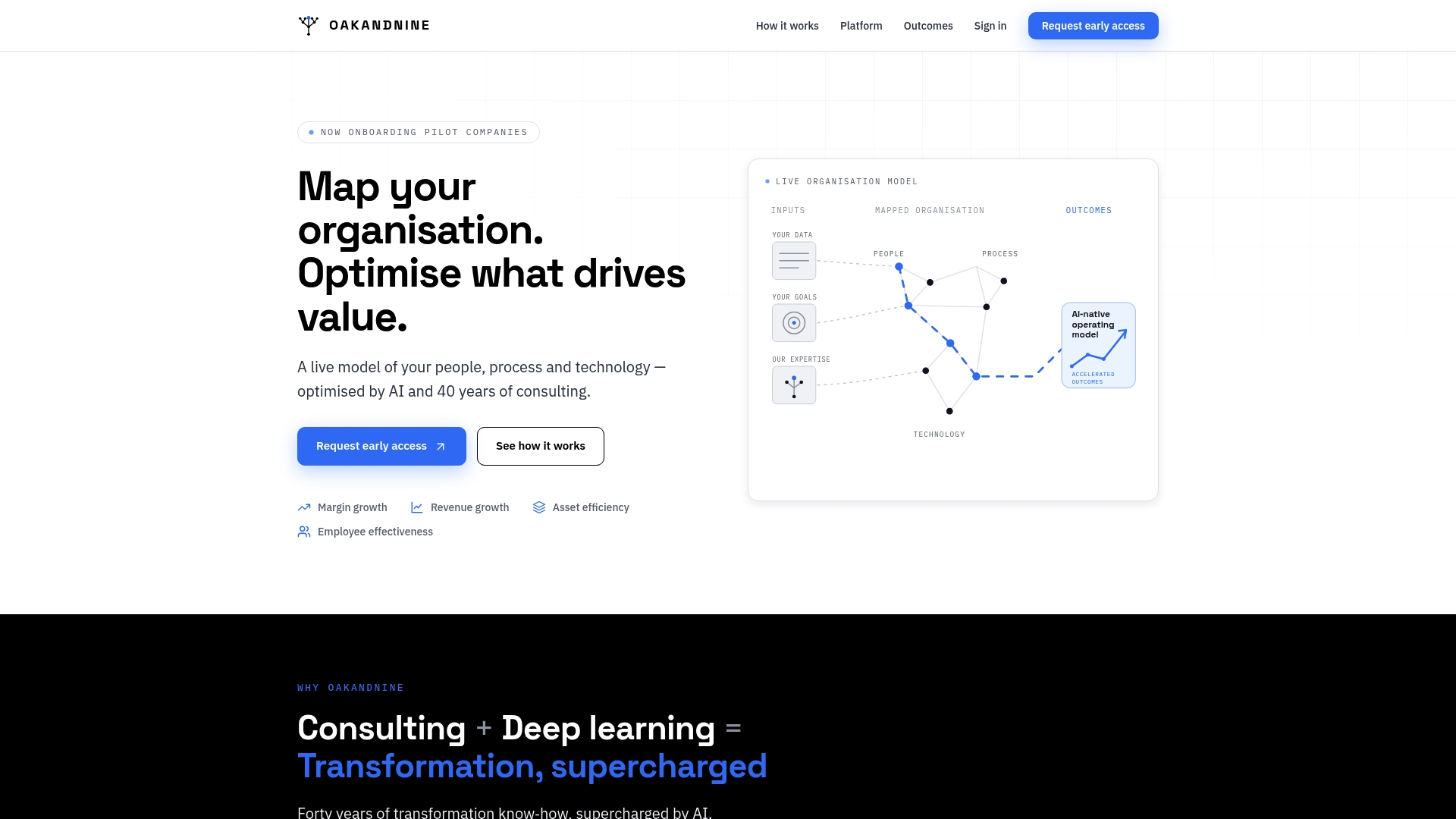
Instead of guessing which process to automate first, a pilot conversation with Oakandnine starts with a review of your existing systems and data, a joint definition of the target outcome, and a rough estimate of achievable ROI based on your actual numbers, not a generic case study. That maps directly onto the 90-day plan above: map, integrate, automate, measure. If you're ready to scope a pilot against your own operations rather than a hypothetical one, book a working session with Oakandnine and bring your current bottleneck to the table.
Sources
- Strategic Integration of AI for Data‑Driven Decisions and Automation in Operations Management
- Artificial Intelligence in operations management - EFMD blog
- Artificial Intelligence and Operations: A Foundational Framework of Emerging Research and Practice