
For UK mid-market IT and operations teams, the strongest Boomi alternatives in 2026 are Oakandnine, MuleSoft Anypoint, Workato, ONEiO, and Informatica IDMC — chosen for operational model fit, pricing predictability, and UK regulatory readiness. The remaining shortlist entries (SnapLogic, Celigo, Jitterbit, Talend Data Fabric, SAP Integration Suite, and Matillion) each serve specific architectural directions that may suit your situation better than the headline five.
The core decision is not which platform has the most connectors. It is whether you want to build and run integrations yourself or hand that operational responsibility to a managed service. That single question narrows the field faster than any feature matrix.
Here is the shortlist at a glance:
- Oakandnine — best for mid-market teams that need combined SaaS integration, AI-driven process optimisation, and consulting outcomes without building an internal integration function.
- MuleSoft Anypoint — best for API-first enterprises with Salesforce ecosystems and the engineering headcount to run a per-vCore model.
- Workato — best for business-led automation where non-technical teams need to build and own recipes without developer dependency.
- Informatica IDMC — best for data-governance-heavy environments where master data management and cloud data quality are non-negotiable.
- SnapLogic — best for mid-to-large enterprises wanting a low-code designer with strong pipeline throughput and hybrid deployment.
- Celigo — best for SaaS-heavy mid-market stacks (NetSuite, Salesforce, Shopify) where pre-built integration apps accelerate delivery.
- Jitterbit — best for mid-market teams wanting a pragmatic, cost-accessible iPaaS with solid ERP and CRM connector depth.
- Talend Data Fabric — best for analytics-led organisations prioritising data quality, lineage, and ETL/ELT pipelines over real-time app integration.
- SAP Integration Suite — best for SAP-centric landscapes where native SAP connectivity and BTP ecosystem alignment matter most.
- Matillion — best for cloud data warehouse teams (Snowflake, BigQuery, Redshift) running ELT at scale; not an iPaaS substitute.
- ONEiO — best for IT service management teams wanting a fully managed integration service with SLA-backed operations and no internal build overhead.
Pro Tip: Before you open a single vendor demo, answer this question in writing: "How many engineers can we dedicate to integration operations post-go-live?" If the honest answer is fewer than three, managed services and outcome-focused platforms should sit at the top of your shortlist.
Table of Contents
- How do the top Boomi alternatives compare at a glance?
- How do you choose the right Boomi alternative for your team?
- Detailed vendor profiles: who should you actually pick?
- Why Oakandnine is a practical alternative for UK mid-market teams
- Migration and pilot checklist: what to test before you switch
- Key takeaways
- The integration platform decision most teams get wrong
- Oakandnine: outcomes-led integration for mid-market teams
- Useful sources for procurement and technical teams
How do the top Boomi alternatives compare at a glance?
| Platform | Best for / primary use case | Deployment model | Pricing model | Connector & protocol breadth | Ease of use | Operational burden | Security & compliance (UK/EU) | Support & partner ecosystem |
|---|---|---|---|---|---|---|---|---|
| Oakandnine | AI-driven org model + integration ops for mid-market | Cloud SaaS + managed consulting | Managed subscription | SaaS apps, on-prem, data unification, process workflows | High (consulting-led onboarding) | Low (managed outcomes) | UK data residency; confirm specifics on site | Dedicated consulting + partner network |
| MuleSoft Anypoint | API-first enterprises, Salesforce ecosystems | Cloud, hybrid, on-prem | Per vCore (complex, scales steeply) | Very broad: SaaS, on-prem, B2B/EDI, APIs | Moderate (developer-oriented) | High (3–10 engineers typical) | SOC 2; EU/UK data residency options | Large SI partner ecosystem; Salesforce support |
| Workato | Business-led automation, citizen developers | Cloud (serverless) | Per task / recipe | Strong SaaS; lighter on B2B/EDI | Very high (recipe-based, low-code) | Low-moderate (platform-managed infra) | SOC 2 Type II; EU data residency available | Strong community; professional services |
| Informatica IDMC | Data governance, MDM, cloud data quality | Cloud, hybrid | Subscription (IPU-based) | Very broad: SaaS, on-prem, B2B/EDI, APIs, MDM | Moderate (technical configuration) | Moderate-high | SOC 2; UK/EU data residency | Global SI partners; enterprise support tiers |
| SnapLogic | Mid-to-large enterprise pipelines, hybrid | Cloud, hybrid, on-prem | Subscription (pipeline capacity) | Broad: SaaS, on-prem, APIs, streaming | Moderate-high (Iris AI assist) | Moderate | SOC 2 Type II; EU data residency | Partner ecosystem; professional services |
| Celigo | SaaS-heavy mid-market stacks (NetSuite, Salesforce) | Cloud | Per connector / subscription | Strong SaaS; moderate B2B/EDI | High (pre-built integration apps) | Low-moderate | SOC 2 Type II; EU data residency | NetSuite partner network; support tiers |
| Jitterbit | Mid-market ERP/CRM integration | Cloud, hybrid, on-prem | Subscription (tiered) | Good: SaaS, ERP, CRM, APIs | High (low-code Studio) | Low-moderate | SOC 2 Type II; EU data residency | Partner network; professional services |
| Talend Data Fabric | Analytics pipelines, data quality, ETL/ELT | Cloud, hybrid, on-prem | Subscription | Strong data connectors; lighter on real-time app integration | Moderate (technical) | Moderate-high | SOC 2; EU data residency | Qlik ecosystem post-acquisition; SI partners |
| SAP Integration Suite | SAP-centric landscapes, BTP ecosystem | Cloud (BTP), hybrid | Subscription (message-based) | Excellent SAP-native; broad third-party | Moderate (SAP expertise required) | Moderate-high | SAP certifications; EU/UK data centres | SAP partner ecosystem; enterprise support |
| Matillion | Cloud data warehouse ELT (Snowflake, BigQuery) | Cloud | Subscription (credit-based) | Strong cloud warehouse connectors; limited app integration | Moderate-high (visual ELT) | Low-moderate | SOC 2 Type II; EU data residency | Snowflake partner; growing ecosystem |
| ONEiO | IT service management managed integration | Managed service (cloud) | Managed subscription | ITSM-focused; growing SaaS breadth | Very high (no build required) | Very low (fully managed) | SOC 2; EU data residency | Dedicated ops team; SLA-backed |
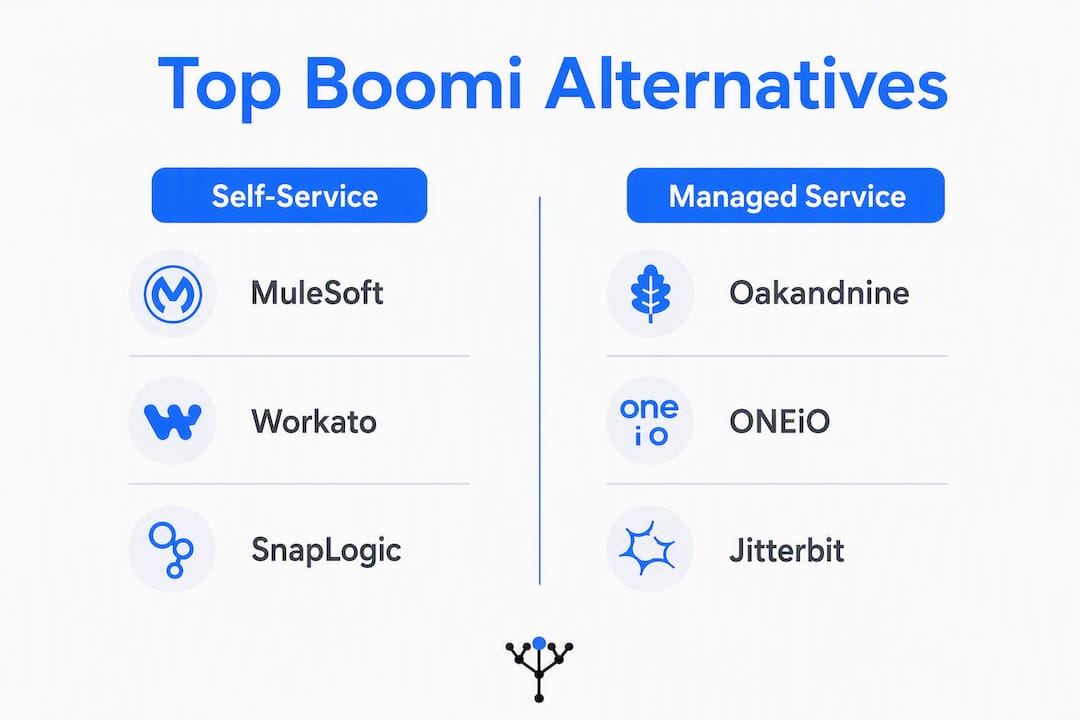
Two procurement cautions are worth flagging before you proceed. First, per-vCore pricing (MuleSoft) and per-task pricing (Workato) scale very differently and can produce budget surprises at volume; model your expected task or vCore consumption against three growth scenarios before signing. Second, marketing claims about security certifications are not evidence of controls — request SOC 2 Type II attestation reports and confirm UK or EU data residency in writing, particularly if you operate in financial services or healthcare.
Pro Tip: Ask each vendor for a cost-at-scale simulation: "Show me the monthly cost at 2x and 5x our current integration volume." Vendors who cannot produce this quickly are signalling that their pricing model is opaque by design.
How do you choose the right Boomi alternative for your team?
Start with operational model, not features
Choose a managed service if you cannot staff three or more integration engineers post-go-live. Larger deployments commonly need 3–10 dedicated integration engineers to design, monitor, and maintain pipelines on a self-service iPaaS. For most mid-market UK teams, that headcount is simply not available. Managed services and outcome-focused platforms absorb that burden by design.
Match the platform to your architectural direction
Evaluate alternatives against your strategic architecture, not as a feature-for-feature Boomi swap. An API-first strategy points toward MuleSoft or SnapLogic. Business-led automation with citizen developers points toward Workato or Celigo. A data-centric analytics direction points toward Talend or Matillion — though it is worth noting that ETL/ELT platforms and iPaaS are not interchangeable; conflating them creates architectural friction that surfaces during migration. For system integration software decisions in UK businesses, this architectural alignment step is the one most teams skip and later regret.
Key criteria for mid-market UK buyers
- Deployment model fit: does the platform support your hybrid or on-prem requirements, or is it cloud-only?
- API governance and lifecycle: does it include a developer portal, policy enforcement, and versioning, or does that require a separate tool?
- Connector breadth: does it cover your SaaS estate, on-prem systems, and any B2B/EDI requirements without expensive add-ons?
- Event-driven and real-time requirements: can it handle streaming and near-real-time triggers, or is it batch-oriented?
- Data residency and UK/EU compliance: can the vendor confirm in writing that data stays within UK or EU boundaries?
- Pricing predictability: which consumption metric drives cost, and what happens to that cost when volume doubles?
- Partner ecosystem and professional services: is there a UK-based SI partner or managed service option if your team needs support?
Procurement questions to ask on vendor calls
- What is the pricing model, and which consumption metric drives cost at scale?
- Can you provide a cost-at-scale simulation for 2x and 5x our current volume?
- What SLAs govern incident detection, response, and resolution — and what are the remedies for breach?
- How are platform upgrades and breaking changes communicated and managed?
- Do you support hybrid or on-prem deployment, and what is the operational model for that?
- Where is our data processed and stored — can you confirm UK or EU data residency in writing?
- What monitoring and alerting tooling is included, and what requires additional licensing?
- What does post-deployment support look like — is there a dedicated customer success resource?
Red flags that justify walking away
- SLA language that excludes "planned maintenance" windows without a defined cap.
- Scaling charges tied to metrics the vendor controls unilaterally (connector counts, message sizes).
- No self-service audit log or traceability for regulated data flows.
- Professional services quoted as the only path to production for standard use cases.
- Inability to provide a reference customer in your sector operating in the UK.
Pro Tip: Run a shadow pilot alongside your current Boomi environment for at least four weeks before cutover. Measure mean time to detect and mean time to resolve on the candidate platform under real load — not demo conditions. This single step surfaces operational burden more accurately than any vendor reference call.
Detailed vendor profiles: who should you actually pick?
MuleSoft Anypoint
MuleSoft is the market reference for API-led connectivity and remains the default choice for enterprises building a formal API governance layer. Its Anypoint Exchange, API Manager, and runtime fabric give architecture teams genuine lifecycle control. The trade-off is cost and complexity: per-vCore pricing scales steeply, and the platform expects a capable internal team. Peer comparisons consistently position MuleSoft as the enterprise API governance benchmark.

Strengths: API governance depth, Salesforce ecosystem alignment, hybrid and on-prem runtime support. Limitations: High TCO, steep learning curve, per-vCore model creates budget risk at scale. Pricing model: Per vCore; complex licensing tiers. UK availability: Yes; EU/UK data residency options available. When to pick: You have a Salesforce-heavy stack, a dedicated integration team, and API governance is a board-level requirement.
Workato
Workato's recipe-based automation model is genuinely accessible to non-technical teams, which is its defining advantage. Business-led automation and citizen developer usability are where Workato consistently outscores more developer-oriented platforms. The per-task pricing model rewards efficiency but can surprise teams running high-frequency, low-value automations. For business process automation decisions in mid-market teams, Workato is often the fastest path to value.
Strengths: Citizen developer accessibility, strong SaaS connector library, serverless infrastructure. Limitations: Per-task costs escalate with volume; lighter on B2B/EDI and on-prem connectivity. Pricing model: Per task / recipe; consumption-based. UK availability: Yes; EU data residency available. When to pick: Your operations or finance team needs to own automations without developer dependency.
Informatica IDMC
Informatica's Intelligent Data Management Cloud is the right choice when data governance, master data management, and data quality are the primary drivers — not application integration. Its IPU-based pricing is more predictable than task-based models, but the platform demands technical configuration expertise. Organisations in regulated UK sectors (financial services, healthcare) will find its compliance tooling and lineage capabilities genuinely useful.
Strengths: MDM depth, data quality and lineage, broad connector library. Limitations: Complex configuration; higher TCO for pure application integration use cases. Pricing model: Subscription (IPU-based). UK availability: Yes; UK/EU data residency confirmed. When to pick: Data governance and master data management are as important as application connectivity.
SnapLogic
SnapLogic's Iris AI assistant lowers the barrier for pipeline building, and its hybrid deployment model suits organisations with a mix of cloud and on-prem systems. Pipeline capacity pricing is more predictable than per-task models for high-volume scenarios. Mid-to-large enterprises with complex data pipelines and moderate internal capability tend to get the most from it.
Strengths: Hybrid deployment, AI-assisted pipeline building, strong throughput. Limitations: Less suited to pure citizen developer scenarios; partner ecosystem smaller than MuleSoft. Pricing model: Subscription (pipeline capacity). UK availability: Yes; EU data residency available. When to pick: You need hybrid deployment with strong pipeline throughput and moderate internal engineering resource.
Celigo
Celigo's pre-built integration applications for NetSuite, Salesforce, and Shopify make it the fastest path to production for SaaS-heavy mid-market stacks. Its per-connector pricing model is transparent for predictable SaaS estates but can become expensive as the connector count grows. UK mid-market teams running NetSuite as their ERP will find Celigo's native depth hard to match.
Strengths: Pre-built SaaS integrations, NetSuite depth, accessible low-code interface. Limitations: Per-connector costs accumulate; lighter on B2B/EDI and on-prem. Pricing model: Per connector / subscription tiers. UK availability: Yes; EU data residency available. When to pick: NetSuite or Salesforce is your ERP/CRM core and you want pre-built integrations rather than custom builds.
Jitterbit
Jitterbit occupies a pragmatic middle ground: capable ERP and CRM connector depth, a low-code Studio, and subscription pricing that is generally more accessible than MuleSoft or Informatica. It suits mid-market teams that need solid integration capability without enterprise-level complexity or cost.
Strengths: ERP/CRM connector depth, accessible pricing, low-code Studio. Limitations: Smaller partner ecosystem; less suited to complex API governance requirements. Pricing model: Subscription (tiered). UK availability: Yes; EU data residency available. When to pick: You need reliable ERP/CRM integration at a mid-market price point without heavy internal engineering.
Talend Data Fabric
Talend (now part of Qlik) is optimised for analytics pipelines, data quality, and ETL/ELT operations. It is not an iPaaS substitute for real-time application integration. Teams that conflate the two categories will find Talend's strengths misaligned with their operational needs. Where it excels is in bulk data transformation, lineage, and governance for analytics-led organisations.
Strengths: Data quality, lineage, ETL/ELT depth, governance tooling. Limitations: Not designed for real-time app-to-app integration; Qlik acquisition adds transition uncertainty. Pricing model: Subscription. UK availability: Yes; EU data residency available. When to pick: Your primary need is analytics pipeline quality and data governance, not application connectivity.
SAP Integration Suite
SAP Integration Suite is the natural choice for SAP-centric landscapes. Its native connectivity to SAP S/4HANA, SuccessFactors, and Ariba, combined with the BTP ecosystem, gives SAP shops a coherent integration layer. Outside the SAP estate, its value proposition weakens considerably, and it requires SAP expertise to configure and maintain.
Strengths: SAP-native connectivity, BTP ecosystem alignment, enterprise support. Limitations: Requires SAP expertise; less compelling outside the SAP estate. Pricing model: Subscription (message-based). UK availability: Yes; EU/UK data centres available. When to pick: SAP is your core ERP and you want native integration without third-party middleware.
Matillion
Matillion is a cloud data warehouse ELT tool, not an iPaaS. Its visual ELT designer and deep Snowflake, BigQuery, and Redshift connectors make it excellent for analytics engineering teams. Positioning it as a Boomi replacement for application integration is a category error that will surface quickly in a pilot.
Strengths: Visual ELT, cloud warehouse depth, Snowflake partnership. Limitations: Not designed for application-to-application integration or real-time process orchestration. Pricing model: Subscription (credit-based). UK availability: Yes; EU data residency available. When to pick: Your primary need is ELT for a cloud data warehouse, not application integration.
ONEiO
ONEiO takes a fundamentally different approach: it designs, runs, monitors, and maintains integrations end-to-end with flexible subscriptions and 24/7 operations. For IT service management teams that want SLA-backed integration without building internal capability, it removes the operational burden entirely. The trade-off is less customisation flexibility than a self-service platform.
Strengths: Fully managed operations, SLA-backed, ITSM-focused, no internal build overhead. Limitations: Less flexible for bespoke integration architectures; narrower connector breadth than enterprise iPaaS. Pricing model: Managed subscription. UK availability: Yes; EU data residency available. When to pick: You want integration operations handled end-to-end with contractual SLAs and no internal engineering overhead.
Why Oakandnine is a practical alternative for UK mid-market teams
Choose Oakandnine when your organisation needs more than a connector platform. Specifically, when you have limited internal integration headcount, when operational outcomes (margin growth, process efficiency, asset utilisation) matter as much as technical connectivity, and when you need a combined SaaS and consulting delivery model rather than a tool you must staff and run yourself.

Oakandnine's core capability is a live organisational model that connects people, processes, and technology, then applies AI to surface friction points, bottlenecks, and efficiency gaps in real time. Where a standard iPaaS connects systems, Oakandnine connects systems and tells you what the data flowing between them means for your operating model. That distinction matters for mid-market teams whose integration investment needs to produce measurable business outcomes, not just technical uptime.
When to pick Oakandnine:
- Your team cannot dedicate three or more engineers to integration operations.
- You need data unification, process bottleneck detection, and operational insight alongside connectivity.
- Your leadership team measures success in margin improvement and employee effectiveness, not connector counts.
- You want a managed consulting engagement with defined deliverables rather than a self-service platform licence.
- UK data residency and compliance posture are requirements; confirm specifics at oakandnine.com.
Pro Tip: When evaluating Oakandnine alongside self-service iPaaS options, ask both vendors to define what "operational success" looks like at 12 months. A platform vendor will describe uptime and connector counts. Oakandnine should describe measurable business outcomes. That difference in framing tells you which model fits your organisation's actual goals.
For teams exploring AI workflow automation as part of a broader operational transformation, Oakandnine's AI-augmented consulting model offers a materially different engagement than a standard iPaaS licence.
Migration and pilot checklist: what to test before you switch
Pilot before you migrate. Specifically, test connector parity, data fidelity under load, error handling, and monitoring coverage before any cutover decision.
A five-step evaluation process reduces migration risk: audit your current integration footprint, define your architectural direction, set non-negotiables, shortlist, and run a structured pilot. This approach surfaces the roughly 20% of flows that carry 80% of business risk and gives you a realistic migration estimate before you commit.
Pilot checklist
- Connector parity: confirm every source and target system in your current Boomi environment has a supported connector on the candidate platform.
- Data fidelity and transformations: run representative data volumes through equivalent transformation logic and validate output accuracy.
- Error handling and retries: deliberately trigger failures and confirm the platform's retry logic, dead-letter handling, and alerting behave as documented.
- Latency under load: test throughput at 2x your typical peak volume; do not test only at average load.
- Monitoring and audit trails: confirm you can produce a complete audit trail for any regulated data flow without custom development.
- Security controls: validate that data residency, encryption in transit and at rest, and access controls meet your requirements in writing.
- ITSM integration and runbooks: confirm the platform integrates with your incident management tooling and that runbooks can be documented and tested.
- Cutover plan: define the rollback procedure before you start the pilot, not after.
For system integration testing best practices during a migration pilot, a structured QA approach significantly reduces post-cutover incidents.
KPIs to measure during the pilot
- Mean time to detect (MTTD) for integration failures.
- Mean time to resolve (MTTR) for integration incidents.
- Data loss incidents per 1,000 transactions.
- Throughput at peak load versus SLA commitment.
- Cost per integration at current and projected volume.
Indicative phased migration timeline
- Optimisation — (weeks 21–26): decommission Boomi, tune monitoring, and review cost-per-integration against original estimates.
Hidden costs to budget for
- Rework on complex transformations that do not map cleanly to the new platform's data model.
- Partner or SI migration fees if your current Boomi environment was built by a third party.
- Training and change management for teams taking on new operational responsibilities.
- Ongoing ops headcount if you are moving to a self-service platform without a managed service wrapper.
The "integration tax" — staff, runbook maintenance, monitoring, and incidental migration rework — often represents a material portion of platform TCO over a three-year period. Budget for it explicitly rather than discovering it in year two.
Key takeaways
For UK mid-market teams, the decisive variable is not which platform has the most connectors. It is whether you have the operational model to run a self-service iPaaS or whether a managed, outcome-focused alternative will deliver more value at lower total cost.
- Operational model first: if you cannot staff three or more integration engineers, managed services and outcome-focused platforms should lead your shortlist.
- Match architecture to platform category: API governance points to MuleSoft; citizen developer automation points to Workato; ELT/analytics points to Talend or Matillion (not an iPaaS substitute).
- Pricing model risk: per-vCore (MuleSoft) and per-task (Workato) models scale very differently; model cost at 2x and 5x volume before signing.
- UK compliance is a written requirement: request SOC 2 Type II attestations and confirm data residency in writing; marketing statements are not evidence of controls.
- Oakandnine suits mid-market teams that need combined integration, AI-driven process optimisation, and managed consulting outcomes rather than a self-service platform licence.
Pro Tip: Before signing any long-term integration platform contract, run a four-week shadow pilot under real load and measure MTTD and MTTR. Operational burden is invisible in demos and only visible under production conditions.
| Point | Details |
|---|---|
| Managed vs self-service | Teams without three or more integration engineers should prioritise managed services over self-service iPaaS. Larger deployments usually require between 3 and 10 dedicated integration engineers to manage a self-service iPaaS. |
| Architecture alignment | Match platform category to strategic direction: API governance, citizen automation, or data/ELT are distinct categories. |
| Pricing model risk | Model per-vCore and per-task costs at 2x and 5x volume before committing to avoid budget surprises. |
| UK compliance evidence | Require written SOC 2 Type II attestations and confirmed data residency; do not accept marketing claims as proof. |
| Oakandnine fit | Oakandnine suits mid-market teams needing AI-driven operational outcomes and managed consulting alongside connectivity. |
The integration platform decision most teams get wrong
Most teams approach a Boomi replacement as a feature-matching exercise. They build a spreadsheet of connectors, compare pricing tiers, and choose the platform that scores highest on a weighted criteria model. Then, six months post-go-live, they discover the real cost: the operational burden they did not model, the transformations that required rework, and the monitoring gap that turned a minor incident into a major outage.
The platforms on this shortlist are genuinely capable. MuleSoft's API governance is best-in-class for enterprises that can staff it. Workato's citizen developer model is the fastest path to business-led automation I have seen at mid-market scale. ONEiO's fully managed approach removes operational risk in a way that no self-service platform can replicate by design.
But the question I would push every procurement team to answer before shortlisting is this: what does operational success look like at 12 months, and who in your organisation owns it? A platform licence transfers capability to your team. A managed service transfers accountability to the vendor. Those are fundamentally different commercial and operational commitments, and conflating them is the single most common source of post-implementation regret.
For mid-market UK teams with limited integration headcount and a mandate to improve operational efficiency, the honest answer is often that a managed, outcome-focused model delivers more measurable value than a self-service platform that requires three engineers to run well. That is not a criticism of the platforms. It is a statement about organisational fit.
Oakandnine: outcomes-led integration for mid-market teams
Mid-market teams that have evaluated the self-service iPaaS options on this shortlist often reach the same conclusion: the platform is capable, but the operational model required to run it is not one they can sustain. Oakandnine is built for exactly that situation.
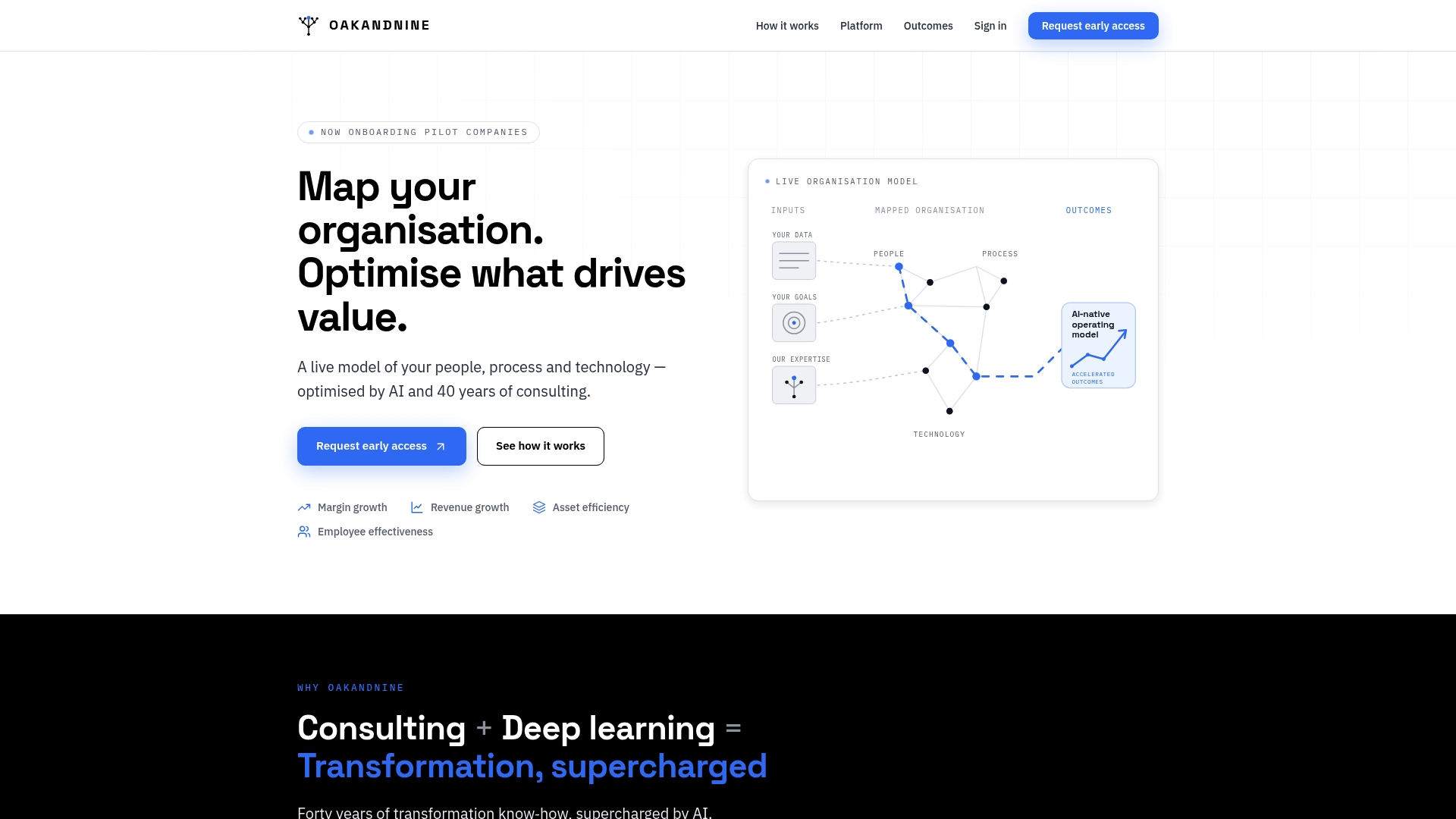
Where a standard iPaaS gives you the tools to build and run integrations, Oakandnine delivers the outcomes: a live organisational model that connects your systems, surfaces process bottlenecks, and applies AI to identify where efficiency and margin are being lost. The engagement model combines SaaS platform access with consulting delivery, so your team gets defined deliverables rather than a licence and a getting-started guide.
A typical engagement begins with a discovery session to map your current integration footprint and operational model, moves into a structured pilot with defined KPIs, and concludes with an outcomes review against the metrics that matter to your leadership team. No three-engineer internal team required.
To book a discovery session or request pilot details, visit oakandnine.com.
Useful sources for procurement and technical teams
The sources below are selected for practical value in vendor evaluation and RFP preparation, not for marketing coverage.
Recommended reading order for procurement teams: start with the Gartner Peer Insights alternatives page for peer-validated shortlists, then the Viewpoint Analysis five-step evaluation framework, then the pricing model comparison from Digital Software Reviews.
Recommended reading order for technical teams: start with the integrate.io alternatives overview for category distinctions (iPaaS vs ETL), then the ONEiO managed service comparison for operational model clarity, then the Smartbridge MuleSoft vs Boomi comparison for API governance depth.
| Source | What it helps you do |
|---|---|
| Gartner Peer Insights: Boomi Enterprise Platform Alternatives | Peer-validated shortlists from verified enterprise buyers; useful for benchmarking your shortlist against real purchasing decisions. |
| Gartner Peer Insights: Data Integration Tools — Boomi Alternatives | Identifies data integration tool alternatives (Matillion, Fivetran, Workato) for analytics-led buyers; clarifies category boundaries. |
| Viewpoint Analysis: Boomi Alternatives 2026 | Five-step evaluation framework; use to structure your audit, shortlist, and pilot process. |
| Digital Software Reviews: Dell Boomi Competitors 2026 | Pricing model comparison and architectural direction mapping; use to model cost-at-scale scenarios. |
| integrate.io: Top 10 Boomi Alternatives | Category distinctions between iPaaS and ETL/ELT; use to avoid conflating Matillion/Talend with application integration platforms. |
| ONEiO: Top Boomi Alternatives for Effortless Service Integration | Managed service vs self-service comparison; use to evaluate operational burden and SLA-backed options. |
| ONEiO: What is Boomi? Key Features, Challenges and Top Alternatives | Quantifies the integration tax and engineering headcount requirements; use to build the operational burden case for your leadership team. |
| Smartbridge: Boomi vs MuleSoft Enterprise Integration Comparison | API governance depth comparison; use when evaluating MuleSoft for API-first architectural requirements. |
| PeerSpot: Top 10 Boomi iPaaS Alternatives 2026 | Peer and review site data on the most commonly considered enterprise alternatives; use to validate your shortlist against real buyer behaviour. |