
Process mining answers where your process breaks. Task mining answers how your people execute a specific task. That single distinction shapes every pilot decision, every data conversation, and every automation business case you will build. For most organisations, the right starting point is process mining: extract your event logs, reconstruct the end-to-end flow, and locate the high-impact hotspots. Then apply task mining selectively to the tasks that sit inside those hotspots, where execution variation is costing you time or quality. The combined approach avoids the trap of fixing the wrong issue in detail while the real bottleneck goes unexamined. UK organisations also need to factor in ICO guidance and GDPR obligations from the outset, particularly when task mining involves desktop monitoring. Oakandnine's platform is built to support exactly this sequence, connecting structured event data with real-time organisational insight.
Key takeaways
Process mining locates where a process breaks by analysing system event logs; task mining explains how users execute the tasks inside those breaks, and the two techniques produce their highest value when used in sequence.
| Point | Details |
|---|---|
| Start with process mining | Use event logs (case ID, activity, timestamp) to locate bottlenecks before committing to desktop monitoring. |
| Task mining fills the execution gap | Deploy desktop agents only for tasks where the system log cannot explain the cause of delay or variation. |
| Data preparation determines success | Case stitching, filtering, and scoping by question matter more than tool selection for either technique. |
| UK GDPR applies to task mining | Complete a DPIA and employee communications before deploying desktop agents; process mining carries lower but non-zero privacy risk. |
| Oakandnine connects both layers | The platform unifies structured event data and organisational context, compressing time-to-insight for mid-market UK teams. |
Table of Contents
- What process mining is and what it produces for your operations team
- What task mining is and how it captures user-level execution
- How the two techniques compare across the dimensions that matter
- When to use each technique: UK-focused use cases and examples
- What your data team must prepare before the pilot begins
- How process mining and task mining work together in practice
- Privacy, employee monitoring and compliance for UK organisations
- How to decide which technique to pilot first
- How Oakandnine approaches combining process and task visibility
- The pitfall most teams do not see coming
- Oakandnine helps you move from data to decisions faster
- Sources
What process mining is and what it produces for your operations team
Process mining reconstructs end-to-end process flows from the digital traces your systems already generate. Every time a case moves through your ERP, CRM, ticketing platform, or workflow engine, it leaves a record. Process mining reads those records and builds an objective model of how your process actually runs, not how it was designed to run.
The minimum data requirement is straightforward: each event needs a case identifier, an activity label, and a timestamp. The case ID ties all events belonging to one instance together (one invoice, one claim, one order). The activity label names what happened. The timestamp places it in sequence. From those three fields, algorithms can reconstruct every path a case has taken, measure cycle times, detect deviations from a reference model, and rank variants by frequency and cost.
The XES standard (eXtensible Event Stream) is the established interchange format for event logs, designed to be simple, flexible, and extensible across tools and application domains. Most enterprise process-mining tools accept XES natively, and many also accept CSV mappings where you define which column carries the case ID, activity, and timestamp.
Concrete outputs your team will work with:
- Process discovery model: a visualised map of all observed paths, showing frequency and duration per route
- Variant frequency table: a ranked list of all process variants, from the happy path to rare edge cases, with case counts and average cycle times
- Conformance report: a comparison of actual behaviour against a target or reference model, flagging deviations and their business impact
- Bottleneck and throughput analysis: waiting-time breakdowns between activities, identifying where cases queue and for how long
- Performance KPI dashboard: cycle time, throughput rate, rework rate, and SLA compliance, updated as new event data arrives
Microsoft's Power Automate documentation frames process mining as a system-level capability, distinct from the desktop-level detail that task mining provides. That framing is useful: process mining gives you the map of the territory; task mining gives you the street-level view of one junction.
What task mining is and how it captures user-level execution
Task mining operates at the level of the individual user. Rather than reading system logs, it captures what happens on a person's screen: mouse clicks, keystrokes, application switches, form entries, and the sequence of windows a user moves through to complete a task. The result is a granular record of how a specific piece of work is actually performed, step by step, across a sample of users or roles.
IBM describes task mining as a technique that captures desktop interactions to identify automation candidates and execution variants. That dual output is the core value proposition: you learn both what steps exist and how much they vary across individuals doing nominally the same job.
Typical outputs from a task mining exercise:
- Step-by-step task maps: a visual sequence of every UI action required to complete a task, with branching where users take different routes
- User and role variants: a comparison of how different people or teams execute the same task, revealing unofficial workarounds and skill gaps
- Task duration distributions: time-on-task measurements per step and per user, showing where effort concentrates
- Automation candidate list: steps that are repetitive, rule-based, and UI-driven, ranked by frequency and time cost, ready to feed into an RPA or workflow-automation design
Task mining is most valuable for manual, UI-driven, high-effort tasks: data entry across multiple systems, month-end reconciliations, helpdesk ticket handling, or any process where the system log shows a long dwell time but cannot explain why. Those are the moments where a desktop agent reveals what the event log cannot.
One critical design consideration: the quality of a task-mining dataset depends heavily on which users you monitor. Sampling design and role-based coverage are critical to creating representative task models. Monitor only your fastest users and you will design automation that most of your team cannot replicate.
How the two techniques compare across the dimensions that matter
Process mining and task mining are complementary, not competing. Microsoft positions them explicitly as system-level and desktop-level capabilities that address different discovery questions. The table below sets out the key differences across the dimensions operations leaders use to make pilot decisions.
| Dimension | Process mining | Task mining |
|---|---|---|
| Scope | End-to-end process across systems | Individual task at user/desktop level |
| Primary data source | System event logs (ERP, CRM, ticketing) | Desktop agents, screen recordings, UI logs |
| Required data fields | Case ID, activity label, timestamp | User session ID, application, action, timestamp |
| Typical outputs | Process maps, variants, conformance reports, KPIs | Step maps, user variants, automation candidates |
| Common use cases | Bottleneck detection, compliance, cycle-time analysis | Automation design, standardisation, training |
| Implementation effort | Data engineering heavy (extraction, case stitching) | Agent deployment, user consent, sampling design |
| Privacy risk | Lower (system logs, usually aggregated) | Higher (individual behaviour, potential PII) |
Strengths of process mining:
- Covers the full process lifecycle without requiring user consent for monitoring
- Scales across millions of cases from existing system data
- Produces objective, auditable evidence of process performance
- Directly supports regulatory reporting and compliance checks
Limitations of process mining:
- Cannot explain why a step takes long if the cause is human behaviour rather than system latency
- Requires clean, correlated event logs with stable case IDs, which many legacy systems do not produce natively
- Misses off-system activity (phone calls, paper steps, manual workarounds)
Strengths of task mining:
- Reveals the execution detail that system logs cannot capture
- Directly identifies which steps are automatable and how complex the automation needs to be
- Surfaces unofficial workarounds and training gaps
Limitations of task mining:
- Carries significant privacy and employee-monitoring obligations under UK GDPR
- Results are only as representative as the user sample selected
- Generates large volumes of raw interaction data that require careful preprocessing
Pro Tip: Before committing to task mining, run a process-mining pilot first. If your event logs already explain the bottleneck (a system handoff delay, a queue build-up between two activities), task mining adds cost and monitoring risk without proportionate insight. Reserve desktop-level capture for tasks where the system log shows a gap it cannot explain.
When to use each technique: UK-focused use cases and examples
The choice between process mining and task mining usually comes down to where the unknown sits. If you do not know which part of the process to fix, start with process mining. If you know the task but not the execution detail, task mining is the right instrument.
Process mining use cases:
- Order-to-cash (O2C): Identify where invoices stall, which approval steps generate rework, and which customer segments drive the longest cycle times. A UK financial-services back office running SAP can extract an event log from its accounts-receivable module and have a discovery model within days.
- Procure-to-pay (P2P): Map the full purchase-order lifecycle, detect maverick buying (purchases that bypass the approved workflow), and quantify the cost of late-payment penalties.
- Insurance claims handling: Reconstruct the claims journey from first notification of loss to settlement, identify which claim types generate the most manual touchpoints, and build a conformance check against FCA-regulated handling timelines.
- Regulatory reporting: Validate that data flows through the correct sequence of controls before submission, producing an auditable trail for internal audit or external review.
Task mining use cases:
- Data entry and reconciliation: A UK insurer's claims team manually re-keys data between a legacy claims system and a modern CRM. Task mining maps every click, reveals that three different users follow three different sequences, and identifies which sequence is fastest and most error-free.
- Helpdesk ticket handling: A logistics operator's IT helpdesk resolves the same category of ticket in wildly different times. Task mining shows that senior agents use a keyboard shortcut that junior agents do not know exists, cutting resolution time by a measurable margin.
- Multi-application lookups: A bank's back-office team switches between five applications to verify a single customer record. Task mining documents the full sequence, enabling an RPA bot to replicate the fastest path.
The sequencing matters. Task mining then explains the execution detail inside that hotspot (agents are manually copying data between two systems because the integration was never built). That sequence avoids spending analyst time and monitoring budget on tasks that are not the real problem.
Cost and resource implications vary by approach. Process mining requires a data engineer to extract and correlate event logs, typically one to three weeks of effort for a well-structured ERP. Task mining requires deploying desktop agents to a sample of users, obtaining consent, and then processing interaction data, which can add two to four weeks depending on the size of the sample and the complexity of the task. For operational efficiency programmes with limited analyst capacity, sequencing process mining first concentrates task-mining effort where it will produce the highest return.
What your data team must prepare before the pilot begins
Data preparation is where most process-mining projects either succeed or stall. Extraction and scoping drive value; the choice of tool is secondary.
Minimum event-log fields for process mining:
- Case ID: a stable, unique identifier that ties all events for one process instance together (order number, claim reference, ticket ID)
- Activity label: a human-readable name for what happened at each step
- Timestamp: the date and time the event occurred, in a consistent format and timezone
Without a stable case ID, you cannot build a usable event log. This is the 'case notion' problem: when a case ID does not exist natively in the source system, you must stitch events together using correlation logic, which is time-consuming and introduces the risk of misattribution. Many legacy ERP and CRM systems store process data across multiple tables with no single case reference, making this the most common blocker in UK mid-market deployments.
Task mining data requirements:
- Desktop agent installed on a representative sample of user machines
- User session identifiers to separate one person's activity from another's
- Application and window titles to contextualise each action
- Action type (click, keystroke, copy-paste, form submission) and timestamp
Preprocessing steps for process mining (following the PM² methodology):
- Extraction: pull raw event data from source systems, scoped to the process and time period in question
- Correlation: assign or construct case IDs to tie events into process instances
- Filtering: remove noise (test cases, system-generated events, outlier cases outside the scope)
- Abstraction: map low-level system events to meaningful activity labels
- Enrichment: add attributes (cost, resource, outcome) that support performance analysis
A critical point from the academic literature: many process-mining algorithms treat the event log as the whole truth. If your log is incomplete or biased, the discovery model will reflect those flaws without flagging them. Data-quality annotations and explicit quality checks are not optional extras; they are the difference between a model you can act on and one that misleads.
Common pitfalls and practical fixes:
- Missing case IDs: work with the source-system owner to identify a surrogate key, or build a correlation rule using timestamp proximity and resource attributes
- Noisy logs: filter out system-generated heartbeat events and test transactions before analysis
- Mismatched timestamps: standardise to UTC and account for daylight saving time, particularly relevant for UK systems that straddle GMT and BST
- Over-collection of PII: define the minimum data fields needed before extraction; do not pull personal data speculatively
Pro Tip: Scope your extraction by the question you want to answer, not by what the system can export. Extraction driven by a specific question produces a cleaner, smaller log that is faster to analyse and easier to govern under UK GDPR.
How process mining and task mining work together in practice
The two techniques hand off to each other in a defined sequence. Treating them as a combined workflow rather than separate projects is what separates organisations that achieve measurable improvement from those that produce interesting reports and move on.
- Scope the process: define the start and end events, the case type, and the time window. Agree on the business question (cycle time, compliance, automation ROI) before touching any data.
- Extract and prepare event logs: work with IT and the source-system owner to pull the minimum required fields. Apply the preprocessing steps above.
- Run process mining discovery: generate the process map, variant table, and bottleneck analysis. Identify the top three to five hotspots by cycle-time impact or case volume.
- Prioritise hotspots for further investigation: for each hotspot, ask whether the cause is visible in the event log (a system delay, a queue) or invisible (a human behaviour, a workaround). Invisible causes are task-mining candidates.
- Select tasks for task mining: choose the specific tasks inside the identified hotspots. Define the user sample, obtain consent, and deploy desktop agents.
- Capture and analyse task data: process the interaction logs, build step maps and user-variant comparisons, and identify automation candidates.
- Design improvements or automation: for automatable steps, use the task-mining output to specify the RPA or workflow-automation design. For process-level issues, use the process-mining output to redesign the flow. Workflow automation tools can then be selected based on the specific task complexity revealed.
- Measure and iterate: track cycle time, error rate, and automation coverage against the baseline established in step 3. Feed new event data back into the process-mining model to confirm improvement.
The artefact that passes between steps 3 and 5 is the hotspot report: a ranked list of process segments with their cycle-time contribution and a hypothesis about the cause. That document is the brief for the task-mining team and the governance checkpoint for HR and legal sign-off on monitoring.
Combining the two techniques into a single process intelligence approach avoids local optimisation. Automating a task that sits outside the critical path produces no measurable process improvement, however elegant the bot. The process-mining map keeps the team honest about where the real work is.
Privacy, employee monitoring and compliance for UK organisations
Task mining is, by definition, an employee-monitoring technology. In the UK, that places it squarely within the scope of UK GDPR, the Data Protection Act 2018, and ICO guidance on workplace monitoring. Getting this wrong does not just create legal risk; it destroys the employee trust that makes change management possible.
Key legal and ethical obligations:
- Lawful basis: you need a lawful basis for processing employee interaction data. Legitimate interests is the most commonly used basis, but it requires a Legitimate Interests Assessment (LIA) that balances the organisation's need against the employee's right to privacy.
- Data Protection Impact Assessment (DPIA): where task mining involves systematic monitoring of employees, a DPIA is likely required under UK GDPR Article 35. Complete this before deployment, not after.
- Data minimisation: capture only the data fields necessary for the specific question. Screen recordings of full sessions are rarely justified; structured interaction logs (application, action type, timestamp) usually suffice.
- Retention limits: define how long interaction data will be held and delete it once the analysis is complete. Do not retain raw desktop logs indefinitely.
- Employee communications: inform employees clearly about what is being captured, why, and how the data will be used. The ICO's guidance on monitoring at work is the reference point for UK organisations.
- Opt-out and representation: consider involving trade union representatives or employee forums in the design of the monitoring programme, particularly in unionised environments.
Process mining carries lower privacy risk because it reads system logs rather than individual behaviour. Those logs still contain personal data in many cases (a case ID tied to a named employee, a resource attribute showing who performed each step), so data-minimisation principles apply. However, the monitoring dimension is absent, which means the legal and cultural friction is significantly lower.
Pro Tip: Run your task-mining user sample through HR and legal before you deploy agents. A representative sample of eight to twelve users per role is usually sufficient for diagnostic purposes and limits the monitoring footprint. Employee engagement during the project is directly correlated with how well the communications were handled at the outset.
How to decide which technique to pilot first
Use this checklist to make the decision. Work through it in order; the first question where you have a clear answer usually determines the right starting point.
Decision checklist:
- Do you know where the process problem is? If no, start with process mining. If yes, and the problem is a specific manual task, consider task mining directly.
- Do you have event logs with stable case IDs? If yes, process mining is feasible. If no, assess the effort to create them before committing to a process-mining pilot.
- Is the suspected cause of the problem a human behaviour or workaround? If yes, task mining will explain it. If the cause is a system delay or integration gap, process mining will surface it without desktop monitoring.
- What is the scale of the problem? Process mining scales to millions of cases from existing data. Task mining is most cost-effective for high-frequency, high-effort tasks performed by a defined user population.
- Are your stakeholders ready for employee monitoring? If HR and legal have not been briefed, task mining cannot start. Process mining can proceed with data engineering alone.
- What is the expected ROI? Process mining typically produces a faster first insight (days to weeks from clean event data). Task mining adds weeks of agent deployment and consent management but produces automation-ready specifications.
Pilot success metrics to track:
- Cycle time reduction (percentage improvement against baseline)
- Error or rework rate (cases requiring manual correction)
- Automation coverage (percentage of task steps automated post-pilot)
- Time saved per case or per user per day
- Conformance rate (percentage of cases following the target process path)
Resource checklist:
- Data engineer: event-log extraction, case stitching, preprocessing (process mining)
- Process analyst: discovery model interpretation, variant analysis, hotspot prioritisation
- Privacy lead: DPIA, LIA, employee communications (task mining)
- Desktop agent administrator: deployment, sampling design, data collection (task mining)
- Operations sponsor: scope definition, stakeholder alignment, change management
For process bottleneck identification, process mining is almost always the faster and lower-risk starting point. Task mining earns its cost when the bottleneck is confirmed and the execution detail is genuinely unknown.
How Oakandnine approaches combining process and task visibility
Oakandnine's platform is built on the premise that process visibility and organisational data belong in the same model. Separating them produces the same problem that separates process mining and task mining when used in isolation: you see either the system-level flow or the human-level execution, but not both in context.
The platform's integrated organisational model stitches structured event data (system logs, workflow records) with unstructured operational data (team structures, role assignments, asset utilisation) into a single live view. That means a bottleneck identified through process analysis can be immediately cross-referenced with the team responsible, the tools they use, and the workload they carry, without switching between four separate dashboards.
Oakandnine's consulting approach follows the same sequencing recommended throughout this guide:
- Start with scope and data readiness: assess whether event logs with stable case IDs exist before proposing a process-mining pilot
- Invest in data preparation: the platform's data unification layer handles much of the extraction and correlation work that typically consumes the first weeks of a process-mining engagement
- Pair process mining with targeted task mining: use process-mining outputs to define the task-mining scope, limiting desktop monitoring to the tasks where it will produce the highest diagnostic value
- Set clear governance from day one: privacy lead, DPIA, employee communications, and retention policy are defined before any data is collected
- Measure against a baseline: every pilot is scoped with defined success metrics so improvement is quantifiable, not anecdotal
For mid-market UK organisations that lack a dedicated process-excellence team, Oakandnine's combined platform and consulting model compresses the time from data to decision. The business process optimisation work that would typically require a specialist team and multiple tools is handled within a single, connected framework.
The pitfall most teams do not see coming
The most common failure in process and task mining projects is not a technology problem. It is a scoping problem dressed up as a data problem.
Teams spend weeks extracting event logs, only to discover that the case ID they assumed existed is actually a composite of three fields that do not always align. Or they deploy desktop agents, collect four weeks of interaction data, and then realise they monitored the wrong user population. Both failures trace back to the same root cause: the question was not defined precisely enough before the data work began.
The second failure mode is subtler. Organisations treat process mining and task mining as a one-time diagnostic exercise rather than a continuous feedback loop. They run a pilot, find a bottleneck, fix it, and move on. Six months later, the process has drifted again, and nobody notices because the event-log analysis was a project, not a capability. The organisations that extract sustained value are the ones that keep the process model live, feed new event data into it regularly, and use it to detect drift before it becomes a crisis.
The collaboration point that most teams underestimate is the HR and legal partnership. Operations leaders often treat the privacy and communications work as a compliance checkbox rather than a genuine enabler. In practice, the quality of employee engagement during a task-mining project determines whether the insights are acted on or quietly shelved. People who understand why they are being monitored, and who trust that the data will be used to improve their working conditions rather than to evaluate their performance, produce better data and support better outcomes.
Oakandnine helps you move from data to decisions faster
Mid-market organisations rarely lack process problems. What they lack is a connected view of where those problems sit, what is causing them, and which fix will produce the greatest return. Oakandnine gives operations and HR leaders exactly that: a live organisational model that unifies your process event data, team structures, and system integrations into a single framework, so you can run a process-mining pilot without months of data engineering groundwork.
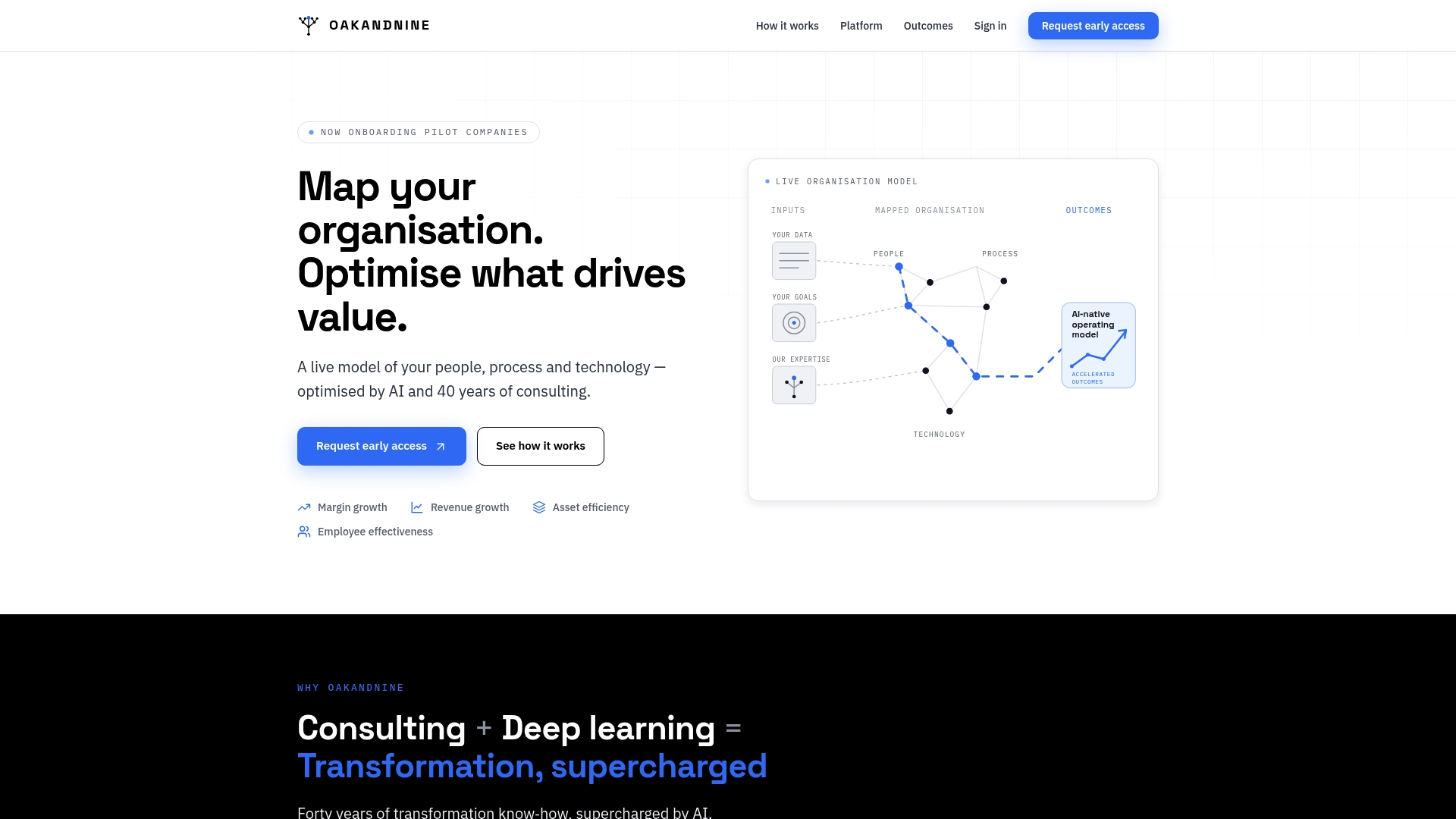
Whether you are preparing your first process-mining pilot or looking to add task-level visibility to an existing programme, Oakandnine's platform and consulting team can scope, run, and measure the engagement with you. The starting point is a scoping conversation: what process, what question, what data exists today. Talk to the Oakandnine team to book that conversation and get a clear view of where your process improvement effort should begin.
Sources
The references below are the canonical technical and vendor sources used to build this guide. Each is worth bookmarking before you begin a pilot.
- Event Data - Process Mining
- XES standard definition 2.0 (PDF)
- Overview of process mining and task mining in Power Automate
- What Is Task Mining? | IBM
- Extracting, filtering and cleaning event data (Springer chapter)
- Process Mining vs Task Mining: Key Differences for Enterprise AI Strategy