
An automation centre of excellence (CoE) is a governance and enablement operating model that centralises standards, decision rights, and accountability while enabling distributed delivery across business units. If you are standing one up, the three actions that matter most right now are: secure a named executive sponsor with cross-functional authority, define two or three measurable objectives tied to business outcomes, and choose your operating model before you hire a single developer.
- Secure executive sponsorship. Without it, the CoE stalls at the first cross-departmental conflict over prioritisation or budget.
- Define measurable objectives. Hours automated, error-rate reduction, and automation penetration are the three most common starting points.
- Choose an operating model. Central, federated, or hybrid: the decision shapes every hiring, governance, and tooling choice that follows.
The rest of this guide builds out each of those decisions in sequence, from definition through to a 90–180 day getting-started checklist.
Key takeaways
A federated automation centre of excellence with centralised standards and a named executive sponsor is the model most likely to scale successfully in a UK mid-market organisation.
| Point | Details |
|---|---|
| Executive sponsorship is non-negotiable | A named C-level sponsor with cross-functional authority is the single factor most consistently linked to CoE success and ROI. |
| Federated model scales; central model bottlenecks | Centralise standards and governance; distribute delivery to business units to sustain throughput as the pipeline grows. |
| 73% of RPA-deploying firms use a CoE framework | Trexin's analysis confirms CoE adoption is the norm, not the exception, among organisations scaling automation. |
| Governance must be embedded, not bolted on | Platform guardrails and automated design reviews enforce standards faster and with less friction than manual approval gates. |
| Oakandnine accelerates CoE delivery | The platform's live org mapping and process discovery capability reduces the time from CoE formation to governed production automation. |
Table of Contents
- What is an automation centre of excellence, and how does an RPA CoE differ from an intelligent automation CoE?
- Why do organisations build a CoE, and what measurable benefits can you expect?
- When is the right time to create a CoE?
- What roles and team structure does a CoE need, and how should decision rights work?
- What governance, policies, and standards must the CoE own?
- How does the CoE select processes and manage the delivery lifecycle?
- What technology and architecture decisions does the CoE need to get right?
- How do you build the skills and change management capability to sustain automation?
- Which KPIs and reporting cadences should the CoE use to demonstrate ROI?
- What does a CoE maturity model look like, and what should you budget?
- What are the most common CoE mistakes, and how do you avoid them?
- Your 90–180 day getting-started checklist
- What the federated model actually costs you in speed, and why it is still worth it
- Oakandnine gives your CoE a live operational foundation to build on
- Sources
What is an automation centre of excellence, and how does an RPA CoE differ from an intelligent automation CoE?
An automation CoE is a small, authoritative team that sets standards, provides consulting to delivery teams, and monitors automation performance across the organisation. Red Hat describes CoEs as the primary source of knowledge and best practice, and notes that many organisations pair a formal CoE with a community of practice to drive adoption beyond the core team.
The naming choice matters more than it might appear. An RPA CoE focuses on rules-based bots: process capture, bot development, scheduling, and incident management within a single RPA platform. Governance is relatively contained because the technology surface is narrow. An intelligent automation CoE (sometimes called a hyperautomation CoE) extends that scope to include process mining, intelligent document processing (IDP), AI/ML services, and orchestration layers that connect multiple tools. Governance becomes considerably more complex because you are now managing data contracts, model drift, and multi-vendor licensing alongside bot uptime.
A practical rule: call it an RPA CoE when your portfolio is predominantly rules-based bots on one or two platforms. Rename it an automation or intelligent automation CoE when process mining, IDP, or AI agents enter the stack, because the governance model, the roles required, and the risk profile all change materially at that point.
Why do organisations build a CoE, and what measurable benefits can you expect?
The core value proposition is faster, safer delivery at scale. A well-governed CoE reduces duplicated effort, prevents rogue automation that creates operational debt, and gives the business a single point of accountability for automation quality and ROI.
Trexin's analysis finds that roughly 73% of organisations deploying RPA use a CoE or similar framework to plan, manage, and track automation initiatives. The analysis projects substantial growth of the RPA market between 2022 and 2029, which signals that the CoE model is not a passing governance fashion.
The benefits decision-makers most frequently cite:
- Cost and capacity release. Automating high-volume, rules-based processes frees staff for judgement-intensive work, reducing overtime and agency spend.
- Error reduction and compliance. Bots execute processes identically every time; audit trails are automatic, which matters particularly in regulated UK sectors such as financial services and healthcare.
- Faster delivery. A CoE with a mature pipeline and reusable components delivers new automations significantly faster than ad-hoc project teams starting from scratch each time.
- Higher ROI on tooling. Centralised licence management and shared infrastructure prevent the duplication that erodes returns when business units procure automation tools independently.
- Improved customer experience. Faster back-office processing reduces customer-facing cycle times in areas such as onboarding, claims, and order fulfilment.
Benchmark expectation: mature CoEs typically report automation penetration rates well above initial pilots, with InfoSeeMedia's practitioner case studies confirming that visible executive sponsorship is the single factor most consistently associated with higher ROI outcomes.
For a broader view of how automation connects to operational efficiency, the link between CoE maturity and margin improvement is direct and measurable.
When is the right time to create a CoE?
Form a CoE when you have enough automation demand to justify shared governance, but before ungoverned pilots create technical and operational debt that is expensive to unwind.
Readiness checklist:
- You have three or more automation initiatives in flight or in the pipeline simultaneously.
- At least one process has moved to production and is running in a monitored environment.
- A named executive sponsor is willing to chair a steering group and resolve cross-functional disputes.
- Basic monitoring exists: you know when a bot fails and who is responsible for fixing it.
- There is organisational appetite to standardise development practices rather than letting each team choose its own approach.
When to delay: if you have only one or two pilots and no executive sponsor, standing up a formal CoE adds overhead without adding value. Fix the sponsorship gap first. A CoE without authority is just a committee.
What roles and team structure does a CoE need, and how should decision rights work?
The CoE lead and the executive sponsor must be visibly accountable from day one. Without that pairing, every governance decision becomes a negotiation rather than a policy.
Core roles at scale (drawing on Trexin's role framework):
- Head of CoE / CoE Lead: owns strategy, governance, and stakeholder relationships.
- Solution architect: designs the technical architecture and integration patterns.
- Automation developers: build, test, and maintain automations.
- Controllers / quality leads: enforce standards, conduct code reviews, and manage production approvals.
- Operations / run team: monitors production bots, manages incidents, and handles scheduling.
- Process owners (business-side): own the process definition and sign off on requirements and UAT.
- Change and enablement lead: manages training, communications, and adoption.
- Security and compliance lead: owns access control, audit requirements, and regulatory alignment.
Operating model options:
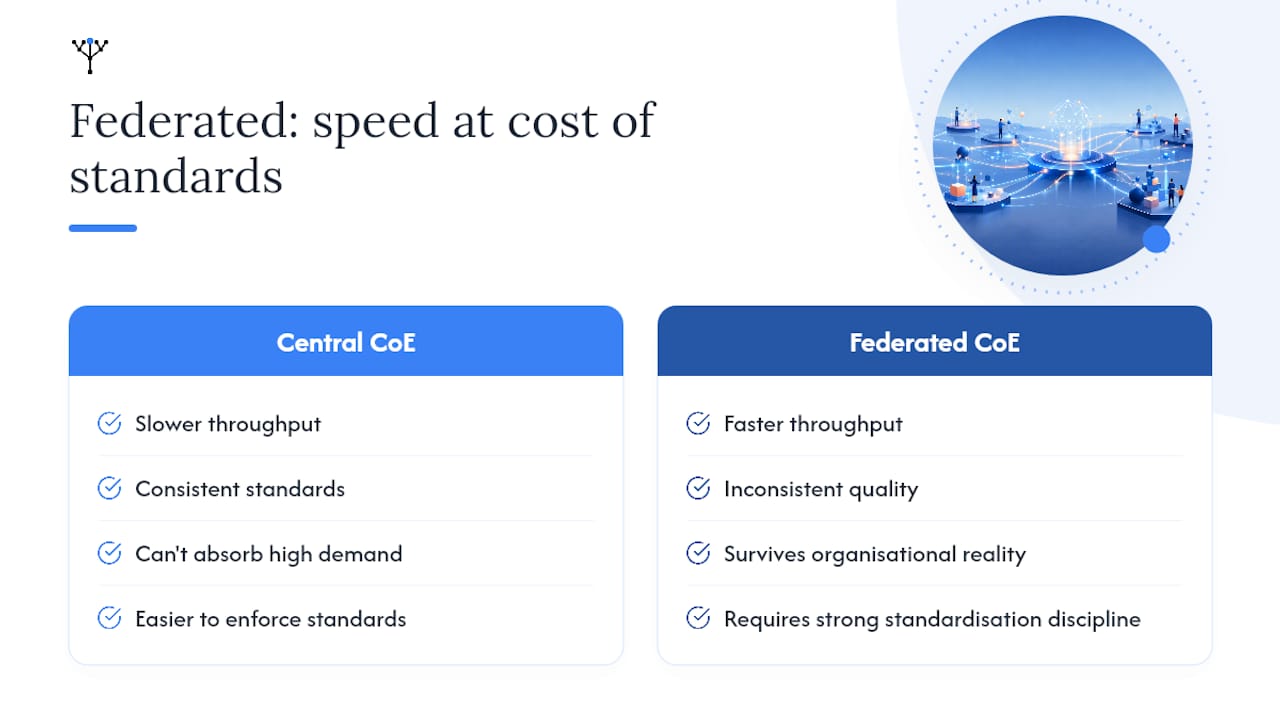
A central model places all developers and governance in one team. It is easy to standardise but creates a bottleneck as demand grows. A federated (hub-and-spoke) model keeps standards and governance central while embedding developers or citizen-developer capability in business units. MIT Sloan Review's research confirms that this federated approach avoids the bottlenecks that prevent automation from scaling. A hybrid model blends both: a central platform and governance team with federated delivery for lower-complexity automations.
Example RACI for key decisions:
R = Responsible, A = Accountable, C = Consulted, I = Informed
What governance, policies, and standards must the CoE own?
The CoE must centralise standards and accountability, not all delivery. Governance that lives only in documents and approval queues slows delivery without improving quality. The goal is to embed controls into the operating model itself.
Essential policies and standards:
- Development standards and coding conventions (naming, error handling, logging).
- Mandatory code review before any promotion to production.
- Segregation of duties: the developer who builds a bot must not be the person who approves its production move.
- Access control and credential management (no hardcoded credentials; use a vault or platform-native secret store).
- Licence management and allocation tracking.
- Change control: all production changes go through a defined change window with rollback procedures.
- Incident response and escalation paths with defined SLAs by severity.
- Data handling and retention policies aligned to UK GDPR requirements.
Pro Tip: Enforce standards through platform guardrails and automated design reviews rather than manual approval gates. Configure your orchestration platform to reject deployments that fail linting rules or lack a runbook entry. This keeps governance fast and removes the perception that the CoE is a bureaucratic obstacle.
Appinventiv's practitioner guidance reinforces this point: governance that embeds controls into the operating model allows speed and safety to coexist, rather than trading one against the other.
How does the CoE select processes and manage the delivery lifecycle?
The single most important selection filter is the intersection of business value, process suitability, and risk. A high-value process that is poorly structured or carries significant regulatory risk is not a good first automation candidate, regardless of the hours it consumes.
Process selection criteria:
| Criterion | What to assess | Target threshold |
|---|---|---|
| Transaction volume | Annual or monthly volume | High (hundreds or thousands per month) |
| Rule-based logic | Proportion of decisions that follow defined rules | Well above initial pilots |
| Exception rate | Frequency of cases requiring human judgement | Below 15–20% |
| Data quality | Structured, consistent inputs | Predominantly structured |
| Compliance impact | Regulatory or audit sensitivity | Manageable with controls |
| Strategic alignment | Ties to a stated business objective | Direct link required |
Delivery lifecycle:
- Discovery: identify and document candidate processes; gather volume, exception, and compliance data.
- Prioritisation: score candidates against the selection criteria; present ranked pipeline to the steering group.
- Design: produce a process design document (PDD) and solution design document (SDD); architect signs off.
- Build: developers build against the approved SDD in a development environment.
- Test: functional, regression, and UAT testing; process owner signs off.
- Production move: controller approves; change control window applied; runbook published.
- Continuous improvement: monthly review of exception rates, uptime, and business outcome metrics; feed findings back into the pipeline.
HashiCorp's Well-Architected Framework describes a five-phase automation pillar (team culture, process definition, automation, deployment, and monitoring) that maps closely to this lifecycle and supports reliable automation at scale.
What technology and architecture decisions does the CoE need to get right?
Prefer platform-agnostic foundations and a shared production orchestration layer. Vendor lock-in at the infrastructure level is one of the most expensive mistakes a CoE can make, particularly as AI and process mining tools enter the stack and require integration with existing RPA platforms.
Architecture principles:
- Single production orchestration layer. All bots run through one monitored environment; shadow production environments create blind spots and licence waste.
- Centralised logging and observability. Every bot execution writes structured logs to a shared monitoring platform. Without this, incident response is reactive and slow.
- Identity and access integration. Bots authenticate through your organisation's identity provider (Active Directory, Entra ID) rather than local accounts.
- Licence management. Track bot runtime licences, developer licences, and orchestrator capacity centrally; unmanaged licence sprawl is a common and avoidable cost leak.
- Disaster recovery and availability. Define RTO and RPO for production bots; critical-path automations need failover or manual fallback procedures documented in their runbooks.
- Platform agnosticism where possible. Orchestration layers that support multiple automation tools (such as open-standard workflow engines) reduce dependency on a single vendor's roadmap.
Integration checklist:
- APIs documented and versioned before automation build begins.
- Data contracts agreed with source system owners.
- Dedicated test environments that mirror production data structures.
- CI/CD pipelines for automation artefacts: version control, automated testing, and controlled promotion.
For a practical overview of workflow automation tools relevant to mid-market UK organisations, the tooling landscape is broader than most teams initially expect.
How do you build the skills and change management capability to sustain automation?
Enablement for business practitioners is as important as technical training. Automations that the business does not understand, trust, or own will be bypassed or abandoned the moment they produce an unexpected output.
Training matrix by role:
| Role | Training type | Delivery format |
|---|---|---|
| Automation developers | Platform certification, coding standards, security practices | Vendor-led + internal workshops |
| Citizen developers | Low-code tool fundamentals, intake process, governance rules | Internal workshops, self-paced modules |
| Process owners | Process documentation, UAT responsibilities, exception handling | Facilitated workshops |
| Governance and compliance leads | Audit requirements, UK GDPR, access control policies | Specialist training + policy review sessions |
| Senior stakeholders | Business case framing, KPI interpretation, steering group responsibilities | Executive briefings |
Change communication priorities:
- Map stakeholders by influence and concern level before any communications go out.
- Lead with benefit narratives tied to team-level outcomes, not enterprise efficiency abstractions.
- Prepare a clear FAQ addressing the most common workforce concern: what happens to roles when processes are automated. In UK organisations, this may require early engagement with trade unions or works councils.
- Establish a feedback channel so business teams can flag automation failures or process changes without going through formal IT channels.
For practical frameworks on change management software and stakeholder engagement, the mid-market context shapes which approaches are proportionate.
Which KPIs and reporting cadences should the CoE use to demonstrate ROI?
Automation penetration and operational stability are the two metrics that matter most. Penetration tells you whether the CoE is delivering business impact at scale; stability tells you whether that impact is reliable enough to trust.
Recommended KPI set:
- Automation penetration rate: percentage of eligible transactions processed by automation.
- Bot uptime / availability: percentage of scheduled runtime where bots complete successfully.
- Mean time to recovery (MTTR): average time to restore a failed automation to production.
- Hours automated per month: total human effort hours replaced or augmented.
- Cost saved: calculated from hours automated multiplied by fully loaded labour cost.
- Exception rate: percentage of transactions requiring human intervention; a rising exception rate signals process drift or poor bot design.
- Rework rate: percentage of automated outputs requiring correction; a proxy for quality.
- Business outcome metrics: process-specific measures such as invoice processing cycle time, onboarding completion rate, or claims turnaround.
Reporting cadence:
| Report | Frequency | Audience | Content |
|---|---|---|---|
| Operational dashboard | Daily | CoE ops team, IT | Bot status, failures, queue depth, MTTR |
| Performance summary | Weekly | CoE lead, process owners | Uptime, exception rates, incidents resolved |
| Business value report | Monthly | Business unit heads, finance | Hours saved, cost saved, pipeline progress |
| Steering committee pack | Quarterly | Executive sponsor, C-suite | ROI, penetration rate, roadmap progress, risks |
Connecting automation metrics to employee productivity frameworks gives the business value report a language that resonates with HR and operations leaders, not just IT.
What does a CoE maturity model look like, and what should you budget?
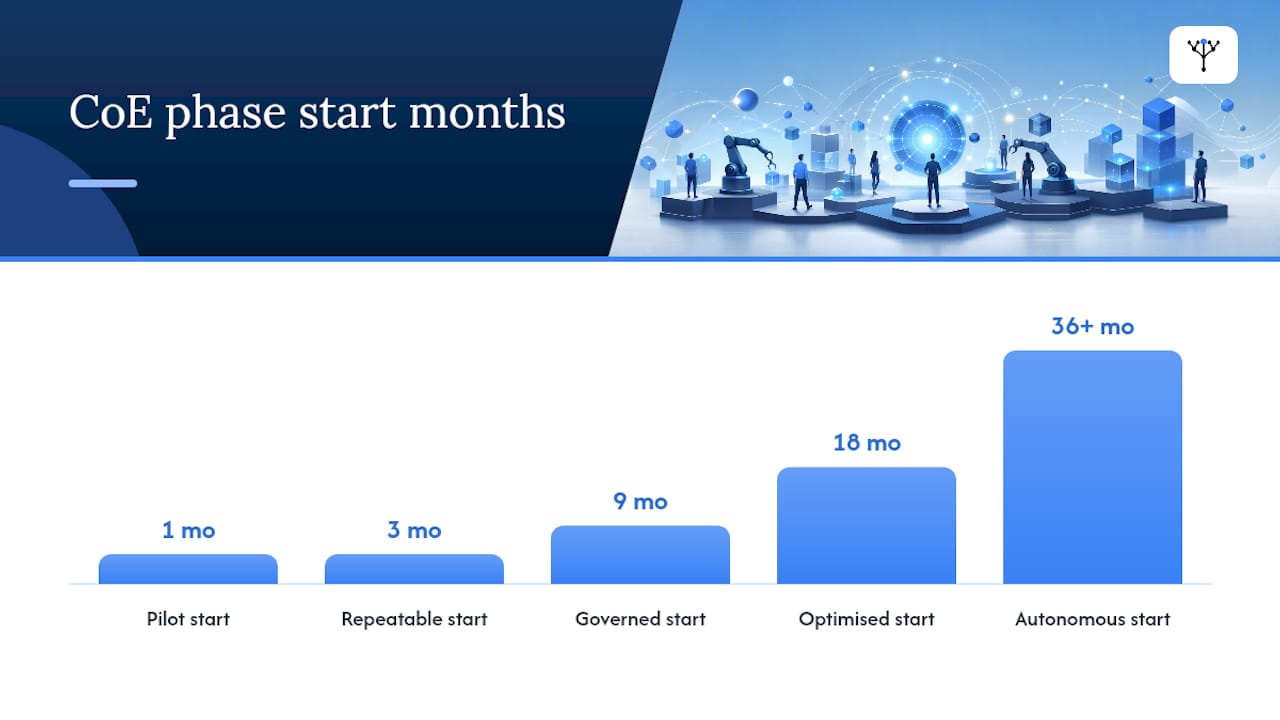
Maturity progresses from pilot through to autonomous: Pilot → Repeatable → Governed → Optimised → Autonomous. Most mid-market UK organisations reach the "Governed" stage within 12–18 months of forming a CoE, assuming consistent executive sponsorship and a funded team.
Phase descriptions and timelines:
- Phase 1 — Pilot (months 1–3): one or two automations in production, basic monitoring, no formal CoE structure yet. Objective: prove the technology and identify the first process owner champions.
- Phase 2 — Repeatable (months 3–9): CoE formally established, intake process live, three to eight automations in production, development standards documented. Objective: build the pipeline and the governance habit.
- Phase 3 — Governed (months 9–18): full RACI in place, steering group meeting quarterly, KPI dashboard live, change control enforced. Objective: make governance invisible by embedding it in the platform.
- Phase 4 — Optimised (months 18–36): process mining integrated, exception rates declining, citizen developer programme active, CoE contributing to digital transformation roadmap. Objective: shift from delivery to enablement.
- Phase 5 — Autonomous (36+ months): AI-augmented automation, self-healing bots, CoE acting as an architecture and governance authority rather than a delivery team.
Cost buckets for UK mid-market planning:
- Initial pilot costs: process analysis, tooling evaluation, and first bot build. Typically funded from departmental budgets before a formal CoE exists.
- Platform and licences: RPA platform licences, orchestrator, and monitoring tooling. Costs vary significantly by vendor and volume; negotiate enterprise agreements early.
- Staffing: a lean CoE of four to six people (lead, architect, two developers, controller, change lead) represents the most significant ongoing cost.
- Enablement: training, certification, and citizen developer programme. Often underbudgeted; plan for 10–15% of the total programme cost.
- Ongoing run cost: infrastructure, licence renewals, incident management, and continuous improvement. Budget this as a recurring operational line, not a project cost.
HashiCorp's five-phase automation pillar provides a useful architectural parallel to this maturity progression, particularly for the monitoring and operate phases.
What are the most common CoE mistakes, and how do you avoid them?
The most common root cause of CoE failure is an operating model mismatch: either the CoE is so centralised that it becomes a bottleneck, or it is so federated that standards collapse and operational debt accumulates faster than value is created.
Pitfalls and mitigations:
- Over-centralisation. Every automation request queues behind the same small team. Mitigation: adopt a federated model from the outset; reserve the central team for governance, architecture, and complex builds.
- Weak or absent executive sponsorship. The CoE cannot resolve cross-functional disputes or secure budget. Mitigation: make sponsorship a formal prerequisite before the CoE is announced; document the sponsor's decision rights explicitly.
- Neglecting change management. Business teams bypass or undermine automations they do not trust. Mitigation: assign a dedicated change and enablement lead; run process owner workshops before build begins, not after go-live.
- Tool lock-in. A single-vendor strategy creates dependency on one roadmap and pricing model. Mitigation: design the architecture around open APIs and standard integration patterns from day one.
- No metrics or vanity metrics only. Bot count is not a business outcome. Mitigation: define business outcome KPIs at intake; tie every automation to a measurable objective before build approval.
- Treating the CoE as a project, not an operating model. Funding and attention drop after the first wave of automations. Mitigation: budget the CoE as a permanent operational capability with a recurring cost line.
Your 90–180 day getting-started checklist
A structured approach produces an operational CoE within 90–180 days, with a prioritised pipeline and the governance foundations in place to scale without accumulating technical debt.
- Secure executive sponsorship (Days 1–10). Identify and brief a C-level or senior director sponsor. Document their decision rights and confirm their availability for a monthly steering group.
- Define two to three measurable objectives (Days 1–14). Tie each objective to a business outcome (cost, capacity, compliance, customer experience). These become the CoE's mandate.
- Choose your operating model (Days 10–21). Central, federated, or hybrid. For most UK mid-market organisations, a federated model with centralised standards is the right default.
- Appoint the initial CoE team (Days 14–45). At minimum: CoE lead, one solution architect, one developer, and a change lead. Roles can be part-time initially.
- Run a process discovery sprint (Days 21–60). Identify 10–20 candidate processes using a structured intake form. Score each against the selection criteria table in this guide.
- Select and scope the first pilot (Days 45–60). Choose the highest-scoring candidate that is also low-risk. Document the PDD and SDD before any build begins.
- Establish governance gates (Days 45–75). Publish development standards, the RACI, and the change control policy. Configure platform guardrails where possible.
- Define and instrument KPIs (Days 60–90). Set up the operational dashboard and agree the reporting cadence with the steering group.
- Move the first automation to production (Days 75–120). Apply the full governance lifecycle: design review, UAT sign-off, production approval, runbook published.
- Launch communications and pipeline review (Days 90–180). Communicate the first live automation to the business. Open the intake pipeline formally and begin scoring the next wave of candidates.
Reusable templates to build alongside the checklist:
- Intake form: process name, owner, volume, exception rate, compliance flags, strategic alignment. Owner: CoE lead.
- Prioritisation rubric: weighted scoring matrix using the selection criteria table. Owner: solution architect.
- Production readiness checklist: code review complete, runbook published, monitoring configured, rollback tested, process owner sign-off. Owner: controller.
- Runbook template: process description, schedule, dependencies, failure modes, escalation path, recovery steps. Owner: operations lead.
What the federated model actually costs you in speed, and why it is still worth it
The conventional wisdom in CoE design is that you must choose between speed and control. Build a tight central team and you get consistent standards; distribute delivery and you get faster throughput but inconsistent quality. That framing is too binary, and it leads mid-market organisations to make the wrong call at the wrong moment.
The federated model with centralised standards is the right default for most UK mid-market organisations, not because it perfectly balances speed and control, but because it is the only model that survives contact with organisational reality. A central team of four people cannot absorb the demand of a business that has identified forty candidate processes. It will either slow delivery to a crawl or lower its standards to keep pace. Neither outcome serves the business.
What the federated model actually costs you is standardisation discipline. When developers sit in business units, the temptation to cut corners on documentation, testing, and change control is real and constant. The CoE lead who treats governance as a service rather than a gate, who makes it easier to comply than to bypass, is the one who keeps the federated model honest. That is a leadership and culture challenge as much as a technical one.
The other trade-off worth naming: local optimisation versus enterprise coherence. Business units will always want to choose their own tools, their own naming conventions, their own exception-handling logic. The CoE's job is not to suppress that instinct entirely, but to channel it within guardrails that keep the portfolio manageable. The organisations that get this right treat the CoE standards as a floor, not a ceiling. Teams can go further; they cannot go lower.
One practical lesson from mid-market CoE projects: the enablement investment is almost always underestimated. Technical delivery gets funded; training, change communication, and process owner engagement get squeezed. The automations that fail in production rarely fail because the bot was poorly built. They fail because the process changed and nobody told the CoE, or because the process owner did not understand their role in the exception-handling workflow. Invest in enablement proportionately, and the operational stability metrics will reflect it.
Oakandnine gives your CoE a live operational foundation to build on
Most CoEs spend their first six months trying to understand what is actually happening across the organisation before they can automate anything. Oakandnine removes that delay. The platform maps your people, processes, and technology in a connected live model, surfaces process bottlenecks and asset inefficiencies in real time, and integrates structured and unstructured data into a single operational view. That means your CoE lead and solution architect start with a clear picture of where automation will deliver the highest return, rather than spending weeks in discovery workshops.
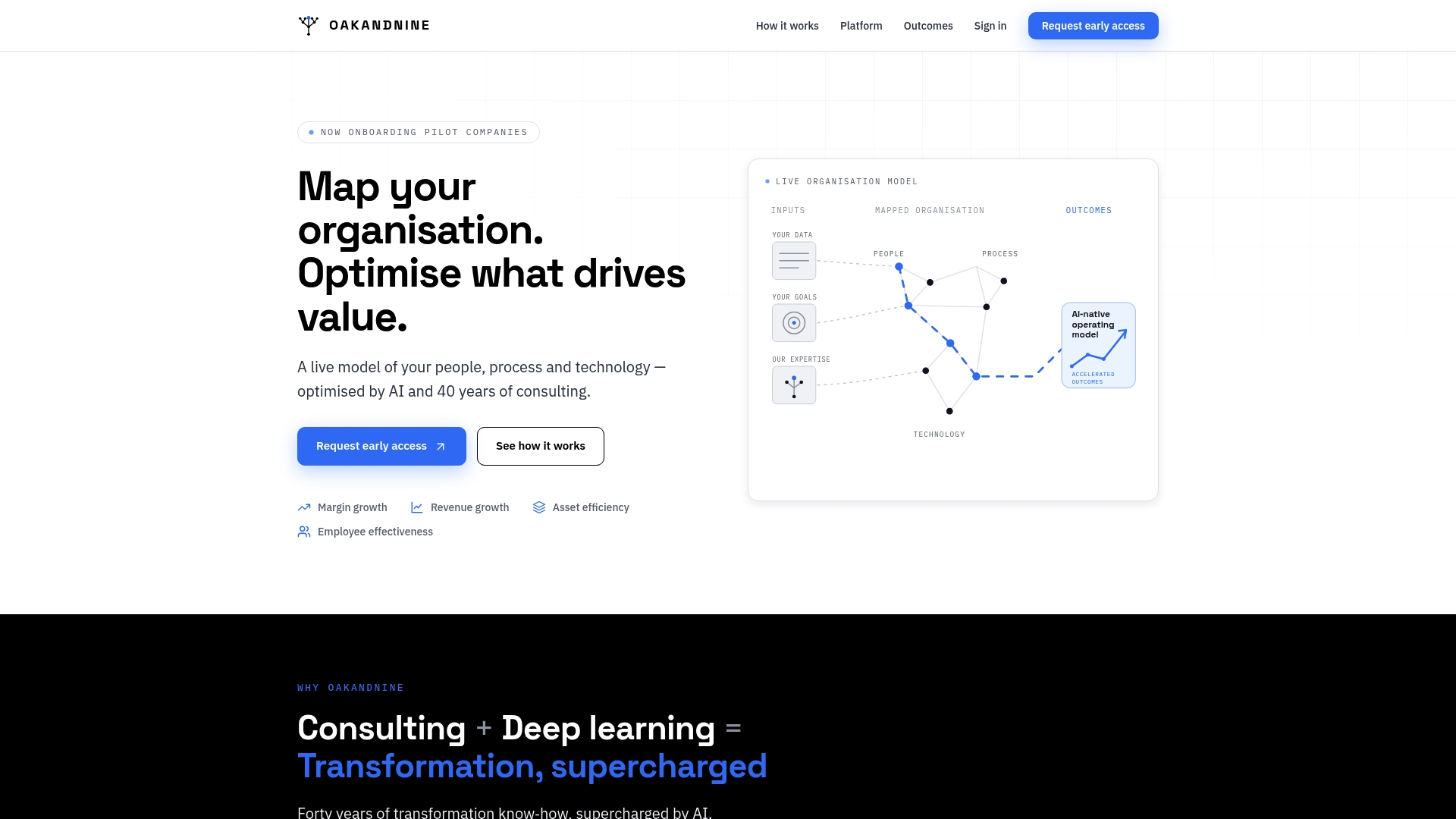
For mid-market UK organisations standing up or scaling a CoE, Oakandnine's combination of platform and consulting accelerates the process discovery sprint, supports integration design, and provides the monitoring layer your operational dashboard needs from day one. The result is a CoE that reaches the "Governed" maturity phase faster, with less rework and a pipeline grounded in real operational data rather than stakeholder opinion. Book a CoE health check or pilot engagement to see where your organisation sits on the maturity curve and what the highest-value next step looks like for your specific context.
Sources
- How to Establish an Automation Center of Excellence
- Establishing a Center of Excellence for Robotic Process Automation — Trexin (PDF)
- Define and automate processes — HashiCorp Well‑Architected Framework
- How to build an automation Center of Excellence — Red Hat
- How to Build a Successful RPA Center of Excellence (CoE) in 2026 — InfoSeeMedia