
Your System of Record (SoR) is the authoritative, auditable source of truth for your organisation. Your System of Engagement (SoE) is the user-facing, task-oriented layer where work actually happens. For mid-market UK firms, the recommended approach is not to replace one with the other but to keep a robust SoR, deploy specialised SoE(s) alongside it, and integrate them through a deliberate synchronisation layer.
- SoR primary roles: stores authoritative transactional data; supports compliance, audit and reporting; owned by finance, IT or HR.
- SoE primary roles: captures real-time operational signals; drives frontline adoption; owned by operations and line managers.
- Recommended architecture: SoR as the ground truth; SoE(s) as the interaction surface; API-first integration seam connecting them.
Pro Tip: Before you touch your ERP or HRIS, map the engagement seam first. The fastest wins come from eliminating manual handoffs and disconnected spreadsheets, not from ripping out core systems.
Table of Contents
- What is the difference between a system of record and a system of engagement?
- Why this distinction matters for UK mid-market firms
- How should your SoR and SoE architecture actually work?
- Step-by-step implementation for mid-market pilots
- Typical costs and timelines for UK mid-market projects
- KPIs that tell you whether SoR+SoE is working
- Governance and UK compliance considerations
- Common mistakes and how to avoid them
- How Oakandnine's live organisational model connects SoR and SoE
- Key takeaways
- Where mid-market UK firms should focus first
- Oakandnine's pilot offer for mid-market UK firms
- Useful sources and further reading
What is the difference between a system of record and a system of engagement?
A System of Record is built for accuracy, compliance and longevity. Think of your ERP (SAP, Oracle NetSuite), HRIS (Workday, Sage HR) or finance ledger: these systems hold the canonical version of every transaction, employee record and financial position. They are evaluated on data integrity, auditability and integration reliability.
A System of Engagement is built for speed, usability and adoption. Mobile work apps, self-service portals, conversational agents and operational workflow tools sit in this category. In manufacturing, for instance, an MES or quality inspection app is the SoE that sits above the ERP as SoR; the integration between them is where most operational value is captured.

| Dimension | System of Record | System of Engagement |
|---|---|---|
| Primary purpose | Authoritative data store | Frontline task execution |
| Success metrics | Accuracy, compliance, uptime | Adoption, task completion, experience |
| Typical owners | IT, Finance, HR | Operations, Line managers |
| Failure mode | Data inconsistency, audit gaps | Low adoption, shadow IT |
| Examples | ERP, HRIS, finance ledger | Mobile apps, portals, chat agents |
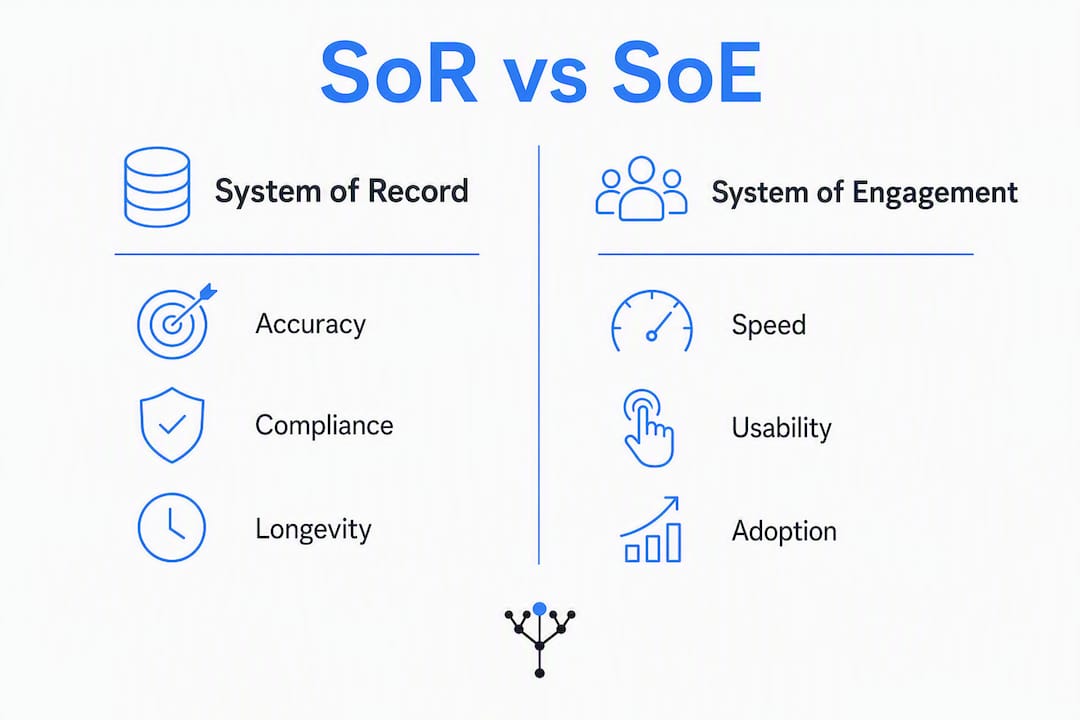
Mixing success metrics across the two systems leads to misdirected investment: you cannot judge an ERP by its user experience scores, nor a frontline app by its audit trail depth. The distinction is not semantic; it determines how you procure, govern and measure each layer.
Why this distinction matters for UK mid-market firms
Most organisations have a SoE problem, not a SoR problem. The ERP works. The HRIS holds the data. What kills speed and adoption is the gap in between: manual handoffs, spreadsheets passed by email, multi-login workflows that frontline workers quietly abandon.
- Adoption: Frontline staff adopt tools designed for their tasks, not tools designed for auditors. Poor SoE design is the single biggest driver of shadow IT.
- Data quality: When workers bypass the SoE and log data directly into spreadsheets, the SoR receives incomplete or delayed inputs, degrading reporting and forecasting.
- Decision velocity: A well-integrated SoE captures real-time operational signals that feed the SoR, giving leaders current data rather than last month's batch export.
For UK mid-market firms operating under tighter resource constraints than enterprise peers, this framing matters. Investing in the engagement layer, rather than replacing the record system, preserves capital and reduces vendor lock-in risk.
How should your SoR and SoE architecture actually work?
The best operational architecture keeps a robust SoR and deploys specialised SoE(s) to collect real-time signals that sync back to the record. The integration seam between them is where architecture decisions have the most leverage.
Integration patterns to consider:
- Read-only views — SoE surfaces data from the SoR without writing back; lowest risk, lowest value.
- Event streaming — SoE publishes events (a task completed, an asset scanned) that the SoR consumes asynchronously.
- Bi-directional sync — changes in either system propagate to the other; highest value, highest governance burden.
- Middleware/orchestration layer — an API gateway or message bus (MuleSoft, Azure Integration Services) mediates all writes, enforcing canonical schema and idempotency.
Checklist for choosing your integration approach:
- Latency tolerance: can the SoR accept a 15-minute lag, or does it need near-real-time?
- Data ownership: which system is authoritative for each field?
- Auditability: can every write to the SoR be traced to a SoE event?
- Rollback strategy: if a SoE write corrupts a record, how do you recover?
Business intelligence tools such as Power BI and Tableau often act as a synthesis layer drawing from both SoR and SoE. Leaders should be clear about which layer is authoritative for each data domain before building dashboards on top.
Pro Tip: Favour API-first, idempotent writes and a small canonical schema for SoE-to-SoR writes. New processes built above the SoR without touching core code let process owners iterate quickly and reduce long-term technical debt.
Step-by-step implementation for mid-market pilots
- Discovery and system inventory — catalogue every SoR and SoE in use, including shadow IT.
- Data mapping — identify canonical fields, ownership rules and reconciliation points.
- Pilot design — select one high-friction process, define measurable objectives and identify a representative user group.
- Integration proof-of-concept — build the minimum viable integration seam; validate data flow and rollback.
- User testing — measure task completion, error rates and adoption against baseline.
- Phased rollout — expand by process or business unit, not by geography alone.
| Migration task | Key decision | Owner |
|---|---|---|
| Data mapping | Canonical field definitions | IT + Operations |
| Reconciliation process | Frequency and tolerance thresholds | Finance + IT |
| Workflow configuration | SoE task design and approval routing | Operations |
| Training and enablement | Role-based onboarding paths | HR + Operations |
Pro Tip: A short, high-impact pilot — one process, one team, eight weeks — validates integration and adoption before you commit broader budget. The pilot's reconciliation failure rate is your clearest early signal of integration health. For system integration testing guidance, build your QA checklist before the pilot starts, not after.
Typical costs and timelines for UK mid-market projects
| Phase | Typical duration | Key milestones |
|---|---|---|
| Pilot | eight weeks | Integration PoC, user testing, adoption baseline |
| Phased rollout | three to six months | Process-by-process expansion, governance review |
| Scale | nine to eighteen months | Full SoR/SoE alignment, AI-enabled reporting |
Primary cost drivers include integration complexity, data cleansing, custom workflow configuration, user training, and ongoing licences and support. Real-world integration work consistently shows that underestimating data cleansing and custom workflow costs is the most common budget error in mid-market deployments.
Pro Tip: Budget vendor and internal resource costs separately. Set aside a 15–25% contingency specifically for integration surprises: schema mismatches, undocumented legacy fields and authentication edge cases appear in almost every project.
KPIs that tell you whether SoR+SoE is working
| KPI | What it measures | Target range (pilot) |
|---|---|---|
| User adoption rate | % of target users active weekly | 70–85% by week 8 |
| Time to task completion | Minutes per key workflow | measurable reduction against the pre-pilot baseline |
| Data accuracy rate | % of SoR records reconciled without manual correction | — |
| Process cycle time | End-to-end time for a defined process | Measurable reduction vs pre-pilot |
| Asset utilisation | % of tracked assets in productive use | Improvement vs baseline |
SoE platforms capture interaction data that the SoR would otherwise miss entirely: dwell time on a task, escalation patterns, partial completions. Feeding that interaction data back into the record creates a dynamic, real-time organisational model rather than a static database. Track employee engagement measurement signals alongside system metrics to separate adoption problems from process design problems.
Governance and UK compliance considerations
UK GDPR requires a Record of Processing Activities (RoPA) that covers every system touching personal data, including SoE tools. When you add a new engagement layer, update the RoPA before go-live.
Compliance checklist:
- RoPA updated to include new SoE and integration layer.
- Data retention policies defined for SoE interaction logs (separate from SoR retention schedules).
- Immutable audit trails maintained in the SoR for all SoE-originated writes.
- Role-based access controls applied at both SoE and integration layer.
- Data minimisation: SoE should collect only what the SoR needs.
Vendor contract questions:
- What are the SLAs for data sync latency and uptime?
- How are audit logs stored, and for how long?
- What is the breach notification timeline?
- Where is data physically hosted — UK or EEA data residency?
For financial services firms, IT compliance standards add further obligations around data lineage and system auditability that should be mapped to your SoR governance framework before any SoE integration goes live.
Pro Tip: Preserve immutable audit trails in the SoR and design every SoE write to be auditable and reversible. If a regulator asks for the provenance of a record, you need a clean chain from SoE event to SoR entry.
Common mistakes and how to avoid them
- Forcing SoR UX customisation — heavy bolt-ons that frontline workers abandon. Fix: modernise the engagement layer instead, not the core system.
- Ignoring the integration seam — treating SoR and SoE as independent tools. Fix: define the canonical schema and sync pattern before selecting the SoE.
- Single-vendor mandates — assuming one platform can serve both roles well. Fix: evaluate each layer by its own success criteria.
- Mixing success metrics — judging the ERP on adoption scores. Fix: measure each system by appropriate criteria.
Red flags during pilots: low frontline adoption by week four, frequent reconciliation failures, and growing custom code debt in the integration layer.
Pro Tip: Measure behaviour, not just system metrics. If adoption numbers look healthy but workers are still maintaining parallel spreadsheets, the SoE has not replaced the workaround — it has added to it. Change management and adoption tactics must address the behaviour, not just the login rate.
How Oakandnine's live organisational model connects SoR and SoE
A mid-market manufacturing firm approached Oakandnine with a familiar problem: their ERP (SoR) held accurate financial and inventory data, but operational decisions were being made from a patchwork of spreadsheets and WhatsApp threads. The SoE layer was effectively non-existent as a managed system.
Oakandnine delivered an AI-driven organisational mapping exercise that surfaced every process handoff, system touchpoint and data flow across the operation. The engagement layer was redesigned around a mobile work app integrated to the ERP via an API orchestration layer. Within the pilot period:
- Process cycle time for the primary workflow reduced measurably against the pre-pilot baseline.
- Data completeness in the SoR improved as manual re-entry was eliminated.
- Frontline adoption reached the target threshold by week six, ahead of the eight-week milestone.
The live organisational model continues to feed interaction signals back into the SoR, converting a static ERP into a dynamic operating model. Friction points identified during the pilot informed a second phase of digital transformation work, extending the integration to asset tracking and workforce scheduling.
Key takeaways
The most effective mid-market architecture keeps the SoR as the authoritative ground truth, deploys purpose-built SoE(s) for frontline execution, and connects them through a deliberate, auditable integration layer.
| Point | Details |
|---|---|
| SoR is the ground truth | Keep your ERP, HRIS or finance ledger as the authoritative, auditable record — do not customise it into an engagement tool. |
| SoE drives adoption | Frontline workers adopt tools designed for their tasks; the engagement layer is where behaviour change happens. |
| Integration seam is the priority | Map the engagement seam before selecting tools; define canonical schema, sync patterns and rollback strategy first. |
| Governance is non-negotiable | Update your RoPA, set retention policies and preserve immutable audit trails before any SoE goes live under UK GDPR. |
| Oakandnine as next step | Oakandnine's AI-driven live organisational model maps your SoR/SoE gaps and delivers a pilot integration with measurable outcomes. |
Where mid-market UK firms should focus first
The conventional wisdom says to fix the record system. Upgrade the ERP. Consolidate the HRIS. Replace the finance platform. In my experience, that is almost always the wrong starting point for a mid-market firm with constrained resources and a board that needs to see results within a financial year.
The real leverage is in the engagement seam. The SoR is usually doing its job. What is failing is the layer between the system and the person who needs to act on it. That is where adoption collapses, where data quality degrades, and where operational speed stalls.
My recommended 90-day priorities:
- Map the engagement seam — document every manual handoff, spreadsheet and workaround between your SoR and your frontline workers.
- Design and launch a focused pilot — one process, one team, one measurable objective. Validate integration and adoption before scaling.
- Feed interaction data back into the record — use the pilot to establish the canonical schema and sync pattern that will underpin your AI-enabled organisational model.
The firms that move fastest are not the ones with the best ERP. They are the ones that have closed the gap between their systems and their people.
Oakandnine's pilot offer for mid-market UK firms
Mid-market UK operations teams face a specific challenge: the SoR is in place, the business case for a better engagement layer is clear, but the integration complexity and governance requirements make it hard to know where to start.
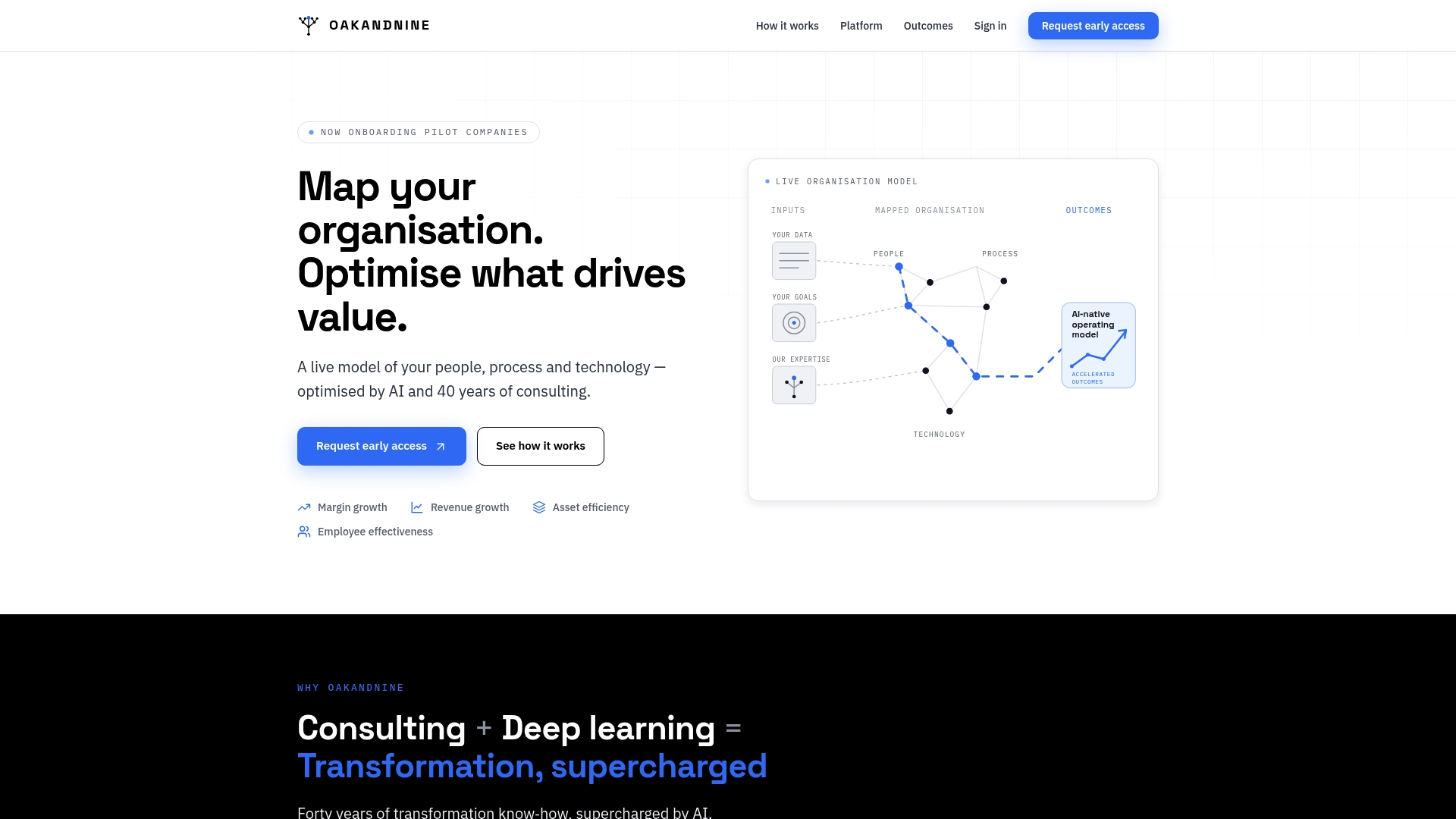
Oakandnine's AI-driven organisational mapping cuts through that complexity. Rather than a lengthy consulting engagement, we start with a structured pilot: eight to twelve weeks, one high-friction process, a live organisational model that maps your people, processes and systems, and a measurable integration outcome. You leave the pilot with a validated architecture, a clear governance framework, and the data to justify the next phase of investment.
Map and optimise your organisation with Oakandnine — or speak to the team about scoping a pilot for your specific operational context.
Useful sources and further reading
- Systems of Engagement vs. Systems of Record — Kinetic Data: Practical guidance on why the engagement seam is where most operational value is captured, and how API-first orchestration reduces technical debt.
- System of Record vs. System of Engagement — Mingo Smart Factory: Mid-market-appropriate architecture patterns and the case for keeping SoR and SoE as distinct, integrated layers.
- System of Record vs. System of Engagement — MangoApps: Clear treatment of why mixing success metrics across SoR and SoE leads to misdirected investment; useful for HR tech and operations contexts.
- System of Record vs. System of Engagement — Tulip: Manufacturing and frontline sector examples showing MES/ERP as SoR and process apps as SoE.
- Systems of Record vs. Systems of Engagement — Mainstream Tech: Cautionary analysis of what happens when organisations try to turn an SoR into an SoE through heavy customisation.
- Systems of Engagement vs. Systems of Reference — Forrester: The foundational infrastructure architecture perspective on the SoR/SoE dichotomy from Forrester analysts.
- The Move from Systems of Record to Systems of Engagement — Forbes/Josh Bersin: The original analyst framing of the shift from ERP-type systems to engagement-first design; still the clearest statement of the core distinction.
- Oakandnine — Map and optimise your organisation: Oakandnine's AI-driven platform and consulting offer for mid-market firms seeking to connect SoR and SoE through a live organisational model.